
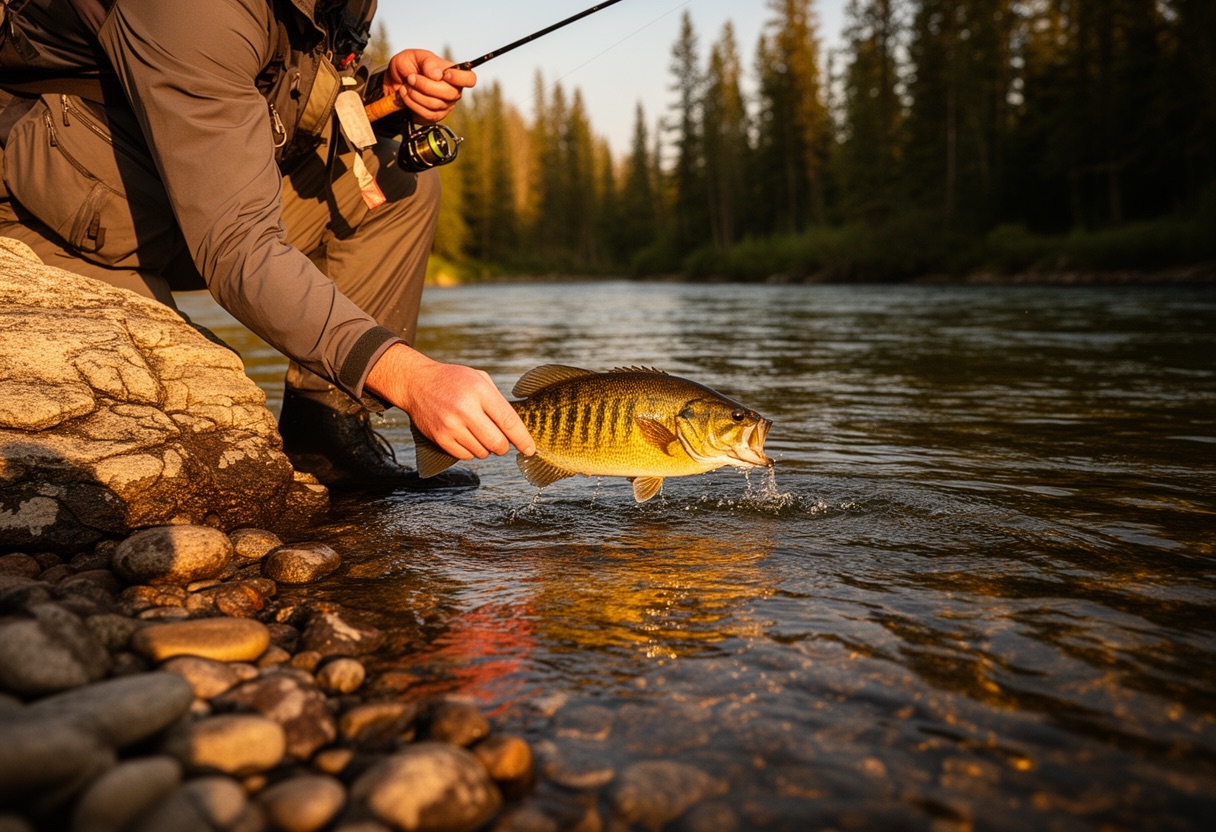
There is a reason seasoned anglers call the smallmouth bass the “bronze beast.” It’s not just the vertical bronze bars that run down its flanks — it’s the fight. A two-pound smallmouth will burn line, leap, and run in a way that belies its size. Throw one on light tackle and you’ll understand why smallmouth is the favorite species of fly fishermen, technical anglers, and anyone who values fight over trophy weight.
If you’ve already caught largemouth, you might think bass is bass. You’ll quickly learn otherwise. Smallmouth live in different water, hold on different structure, and respond to different presentations. The tactics that fill your coolers on a weedy pond won’t translate to a clear-water river with a rocky bottom.
This guide walks you through everything you need to start catching smallmouth: where they live, when they bite, what gear and lures to use, and the techniques that work on clear-water structure. If you haven’t read our largemouth bass beginner’s guide yet, that’s a good companion read — the two species share DNA but not tactics.
Smallmouth vs. Largemouth — Why Different Tactics Matter
The most practical way to understand smallmouth is to see how they differ from their larger cousin. The differences are not cosmetic — they determine every decision you make on the water, from line choice to retrieval speed.
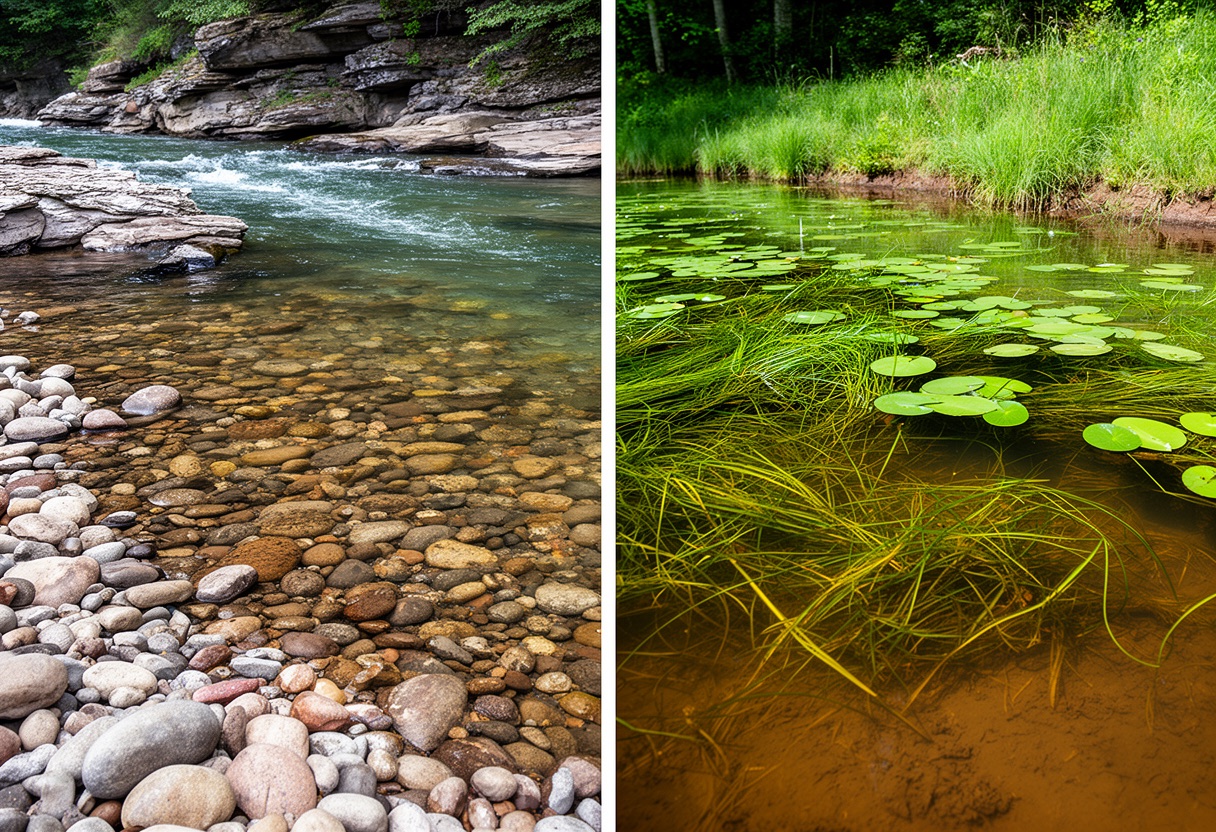
Water clarity. Smallmouth thrive in clear water. They have better eyesight than largemouth and use it — they can see line, lures, and shadows from farther away. Largemouth are comfortable in stained water where visibility drops to a few feet. On smallmouth water, finesse matters because the fish can see everything.
Temperature preference. Smallmouth peak in the 60–72°F range. Largemouth prefer it warmer, typically 75–85°F. That means smallmouth often start biting earlier in spring and stay active later in fall, while largemouth own the peak summer months.
Habitat. You’ll find smallmouth where the water’s clear and the rocks start: river bottoms, bedrock ledges, boulder fields, and the structured shorelines of clear lakes. Largemouth hold in weeds, around docks, in ponds and slow backwaters. The habitat gap is why a weedless plastic worm — a largemouth staple — is less effective on smallmouth than a football jig designed to skip across rock.
Fighting style. Smallmouth are acrobatic fighters. They jump, roll, and dart. Largemouth are powerful but tend to run in straighter lines. The difference is partly anatomical — smallmouth have a smaller mouth relative to body size, which gives them more maneuverability, and partly behavioral. Both are thrilling, but smallmouth fight closer to the surface and in tighter spaces.
The takeaway: if you walk onto smallmouth water with a heavy-line, loud-lure largemouth setup, you’ll likely come up empty. Smallmouth demand lighter gear, natural presentations, and an understanding of rocky structure.
Where to Find Smallmouth Bass
Smallmouth bass are habitat specialists. Unlike largemouth, which will hold in almost any slow or still water with cover, smallmouth are drawn to clarity, current, and rock. Knowing where to look is half the battle.
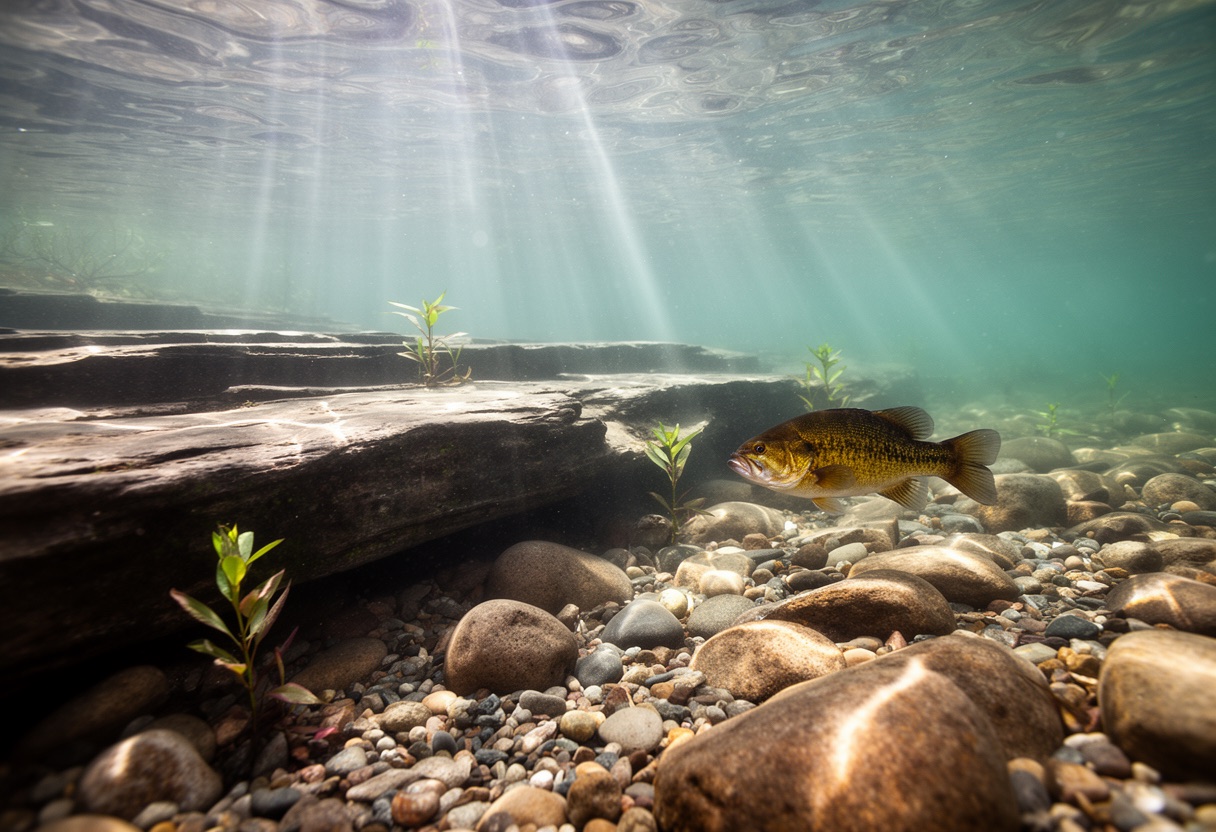
River systems. Rivers are smallmouth country. Look for current breaks behind large rocks, the seams where fast water meets slower water, and the transition points where a shallow riffle drops into a deeper run. Smallmouth hold in these edges — close enough to ambush prey swept by the current, but out of the main flow so they conserve energy.
Lake ledges and points. In lakes, smallmouth stack up on rock ledges — the underwater equivalent of a steep shelf. A ledge might drop from 8 feet to 20 feet over just a few yards. Smallmouth hold on the edge of that drop, facing current or wind-driven water movement, waiting for forage to pass overhead. Rocky points that extend into the lake are equally productive, especially during the spring and fall.
Key structure types. Within these habitats, target specific features:
- Boulders and bedrock. The bread and butter of smallmouth habitat. Crawfish live among the rocks, and smallmouth feed on them relentlessly.
- Brush piles near rock. Where woody debris meets a rocky bottom, you’ll find concentrated holding fish.
- Stumps in clear water. Unlike largemouth stumps in weeds, smallmouth stumps sit in clearer water and function more like individual rock piles — ambush points with overhead cover.
- Riprap and man-made structure. Bulkheads, rock walls, and boat ramps with exposed concrete attract smallmouth for the same reason natural rock does: crawfish and forage.
Geographic range. Smallmouth are widespread across North America. Classic smallmouth waters include the Great Lakes basin, Appalachian streams, the Missouri River system, and western reservoirs from Montana to New Mexico. If a lake or river has clear water and a bottom that isn’t entirely soft mud, there’s a chance smallmouth are in it. Check your state fishery maps for confirmed populations.
For a deeper dive on how to visually identify fish-holding structure from the bank or a boat, our guide to reading water covers the principles that apply to smallmouth specifically.
When to Fish Smallmouth — Seasonal Patterns
Smallmouth behavior shifts with water temperature more predictably than with calendar dates. Water in the 60–72°F range is the sweet spot, and tracking where that temperature sits through the seasons tells you where to fish and what to throw.
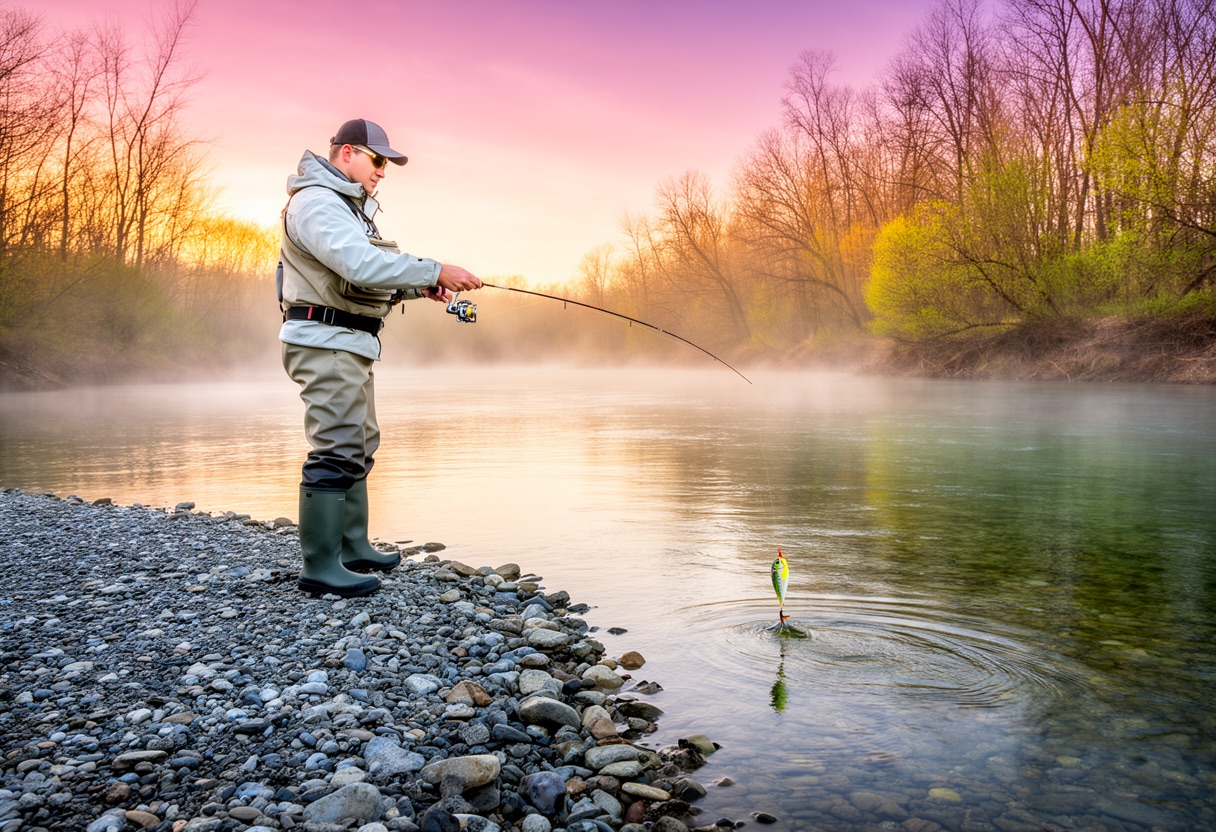
Spring. As water warms into the 55–65°F range, smallmouth move shallow to spawn. Unlike largemouth that build nests in weeds and mud, smallmouth spawn on gravel and rock beds. They’ll hold on shallow rocky points, river bends, and lake shorelines with exposed bottom. This is one of the most productive times to fish — spawning smallmouth are aggressive and territorial. Flip a small football jig or a tube bait along the edges of spawning beds, but be respectful of nesting fish and local regulations.
Summer. Once water exceeds about 75°F, smallmouth move deeper. They stage on ledges, hold in current seams, and occupy mid-depth structure rather than the shallow cover that draws largemouth. Lure selection shifts toward slower presentations: drop-shot rigs, tube baits, and weighted grubs fished near the bottom. Early morning and late evening remain the best windows, since daytime heat pushes smallmouth off their daytime haunts.
Fall. Fall is arguably the best smallmouth fishing of the year. Water cools back into the 60–70°F range, and smallmouth feed aggressively to build winter reserves. They move back toward shallower structure but remain on rock rather than moving into weeds. Topwater lures, spinnerbaits, and jigs all work during this window. The bite can be explosive, especially during that first cold front that drops water temperatures 5–10 degrees.
Winter. Below 50°F, smallmouth slow down. They hold deep, often near current breaks or on the deepest part of a ledge. Small presentations — tiny jigs, micro drop-shot rigs, small tube baits — fished slowly are the key. Winter smallmouth fishing is less about covering water and more about finding the fish and sitting on them.
For the full temperature chart and how it affects fish behavior across species, our bass temperature guide has the details. And for broader seasonal strategy, see our month-by-month seasonal guide.
Gear & Tackle for Smallmouth
Smallmouth fishing rewards lighter, more sensitive tackle than largemouth fishing. The goal is to feel bites that are often subtle and to present lures naturally in water where the fish can see your line.
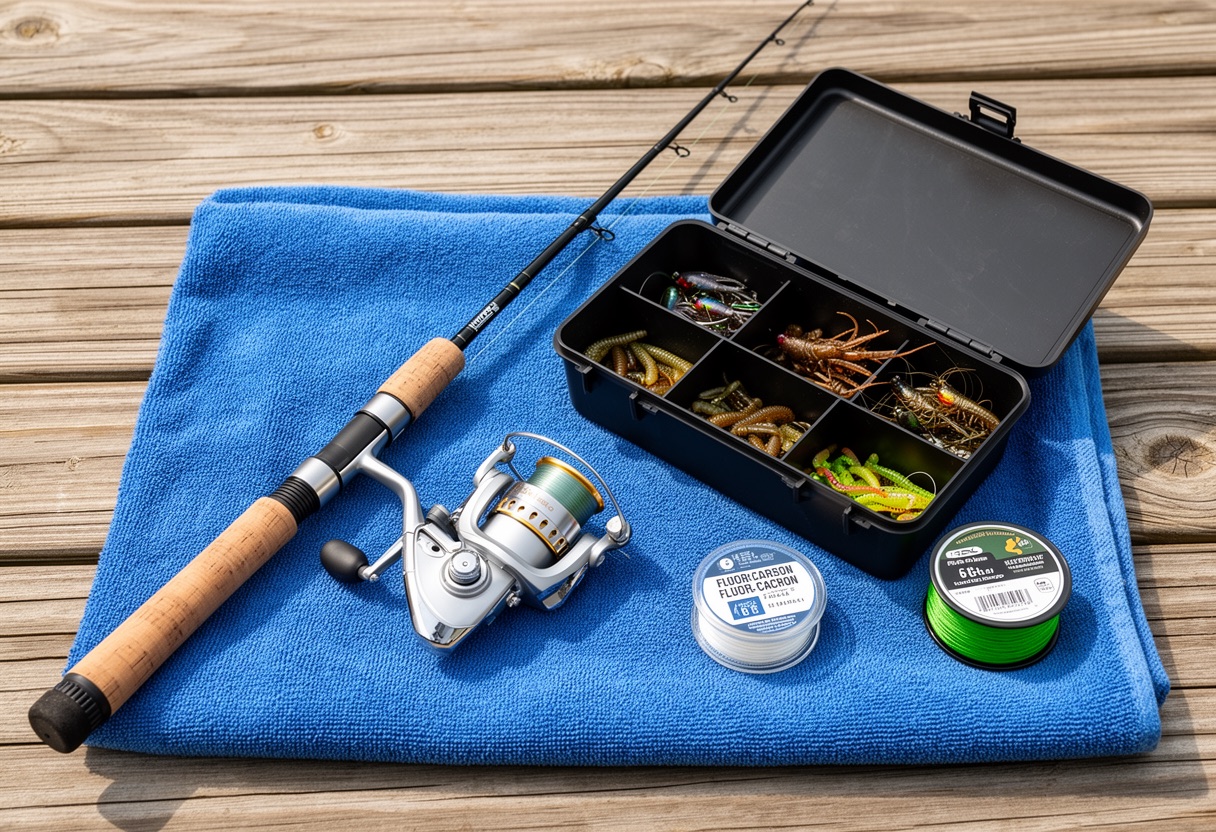
Rod. A 6’6″–7′ medium to medium-fast spinning rod is the ideal starting point. The slightly shorter length and lighter power compared to a typical largemouth setup gives you better sensitivity for feeling bites on rocky bottom. Fast action helps set the hook when a smallmouth turns — they have smaller mouths, so hook sets need to be quick.
Reel. A 2000–2500 size spinning reel handles the line weights you’ll use on smallmouth. Look for a gear ratio around 5.2:1 to 6.2:1 — slow enough to maintain line contact during a fight, fast enough to retrieve lures efficiently. Baitcasting reels work too, especially if you plan to flip jigs into tight rock seams, but spinning is more forgiving for beginners.
Line. This is where smallmouth gear differs most from a general bass setup. Braid paired with a fluorocarbon leader is the preferred combination. Braid (10–14 lb test) gives you sensitivity and zero stretch, which matters when you’re skipping a jig across rock and need to feel every pebble. The fluorocarbon leader (12–16 lb test, 18–30 inches) is critical because smallmouth see well in clear water — fluoro refracts light similarly to water and is much harder for fish to detect than mono.
If you’re building your first combo and want guidance on matching rod to reel, our rod and reel combo guide covers the basics. And for a full breakdown of line types and when to use each, see our line comparison guide.
Top Lures & Baits for Smallmouth
Smallmouth are crawfish eaters above all else. The lures that work best imitate crawfish, small baitfish, or bottom-dwelling forage. Natural colors outperform bright ones in clear water, and presentation matters more than lure size.
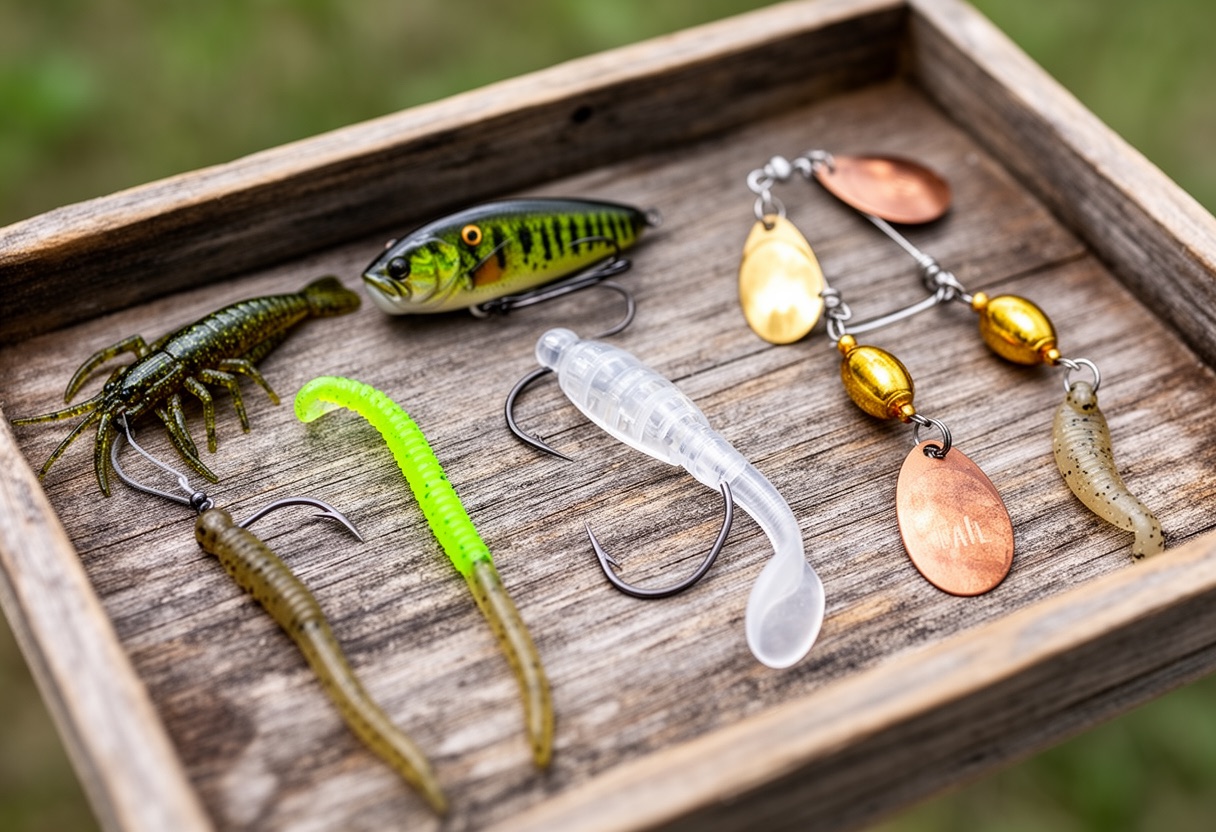
Football jigs. The football-head jig is the number-one smallmouth lure, and for good reason. The rounded, football-shaped head skips across rock without snagging, and the crawfish-style trailer imitates smallmouth’s primary food source. Start with a 1/4 to 3/8 oz jig in green pumpkin or Junebug colors. Skip it along the bottom, let it settle, then drag it slowly with short rod twitches. This one lure covers more smallmouth situations than any other.
Tubes and grubs. Tube baits are versatile smallmouth weapons. They imitate crawfish when hopped along the bottom and small baitfish when fluttered through current. Fish them on a jig head or a weighted hook in the 1/8 to 1/4 oz range. Grubs — straight-tail soft plastics on a weighted hook — work the same way but are more compact and cast farther. Both are effective in current and around structure.
Drop-shot baits. When smallmouth are suspended or holding tight to structure and refusing a bottom lure, the drop-shot rig is the finesse answer. A small grub or stick bait hangs above weight, hovering at a specific depth. It’s particularly effective in clear water where smallmouth are wary and a slow, natural presentation triggers bites that a dragged bottom lure won’t get.
Spinnerbaits (tandem blade). For covering water, a tandem-blade spinnerbait is the go-to smallmouth search bait. The two blades — typically a Willow leaf and a Colorado blade — create flash and vibration that attract smallmouth from a distance. Run it steadily through current breaks and along ledge edges. Gold and silver blade combinations work in most conditions.
Topwater lures. Walk-the-dog plugs and buzzbaits produce unforgettable smallmouth moments. A smallmouth smashing a topwater lure at dawn or dusk is one of the most exciting strikes in freshwater fishing. Use these during low-light windows in shallower water — 2–5 feet over rock or gravel.
Live bait. Minnows on circle hooks, fished under a cork or bobber near river current, remain one of the most reliable ways to catch smallmouth in river systems. It’s old-school, and it works because smallmouth in rivers are often conditioned to take drifting prey.
For help matching lure type to conditions beyond just smallmouth, our lure selection guide walks through the decision process. And for a deeper look at soft plastic options, see our soft plastic baits guide.
Techniques That Work
Having the right lure is only half the equation. How you present it on smallmouth water separates anglers who catch one or two fish from those who fill the cooler — or the camera roll, if you’re practicing catch and release.
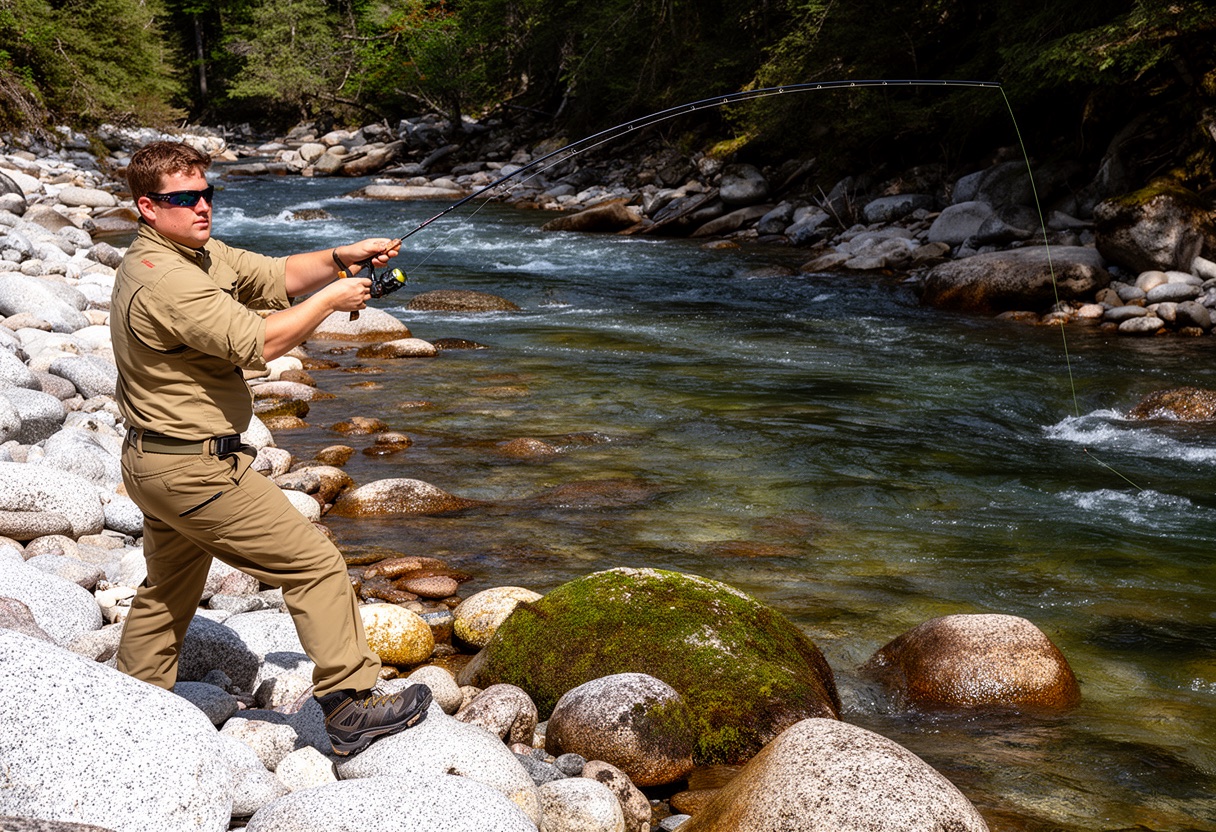
Fishing current. Cast across and slightly downstream of your target structure. Let the lure drift with the current while maintaining light line contact. When the lure reaches the seam or ledge edge, twitch the rod tip and reel slowly to keep it in the strike zone. The key is keeping your lure moving through the current break at the same speed natural prey would drift — fast enough to look alive, slow enough to look vulnerable.
Skip-the-bottom with a football jig. This is the core smallmouth technique. Skip means to bounce your lure along the bottom, letting it roll over rocks and settle in crevices. Cast beyond the rock pile or ledge, let the jig sink, then reel with short, firm strips that move it a few feet at a time. Pause when it hits a rock — smallmouth often strike on the pause, not the movement. If you lose contact, you may have snagged; a sharp strip usually frees the jig thanks to its rounded head.
Retrieval speed. Smallmouth generally prefer slower presentations than largemouth. Whether you’re working a tube, a grub, or a drop-shot, keep your retrieve deliberate with frequent pauses. A common mistake is reeling too fast — in clear water, a fast-moving lure looks unnatural to a smallmouth that can clearly see it.
Finesse presentations. When fish are pressured or water is exceptionally clear, slow everything down. Drop-shot rigs, tube baits on light jig heads, and small grubs fished near the bottom with minimal movement can catch smallmouth that refuse anything more aggressive. The finesse approach is especially effective in spring when post-spawn smallmouth are finicky.
Reading smallmouth water. The best smallmouth anglers spend more time looking for structure than casting. Scan the water for visible current breaks, submerged rock piles, and ledge edges. In rivers, the transition from fast to slow water is your target. In lakes, find the points and ledges that extend toward the main channel. Our guide to fishing vegetation covers a very different environment — smallmouth is about rock, not weeds — but the principle of matching presentation to habitat is the same.
Catch & Release for Smallmouth
Catch and release matters more for smallmouth than for many other freshwater species. Smallmouth are slower to reproduce than largemouth — they produce fewer eggs per spawn and reach maturity later. Overfishing, especially during spawn, can depress local populations quickly.
Best practices:
- Wet your hands. Smallmouth have sensitive skin. Dry hands remove their protective slime coat, increasing infection risk.
- Minimize air time. Keep the fish in the water as much as possible. If you need to remove a hook, use wet pliers and work quickly.
- Five-count before tension. If the fish is fatigued, support it in the water and let it recover for five seconds before applying any line tension for the release.
- Proper grip. Avoid jaw-sacking smallmouth — their jaws are fragile relative to their body size. A belly grip or supporting the fish horizontally is safer.
- Revive before letting go. Hold a tired fish facing into the current until it swims away on its own. A fish that drifts sideways or fails to maintain position needs more recovery time.
Quick-Start Checklist
Ready to target smallmouth for the first time? Here’s your five-step game plan:
- Find clear, rocky water. Rivers with visible bottom, lake ledges, or boulder-lined shorelines.
- Set up light. 6’6″–7′ medium rod, spinning reel, 10–14 lb braid with a 12–16 lb fluoro leader.
- Start with a football jig. 1/4 oz in green pumpkin or Junebug. It covers the most situations.
- Fish current breaks and ledges. Cast across seams, let your jig skip the bottom, and pause on rocks.
- Keep it slow and steady. Smallmouth respond to deliberate presentations. Patience beats speed every time.
The bronze beast rewards technique. Get on clear water, slow your retrieve, and let the structure do the talking.
Frequently Asked Questions
What is the best lure for catching smallmouth bass?
A football-head jig in the 1/4 to 3/8 oz range, fished in green pumpkin or Junebug. It skips across rock without snagging, imitates crawfish (smallmouth’s primary food), and works in spring through fall. If you buy only one lure for smallmouth, make it a football jig.
Can I use the same gear for smallmouth and largemouth?
You can, but you won’t catch as many smallmouth. Smallmouth benefit from lighter line and a fluorocarbon leader because they see well in clear water. If you’re sharing gear, the compromise is a 7′ medium-fast rod with 10–14 lb braid and a fluoro leader — that setup works reasonably well on both species.
What water temperature is best for smallmouth fishing?
The peak activity window is 60–72°F. Below 50°F, they slow down and hold deep. Above 75°F, they move deeper and feed less aggressively. Spring and fall, when water sits in that range, are the best seasons.
Do smallmouth bite at night?
Less than largemouth. Smallmouth are more active during dawn and dusk than in full darkness. That said, topwater and chatterbait can produce strikes after dark during peak summer months, particularly on lakes with current or wind-driven water movement.
How deep should I fish for smallmouth?
It depends on the season. Spring: 2–8 feet near spawning beds. Summer: 10–25 feet on ledges. Fall: 5–15 feet on shallower structure. Winter: 15–30 feet near current breaks or deep structure. Adjust based on local conditions and what you find on your fish finder.
Is braid really necessary for smallmouth fishing?
Not strictly necessary, but highly recommended. Braid’s zero stretch gives you the sensitivity to feel a jig hit rock — which is half the technique. If you prefer monofilament, use 8–10 lb test and accept that your bottom contact won’t be as crisp. The fluorocarbon leader is the more critical component.
What color lures work best for smallmouth in clear water?
Natural colors: green pumpkin,Junebug,watermelon patterns, and crawfish-colored tubes. In slightly stained water, add white or chartreuse accents to increase visibility. Avoid bright chartreuse or firetiger in crystal-clear water — smallmouth see those as unnatural.
Where can I find smallmouth bass near me?
Check your state fish and wildlife agency’s fishery maps and reports. They typically list which lakes and rivers stock or naturally support smallmouth. Local tackle shops are also a reliable source — ask about clear-water lakes with rocky bottom.