If you’ve ever caught fish one weekend and nothing the next — same gear, same lake, same technique — it probably wasn’t your skill that failed you. It was the season.
Fish behavior changes dramatically throughout the year. Most beginner anglers don’t realize why a technique that worked last month has suddenly stopped producing. The same lake can produce completely different fishing in spring versus summer, even though the water looks identical from the bank.
Understanding those changes doesn’t require memorizing a fishing calendar. It starts with learning to read water temperature.
This guide walks through all four seasons: what species are active, which lures and techniques work, where to find fish, and how to adjust as the water warms and cools. By the end, you’ll have a seasonal framework — a mental calendar connecting water temperature, fish behavior, and lure selection — so you can walk onto the bank with a plan instead of guessing.
Why the Season Matters More Than You Think
The reason seasonal changes matter so much comes down to basic biology. Fish are cold-blooded — technically called ectothermic — which means they can’t regulate their own body temperature. Water temperature directly controls their metabolism, digestion rate, and energy levels. Warm water means faster metabolism and more active fish. Cold water slows everything down.
That’s why the same lake can produce completely different fishing across seasons. A bass that aggressively strikes a lure in June might barely notice it in January, even though it’s sitting in the exact same spot.
Water temperature also changes more slowly than air temperature. A cold front might drop the air 20°F overnight, but the water below might only shift 3–5°F over several days. Checking the actual water temperature gives you a much more reliable picture than checking the weather app.
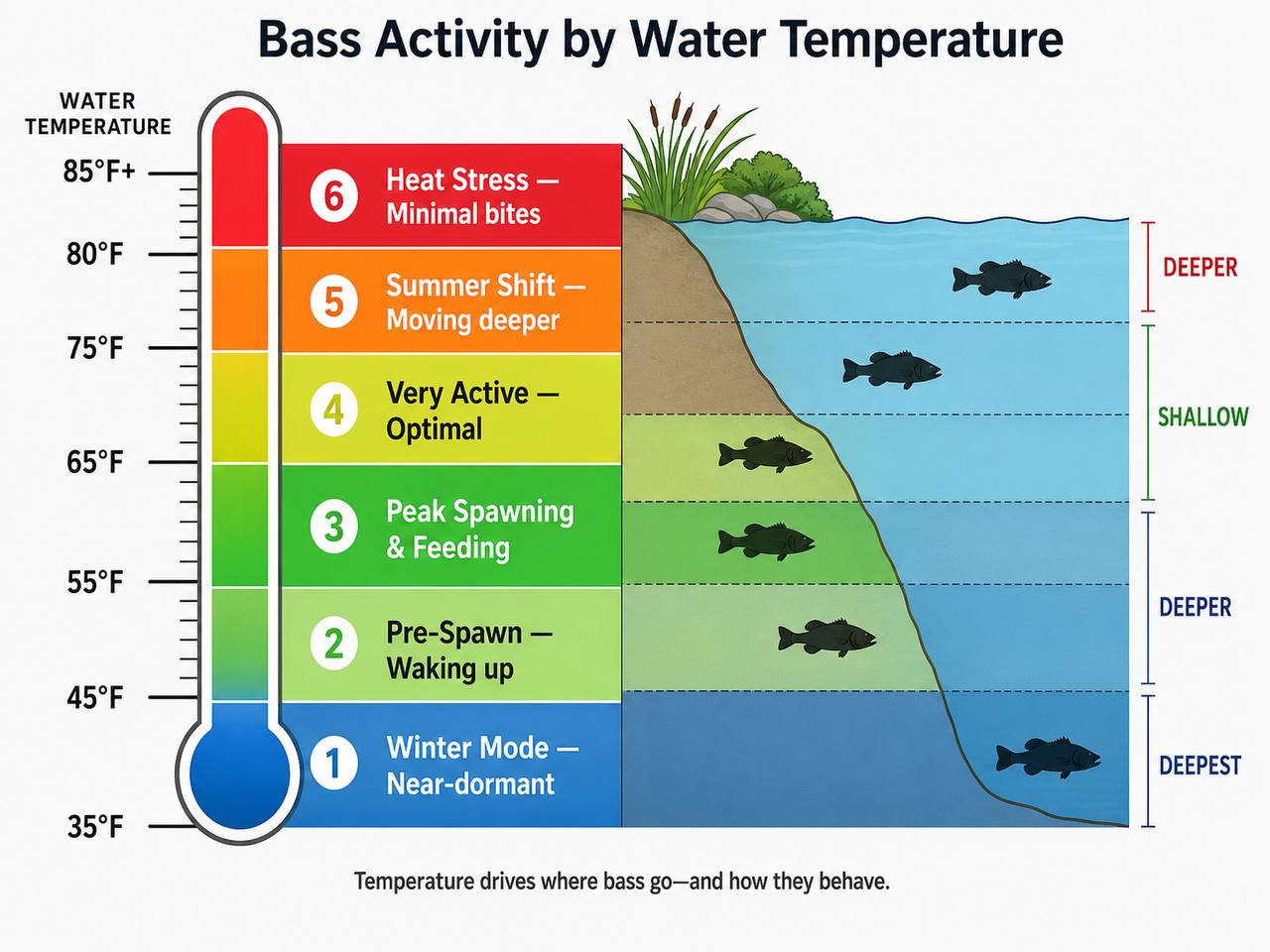
Think of water temperature as the master dial that controls everything else: where fish hold in the water column, how aggressive they are, what size bait they’ll eat, and even what time of day they’re most active. Understanding this one variable transforms fishing from guessing to planning.
For a deeper look at how temperature specifically affects bass, the Bass Water Temperature Guide breaks down the science. And to understand what actually triggers fish to strike, temperature is the starting point.
Spring Fishing: Warming Water, Shallow Fish, and the Spawn
Spring is when most freshwater lakes come alive. Water warms from winter levels — typically climbing from around 45°F (7°C) to 65°F+ (18°C+) over several weeks — and fish metabolism kicks back on. Everything starts moving toward shallow water.
What’s Happening
The key threshold to watch is 50°F (10°C). Once water hits that mark, bass begin actively feeding and moving toward spawning areas. As it climbs into the 55–65°F (13–18°C) range, that’s peak spawning activity across most of the United States. During this window, fish are focused on reproduction rather than feeding — but the transition into and out of spawn creates excellent fishing opportunities.
Target Species
- Largemouth and smallmouth bass — the headline act. Pre-spawn, spawning, and post-spawn each offer different presentations and locations.
- Crappie — spawn at slightly cooler temperatures than bass, typically 50–60°F (10–15°C).
- Bluegill and panfish — active near shore as soon as shallow water warms up.
- Trout — still productive in cool-water streams and spring-fed rivers.
- Catfish — starting to wake up, especially in the deeper channels that warm more slowly.
Where Fish Hold
Spring fish are shallow. During the pre-spawn phase, bass typically hold at 2–8 feet deep near points, submerged timber, and gravel bars — areas that warm faster and attract baitfish. During the spawn itself, they move even shallower to 1–4 feet on gravel and sand beds where they build nests. After spawning, bass disperse to weed lines and drop-offs in the 4–10 foot range, feeding aggressively on baitfish and their own young.
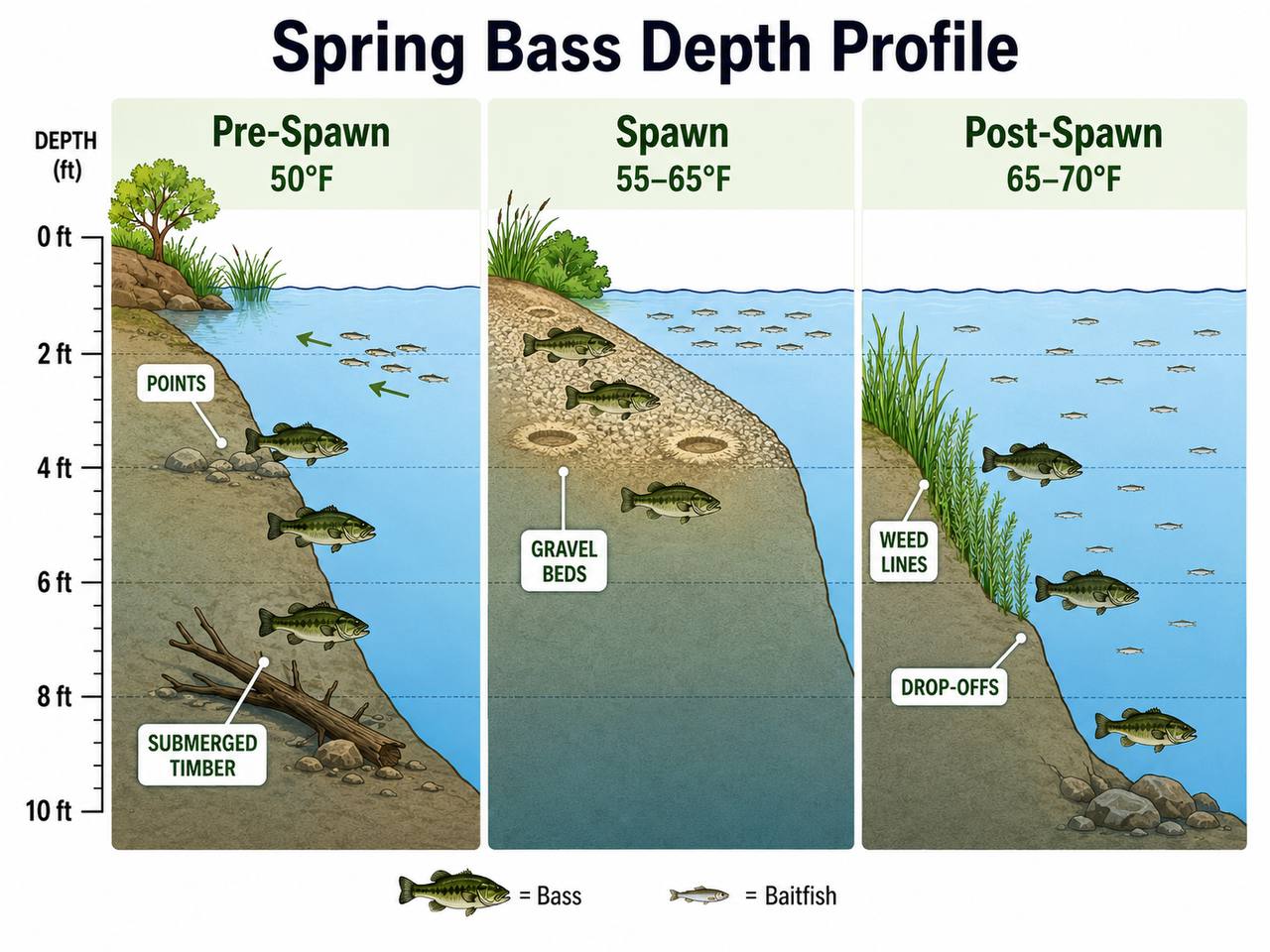
The key to finding spring fish is learning to identify shallow cover and spawning structure. Points, coves, weed edges, and gravel bars are the places to start.
Lures and Techniques
Pre-spawn bass are still relatively deep, so crankbaits and jerkbaits work well — they reach down to fish before the fish move up to you. As fish hit the beds, switch to slower presentations like drop-shot rigs or floating worms. Post-spawn, bass guard nests and feed aggressively — soft plastic worms are commonly effective in this phase. For more on soft plastic worms for post-spawn bass, the basics are covered there.
Match your retrieve speed to the water temperature. Start slower in early spring and pick up the pace as the season progresses. Moderate speeds work through mid-spring; faster retrieves become viable as the water approaches 70°F.
Beginner Mistakes to Avoid
- Using heavy cover baits before the water is warm enough. In 45–50°F water, fish rarely chase aggressive presentations.
- Not checking local spawn regulations. Many states restrict fishing near beds or ban certain bait types during spawning season.
- Fishing too deep in early spring. Spring fish move shallow — if you’re still working 20-foot channels, you’re probably fishing like it’s winter.
- Assuming all lakes warm at the same rate. Shallow, clear lakes warm faster than deep, stained ones.
Summer Fishing: When Heat Drives Fish Deep
Summer fishing looks nothing like spring fishing. The same lake that produced easy catches on a topwater frog in May might require a completely different approach by July. Heat is the defining challenge of the season.
What’s Happening
As water climbs from 65°F (18°C) toward 85°F+ (29°C+), fish metabolism stays active but heat stress sets in. The critical shift happens around 75°F (24°C) — bass begin seeking deeper, cooler water or heavy cover. Above 85°F, many fish stop biting during the peak heat of the day entirely. Warm water also holds less dissolved oxygen, which compounds the stress and can suppress feeding even when the temperature itself would suggest activity.
Target Species
- Bass — deeper water or heavy cover. They don’t disappear — they just relocate.
- Catfish — increasingly active in summer heat. Catfish are more tolerant of warm, low-oxygen water than bass.
- Pike — productive in early summer, tend to slow during peak heat.
- Crappie — near structure and cover, often near weed edges and fallen trees.
- Bluegill — near shade and cover; they handle summer heat better than bass in open water.
Where Fish Hold
Summer bass hold in deep channels (10–25 feet), near the thermocline — the transition zone where warm surface water meets cooler deep water — and in heavy cover like lily pads, standing timber, and submerged ledges. Shade from overhanging trees and cliffs creates productive pockets. In rivers, current breaks and deeper runs are the go-to spots.
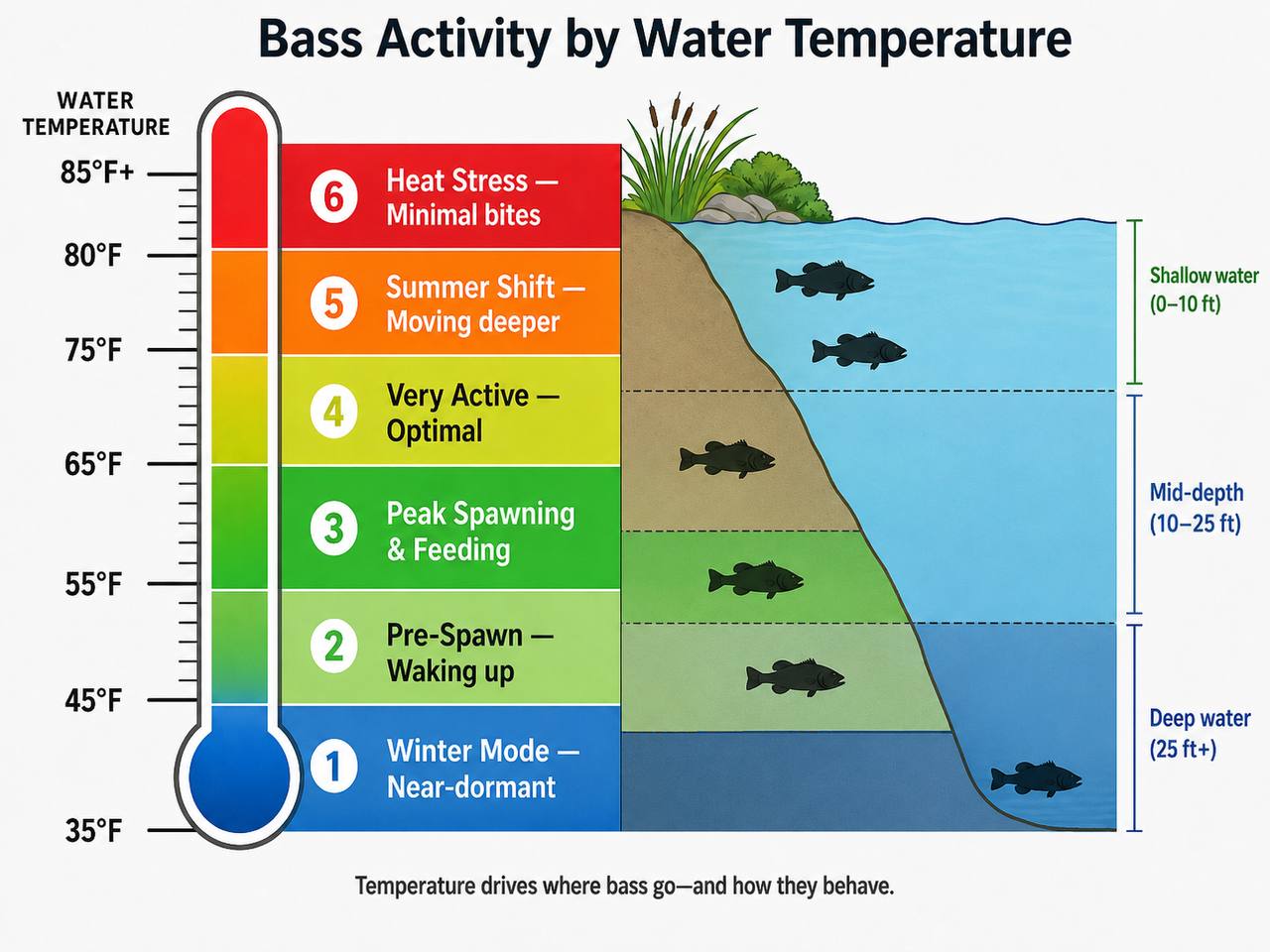
The thermocline is the most important concept for summer fishing. Think of it as a boundary between warm and cool water. Fish tend to suspend right at that line or just below it. Learning to read the water to find summer cover and structure — deep channels, submerged points, and timber — is critical.
Lures and Techniques
Dawn and dusk are prime — that’s when topwater lures (frogs, poppers, walking baits) shine. During the day, slow it down: flipping and pitching creature baits into cover, deep-diving crankbaits, and Ned rigs. Night fishing becomes a legitimate strategy in summer for both bass and catfish.
Use fluorocarbon line for stealth in clear, warm water. Fish see better when oxygen levels are lower, and a heavy monofilament line can spook them. For more on soft plastic creature baits and Ned rigs, those techniques are covered in detail elsewhere.
Beginner Mistakes to Avoid
- Fishing midday in open shallow water. That’s the worst combination in summer.
- Using fast-retrieve lures when fish are lethargic. Even aggressive presentations need to slow down in hot water.
- Not adjusting for oxygen levels. Stagnant warm water suppresses bites — target areas with current or wind chop.
- Ignoring cloud cover. Overcast conditions may improve midday bites by reducing surface glare and keeping water slightly cooler.
Fall Fishing: Why Many Anglers Consider It the Best Season
Fall is widely considered the best season for fishing — and for good reason. Water cools, fish feed aggressively, and bite windows expand. For beginners, fall often produces the most consistent catches.
What’s Happening
Water cools from around 70°F (21°C) down to 45°F (7°C) over the course of the season. Fish sense winter coming and feed heavily to build energy reserves. This “feeding frenzy” behavior is real — bass, in particular, become voracious predators that will chase larger baits and strike more aggressively than at any other time of year.
Target Species
- Bass — very active. The fall feeding frenzy is legendary among anglers.
- Crappie — active early fall, then slow as water drops.
- Catfish — very active; fall is a top season for catfishing.
- Pike — excellent in cooler fall water. Pike are arguably at their most aggressive in autumn.
- Bluegill — active early fall, productive for panfish anglers.
Where Fish Hold
This is the trickiest part about fall fishing: fish are constantly on the move. Early in the season, bass hold in shallow feed belts — 3–6 feet deep near points and weed lines where baitfish concentrate. As water cools, they move progressively deeper: transition zones at 8–12 feet over drop-offs in mid-fall, then deeper haunts at 15–25 feet near channels and submerged humps by late fall.
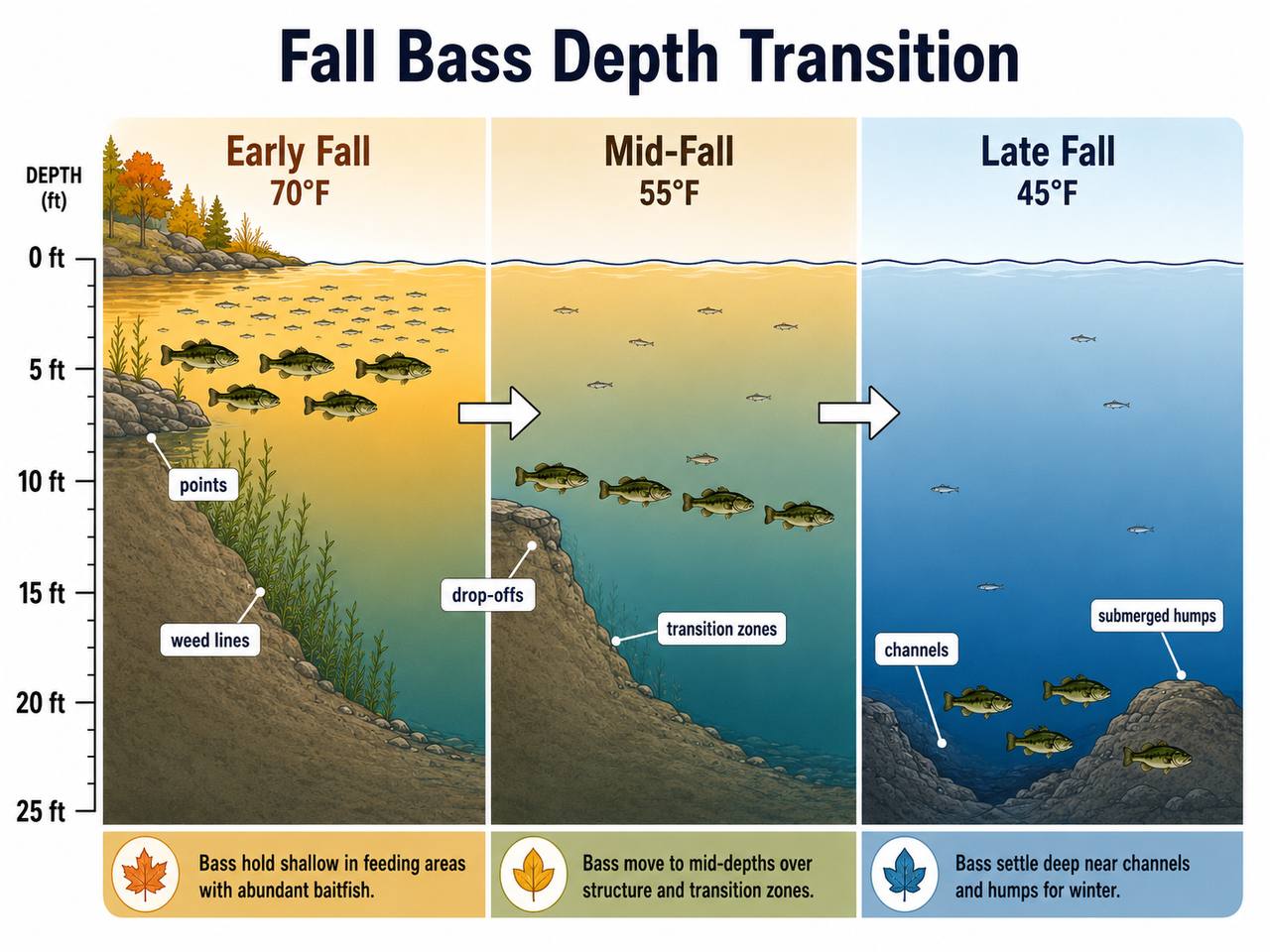
The key is to track that movement. Start fishing shallow and work deeper as the season progresses. Finding transition zones and drop-offs — the areas where shallow water meets deeper water — is especially important because that’s where fish stage up as they move.
Lures and Techniques
Fall fish want bigger baits. Jigs, swimbaits, crankbaits, soft plastic tubes, and spinnerbaits all work well. Live bait — minnows and nightcrawlers — is especially effective for panfish and catfish in fall. For swimbaits and soft plastic tubes, the technique basics apply here.
Match your retrieve speed to the cooling water. Start faster in early fall when fish are aggressive, then gradually slow down as the water drops. The baitfish schools that fish are chasing also concentrate and move deeper, so follow the food.
Beginner Mistakes to Avoid
- Continuing summer techniques too long into fall. Once water drops below 70°F, switch from topwater to subsurface presentations.
- Not adjusting lure size. Fish want larger baits in fall — small presentations can look like a snack, not a meal.
- Fishing only shallow water as the season progresses. Late-fall bass are often in much deeper water than early-fall fish.
Winter Fishing: Managing Expectations and Making the Most of Slow Water
Winter gets a bad reputation — but fish can be caught. The challenge is adjusting expectations and matching the slow, deliberate pace that cold water demands.
What’s Happening
Water drops to 35–50°F (2–10°C). Fish metabolism is at its slowest. Feeding becomes opportunistic — fish don’t chase bait, they wait for it. Below 40°F (4°C), activity becomes very slow. Below 35°F (2°C), fish are essentially near-dormant, except in spring-fed or flowing waters that stay slightly warmer.
Target Species
- Bass — slow but catchable in most conditions. They concentrate in deep water near structure.
- Trout — still active in spring-fed streams and flowing rivers.
- Catfish — possible in warmer southern waters; much less active in the north.
- Bluegill — near deeper cover, but will bite on small presentations.
- Pike — possible near deep structure; slow but not inactive.
Where Fish Hold
Winter fish hold in the deepest parts of the lake — 15–30+ feet. Channel bottoms, points that extend into the main lake, submerged humps, and current breaks in rivers are the primary holding spots. Spring inflow areas often produce slightly warmer water (sometimes 4–6°F warmer) and attract more active fish.
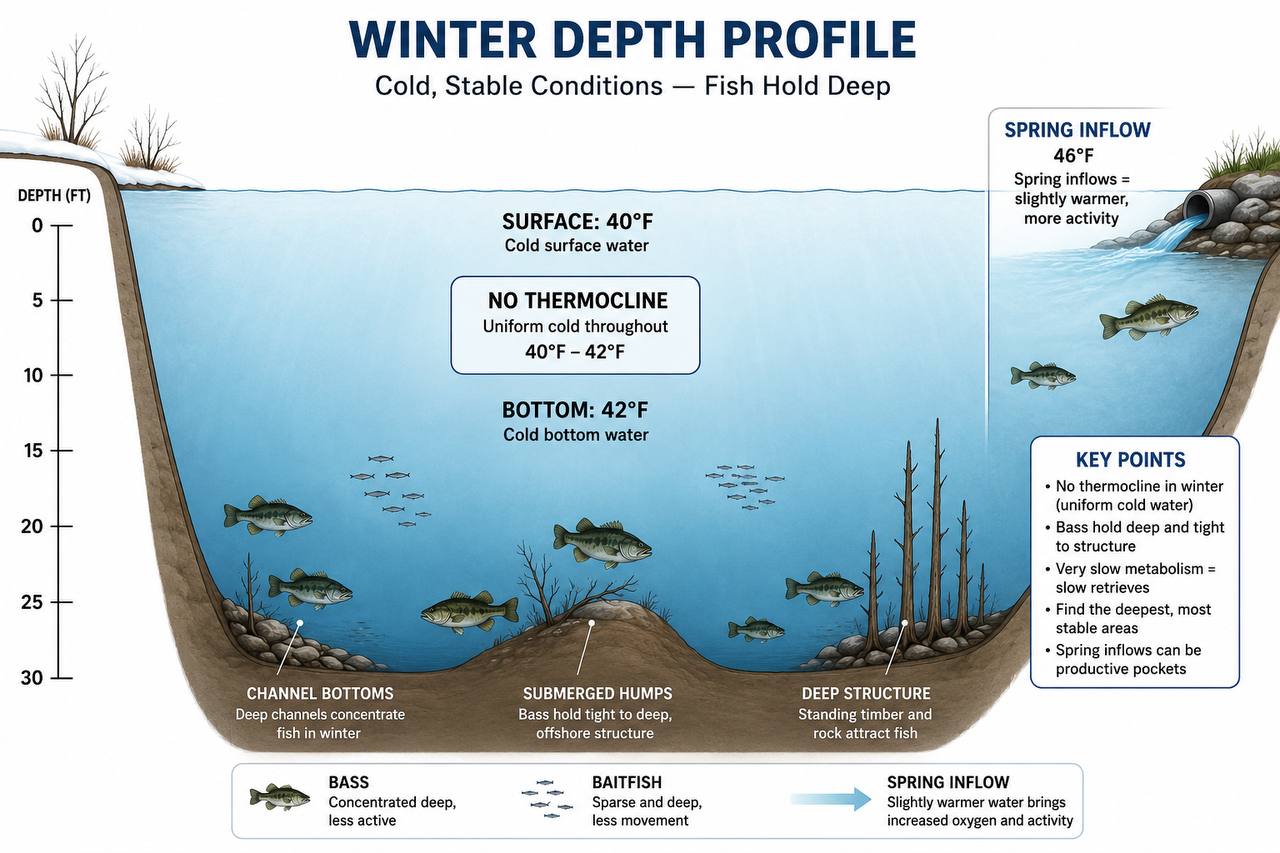
Unlike summer, there’s no thermocline in winter — the water column is uniformly cold from surface to bottom. Fish are concentrated in the deepest, most stable areas, clustered tight around structure. For a refresher on bass behavior at different water temperatures, the temperature guide covers winter conditions in more detail.
Lures and Techniques
Very slow retrieve is essential. Small jigs, tube baits, slow-rolling crankbaits, drop-shot rigs, and small soft plastics are the go-to choices. Let the bait sit on the bottom, then twitch it subtly. Cover less water per spot — patience at each location pays off more than covering new territory.
Beginner Mistakes to Avoid
- Giving up entirely. Fish CAN be caught in winter — the technique just needs to match the conditions.
- Using large, loud baits. A 4-ounce jig in 40°F water is overkill.
- Fishing too fast. If you’re reeling at anything faster than a slow, steady pace, you’re likely moving too fast.
- Not targeting deep structure. Winter bass rarely wander far from deep cover.
A note on ice fishing: Ice fishing is a winter option in northern climates, but it requires proper equipment and safety knowledge. Ice thickness must be verified (minimum 4 inches for walking, more for groups), and you should never fish alone on ice. This guide focuses on open-water winter strategies — if ice fishing is your interest, seek out dedicated resources and always prioritize safety.
Regional note: In southern states, “winter” may still produce productive fishing with water temperatures in the 50s. In northern states, open-water fishing may be limited or impossible during the coldest months.
The One Tool Every Beginner Should Own: A Water Thermometer
Water temperature is a better guide than calendar dates. Sixty degrees Fahrenheit in a Florida lake in March means the same thing as 60°F in a Minnesota lake in June — the fish will behave similarly regardless of the month on your calendar.
How to use one: Measure at the depth you’re fishing, not just at the surface. In summer, surface water can differ from bottom temperature by 10°F or more because of the thermocline. A surface reading of 78°F doesn’t tell you much if you’re fishing at 20 feet where it might be 65°F.
Types: Digital handheld thermometers are the most practical for beginners and cost $5–15. Most fish finders and sonar units include built-in temperature readings. Some fishing apps report real-time lake temperatures, which is useful for planning before heading out.
When to check: Check before you leave (fishing apps or lake reports), measure on arrival (surface reading), and recheck at target depth if you’re using a fish finder. If conditions change — a cold front passes, wind shifts, or you move to a different part of the lake — check again.
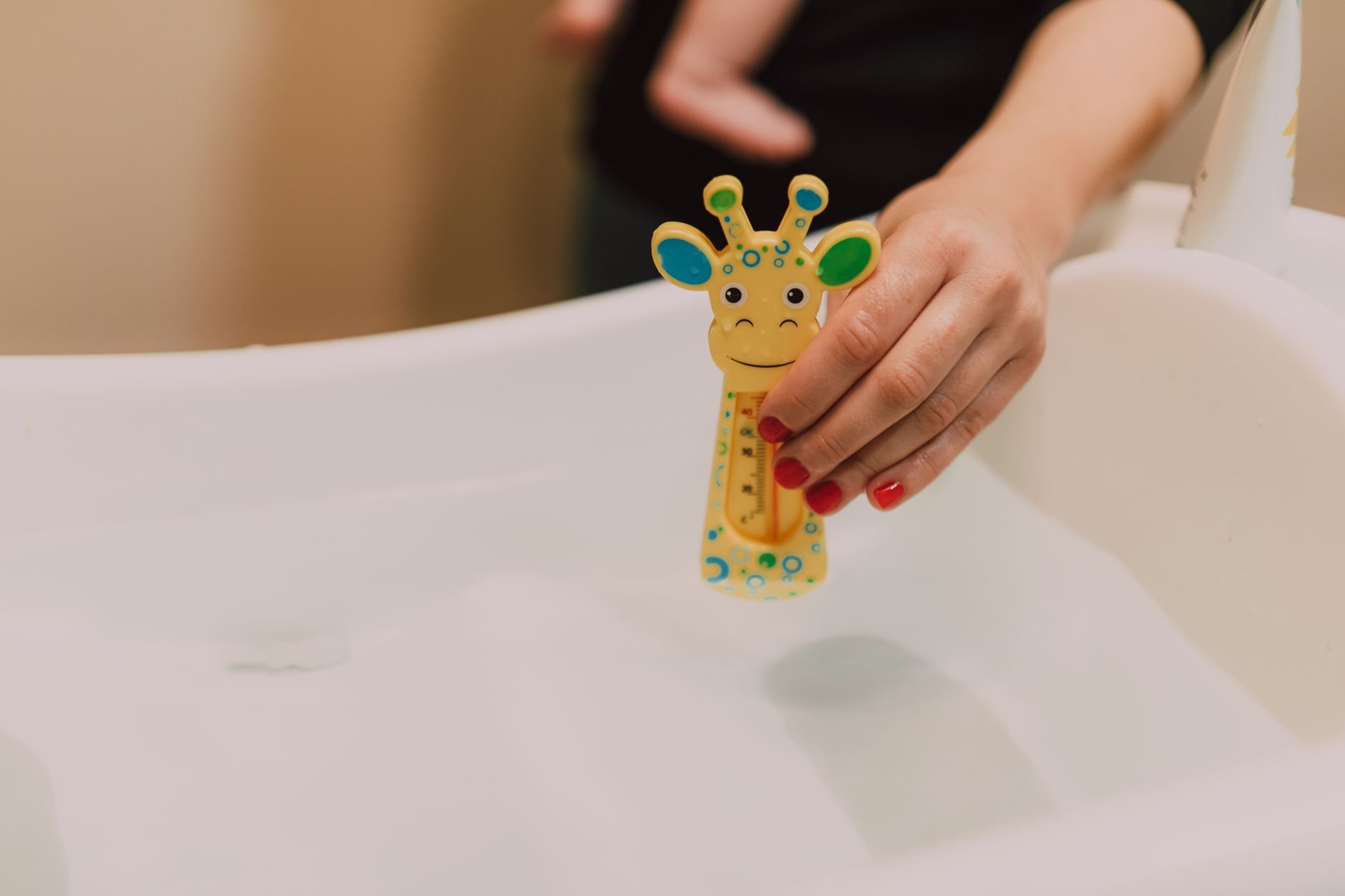
A $10 water thermometer tells you more about fish behavior than the calendar date on your phone. It’s the single most practical upgrade a beginner angler can make.
Regional Variation: Think Temperature, Not Calendar
The seasonal patterns in this guide apply everywhere — they just start at different times depending on where you live.
Spring in Florida ≠ spring in Minnesota. In the South, water may reach 55°F as early as February or March. In the North, it might not hit that mark until May or June. A fisherman in Florida in March may be experiencing the exact same water temperatures — and the same fishing conditions — as a fisherman in Minnesota in June.
Here’s a rough timeline of when seasons typically start in different regions:
- Southern states (Florida, Gulf Coast): Spring begins February–March. Winter is mild; water rarely drops below 50°F.
- Central states (Missouri, Tennessee, Carolinas): Spring begins March–April. Four distinct seasons.
- Northern states (Minnesota, Michigan, Maine): Spring begins May–June. Shorter fishing season; ice cover common December through March.
- Mountain West (Montana, Idaho, Colorado): Similar to northern states, but high altitude extends cold conditions even further.
The practical takeaway: use water temperature as your guide, not calendar months. If your lake is reading 55°F, treat it like spring — regardless of whether it’s March in Florida or June in Minnesota.
Saltwater note: Saltwater seasonal patterns follow similar temperature-driven logic but add complexity from tides, currents, and migratory species. Saltwater anglers should look for dedicated saltwater seasonal guides.
Seasonal Quick-Reference: Your At-a-Glance Cheat Sheet
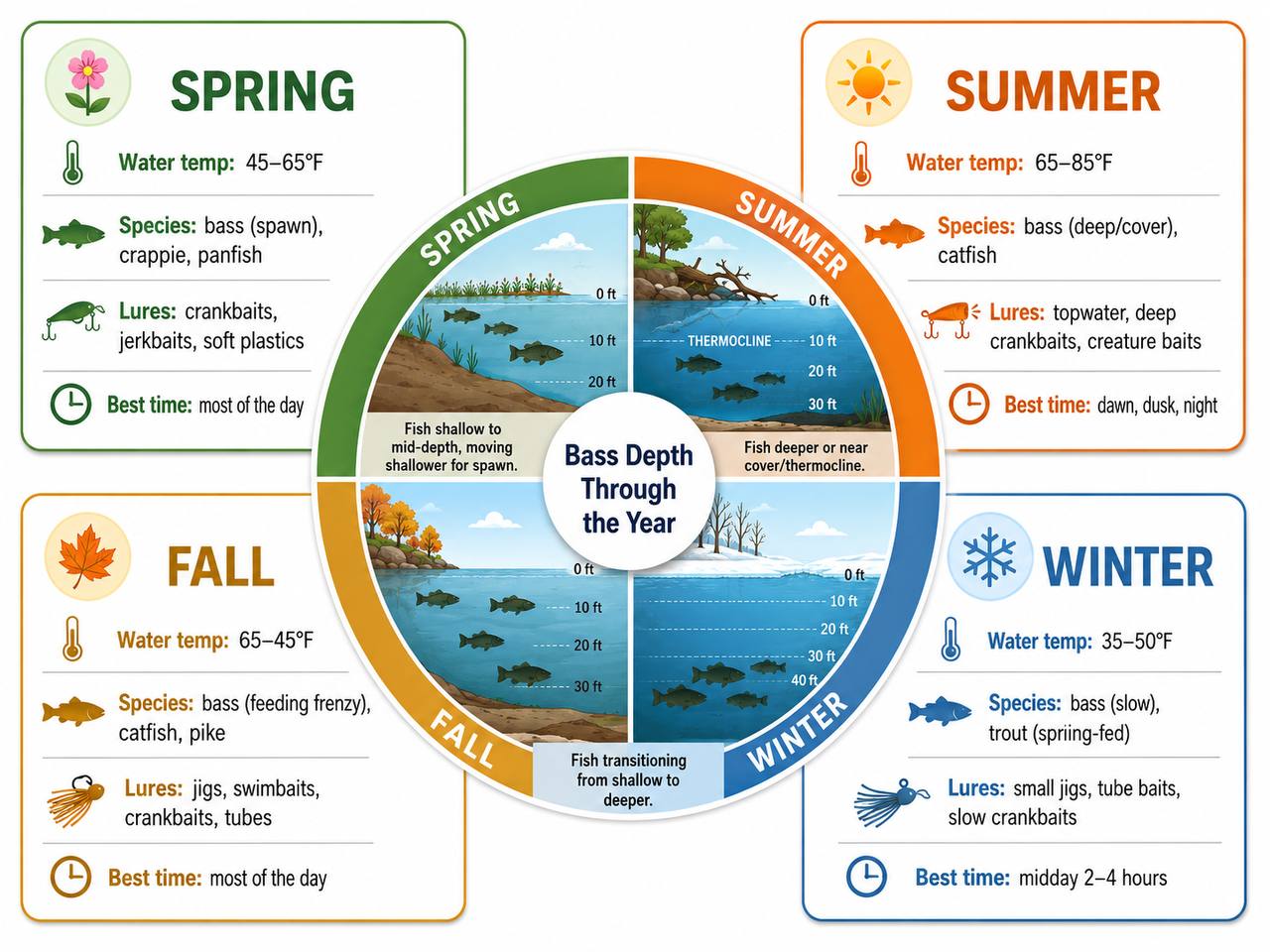
Here’s a quick summary you can return to throughout the year. These are averages — always check actual water temperature for your local lake.
Spring (45–65°F / 7–18°C)
- Active species: Bass (spawning), crappie, panfish
- Lures: Crankbaits, jerkbaits, soft plastics
- Best time: Most of the day (expanding as water warms)
Summer (65–85°F / 18–29°C)
- Active species: Bass (deep/in cover), catfish
- Lures: Topwater (dawn/dusk only), deep crankbaits, creature baits
- Best time: Dawn, dusk, night
Fall (65–45°F / 18–7°C)
- Active species: Bass (feeding frenzy), catfish, pike
- Lures: Jigs, swimbaits, crankbaits, tubes
- Best time: Most of the day (expanding as water cools)
Winter (35–50°F / 2–10°C)
- Active species: Bass (slow), trout (spring-fed waters)
- Lures: Small jigs, tube baits, slow crankbaits
- Best time: Midday (2–4 hours)
If you want to dive deeper into how temperature drives bass behavior specifically, the Bass Water Temperature Guide covers the science in detail. And now that you know what lures work each season, here’s what to actually put in your tackle box.
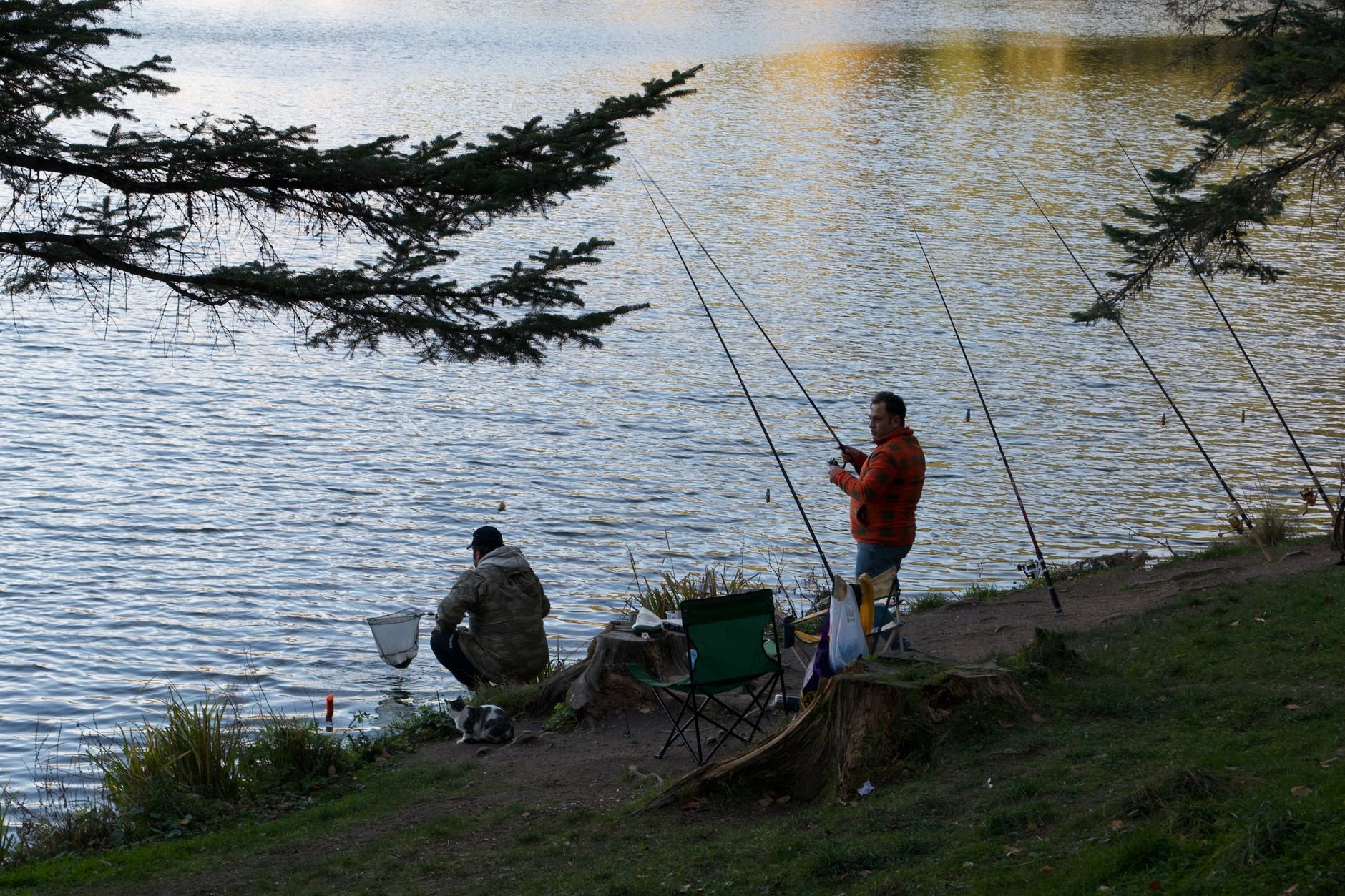
With this seasonal framework, you can walk onto the bank with a plan instead of guessing.
Now You’re Ready to Fish Any Season
Seasons change fish behavior through water temperature. Match your lures, depths, and timing to the actual water conditions — not the calendar. Check the temperature, target the right species, use the right presentations, and adjust as conditions shift.
With this framework in place, you’ll stop guessing and start fishing with a plan. Here are some next steps to build on this foundation:
- Tackle Box Starter Kit — building your tackle box around seasonal needs
- Why Fish Bite — understand the behavioral science behind seasonal feeding patterns
- How to Read Water for Fishing — learning to read the water for seasonal structure