

You’re on a rocky point with a Ned rig tied on. You’ve caught fish here before. Today you get follows, short strikes, and a lot of nothing. You’ve heard a shaky head might be the answer, but it looks like the same thing — a jighead with a plastic worm on it.
It isn’t the same thing. They solve different problems.
The Short Answer: Same Family, Different Jobs
Both are finesse bottom rigs: a weighted head with a soft plastic threaded onto a hook. Both stand the bait up off the bottom. Both get fished slowly. That’s where the similarity ends.
The Ned rig is a small mushroom head with a short, buoyant stickbait — usually 2.5 to 3 inches — on an exposed light-wire hook. Heads run about 1/16 to 1/4 ounce, and you fish it on 6 to 8 pound line. It’s built to get bites from fish that have seen everything, on open rock and gravel where an exposed hook has nothing to grab.
The shaky head is a ball, football, or stand-up head with a longer finesse worm — 4 to 7 inches — on a bigger hook. Heads start around 1/16 ounce and go past 3/8, and the hook point normally tucks into the plastic so it comes through cover. It’s built to cover water, hold bottom in wind and current, and fish around wood, docks, and grass edges.
Start with this rule: a Ned rig typically gets more bites wherever the cover lets you fish it. A shaky head gets bites where the Ned rig can’t go, or when the fish want a bigger meal.
That rule has exceptions. Depth, bottom, and the mood of the fish decide more than a bait’s reputation does.
What Each Rig Is, Part by Part
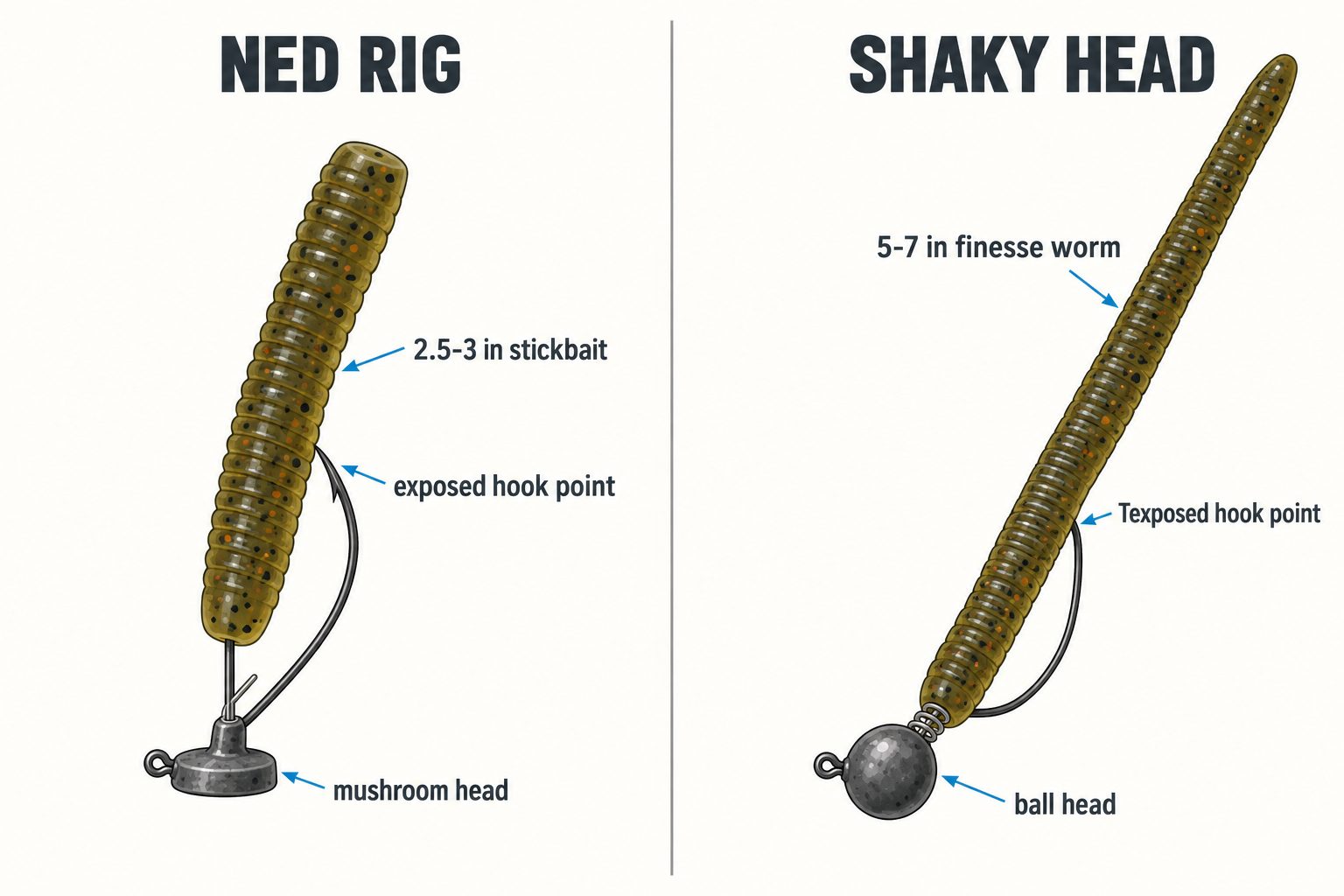
The Ned rig is four parts. A mushroom-shaped jighead with a flat bottom. A small light-wire hook, typically size 1 up to about 2/0. A wire or screw keeper to hold the plastic’s nose. And a short stickbait — the 2.75-inch Z-Man TRD is the size everyone compares against.
The flat mushroom base is the whole trick. It sits on the bottom and holds the bait up at an angle instead of letting it lie flat. Buoyant plastics like ElaZtech make that posture more pronounced, because the tail floats upward at rest.
The shaky head is the same layout with different proportions. A ball, football, stand-up, or pointed finesse head. A 3/0 to 5/0 light-wire worm hook. A screw-lock spring or barb keeper. And a thin, straight-tail finesse worm, ideally one that floats so the tail lifts off the head.
Rigging matters more than most anglers expect on both. The worm has to hang dead straight. A bend in the plastic makes it spin on the fall and twists your line, and a spinning bait doesn’t get eaten. Around cover, tuck the point just under the skin — about an eighth of an inch, no deeper. Bury it too far and you’ll miss fish. In open water, leave the point exposed and your hookup rate goes up.
Both rigs tie on with a Palomar knot. That’s the one knot worth knowing cold.
The Real Difference: Fall Rate, Posture, and Hook Exposure
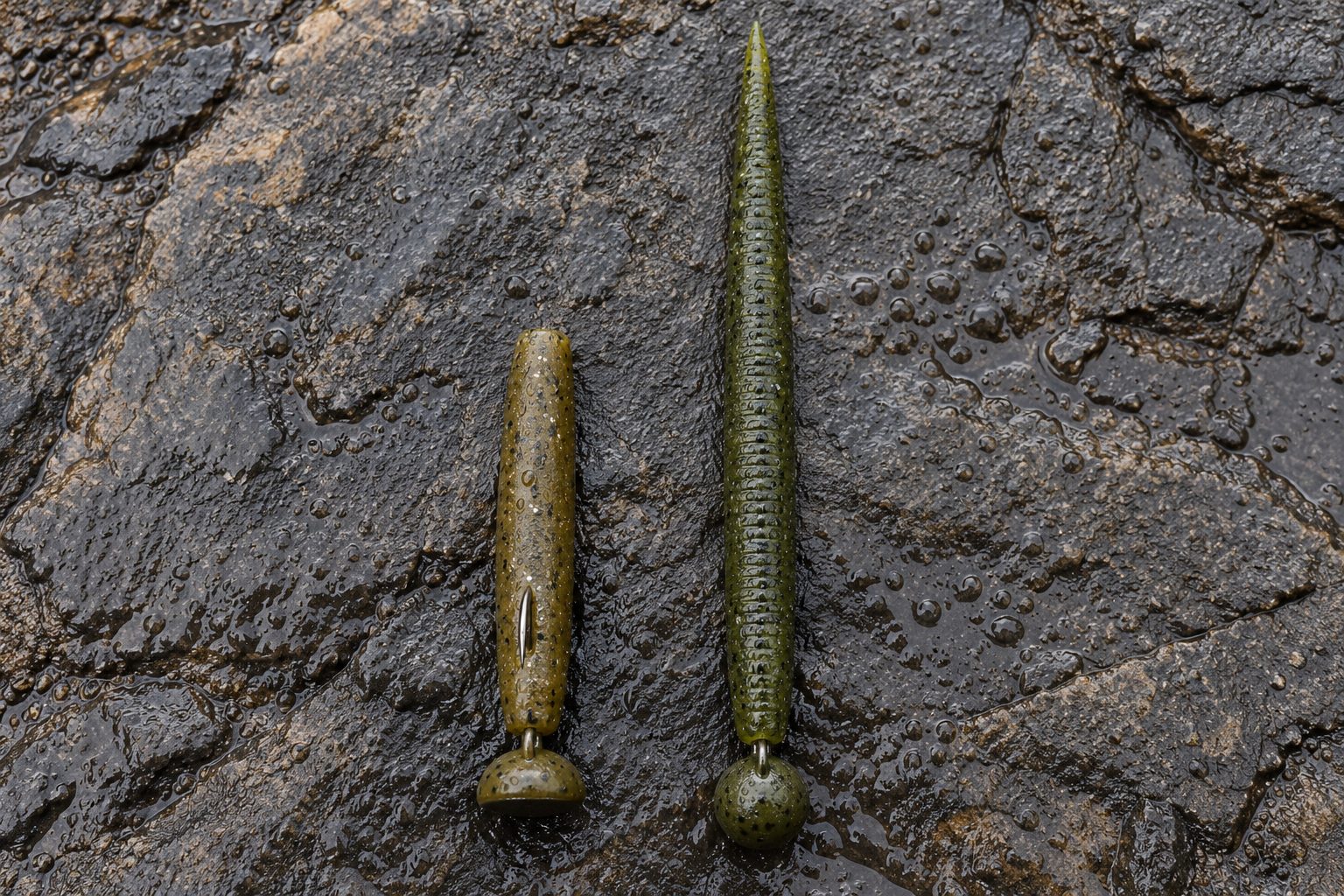
Set these two rigs on a rock and the argument becomes obvious.
Fall rate. The Ned’s small plastic and light head fall slowly and glide. The shaky head’s heavier head and longer worm drop faster and stay pinned down. A slow fall keeps the bait in the strike zone longer, which matters when fish are suspended under a dock or sitting above a brush pile. A fast drop gives you contact and control in wind, current, and depth.
Posture. A mushroom head stands the bait up on its flat base. A ball head rolls and rocks as you drag, which adds a wobble. A football head rocks in place on rock without tipping over, which is why it’s the pick on broken hard bottom. All three hold the worm up; the difference is how much the head itself moves.
Hook exposure. This is the practical dividing line. Ned hooks sit exposed, or behind a weedguard on the EWG-style heads made for cover. Shaky heads are normally rigged Texposed, point tucked into the plastic, so they slide through wood and grass.
Profile. Three inches versus six is most of the argument about matching bait size to the fish you’re actually catching.
Weight scales with depth on both. For a shaky head, Kevin VanDam’s ladder is a good default: 1/16 ounce in 5 feet or less, 1/8 ounce from 5 to 10, 3/16 ounce from 10 to 20, and 1/4 to 1/2 ounce deeper or in current. The Ned ladder runs 1/16 ounce under 5 feet, 1/8 ounce as the all-around, 3/16 ounce when wind or depth steals your feel, and 1/4 ounce past about 10 feet.
When the Ned Rig Is the Better Call
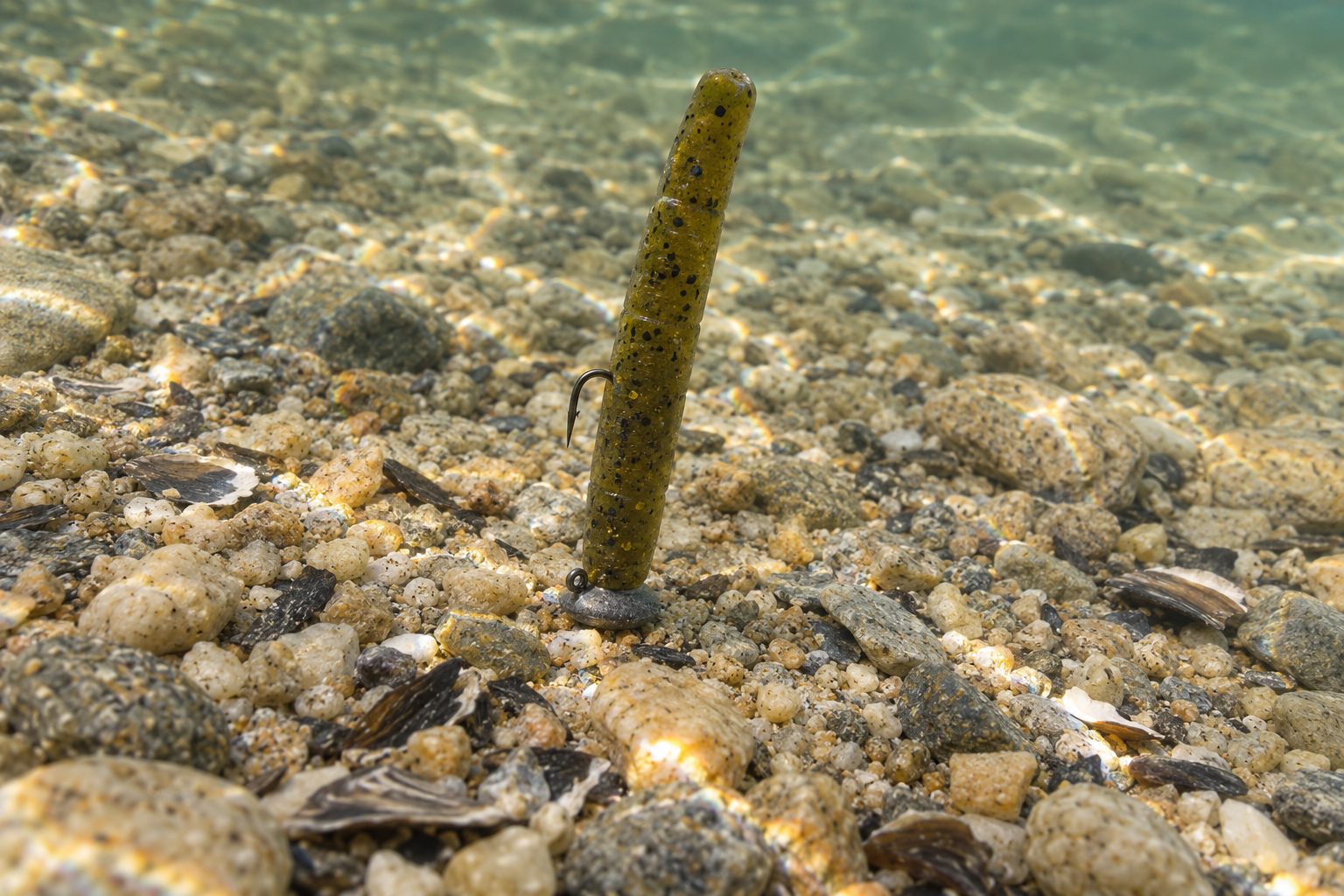
Start with the Ned rig when the bottom is clean rock, gravel, or pea gravel — a hard, open flat where an exposed hook has nothing to snag. Add clear water and pressured fish and it gets stronger, because a small profile that falls slowly gets inspected and eaten instead of refused.
It’s also the better answer when fish follow and don’t commit. Deadstick it: cast, let it settle, leave it alone for 10 to 30 seconds, then give it one small twitch. That’s the standard post-cold-front fix, and it’s boring in exactly the way that works.
Most Ned fishing happens from the bank out to about 8 or 12 feet. Current seams — rivers, creeks, the water below a bridge — and riprap banks are prime. Clear-water smallmouth eating gobies are about as good a match for a 2.75-inch stickbait as exists.
There’s field evidence for the bite rate, too. In a side-by-side test on rocky banks with identical rods, reels, line, and leaders, one angler alternated an hour on a Ned rig and an hour on a shaky head. The Ned out-produced the shaky head roughly 7 to 1 — for 1 to 2 pound spotted bass eating small bait.
Read that honestly. It’s one experiment, on one kind of water, for one size class of fish. It says a Ned rig is a bite machine in open rock. It doesn’t say it wins everywhere.
What the Ned costs you: that exposed hook hangs in brush, stumps, and laydowns. And 6 to 8 pound line with a light-wire hook limits how much cover you can lean on and how much pressure you can put on a good fish.
When the Shaky Head Is the Better Call
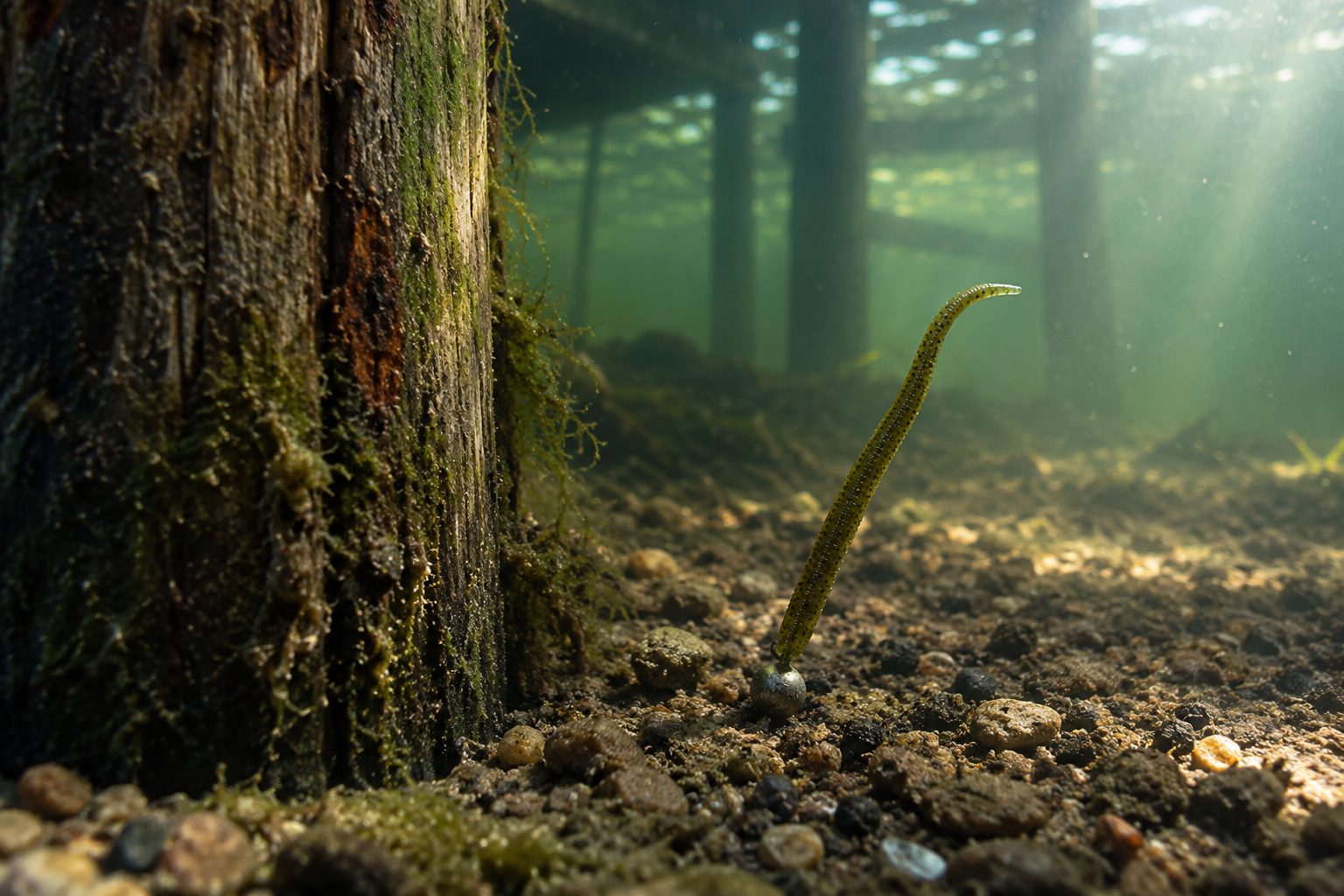
Flip the conditions and the shaky head takes over.
Wood is the clearest case. Brush piles, laydowns, dock cables, stumps, grass edges — anywhere a tucked hook point earns its keep. Skip a light head into dock shade, let it fall, deadstick, then shake. Work a 4 to 6 foot target zone thoroughly, then move to the next piece of structure instead of picking the same water apart.
Depth and current are the second case. A heavier head holds bottom and keeps feel on a long cast, and a shaky head still reads bottom at 15 to 20 feet with 3/16 to 1/4 ounce. In wind, the extra weight isn’t a compromise; it’s why you can fish at all.
The third case is size. When fish want a bigger meal, the shaky head scales up in a way the Ned rig doesn’t. A magnum version — half-ounce head, 8 to 10 inch worm — dragged across a ledge or offshore structure is a real tactic, and it’s what a lot of anglers reach for when the fish are big and competitive. VanDam called the big-worm version “a power-finesse tactic”: subtle enough to tempt tentative bass, heavy enough to land a good one.
The fourth case is the one you’ll hit most often. Your Ned rig draws followers. Fish come to it, look, and turn away. That’s the cue to step up in profile and action — same bottom, bigger presentation, more movement.
What it costs you: fewer bites per cast in open water. More work to fish correctly, since dragging is most of the retrieve and constant shaking is the classic mistake. And it wants slightly heavier tackle to perform.
A Decision Framework You Can Use On the Water
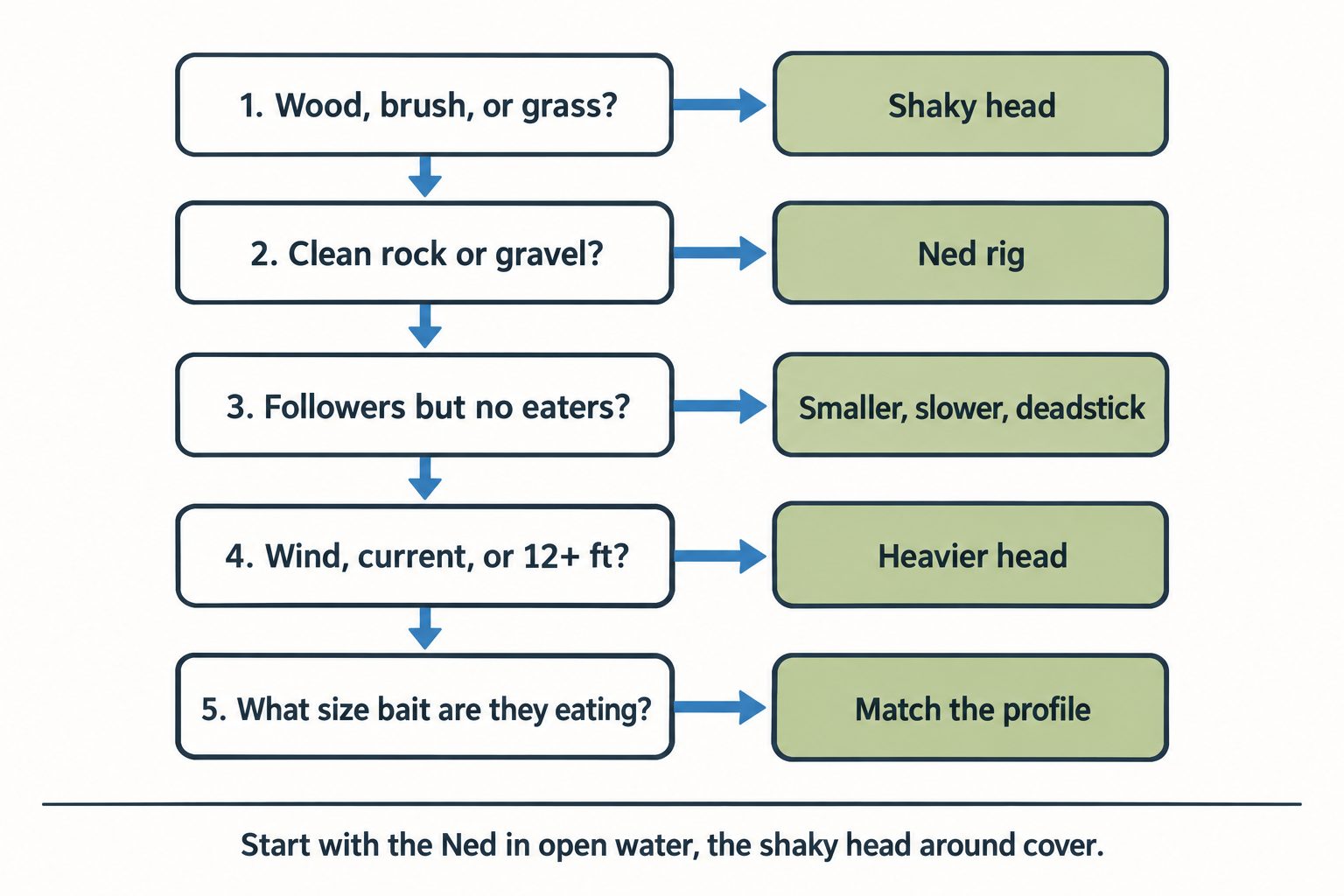
Five questions, asked in order, will pick the rig for you most days.
Is there wood, brush, or grass where the fish are? Yes — shaky head.
Is the bottom clean rock or gravel? Yes — start with the Ned.
Are fish following and refusing? Go smaller and slower first: lighter head, smaller plastic, longer deadstick. If that fails, go the other direction with a bigger shaky head worm.
Is there wind, current, or more than about 12 feet of water? Go heavier. A shaky head carries weight more comfortably than a Ned does.
What size bait are the fish eating? Match the profile first, then worry about color.
Default to a Ned rig in open water and a shaky head around cover, then let the bite overrule the flowchart. Three or four follows on the Ned without a hookup is your answer.
How to Fish Each One
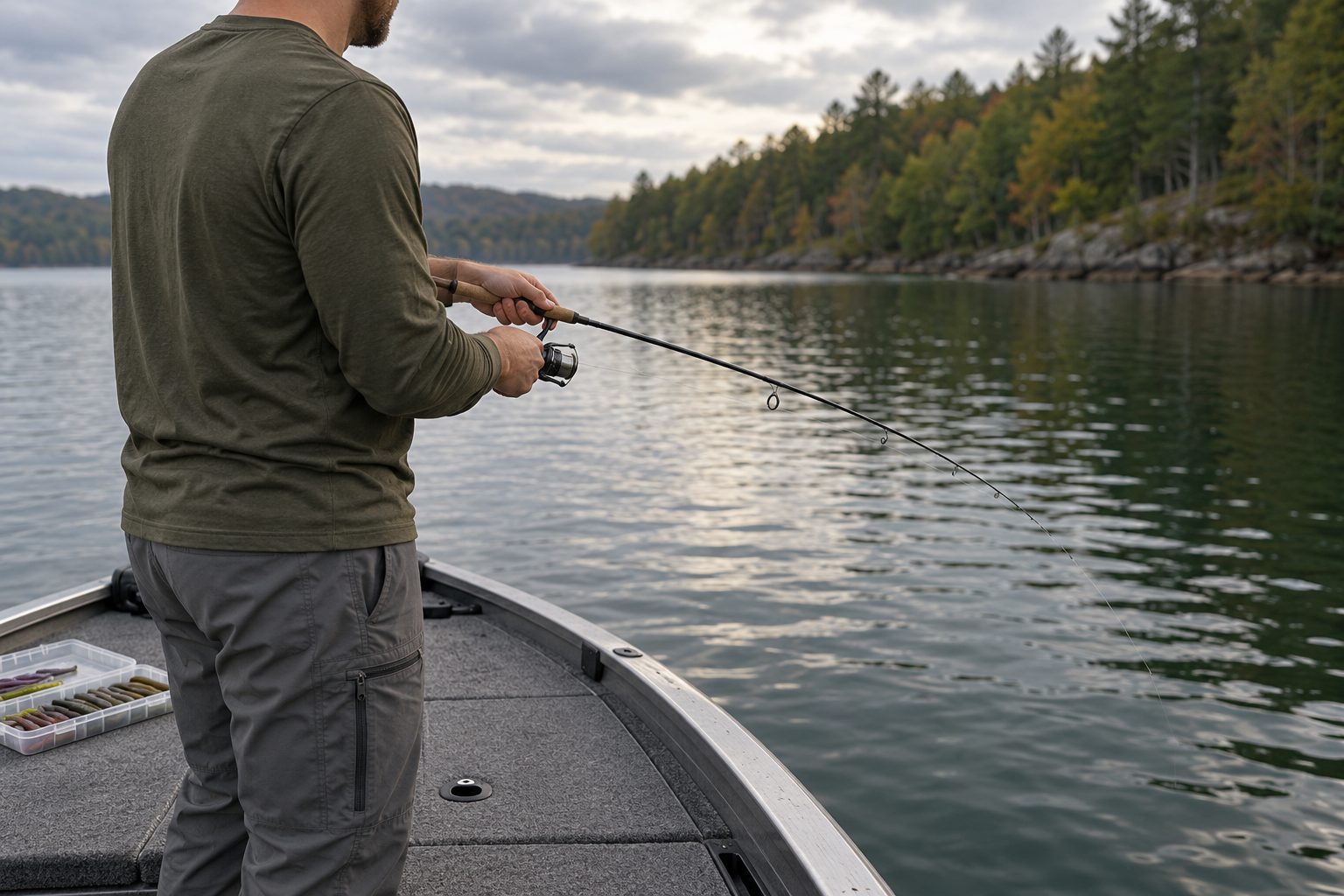
Fishing the Ned rig. Cast, let it fall on a semi-slack line, drag it 6 to 12 inches with the rod tip, then pause 3 to 5 seconds. Or swim-and-hop: lift the tip a foot or two, let it fall, repeat — most bites come on the fall. When it’s tough, deadstick. Keep the line fairly tight while dragging so the hook point stays upright, and sweep-set rather than snapping.
Fishing the shaky head. Keep the rod low and to the side and drag a foot or two. When the head hangs on a rock or a stump, stop and shake the tip two to four inches with your wrist — the head stays put and only the worm quivers. Hold for three to five seconds after the shake, because a lot of strikes come right as the action stops. Then drag again. Hop low when you need to clear something.
Reading the bite. On both rigs it’s usually a tick, a sudden heaviness, or the line going slack or sliding sideways. Watch the line where it enters the water. Set the hook with a firm sideways sweep, not a vertical snap — light-wire hooks and Texposed points need a pull, not a shock.
Tackle That Covers Both, and the Mistakes That Flatten Them
One spinning rod handles most of this. A 6’10” to 7’4″ medium-light to medium with a fast tip, a 2500 or 3000 size reel, and 10 to 15 pound braid to a fluorocarbon leader will fish both rigs.
Lean the leader to the rig. For a Ned rig, 6 to 8 pound fluorocarbon. For a shaky head, 8 pound is the standard, up to 10 in stained water. A longer leader — 8 to 10 feet in clear water — keeps the braid connection away from line-shy fish.
The mistakes are the same on both, and they’re what actually costs you fish:
- Shaking the whole time. Dragging is most of the retrieve on a shaky head, and a Ned rig is at its best barely moving.
- Going too heavy. An over-weighted head lays the worm flat and turns your finesse rig into a bad Texas rig.
- Using too thick a worm. A finesse worm is thin so the tail moves; a big ribbon-tail belongs on a different rig.
- Braid straight to the jig in clear water. The leader is the point of the setup.
- Snapping the hookset. Reel down, load the rod, sweep.
- Fishing either one fast. Both are slow baits, and slow is not the same as inactive.
Knowing when to switch is worth more than owning every head shape in the catalog. Start with the bait that matches the water, watch what the fish tell you, and change one thing at a time.
For the full breakdown of the bait that started this comparison, see how to fish a Ned rig for pressured bass. If you’re still deciding whether finesse is the right approach at all, when light line and small baits beat power fishing covers that decision. And if you want the same bottom-contact logic applied to offshore rock, football jig fishing around rock and timber is the deeper dive.