
Saltwater Fishing Rods for Beginners: What to Look for When You Buy Your First Rod
Standing in the fishing aisle with 50 rods labeled with specs like “medium-heavy power,” “fast action,” and “Fuji K-series guides” is overwhelming. You don’t know what it means. And you don’t know whether to buy a $40 rod that corrodes after two trips or a $150 rod you don’t actually need.
That confusion is completely normal. Saltwater rods have more variables than freshwater rods because the environment is harsher. But the decision isn’t as complicated as those labels make it sound.
This article walks through every spec, what it means for your actual fishing, and ends with one specific rod profile you can take into a store or search for online.
Whether you’re fishing surf, pier, boat, or kayak, the same framework applies. If you haven’t decided where to fish yet, the pier and jetty beginner’s guide covers the most accessible entry point.
Spinning Rod vs Conventional Rod: Which Should You Choose?
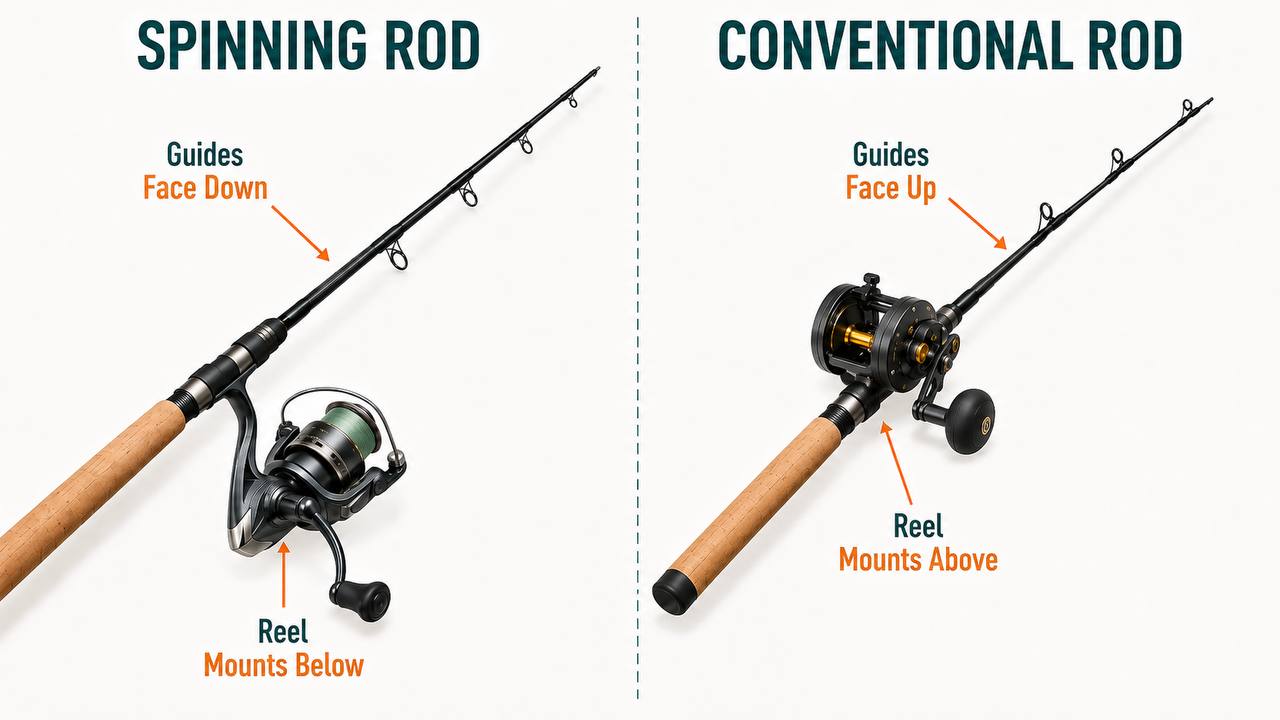
The first decision is rod type. The physical difference is easy to spot once you know what to look for.
A spinning rod has its reel foot mounted below the blank and guides face upward. The guides are larger near the reel, smaller toward the tip. The reel hangs underneath.
A conventional rod (also called a casting or baitcasting rod) has its reel foot above the blank and guides face downward. The guides are smaller near the reel, larger toward the tip. The reel sits on top.
For a first saltwater rod, spinning is the clear recommendation for nearly every beginner. Here’s why:
- Spinning rods are more forgiving with line management. Backlashes — the tangles that happen with conventional reels — are far less common.
- They handle lighter lures and live bait better, which covers the majority of beginner saltwater techniques.
- They work well for surf casting and pier fishing, the two most common entry points for saltwater anglers.
- The learning curve is gentler, so you spend time fishing instead of untangling line.
Conventional rods make sense only if you already have baitcasting experience from freshwater fishing or if you’re specifically targeting heavy-cover species with large jigs and rigs. For almost everyone starting out, the spinning configuration is where your first rod dollar should go.
The rest of this article focuses on spinning rods, since that’s where beginners should invest.
Rod Power, Action, and Length: What Those Labels Actually Mean
Every rod has three specs printed on it. Understanding them is the difference between picking at random and making an informed choice.
Rod power refers to the overall stiffness of the rod — how much force it takes to bend it. Think of it as lifting strength. The scale runs from ultra-light (UL) to extra-heavy (XH). Medium power handles 1/4 to 3/4 oz lures. Medium-heavy handles 3/8 to 1 oz lures and provides backbone for fighting larger fish. Heavy and extra-heavy are for big game and surf.
For beginners, medium and medium-heavy are the sweet spots — they cover the widest range of inshore species without sacrificing too much in either direction.
One caveat: power ratings vary by manufacturer. A “medium” from one brand may feel like “medium-heavy” from another. The lure weight and line weight printed on the rod are more objective numbers to compare.
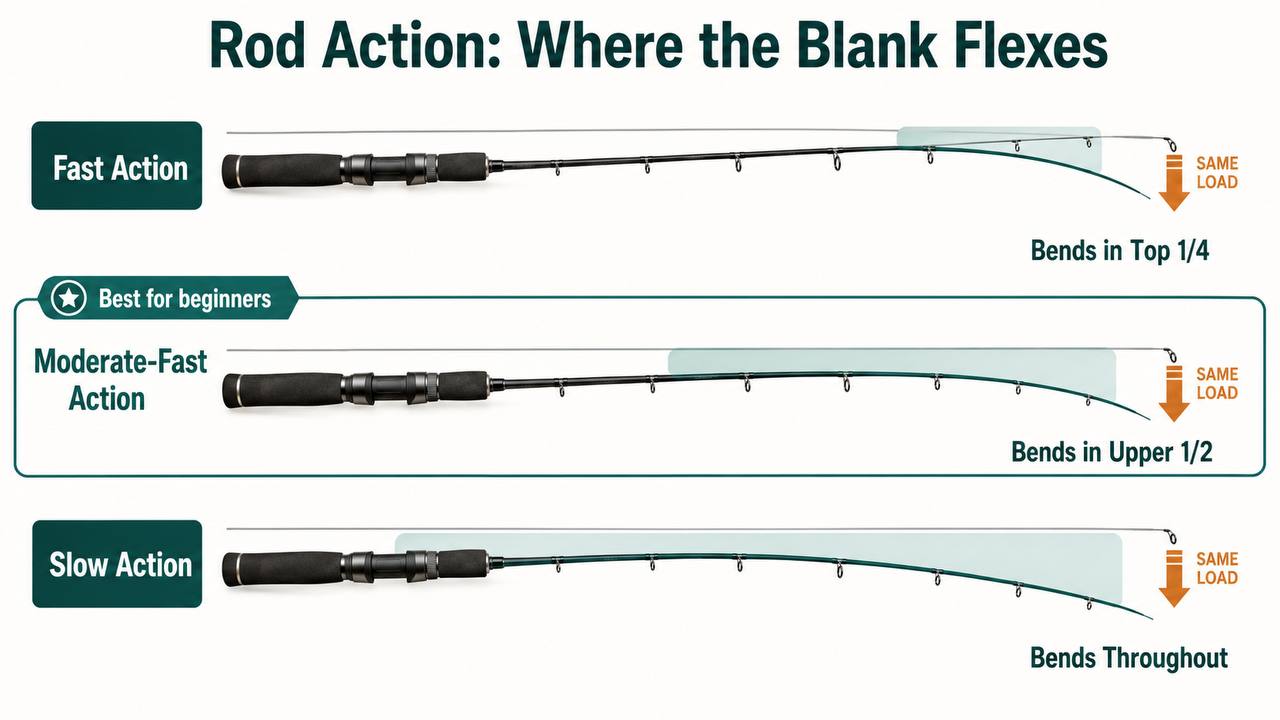
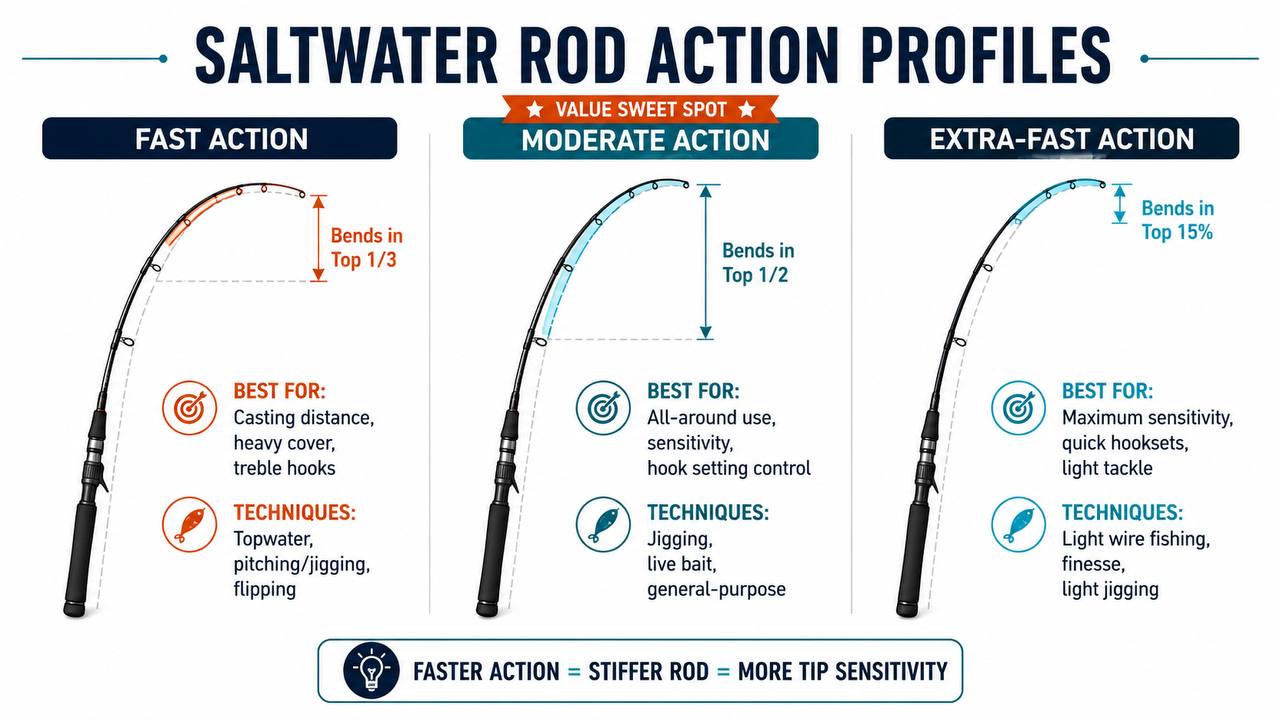
Rod action describes where the rod bends under load. A fast-action rod bends primarily in the top quarter to third — sensitive for detecting bites, powerful for hook-setting. A moderate-fast rod bends in the upper half — it balances sensitivity with enough flex to absorb shock from fighting fish. A moderate rod bends more evenly through the middle third, gentler on fish with delicate mouths. A slow rod bends into the lower half.
For beginners, moderate-fast action is the most versatile choice. It works with lures, live bait, and a wide range of species.
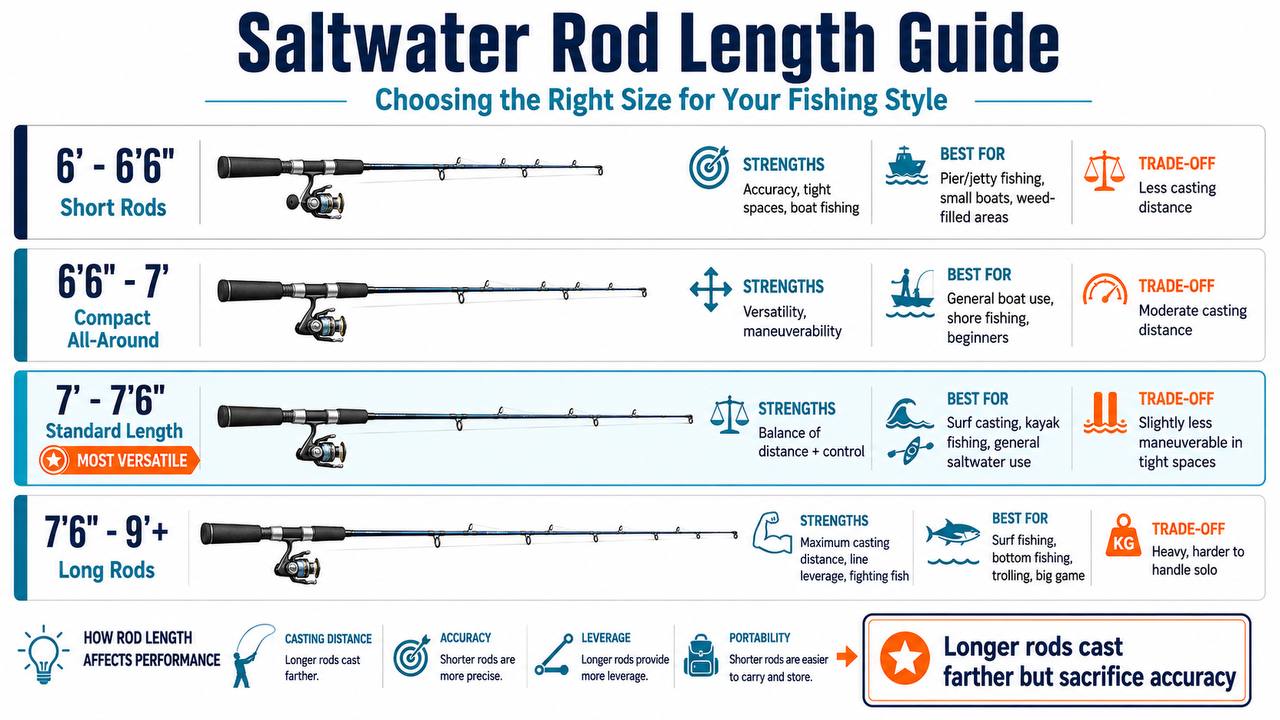
Rod length affects casting distance, accuracy, and handling. Longer rods cast farther and give you better line control, but they’re harder to manage in tight spaces. Shorter rods are more accurate and easier to handle, but you sacrifice distance. We’ll cover specific length recommendations by fishing location in the next section.
One practical tip: always read the printed specs on the rod. The recommended line weight range and lure weight range tell you exactly what the rod is designed to handle. These numbers are more reliable than the power label alone.
What Rod Length Do You Need? It Depends on Where You Fish
Rod length is one of the most practical ways to narrow your choices. Think about where you’ll actually stand — or sit — while fishing.
Surf fishing: 9 to 12 feet. Casting distance past the breakers is critical. Pair with medium to heavy power and moderate to fast action.
Pier and jetty fishing: 6 to 7 feet. Maneuverability around pilings and other anglers matters most. Medium to medium-heavy power, moderate-fast to fast action. See the pier and jetty beginner’s guide for what to expect.
Boat fishing: 6 to 7 feet. Space constraints favor shorter rods. Fast action for sensitivity and hook-setting power from a moving platform.
Kayak fishing: 6 to 7 feet, with 6’6″ being the sweet spot. Short enough for seated handling, long enough to reach around the kayak.
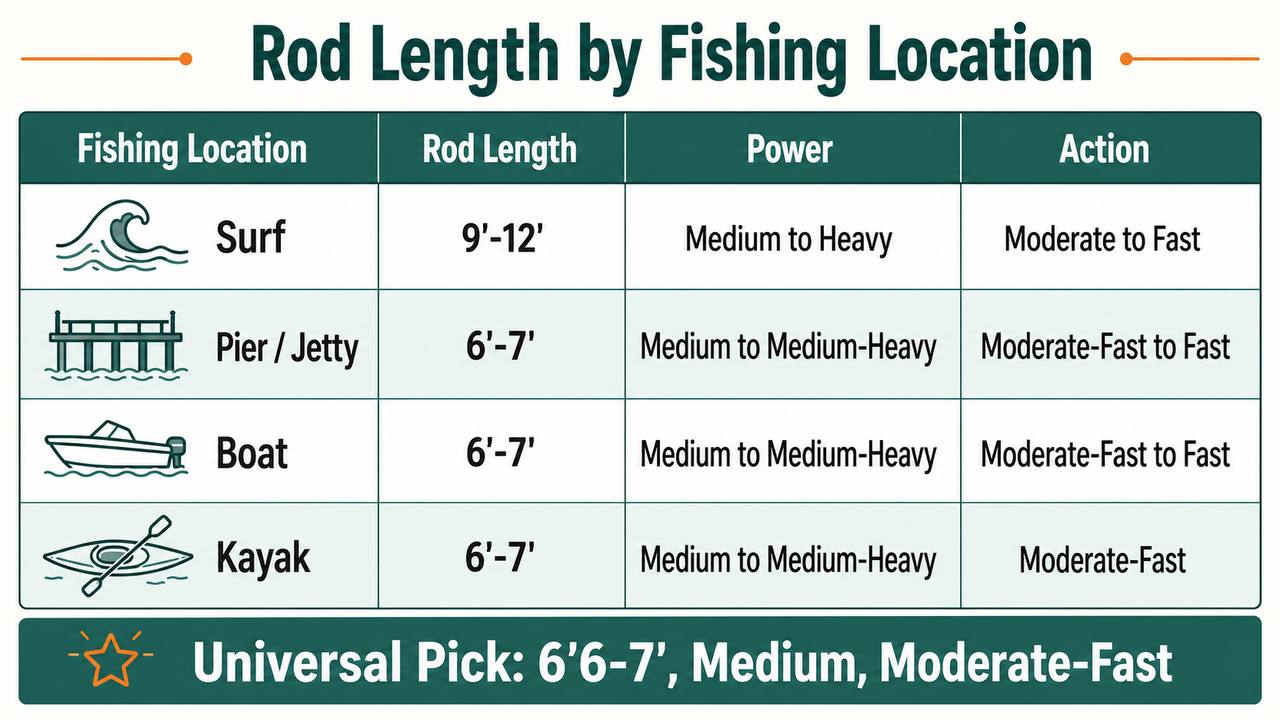
The universal beginner pick: 6’6″ to 7 feet. If you haven’t decided on a specific fishing location yet, or if you plan to fish multiple venues, this length works acceptably well from a pier, boat, kayak, or shoreline. It’s the most versatile single rod length you can buy.
What Makes a Rod Saltwater-Rated? (And What It Actually Means)
“Saltwater-rated” is not a standardized certification — there’s no universal test a rod must pass. What it means is the manufacturer used corrosion-resistant materials in components vulnerable to salt exposure.
The rod blank — whether graphite or fiberglass — is chemically inert to salt. The components are what fail: guides, reel seats, and metal hardware.
Guides are the metal rings your line runs through — the most corrosion-prone part of any rod. Guide frames come in different materials. Stainless steel is most common on mid-range rods — good strength, moderate corrosion resistance. Titanium is the premium option, virtually immune to corrosion but expensive. Aluminum is lighter but less corrosion-resistant unless anodized.
The guide insert — the smooth ring inside the frame — also matters. Alconite is Fuji’s ceramic insert, offering excellent value and durability. Silicon carbide (SiC) is the hardest insert available and preferred if you use braided line, since braid wears softer inserts over time. Hardened stainless steel inserts are found on budget rods and work fine with monofilament.
Fuji is the dominant guide manufacturer. Their K-series is the gold standard for saltwater. The FG-series is budget-friendly.
Reel seats hold the reel to the rod. Graphite or composite seats are naturally corrosion-resistant and lightweight. Anodized aluminum has a protective oxide layer. Stainless steel seats are excellent but heavy, found on premium offshore rods.
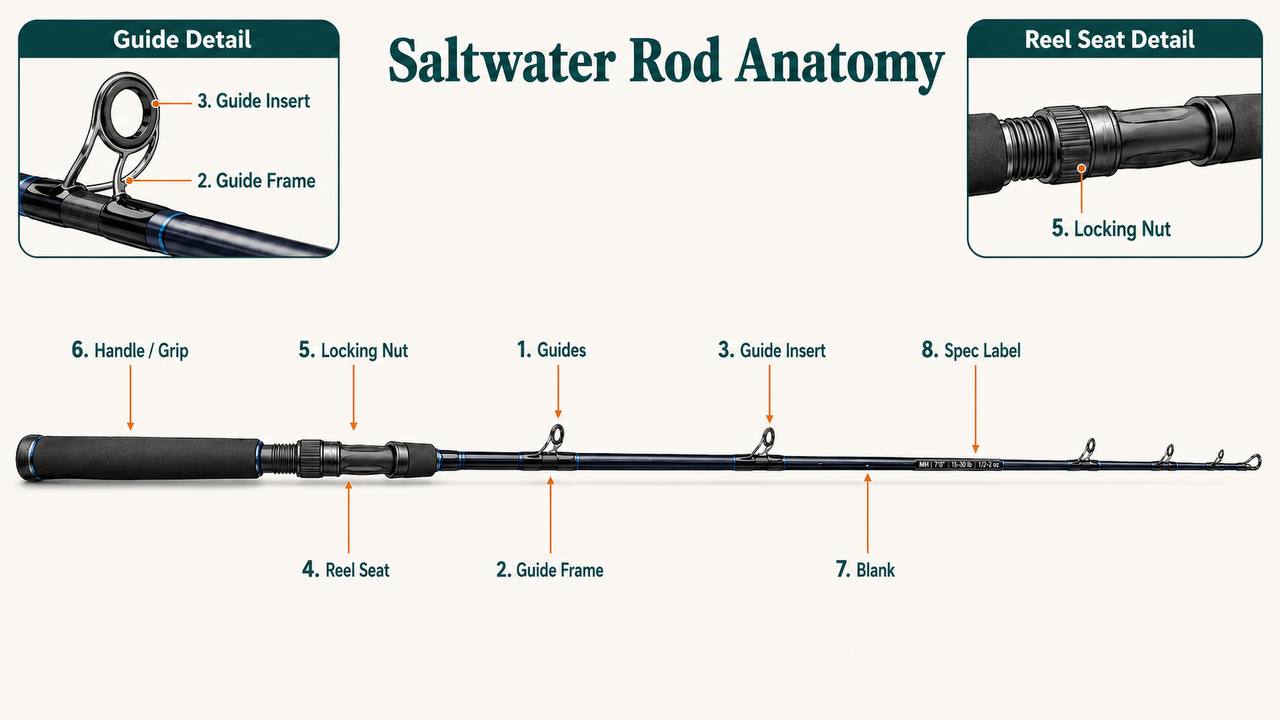
Some rods feature titanium nitride plating — a gold-colored coating that improves corrosion resistance at a lower cost than solid titanium. Multi-piece saltwater rods may have sealed ferrules to keep moisture out of the blank.
The important caveat: no rod is truly saltwater-proof. Saltwater-rated means better resistance, not immunity. Even premium rods corrode without maintenance — the difference is a longer runway before corrosion becomes a problem.
Graphite vs Fiberglass: What’s the Blank Made Of?
The rod blank is the main shaft.
Graphite blanks offer higher sensitivity — they transmit vibrations from the lure or bait to your hand clearly. Graphite is also lighter and more powerful. The downside: graphite is more brittle and can snap under sudden heavy loads.
Fiberglass blanks have lower sensitivity but are much more durable. They flex without breaking and handle abuse well.
Composite blanks blend both — more sensitive than fiberglass, tougher than graphite.
For a first saltwater spinning rod, graphite is standard because sensitivity matters. However, composite is the safest beginner choice — it balances sensitivity with the forgiveness you need while learning.
How Much Should You Spend? Saltwater Rod Budget Tiers
You don’t need to overspend to start fishing. But don’t go so cheap that the rod corrodes in one season.
Entry-Level ($30–60)
Basic saltwater-rated construction. Composite or fiberglass blanks. Hardened stainless steel guide inserts. EVA foam grips. Perfectly functional for learning. Rod-and-reel combos are widely available in this range — convenient if you don’t want to match components yourself. The pre-spooled line on the reel is usually lower-quality and should be replaced eventually.
Mid-Range ($60–120)
The value sweet spot. Graphite or high-grade composite blanks. Fuji guides (FG or K-series) with Alconite or SiC inserts. Anodized aluminum or graphite reel seats. Noticeably lighter and more sensitive than entry-level. Proper saltwater construction features become standard here.
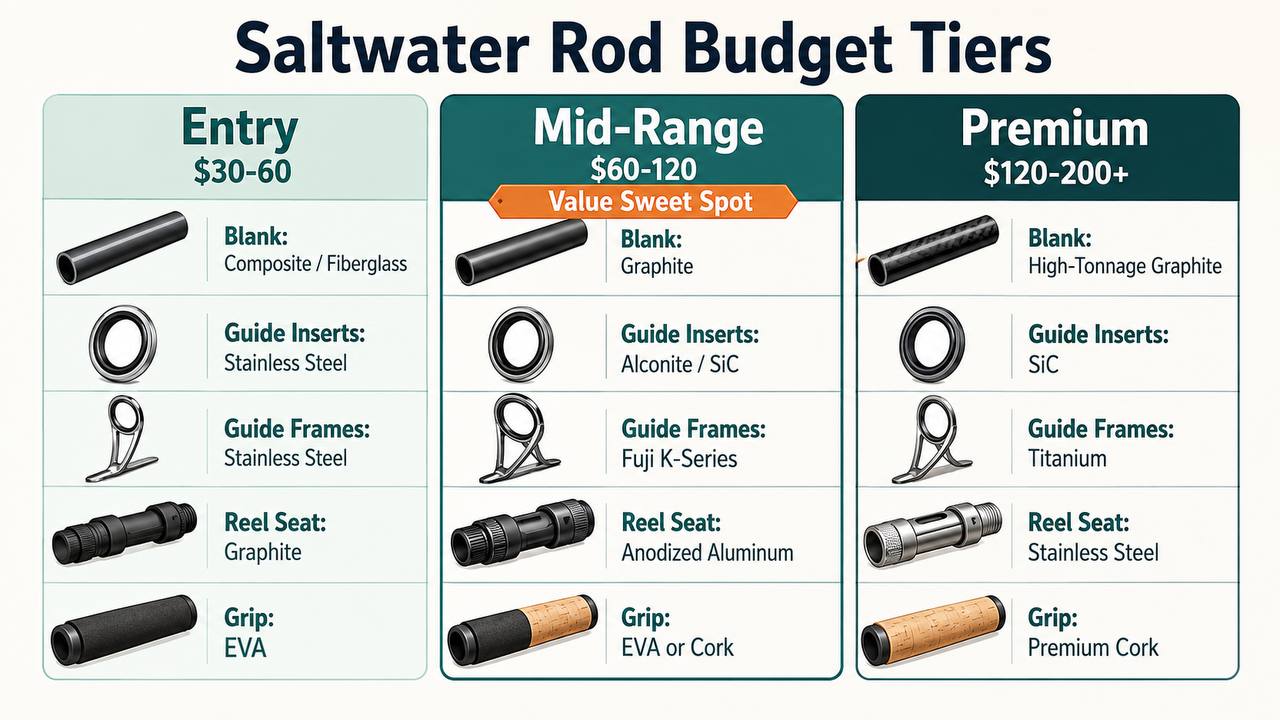
Premium ($120–200+)
High-tonnage graphite blanks. Titanium guides with SiC inserts. Premium cork or Winn grips. Advanced corrosion-resistant hardware throughout. These rods are excellent — but a $200 rod won’t help you catch more fish than an $80 rod if you’re still learning. The returns diminish sharply once you move past the mid-range tier.
The honest guidance: the mid-range tier gives you the best saltwater construction features for the money. Don’t feel pressured to buy the most expensive rod on the rack, but don’t sacrifice basic saltwater-rated construction to save $20 either.
Matching Your Rod, Reel, and Line
A rod doesn’t work in isolation. Your reel and line need to match its specs, or the whole setup performs poorly. Three rules prevent mismatched purchases.
Rule 1: Type match. Spinning rod with spinning reel, conventional rod with conventional reel. Non-negotiable.
Rule 2: Size balance. A medium-power rod pairs with a 2500 to 3000 spinning reel and 8 to 12 lb line. Too-small a reel makes the rod feel tip-heavy. Too-large makes it feel butt-heavy.
Rule 3: Line rating alignment. Your line should fall within the rod’s printed recommended range. Line that’s too heavy reduces sensitivity and can damage the blank. Line that’s too light gives you no backup when a fish runs.
Brand matching doesn’t matter. A Shimano reel works fine on a Daiwa rod. Compatibility is about specs, not logos.
A recommended beginner setup: a 7-foot medium or medium-heavy spinning rod, paired with a 2500 to 3000 saltwater-rated spinning reel, spooled with 10 lb braided main line and a 20 lb fluorocarbon leader (or 10 to 12 lb monofilament if you prefer to skip the leader). The monofilament vs fluorocarbon vs braid comparison covers line types in more detail if you’re deciding between them.
Can You Use a Freshwater Rod in Saltwater?
If you already own a freshwater rod and are wondering whether you can skip buying new gear, the answer depends on how often you plan to fish saltwater.
The short answer: yes for occasional use with diligent maintenance, no for regular saltwater use.
The blank itself isn’t affected by saltwater — it’s chemically inert. The components are the problem. Freshwater rods use cheaper guide frames, non-anodized reel seats, and basic hardware that corrode faster in salt. The rod outlasts the components, but guides and reel seats show corrosion first.
Reels are even more vulnerable than rods. A freshwater reel in saltwater is far more likely to fail — the mechanical internals are exposed to salt through the bail arm, spool, and drag system.
If you’re fishing saltwater more than once or twice, invest in a dedicated saltwater rod. Occasional freshwater-rod use is fine if you rinse and dry it meticulously.
Keep Your Rod Alive: Essential Saltwater Rod Maintenance
A saltwater rod is only as durable as the care you give it after each trip. Most rod failures aren’t caused by fish — they’re caused by neglect.
The non-negotiable step: rinse with fresh water after every saltwater trip, even short ones. Remove the reel first so you can clean the reel seat properly. Focus on the guides — salt crystals accumulate in the crevices between guide foot and thread wrap. A soft toothbrush dislodges particles a quick rinse alone won’t flush out.
Dry thoroughly with a microfiber cloth before storing. Storing a wet rod traps moisture and speeds up corrosion.
Cut off the section of fishing line exposed to saltwater after each trip — salt-crusted line acts like sandpaper on guide inserts.
Avoid soap or detergent — it’s almost as corrosive as saltwater. Don’t store the rod wet or in a hot car trunk, which degrades grips and loosens thread wraps.
Optional but recommended: light anti-corrosion spray on guides and reel seat hardware creates an extra barrier. Apply with a cloth or Q-tip, not directly.
Two to three minutes of rinse-and-dry right after the trip beats a thorough cleaning three days later.
The One Rod to Start With: A Specific Recommendation
After working through all the specs, here’s the concrete answer.
Look for a 6’6″ to 7-foot spinning rod with medium or medium-heavy power and moderate-fast action. That’s it. That spec profile covers the widest range of inshore saltwater species — redfish, speckled trout, flounder, sheepshead, even bluefish with heavier line. It works from a pier, a boat, a kayak, or the shoreline.
When you’re in the store, check the printed label for these numbers:
- Line rating around 8 to 12 lb
- Lure weight around 1/8 to 1/2 oz
- Graphite or composite blank
- Fuji guides (FG or K-series) or equivalent
- Saltwater-rated reel seat (anodized aluminum or graphite)
Aim for the mid-range budget tier ($60–120) where proper saltwater construction features are standard. Any rod matching these specs will serve you well — this is a spec profile, not a brand endorsement.
Take this rod to the pier on a productive tide, and you’ll be set for your first saltwater outing. The tide chart reading guide will help you figure out the best times to be there.
Conclusion
Choosing a first saltwater rod doesn’t have to be overwhelming. The framework is straightforward: spinning configuration, 6’6″ to 7 feet, medium or medium-heavy power, moderate-fast action, saltwater-rated components.
The right rod won’t make you an expert overnight, but it removes gear as a variable so you can focus on learning to actually fish. Now you know how to read the specs, what features matter in saltwater, and where to invest your money.
Rinse your rod after every trip. Everything else will follow.