
What Is a Tide Chart and Why Should You Care?
If you’re transitioning from freshwater to saltwater fishing, or just getting started with the sport, there’s one thing that will separate you from the anglers heading home empty-handed — reading tide charts.
Tides are the rhythmic rise and fall of ocean water, driven primarily by the gravitational pull of the moon and the sun. Unlike freshwater fishing, where conditions are relatively stable, saltwater environments are in constant motion. The water level, current direction, and even the behavior of the fish change throughout the day.
A tide chart tells you exactly when and how high the water will be at any given time. For saltwater anglers, this is like having a roadmap of fish activity. Fish don’t care what time your watch says — they respond to water movement. Understanding tide charts means understanding when and where fish will be feeding.
Here’s the basic reality: during moving water, fish are actively feeding. During still water, they tend to shut down. That’s the foundation everything else builds on.
Reading Your First Tide Chart: A Step-by-Step Walkthrough
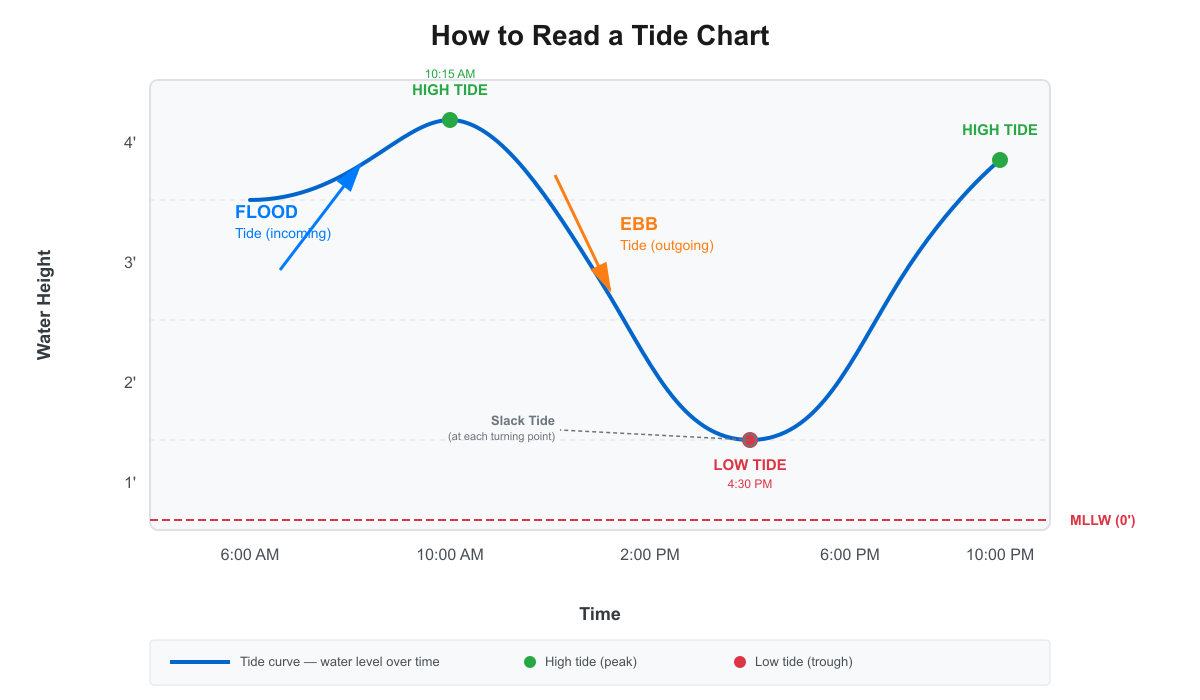
Most tide charts follow a similar format. Let’s walk through the key components you’ll see:
Time Axis (Horizontal): This runs across the bottom of the chart and shows a 24-hour period. Most charts use a 12-hour format, and some also include the date.
Water Height Axis (Vertical): This shows the water level in feet (or meters in some regions). The numbers represent how high the water is above a reference point.
The Curved Line: This is the heart of the chart. It traces the water level throughout the day, creating a wave pattern that looks like a series of hills and valleys.
High Tide Points (Peaks): The highest points on the curve mark when the water reaches its maximum height. These are labeled with “H” and include the time and exact water level.
Low Tide Points (Valleys): The lowest points mark when the water drops to its minimum. These are labeled with “L” and include time and height.
The Datum Line (MLLW): You’ll often see a baseline labeled “MLLW” — that stands for Mean Lower Low Water. It’s the average of the lowest tides over a 19-year period and serves as the zero point. All water heights on the chart are measured relative to this baseline.
The curve itself tells a story. When it’s rising, water is moving toward shore. When it’s falling, water is heading back out. The steepest parts of the curve represent the strongest water movement — and that’s where the fishing action typically heats up.
High Tide, Low Tide, and the Movement Between
Understanding the tide cycle is essential. Here’s how it breaks down:
Flood Tide (Incoming): This is when water is rising and moving toward the shore. During flood tide, water pushes into bays, estuaries, and shallow flats. This brings baitfish and food sources into shallower areas, which attracts predatory fish. Many anglers consider incoming tides the best time to fish, especially on shallow flats.
Ebb Tide (Outgoing): This is when water is falling and moving away from the shore. Some species prefer outgoing tides — particularly fish that hold near channels or drop-offs and feed as water flows past them. The best fishing often happens in the first half of the ebb, before the water gets too shallow.
Slack Tide: This is the brief pause between incoming and outgoing — usually lasting about 30 minutes to an hour. During slack tide, current movement is minimal or nearly nonexistent. Fish activity typically slows down during this window because there’s no water movement to trigger feeding behavior.
The general rule of thumb most anglers follow: the best fishing happens about two hours before a tide change, then slows down about an hour after. That window captures the peak current movement on both sides of the transition.
Species and the Tide: General Patterns to Know
Different fish respond differently to tidal conditions. While there are always exceptions, these general patterns hold up:
Redfish (Red Drum): These are classic incoming tide fish. They follow baitfish onto shallow flats as water rises. If you’re targeting redfish, plan to be in position before the tide starts moving in.
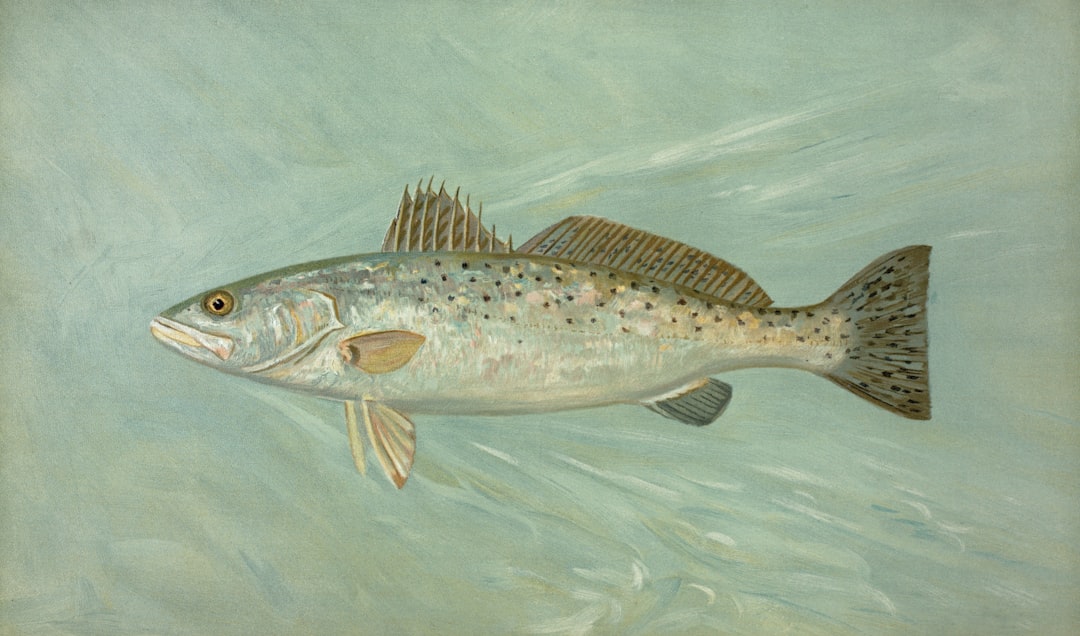
Speckled Trout (Sea Trout): They tend to hold near structure — oyster beds, grass edges, and drop-offs — and feed as the tide moves past them. Both incoming and outgoing work, but the key is being near the structure the tide flows across.
Flounder: These bottom dwellers often feed more aggressively during outgoing tides. As water drains off flats, bait gets funneled into channels where flounder wait.
Snook: They prefer deeper water and hold near structure like docks and mangroves. They’re active during both tides, but many anglers find the incoming tide pushes bait into snook-holding areas.
Pier Fishing: If you’re fishing from a pier, the incoming tide is generally your friend. It brings fish closer to the structure and covers more water with bait.
Spring Tides and Neap Tides: Why Some Days Are Better
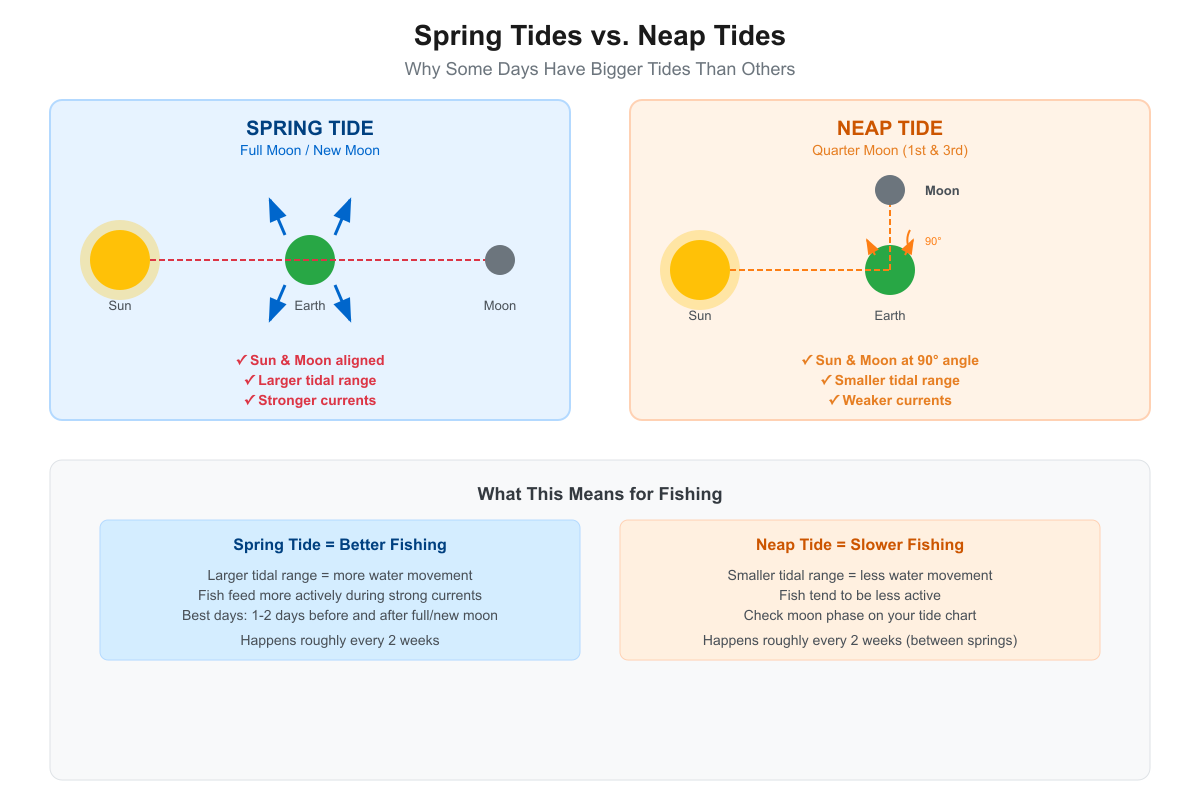
Not all tides are created equal. The moon phase affects how extreme the tidal range is, and this matters for fishing.
Spring Tides happen around the full moon and new moon, when the sun, Earth, and moon align. The gravitational forces combine, producing the largest tidal range of the month — higher high tides and lower low tides. This means more water movement and stronger currents. For fishing, spring tides generally mean better conditions because the increased water movement triggers more active feeding.
Neap Tides occur during the first and third quarter moons, when the sun and moon form roughly a 90-degree angle relative to Earth. Their gravitational forces partially cancel each other out, producing the smallest tidal range. Smaller tides mean less water movement and weaker currents — which often translates to slower fishing.
Most tide charts include a moon phase indicator, so you can see at a glance whether you’re heading out during a spring or neap period. If you have a choice of days, aim for the spring tide window — roughly one to two days before and after the full or new moon.
Free Tide Chart Tools Every Beginner Should Use
You don’t need expensive gear to access tide information. Here are the best free tools:
Tides4Fishing: One of the most popular free apps and websites for anglers. It provides detailed tide charts, solunar tables, weather forecasts, and even a “bite forecast” that combines tide, weather, and moon data to predict fishing conditions. Available on iOS and Android.
NOAA Tides & Currents: The National Oceanic and Atmospheric Administration offers official tide predictions for thousands of locations along the U.S. coast. The app and website (tidesandcurrents.noaa.gov) are accurate and reliable, though less fishing-focused than dedicated apps.
Printed Tide Tables: Many tackle shops sell regional tide tables — compact booklets with daily predictions for your local area. They’re a reliable backup when your phone battery dies or you’re out of cell range.
Most anglers use a combination of these. Check the app before you leave home, then keep a printed copy in your cooler just in case.
Common Beginner Mistakes (and How to Avoid Them)
Even after reading a tide chart, there are a few things that trip up new anglers:
Ignoring Local Conditions: Tide charts show predictions, but wind, weather, and local geography can modify actual conditions. A strong onshore wind can push water levels higher than predicted, while an offshore wind can do the opposite. Always check the weather alongside the tide.
Not Accounting for the Lunar Day: The moon’s cycle is about 24 hours and 50 minutes, not 24 hours. This means tide times shift roughly 50 minutes later each day. If high tide was at 10:00 AM today, it’ll be around 10:50 AM tomorrow. Plan accordingly.
Fishing the Wrong Part of the Curve: The best fishing happens during the steepest part of the tide curve — when water is moving the fastest. If you show up right at high or low tide, the water’s already slowing down. Aim for the middle of the transition.
Overcomplicating It: You don’t need to memorize every detail. Start with the basics: know whether the tide is coming in or going out, and try to be on the water during the two hours before a tide change. You can refine from there.
Quick Reference: Your Tide Fishing Cheat Sheet
Here’s a summary you can keep on your phone or print out:
- Best fishing: Two hours before a tide change (high or low)
- Incoming tide: Best for shallow flats, redfish, and pier fishing
- Outgoing tide: Best for channels, flounder, and structure fishing
- Slack tide: Expect slower action — use this time to reposition
- Spring tides (full/new moon): Bigger tidal range, better fishing
- Neap tides (quarter moon): Smaller range, slower conditions
- Lunar day: 24 hours, 50 minutes — tide times shift ~50 minutes later daily
- Chart datum: MLLW (Mean Lower Low Water) is the zero reference point
Start Using Tide Charts on Your Next Trip
Reading tide charts takes a little practice, but once it clicks, you’ll never look at a day on the water the same way again. Start simple: check the tide before you head out, note whether it’s incoming or outgoing, and pay attention to when the fish start biting. Over time, you’ll build a feel for how the tides work in your local waters — and that’s knowledge no tackle can replace.
For more on saltwater fishing fundamentals, check out our guide on how to choose the right saltwater fishing rod or learn about the best baits for saltwater fishing.