

Picture this: you’re on the water, casting a lure that’s worked a hundred times before. You work it back the way every guide says to, and the fish just doesn’t bite. Maybe a couple of them even follow it all the way to the boat. Then you switch to something completely different — and suddenly, the bites start coming.
The difference usually comes down to one thing — you triggered the right instinct.
Understanding why fish bite is the foundation of better fishing. It’s not just about picking the right lure or knowing where to cast. It’s about understanding what makes a fish decide to strike in the first place. Once you know how fish detect prey and what triggers them to attack, you can make smarter choices about every aspect of your presentation.
The Simple Answer: It’s Not Always About Hunger
Most anglers assume fish bite because they’re hungry. And while feeding is certainly one reason fish strike, it’s only part of the story. Fish will attack lures they have absolutely no intention of eating. They’ll strike out of aggression, territorial defense, or even curiosity.
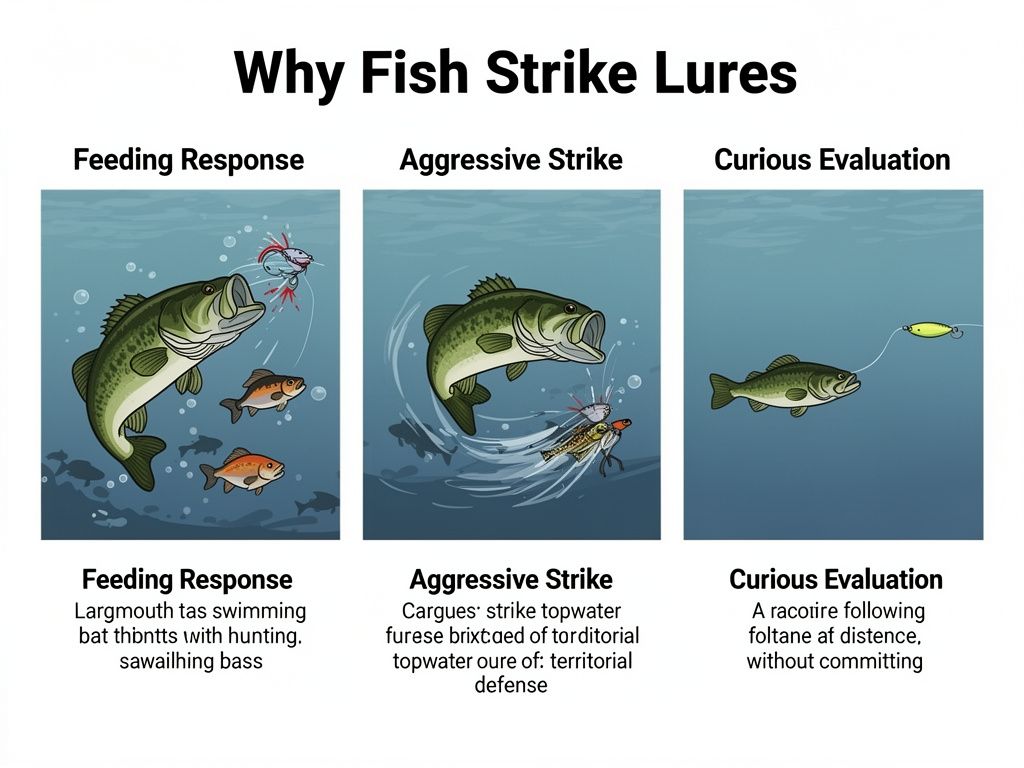
There are three main triggers behind every fish strike:
- Feeding and hunger responses — the fish is actively looking for food
- Aggressive and territorial strikes — the fish perceives a threat and attacks defensively
- Curiosity and evaluation — the fish is investigating something unfamiliar
Knowing which trigger is dominant in a given situation helps you choose the right lure, the right retrieve speed, and the right approach.
Three Reasons Fish Strike
Feeding and Hunger Responses
This is the most straightforward trigger. Fish need to eat, and when conditions are right, they actively hunt for prey. During feeding mode, fish are looking for food sources and will strike anything that looks edible.
Feeding activity is heavily influenced by water temperature. Cold water slows fish metabolism, meaning they don’t need to eat as often and their strikes are less aggressive. Warm water speeds things up — but only to a point. When water gets too warm, fish tend to hold deeper and feed less actively.
Seasonal transitions also play a big role. Spring spawning brings increased feeding activity as fish build energy reserves. Fall is another peak period, as fish bulk up before winter. During these windows, fish are more likely to commit to a strike because their feeding drive is at its highest.
Aggressive and Territorial Strikes
Here’s where things get interesting. Fish will strike lures even when they’re not hungry at all. Some species — particularly bass, pike, and muskie — have strong aggressive tendencies. They’ll attack moving objects that enter their territory, even if they have no intention of eating them.
This is why you can catch bass on topwater lures in the middle of a hot afternoon when feeding activity should be minimal. The bass isn’t necessarily hungry — it’s defending its space. The surface disturbance triggers an aggressive response, and the strike happens almost automatically.
Territorial behavior is especially common during spawning season. A bass guarding a nest will chase and strike anything that gets too close, including lures, other fish, and sometimes even anglers’ hands. This isn’t feeding behavior — it’s defensive aggression.
Understanding this distinction matters because aggressive strikes are often more explosive but also more easily spooked. A fish striking out of hunger will usually hold onto a lure longer. A fish striking out of aggression might hit hard and then let go quickly.
Curiosity and Evaluation
Have you ever watched a fish follow your lure all the way to the boat without biting? That’s evaluation behavior, and it’s one of the most common reasons anglers think “the fish are off.”
Fish are cautious predators. Before committing to a strike, many species will follow a potential prey item to assess whether it’s safe to eat. They’re looking for signs of weakness, injury, or unusual behavior that would make the prey an easy meal.
This evaluation process is especially common in heavily fished waters. Fish that get struck repeatedly learn to be more careful. They’ll follow a lure, inspect it, and then decide whether it’s worth the risk of attacking.
The key insight here is that a following fish is an interested fish. The bite hasn’t been refused — it just hasn’t been committed to yet. And there are ways to turn that evaluation into a strike, which we’ll cover later.
How Fish Detect Prey: The Five Senses
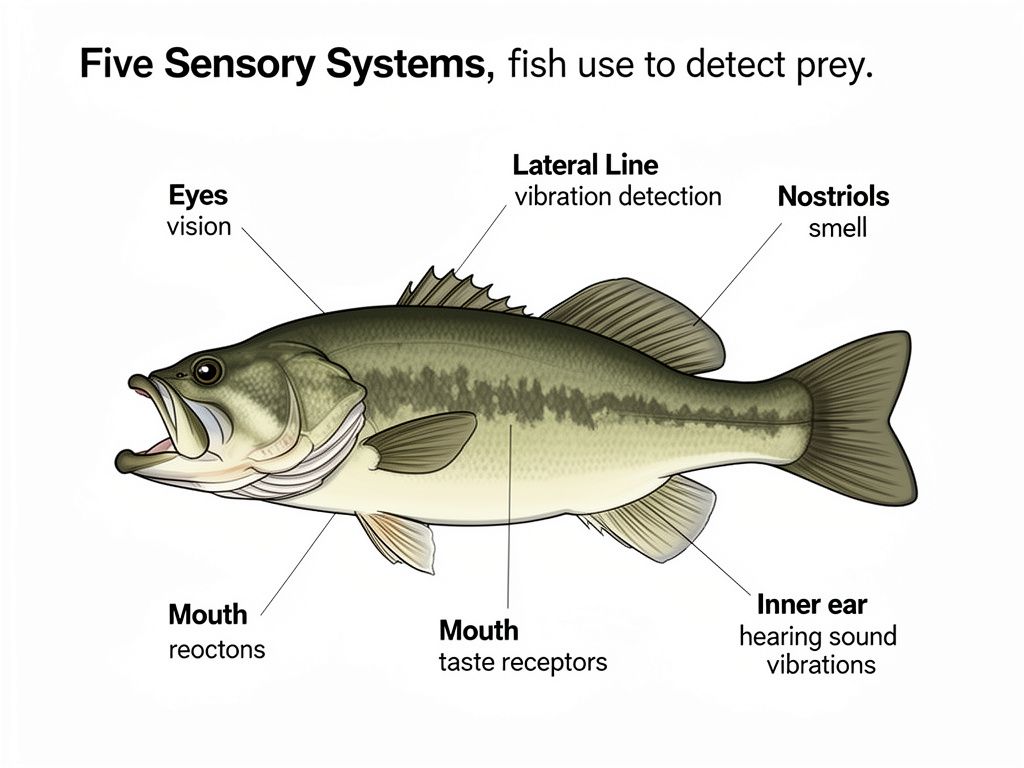
Before we can understand what triggers a bite, we need to understand how fish perceive the world around them. Fish rely on five sensory systems to find prey, and each one plays a different role depending on conditions.
Vision: The Primary Hunting Tool
For most freshwater gamefish, sight is the primary sense used to locate and identify prey. Fish eyes are quite different from human eyes — they’re positioned on the sides of the head for a wider field of view, and many species can see in color.
In clear water, most freshwater fish can distinguish colors fairly well. But water filters light, and different colors disappear at different depths. Red wavelengths are absorbed first and typically disappear within the first few feet. Orange follows, then yellow. Blue and green light penetrate the deepest, which is why things tend to look bluish underwater.
This has practical implications for lure selection. In deep clear water, a red lure won’t look red to a fish — it’ll appear dark gray or black. In shallow clear water, natural colors that match local baitfish tend to work well. In stained or murky water, brighter colors and higher-contrast patterns stand out better because there’s less light for the fish to work with.
Light conditions also matter. During bright midday sun, fish can see very well and may be more selective about what they’ll strike. During dawn, dusk, or overcast conditions, reduced light levels make fish more willing to commit to a strike because they can’t evaluate as carefully.
The Lateral Line: The Sixth Sense
If you’ve never heard of the lateral line, you’re not alone. It’s one of the most important fish sensory systems, and most anglers overlook it.
The lateral line is a system of small pores running along both sides of a fish’s body, from head to tail. Inside these pores are sensory cells that detect changes in water pressure and low-frequency vibrations. Think of it as a vibration-detection system that works even in complete darkness — which is why fish can still find food on murky days or deep underwater.
The lateral line is directional, meaning a fish can tell where a vibration is coming from. Research has shown it’s sensitive enough to distinguish between different types of movement — for example, the tail beat of a minnow versus the flapping of a crayfish. This helps fish identify what kind of prey is nearby before they even see it.
This is why lures that create vibration — spinnerbaits with spinning blades, crankbaits with internal rattles, or even soft plastics worked with a pulsing retrieve — can trigger strikes even when visibility is poor. The fish doesn’t need to see the lure clearly. It feels it.
Smell and Taste
Fish have a well-developed sense of smell, though it plays a different role than vision or the lateral line. Fish detect food through water-soluble chemical compounds — essentially, they smell what’s dissolved in the water around them.
Not all fish rely on smell equally. Catfish, which have barbels or “whiskers” covered in taste buds, depend heavily on chemoreception. In clear water, bass and other sight-oriented predators rely more on vision. But as water gets murkier, smell becomes more important for all species.
This is why natural baits — live worms, cut bait, or scented soft plastics — can outperform hard lures in certain conditions. A crankbait might look perfect, but it doesn’t smell like food. When a cautious fish picks up a natural bait, the taste confirms it’s edible, and the fish is more likely to hold on.
It’s worth noting that fish nostrils have no connection to their throat. Smell in fish is entirely separate from breathing — water flows over specialized olfactory organs, and chemical signals are sent directly to the brain.
Hearing
Fish can hear, but hearing plays a smaller role in prey detection compared to the other senses. Fish inner ears detect sound pressure changes, and combined with the lateral line, they help fish orient themselves in their environment. For most freshwater fishing situations, hearing is less important than vision, vibration, and smell — but it’s part of the complete picture.
How Water Conditions Change What Triggers a Bite

The same lure can produce completely different results on different days, and it almost always comes down to water conditions changing how fish detect and respond to it.
Water clarity is the biggest factor. In clear water, fish rely heavily on vision, so lure color, size, and profile matter a lot. Fish can evaluate more carefully, which means they’re more selective. In murky water, vision breaks down and fish rely more on vibration and smell — which means noisy, high-contrast, or scent-rich presentations work better. Learning how to read water helps you understand clarity and find productive zones.
Water temperature affects everything. Cold water slows metabolism, which means less active feeding and slower strikes. Warm water speeds things up, but only within a species’ comfortable range. Extremely warm water pushes fish deeper, where they’re harder to reach and less likely to feed actively.
Light levels change strike behavior throughout the day. Early morning and late evening are peak feeding times for most species. During bright midday sun, many fish retreat to deeper water or heavy cover. Overcast days often produce more consistent biting throughout the day because the reduced light makes fish feel more comfortable feeding.
Barometric pressure also plays a role. Stable or slowly rising pressure generally encourages feeding activity. Rapid pressure drops — like the kind that happen before a storm front — often suppress biting. After a front passes and conditions stabilize, feeding usually picks back up.
Using Fish Behavior to Your Advantage
Now comes the practical part. How do you actually use this knowledge to catch more fish?
Match the Lure to the Trigger
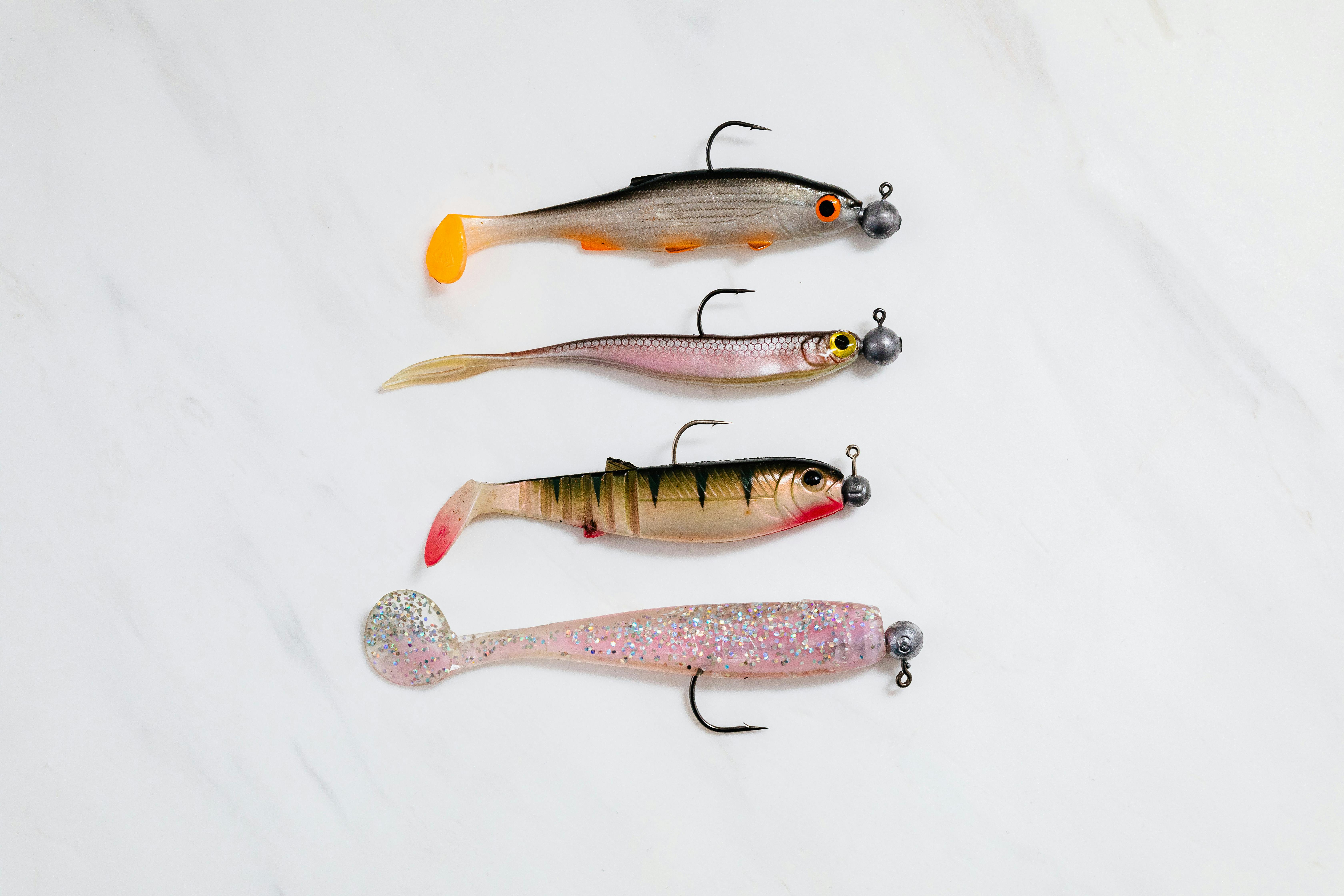
Different lures trigger different responses. Spinnerbaits create vibration and flash, making them excellent for triggering aggressive strikes. Crankbaits combine flash, vibration, and depth control, appealing to both visual and lateral line senses. Soft plastics move naturally in the water, triggering feeding responses. Topwater lures create surface disturbance, which triggers explosive aggressive strikes.
Think about what you’re trying to trigger before you pick a lure. If fish are feeding actively, natural presentations that look like baitfish work well. If you’re targeting aggressive strikes — like spawning bass near a nest — anything that intrudes on their territory can get hit.
Adjust Your Retrieve Speed
Retrieve speed is one of the most overlooked variables. A fast retrieve covers water and triggers chase instincts, but it can also push cautious fish away. A slow retrieve gives fish more time to evaluate and commit, which is especially important when fish are in evaluation mode.
One effective technique is to vary your retrieve speed. Work a lure steadily for a bit, then pause. Or speed up briefly, then slow down. Changes in speed can trigger a strike from a fish that was just following. The pause in particular is deadly — many strikes happen when a lure stops moving and looks like an injured or resting prey item.
What to Do When Fish Follow Without Biting
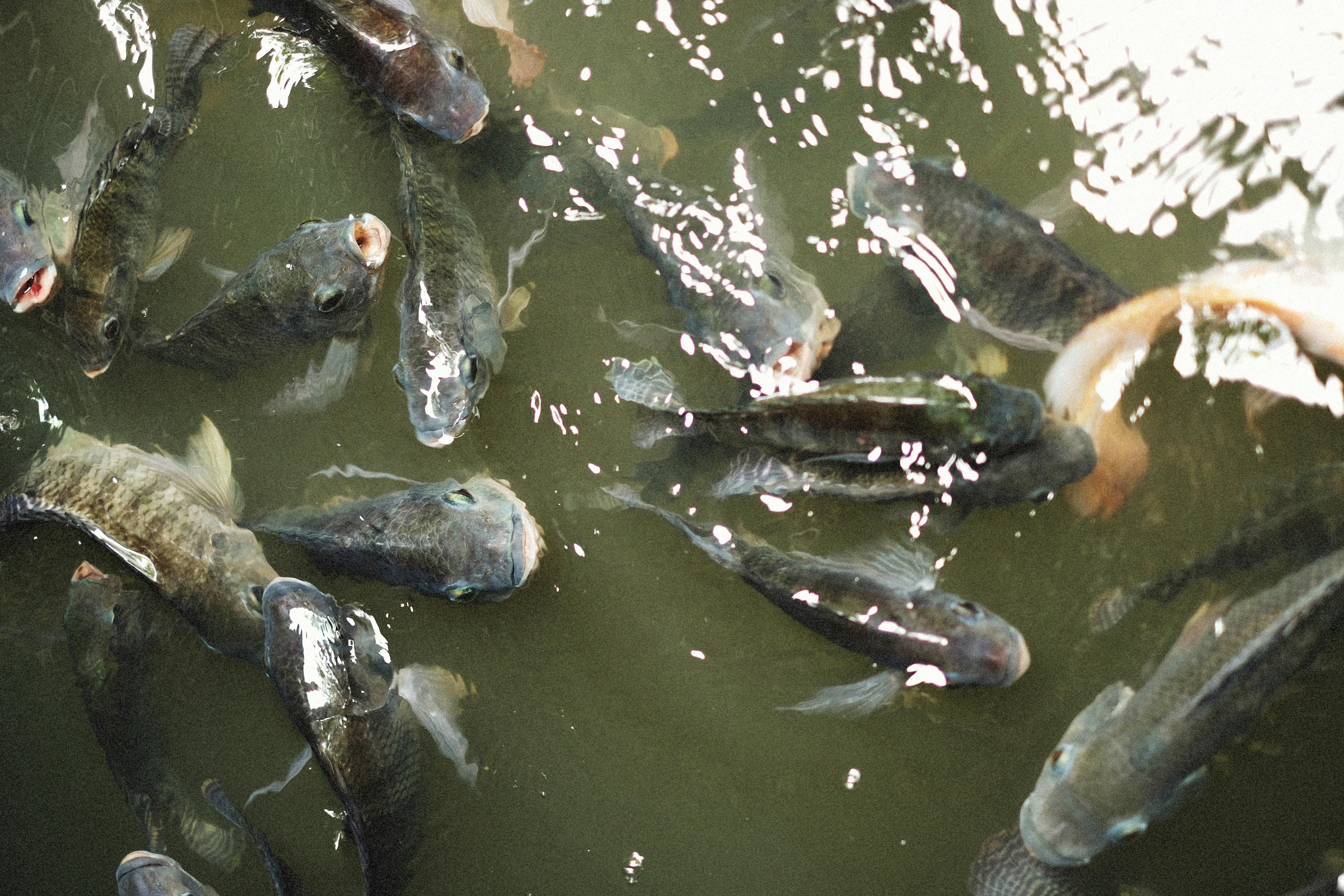
If you’re seeing fish follow your lure but not commit, try these adjustments:
- Slow down — give the fish more time to decide
- Downsize — a smaller lure looks less threatening and more like natural prey
- Change the retrieve — add pauses, speed changes, or direction changes
- Switch to a more natural color — fish in evaluation mode are being picky
- Let it sit — when a fish is following, resist the urge to reel faster. Sometimes patience is the answer
Practical Tips for Different Conditions
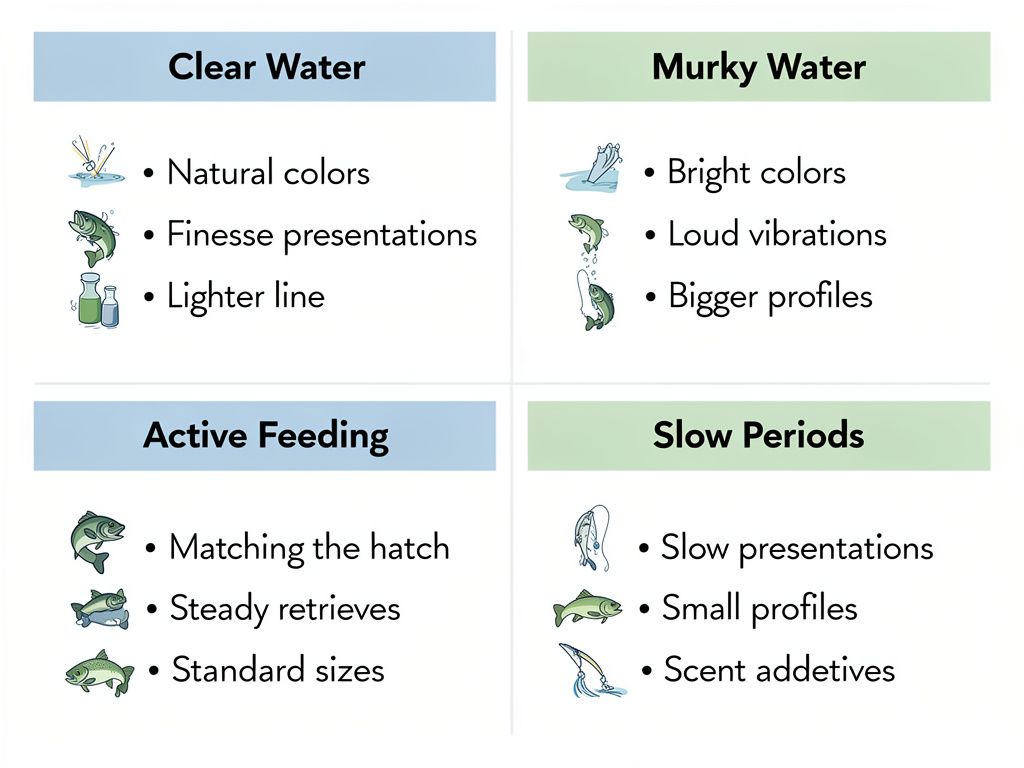
In clear water, go with natural colors and subtle presentations. Fish can see well, so realism matters. Thinner line helps too — it’s less visible and allows lures to move more naturally. Your choice of fishing line type matters here — fluorocarbon is less visible in clear water than monofilament.
In murky water, prioritize vibration and contrast. Lures with rattles, blades, or bright colors stand out. Heavier line is less of a concern since visibility is already reduced.
During active feeding periods (dawn, dusk, seasonal transitions), fish are more willing to commit. You can get away with a wider range of lures and retrieve speeds.
During slow periods, slow everything down. Smaller lures, natural colors, slower retrieves, and longer pauses.
Common Mistakes That Kill Bites
Even experienced anglers make these mistakes:
- Retrieving too fast — not giving fish time to commit, especially during evaluation mode
- Using lures that are too big — oversized lures look unrealistic and can spook cautious fish
- Ignoring water conditions — using visual triggers when fish can’t see, or vice versa
- Yanking on a following fish — reeling harder when a fish tails your lure often scares it off
- Changing lures too quickly — sometimes you need to give a presentation time to work before switching
- Not matching the hatch — if the local baitfish are small, throwing oversized lures won’t produce bites
Putting It All Together
The next time you’re on the water and the bites aren’t happening, don’t just randomly switch lures. Think about what’s triggering the fish — or what should be.
Are fish feeding actively right now, or are they being aggressive? Can they actually see your lure in the current water clarity? Is your retrieve speed giving them enough time to commit? Is the lure creating the right combination of visual and vibration triggers?
Answering these questions won’t make every cast productive, but it will make your decisions intentional instead of random. And that’s the difference between an angler who gets lucky and one who consistently catches fish.
Understanding fish behavior also connects to everything else you do on the water. Knowing how to read water helps you find where fish are holding. Choosing the right line affects how your lure moves and how much vibration reaches the fish — and building a starter tackle kit with the right basics makes it easier to adapt on the water. And once a fish does bite, knowing how to set the hook and fight it properly makes the difference between a keeper and a kicker.
Frequently Asked Questions
Do fish always bite because they’re hungry? No. Fish strike for three main reasons: feeding hunger, aggressive or territorial defense, and curiosity. A fish striking out of aggression may have no intention of eating the lure at all — it’s just defending its space.
Can fish really smell my bait? Yes. Fish have well-developed olfactory systems that detect water-soluble chemical compounds. Smell is especially important in murky water and for species like catfish that rely heavily on chemoreception. It’s one reason scented soft plastics can outperform hard lures on tough days.
What is the lateral line and why does it matter? The lateral line is a vibration-detection system running along both sides of a fish’s body. It detects pressure changes and low-frequency movements in the water, helping fish locate prey even when visibility is poor. Lures that create strong vibration — like spinnerbaits and rattling crankbaits — appeal directly to this sense. Think of it as the fish’s way of “feeling” your lure when it can’t see it well.
Why do fish follow my lure without biting? Following is evaluation behavior. The fish is interested but hasn’t committed to a strike yet. Try slowing down, downsizing your lure, or adding pauses to your retrieve to encourage the bite. Remember — a following fish isn’t a refused bite. It’s a bite that hasn’t happened yet.
Does water temperature really affect whether fish bite? Yes. Water temperature directly affects fish metabolism. Cold water slows metabolism and reduces feeding activity. Warm water speeds it up — but only within a species’ comfortable range. Extremely warm water can push fish deeper and reduce biting.