
The Overwhelm Every Beginner Faces at the Tackle Store
You walk into a sporting goods store — or open an online retailer — and there it is: wall after wall of fishing rod and reel combos. Some are priced at $25, others at $200. Each one carries a different set of specs — medium, medium-heavy, fast action, size 2000, graphite, fiberglass — that might as well be code. Nothing looks obviously wrong, which somehow makes choosing harder.
It’s not a lack of options that’s the problem. It’s a lack of a decision framework. Without understanding what the labels mean, any combo looks like a reasonable guess. That’s how beginners end up with gear that feels awkward, performs poorly, or simply sits in a closet.
This article gives you a step-by-step system to decode every spec printed on a freshwater fishing rod and reel, understand how the components work together as a matched system, and choose a setup that fits the fish you want to catch and the budget you’re comfortable with. If you plan to fish saltwater instead, see our saltwater rod and reel guide — the framework is similar, but the specs differ.
Spinning vs Casting Combos: Which One Should You Start With?
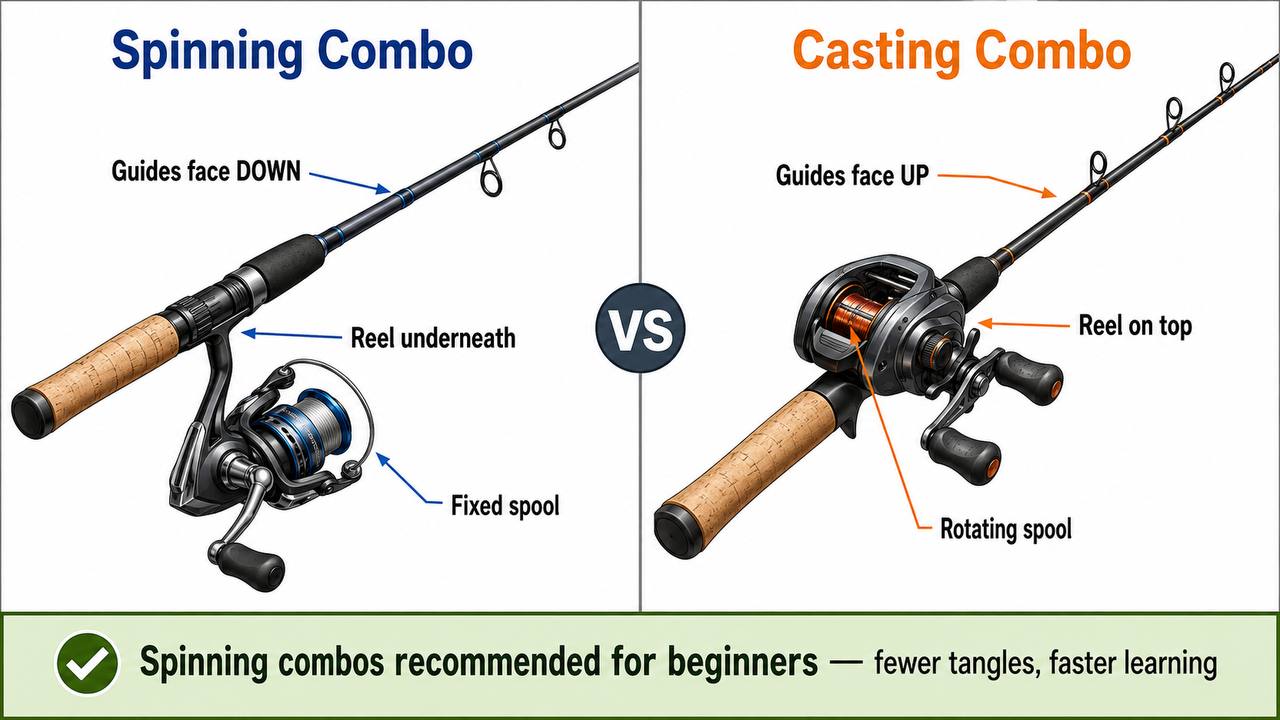
Every freshwater combo falls into one of two categories: spinning or casting (also called baitcasting). The difference is physical, mechanical, and it matters — especially for beginners.
On a spinning rod, the guides — those eyelets the line runs through — face downward, and the reel mounts underneath the rod. The reel’s spool is fixed, meaning it does not rotate during the cast. Line simply peels off freely as you cast. On a casting rod, the guides face upward and the reel sits on top. Here the spool rotates during the cast, spinning as the line flies out toward the lure.
That mechanical difference has a direct practical effect. Spinning reels produce dramatically fewer tangles because you do not need to control spool speed with your thumb. Beginners learn casting techniques faster. Spinning combos are more forgiving across a wide range of lure weights and line types. A single spinning combo can handle everything from tiny panfish to bass to small catfish, while a casting combo tends to be more technique-specific and less versatile.
So when does a casting combo make sense for a beginner? Two situations. First, some right-handed casters find the over-the-shoulder spinning motion uncomfortable — casting reels allow a more natural right-hand retrieve. Second, if you are specifically targeting larger species like pike or big catfish, a casting setup provides more retrieval power and line capacity. For nearly everyone else, start with spinning.
Spinning is not “cheating.” Most anglers use spinning gear their entire lives, and the consensus among fishing educators is clear: spinning is genuinely easier to learn and nothing to be ashamed of.
Decoding Rod Specifications
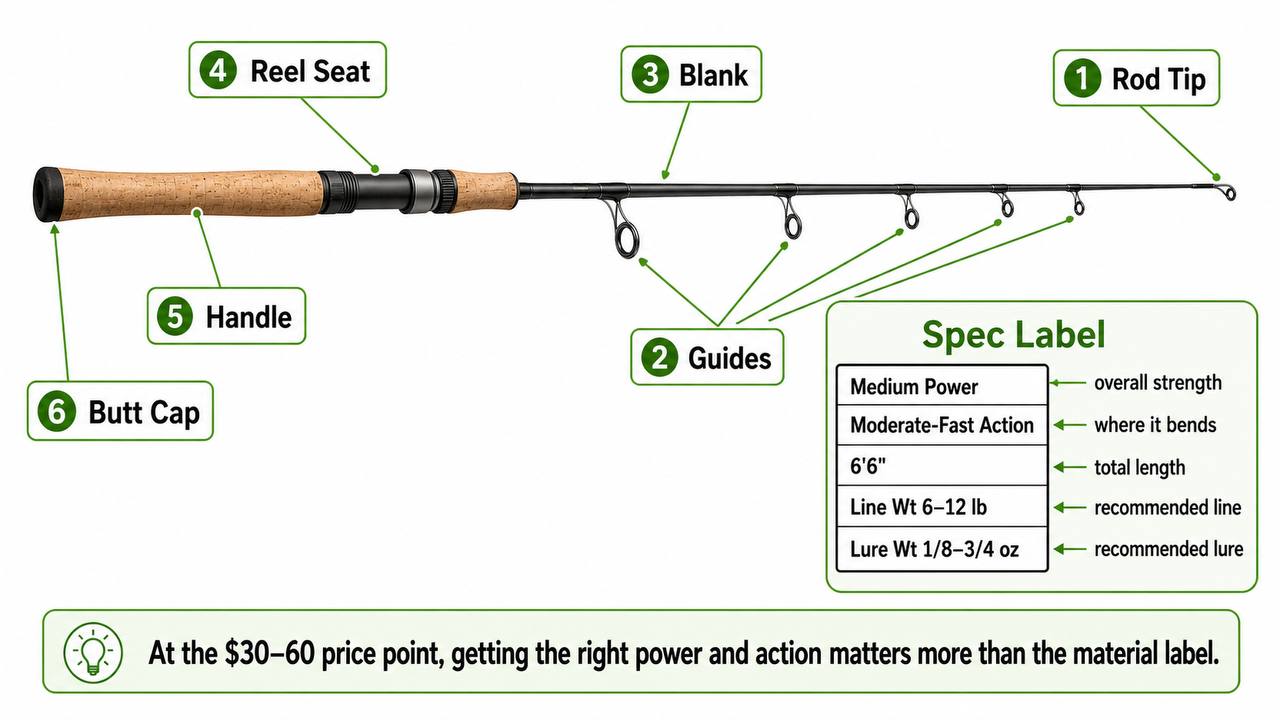
The label printed on the blank of a fishing rod tells you everything you need to know about what it’s designed for. There are four specs to understand: power, action, length, and material.
Rod Power: How Strong Is the Rod?
Rod power measures the overall strength and stiffness of the rod — how much weight and force it can handle before stressing or breaking. Power directly controls what line strength and lure weights the rod is designed for, and roughly what size fish it can handle.
Power is rated on a scale from ultra-light to extra-heavy. Here’s what each rating means in practical terms:
| Power | Line Weight | Lure Weight | Best For |
|---|---|---|---|
| Ultra-Light (UL) | 2–6 lb | 1/16–1/4 oz | Tiny panfish, small trout |
| Light (L) | 4–8 lb | 1/8–1/2 oz | Trout, panfish, crappie |
| Medium (M) | 6–12 lb | 1/8–3/4 oz | Bass, walleye, general freshwater |
| Medium-Heavy (MH) | 8–17 lb | 1/4–1 oz | Largemouth bass, pike, small catfish |
| Heavy (H) | 12–25 lb | 3/8–3 oz | Catfish, pike, heavy cover |
Medium power is the beginner sweet spot. It handles a wide range of lures and fish sizes — bass, panfish, trout, and small catfish all fit here. Go lighter if you are focusing on panfish or trout. Go heavier if catfish or pike are your main targets. Keep in mind that power ratings vary by manufacturer, so treat the scale as a guide rather than an absolute standard.
Rod Action: Where the Rod Bends
Rod action describes where along the blank the rod bends under load. It is not the same as power — power tells you how strong the rod is, while action tells you where it flexes.
| Action | Where It Bends | Practical Effect |
|---|---|---|
| Fast | Top 20–30% (near tip) | Snappy hooksets, great for jigs, less forgiving with treble hooks |
| Moderate-Fast | Top 30–40% | Balanced feel; cushions treble hooks without feeling mushy |
| Moderate | Top half of rod | More forgiving, better for light tackle and treble hooks |
| Slow | Lower third and into handle | Maximum flex, good for light lines only |
Moderate-fast action is the most versatile beginner choice. It provides enough sensitivity and hook-setting power for bass while remaining forgiving enough for panfish and trout. Different brands may rate the same rod differently, so use these categories as general guides.
Rod Length: Longer Is Not Always Better
Rod length affects casting distance, accuracy, leverage when hooking fish, and portability. The general guidance for freshwater is:
- Under 6′: Panfish-specific work, small creeks, or younger anglers.
- 6’–6’6″: Good for boat fishing, tight spaces, and accuracy-focused casting.
- 6’6″–7′: The “Goldilocks zone” — balances accuracy and casting distance, handles the widest variety of lures. This is the most recommended starting length for beginners.
- 7’–8′: Better for bank fishing, longer casts, and larger species like catfish.
If you want one rod that works everywhere — boat, dock, shore, bank — a 6’6″ rod is the safest starting point.
Graphite vs Fiberglass: What the Blank Is Made Of
The blank is the main body of the rod, and it’s made from one of three materials.
Graphite (carbon fiber) blanks are more sensitive — they transmit bite vibrations and bottom structure details to your hand more clearly. They are lighter, too, which reduces fatigue during long days. The trade-off is that graphite is more brittle and can snap under extreme stress or if dropped on hard surfaces.
Fiberglass blanks are tougher and can take significant abuse without breaking. They have a slower, more flexible action that cushions treble hooks well. The downside: less sensitivity and slightly more weight than graphite.
Composite blanks blend graphite and fiberglass, offering performance between the two. This is common at budget prices — many rods labeled “graphite” in the $30–60 range are actually composite blends. At entry-level price points, getting the right power and action matters far more than the material claim on the label.
Decoding Reel Specifications
Now that you understand rod specs, let’s look at the reel. There are three reel specs a beginner needs to know: size code, gear ratio, and drag system.
Reel size codes — numbers like 1000, 2000, 2500, 3000 — indicate physical size, which correlates with line capacity, drag strength, and overall weight. Higher numbers mean larger reels with more line capacity and stronger drag. Size 2000 is the beginner freshwater sweet spot: it pairs well with medium-power rods and handles the widest range of situations. Keep in mind that size codes are not standardized across brands — a “3000” reel from one manufacturer may differ physically from a “3000” from another. Always check the actual line capacity and maximum drag rating when comparing reels.
Gear ratio tells you how many times the spool rotates per single turn of the handle. A 5.2:1 ratio means the spool turns 5.2 times per handle revolution. Most spinning reels fall in the 5.2:1 to 6.2:1 range. A medium ratio of 5.2:1 to 6.0:1 covers roughly 80% of freshwater situations. High ratios (6.5:1 and above) and low ratios (below 5.2:1) are for specific techniques — not essential for beginners. Gear ratio is the least important reel spec to worry about when choosing your first combo.
The drag system is the braking mechanism that allows a fish to pull line when you need it to — preventing your line from breaking when a hooked fish makes a strong run. Budget reels typically use felt drag washers, which are functional but less smooth and less durable in wet conditions. Mid-range reels and up generally use carbon fiber drag washers, which are smoother, more consistent, and more water-resistant. Your working drag setting should be roughly one-third to one-half of your line’s breaking strength — not the reel’s maximum drag rating. Drag quality matters more than beginners realize: it is the feature that saves fish when they run.
Matching Rod and Reel: Why the Combo Matters
A fishing rod and reel are not independent purchases — they must work together as a matched system. Rod power, reel size, and line weight need to align. When they do, the combo casts smoothly, hooks fish reliably, and plays them without weak points. When they do not, you get poor casting, tangled line, or a rod that bends dangerously under pressure.
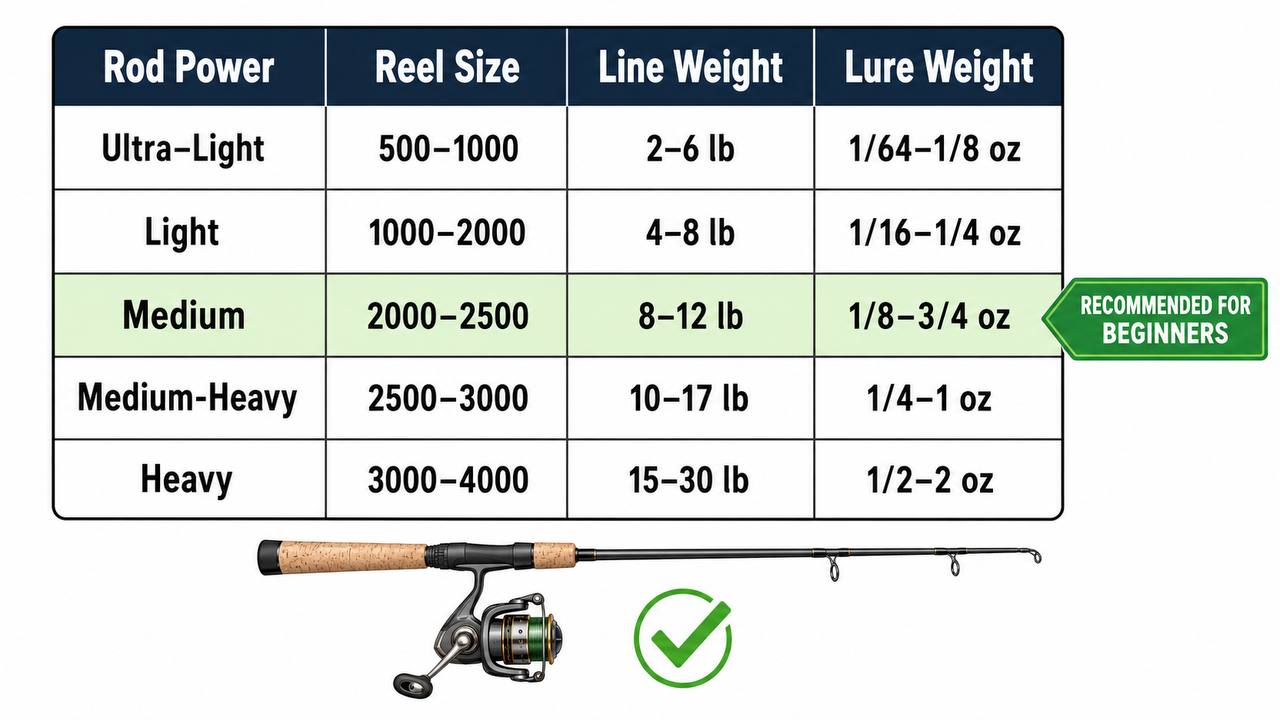
Here is how rod power, reel size, and line weight should pair up:
| Rod Power | Reel Size | Line Weight | Lure Weight |
|---|---|---|---|
| Ultra-Light | 500–1000 | 2–6 lb | 1/16–1/4 oz |
| Light | 1000–2000 | 4–10 lb | 1/8–1/2 oz |
| Medium | 2000–2500 | 6–14 lb | 1/8–3/4 oz |
| Medium-Heavy | 2500–3000 | 10–20 lb | 1/4–1 oz |
| Heavy | 3000–4000 | 14–30 lb | 3/8–2 oz |
Rod labels typically show a line weight rating (for example, “Line Wt: 6–12 lb”) and a lure weight rating (for example, “Lure Wt: 3/8–1 oz”). These tell you the range the rod is designed for. A matched beginner combo looks like this: a medium-power 6’6″ spinning rod paired with a size 2000 spinning reel, spooled with 8–12 lb monofilament line. All three specs overlap in the medium range, and everything works together.
Here’s what goes wrong with a mismatch. A reel that is too large for the rod makes the combo head-heavy, ruins casting feel, and can overpower the rod’s strength with its drag. A reel that is too small does not have enough line capacity, and its drag cannot handle fish the rod is strong enough to hook. A rod that is too heavy for your target fish means you cannot feel bites and risk tearing soft mouths. A rod that is too light for your target fish bends dangerously and risks breaking the blank.
As a beginner, the safest path is to buy a pre-matched combo — the manufacturer has already aligned the specs. If you buy a rod and reel separately, use the table above to verify they match.
Picking a Combo for the Fish You Want to Catch
What fish do you actually want to catch? That question narrows down the right specs faster than anything else. Here are the recommended specs for the five most common freshwater targets:
Bass (largemouth and smallmouth): Medium to medium-heavy power, moderate-fast to fast action, 6’6″ to 7′ length, size 2000–2500 reel, 8–14 lb line. Medium power is the most versatile for bass — it handles soft plastics, jigs, and crankbaits without being overpowered. See our soft plastic baits guide for lure recommendations that pair well with this setup.
Panfish (bluegill, crappie, sunfish): Light to medium power, moderate to moderate-fast action, 5′ to 6’6″ length, size 1000–2000 reel, 4–8 lb line. Light power provides sensitivity for tiny bites, and a shorter rod improves accuracy for targeting specific spots near cover.
Trout (rainbow, brown, brook): Light to medium power, moderate to moderate-fast action, 6′ to 7′ length, size 1000–2000 reel, 4–10 lb line. A 1000-size reel with light tackle is more than sufficient for stream trout fishing.
Catfish (channel, blue, flathead): Medium-heavy to heavy power, moderate to fast action, 7′ to 8′ length, size 3000–4000 reel, 12–25 lb line. Catfish require stronger setups. If catfish are your primary target, prioritize rod strength over sensitivity.
Pike: Medium-heavy to heavy power, fast action, 7′ to 8′ length, size 3000–5000 reel, 12–20 lb line. Pike are aggressive and powerful, and a stronger setup prevents losing fish to heavy cover.
Here is a quick-reference summary:
| Species | Rod Power | Action | Length | Reel Size | Line |
|---|---|---|---|---|---|
| Bass | M–MH | MF–F | 6’6″–7′ | 2000–2500 | 8–14 lb |
| Panfish | L–M | M–MF | 5’–6’6″ | 1000–2000 | 4–8 lb |
| Trout | L–M | M–MF | 6’–7′ | 1000–2000 | 4–10 lb |
| Catfish | MH–H | M–F | 7’–8′ | 3000–4000 | 12–25 lb |
| Pike | MH–H | F | 7’–8′ | 3000–5000 | 12–20 lb |
If you are unsure which species you’ll encounter, remember that a medium-power combo covers bass, panfish, and trout — the three species most beginners meet first. That versatility is worth more than specialization.
Budget Tiers: What You Get for Your Money
Not all combos are created equal, and price differences reflect real differences in component quality. Here is what to expect at each tier:
Entry-level ($25–$50): You get functional fiberglass or composite blanks, basic spinning reels with fewer bearings (typically 3–5), felt drag washers, and pre-spooled monofilament line. These combos are perfectly adequate for learning and casual fishing. Budget “graphite” rods in this range are frequently composite blends rather than pure graphite, so do not get hung up on material claims. What you sacrifice is sensitivity, long-term durability, and refinement — rougher casting and heavier overall weight.
Mid-range ($50–$100): This is where component quality steps up noticeably. Graphite or high-quality composite blanks, more bearings (5–7+) for smoother operation, carbon fiber drag washers, better guide materials, and improved balance and lighter weight. The biggest performance jump in freshwater combos is from entry-level to mid-range. You get smoother casting, better bite detection, and longer service life.
Premium ($100+): High-modulus graphite blanks, CNC gears, sealed bearings, advanced drag systems, superior balance, and multiple corrosion seals. Most beginners do not need to spend above $100 on their first combo. Skill and technique matter far more than gear — a well-matched $50 combo catches more fish than a poorly-matched $200 combo. A good starter fishing combo typically costs between $30 and $80.
Common Mistakes When Buying Your First Combo
Avoid these frequent errors and you will save money, frustration, and closet shelf space:
Overpowering the setup. Buying medium-heavy or heavy “just in case” you catch a big fish. The result is that catching small and medium fish feels impossible — like trying to feel a mosquito land while wearing winter gloves. Thick line and stiff rods destroy the soft mouths of panfish and trout.
Buying mismatched rod and reel. A heavy reel on a light rod, or a tiny reel on a heavy rod, creates balance problems and poor performance. If you buy rod and reel separately, always verify that the specs align using the matching table above.
Buying too many specialized combos. One versatile medium-power combo beats three specialized rods for a beginner. You do not need separate gear for bass, trout, and catfish before you have cast a single lure.
Assuming expensive equals better for you. Premium features like high-modulus graphite, advanced gear ratios, and sealed bearings are real advantages — for experienced anglers. For beginners, technique and understanding of fish behavior matter far more than gear price.
Ignoring the casting reel learning curve. Baitcasting backlash frustration is real, and it is enough to make some beginners quit fishing entirely. Start with spinning; add casting gear later if you want to.
The One Combo to Start With
Based on research consensus, the most versatile beginner freshwater spec profile is:
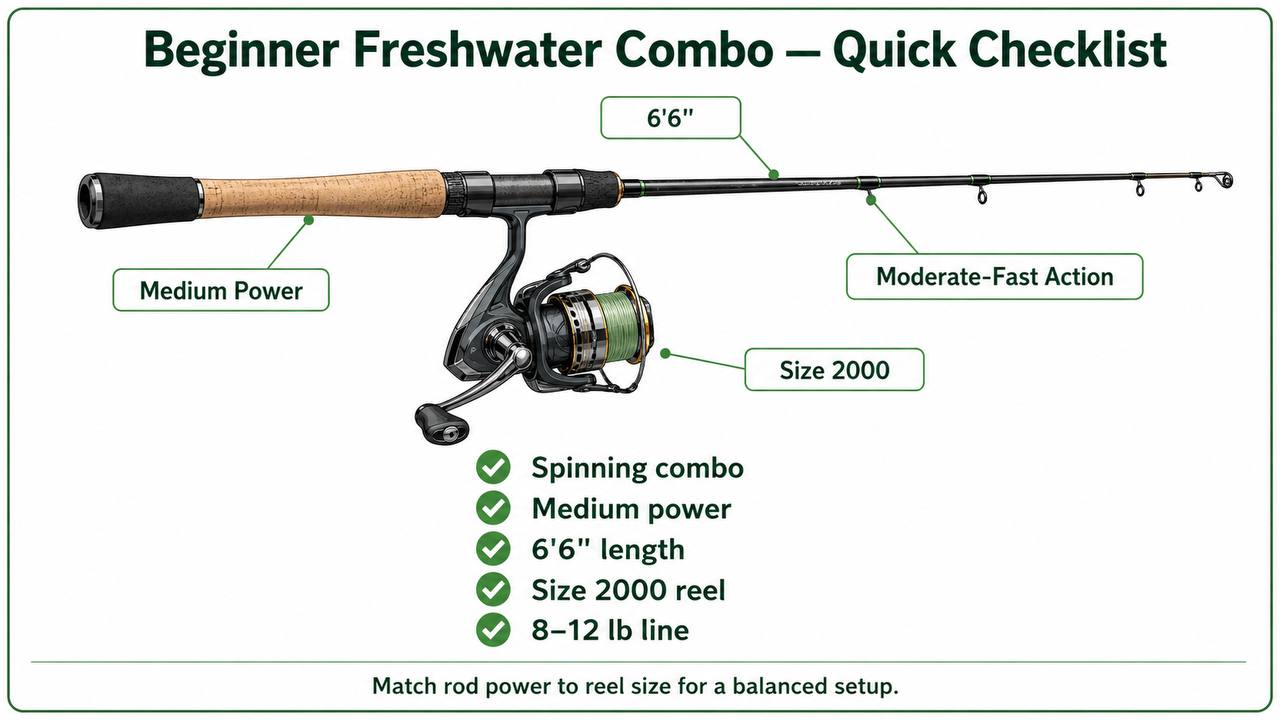
6’6″ medium-power, moderate-fast action spinning rod + size 2000 spinning reel
This single setup handles bass, panfish, trout, and small catfish. It works from banks, boats, docks, and shore. A size 2000 reel holds 8–12 lb of monofilament line, which covers the line rating of a medium-power rod. Together, they cover approximately 80% of beginner freshwater fishing situations.
Use this as your starting point — not as the only right answer. The framework matters more than any single spec:
- [ ] Spinning combo (not casting)
- [ ] Medium power
- [ ] Moderate-fast action
- [ ] 6’6″ length
- [ ] Size 2000 reel
- [ ] 8–12 lb line weight rating
Your Next Steps After Choosing a Combo
Once you have your combo, a few simple practices will keep it performing well. Rinse the rod and reel with fresh water after each use — even when fishing freshwater, sediment and organic matter degrade components over time. Dry everything before storing. Most beginner combos come pre-spooled with monofilament line, which is functional for learning. When you are ready to upgrade your line, monofilament is still the recommended first choice — it is forgiving, easy to tie, and affordable. For a full breakdown of line options, see our monofilament vs fluorocarbon vs braid guide.
Learn a few basic knots — you need them to attach line to rod and to tie on lures. Then fill a tackle box with a starter selection of basic lures to match the fish in your local waters. If you are new to fishing entirely, our beginner fishing 101 guide covers the foundational concepts you need before your first outing. And always check your local fishing regulations — rod limits and species restrictions vary by location and season.
The right combo opens the door. Technique, patience, and time on the water do the rest.