

You’ve spent the morning learning to cast. You finally have your bait in the water. Then — the rod tip jerks. Your heart jumps. You yank the rod up and… silence. Either the fish got off, or worse, your line snapped.
If that sounds familiar, you’re not doing anything wrong. You’re doing what almost every beginner does. The problem isn’t your casting or your bait — it’s what happens in the five seconds after the bite.
Reeling in a fish is a skill entirely separate from casting. It involves three phases: setting the hook, fighting the fish, and landing it. Each one has its own techniques, and each one has mistakes that beginners make consistently. Here’s how to get all three right.
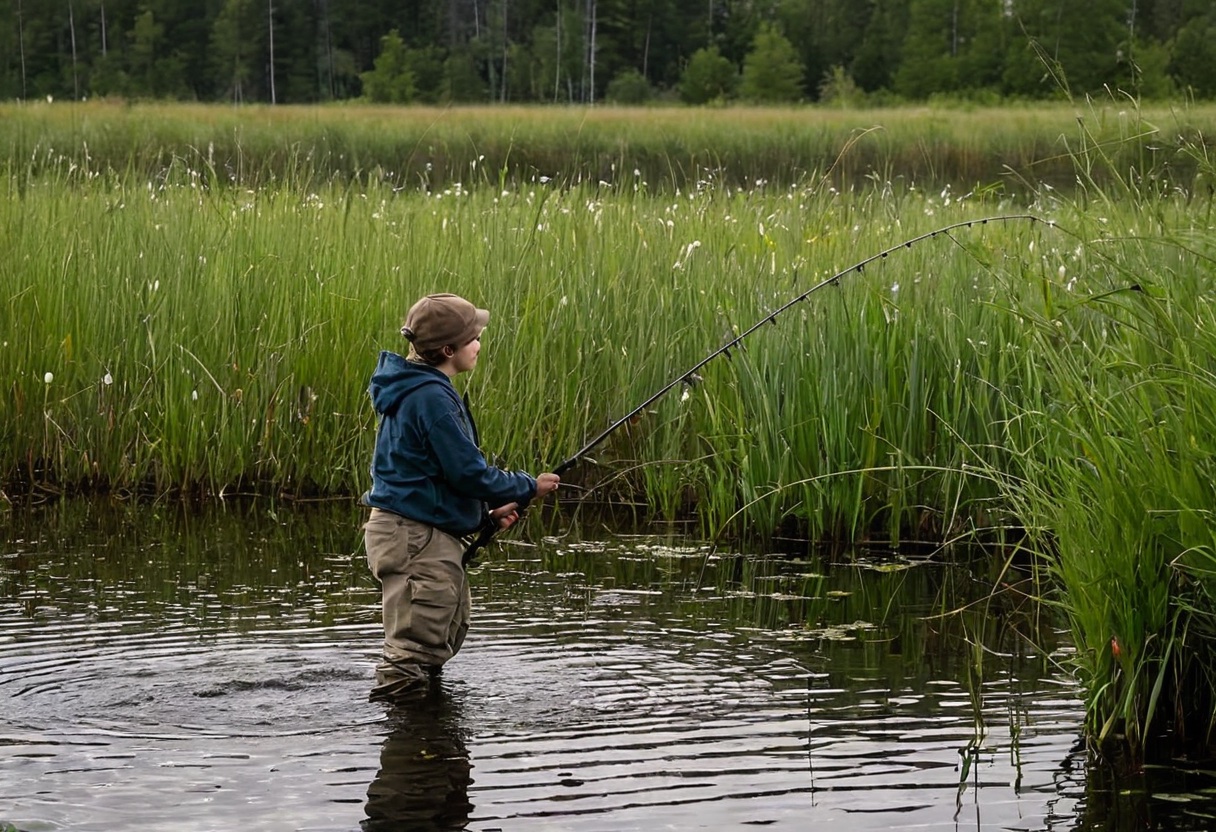
What to Do When the Fish Bites
The hardest part of fighting a fish isn’t the physical effort. It’s the first two seconds, when your brain has to decide what’s happening. Is that a real bite, or just the current bumping your line? Is the fish curious, or committed?
Here’s what to feel for: a real bite typically shows up as a sharp tug or pull — not a tickle. The rod tip moves decisively. Your line goes from relaxed to tight. If you’re using a float, it either disappears underwater or gets dragged sideways. If you’re bottom fishing, you feel a weight shift.
When you feel that decisive pull, don’t think — act. But act with control, not panic.
Setting the Hook — Firm, Not Furious
Setting the hook is the motion that drives the hook point into the fish’s mouth. Get it right, and you’ve won half the battle. Get it wrong, and the best fight in the world never happens.
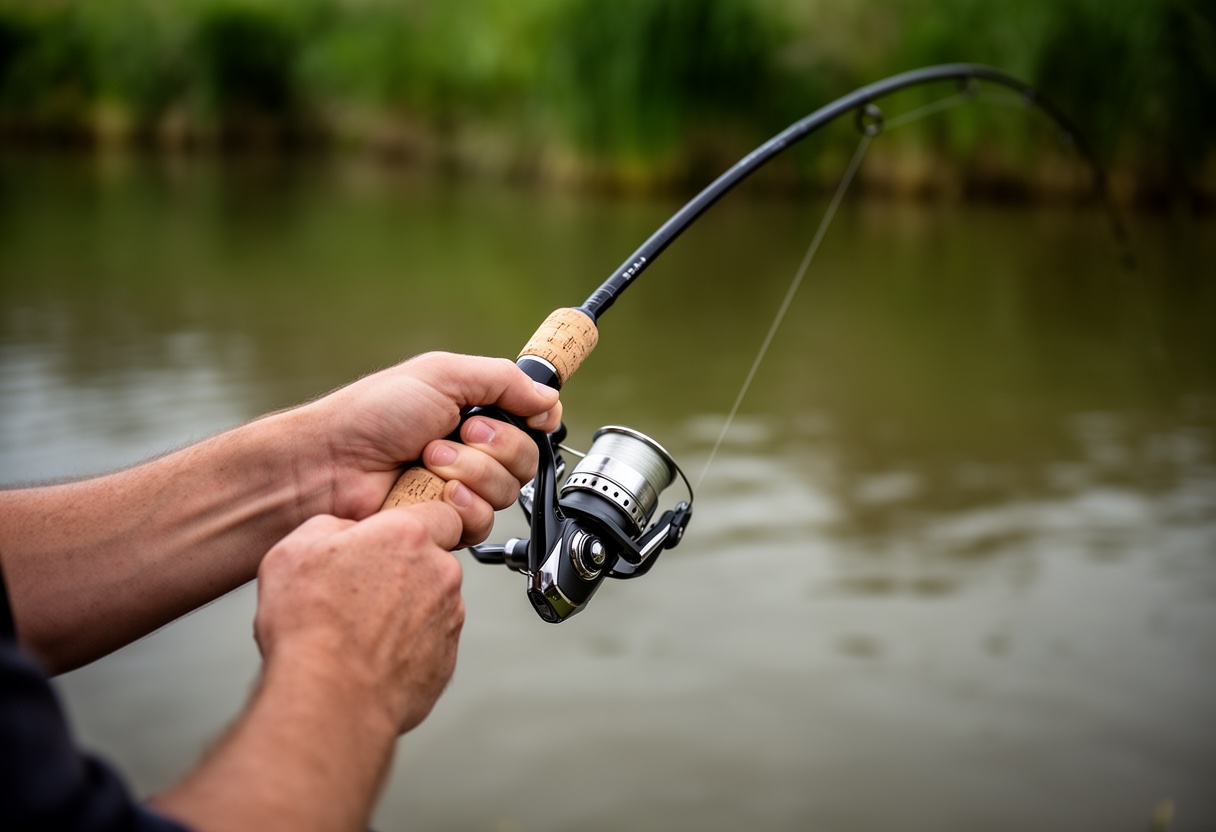
The correct motion is an upward sweep of the rod, not a straight vertical yank. Think of it like drawing a backward “J” with your rod: lift the rod tip up and slightly back, in one smooth, firm motion. The sweep angle should be roughly 45 degrees.
How hard should you set the hook? Hard enough that you feel solid resistance, but not so hard that you think your rod might break. A good rule of thumb: set the hook with about the same force you’d use to shake hands firmly. Any harder and you risk pulling the hook free from the fish’s mouth or snapping your line — especially if you’re using light line (4-8 lb test).
The motion feels slightly different depending on your reel type. With a spinning reel, the upward sweep works naturally because the rod guides face down and the rod bends evenly. With a baitcasting reel, you may want to add a slight backward pull because the rod is positioned above the reel and has less natural leverage.
Timing matters. If you set the hook the instant you feel the first tap, the fish is probably just investigating your bait and hasn’t committed yet. Wait for the pull — the moment the fish actually turns to swim away with the bait in its mouth. That’s when the hook should go in.
Want to practice? Set your hook on a dock piling or a submerged log. You’ll feel exactly what “solid resistance” feels like without losing a fish or a hook.
Drag 101 — The Setting Most Beginners Get Wrong
If there’s one thing that separates beginners who land fish from beginners who don’t, it’s drag adjustment. Drag is the most misunderstood setting on a fishing reel, and it’s the #1 reason lines snap when a fish makes a hard run.
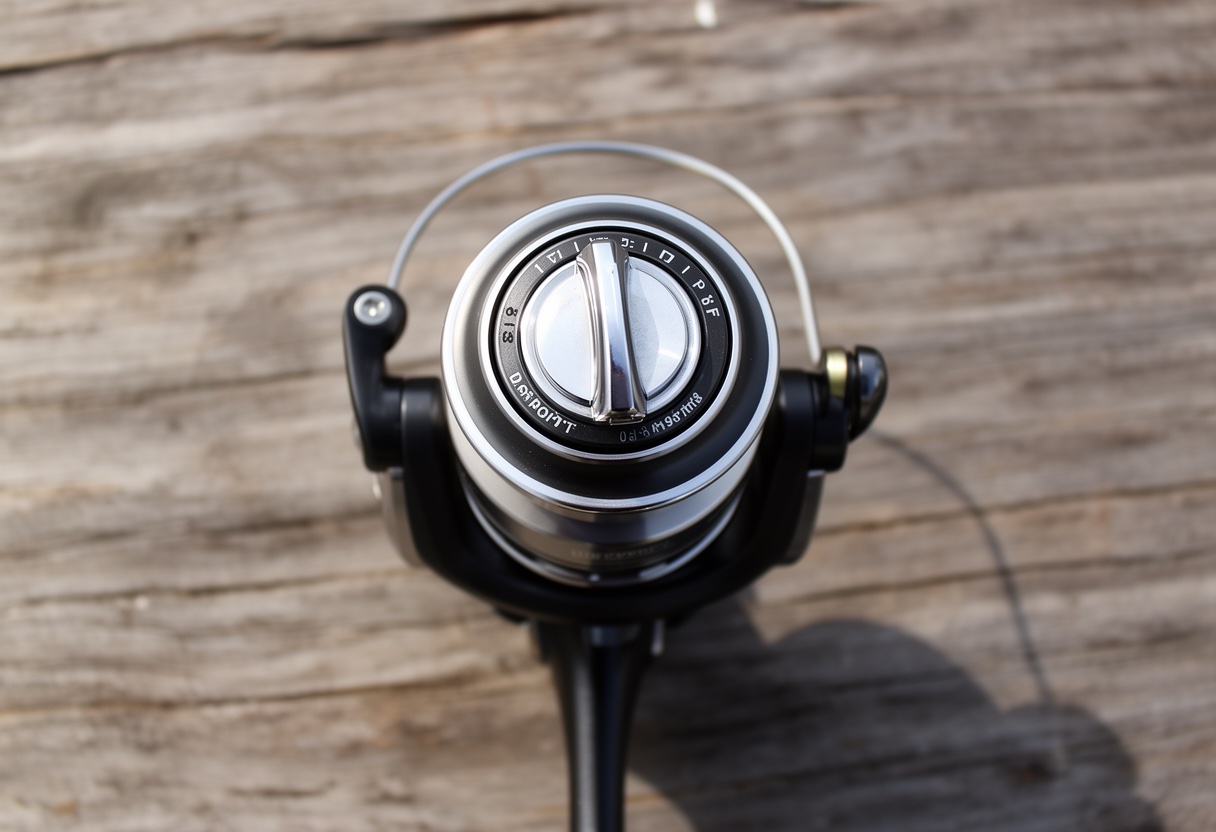
What is drag? Think of it as a friction brake on your reel’s spool. When you reel normally, the brake holds the spool in place and line winds on. When a fish pulls harder than the brake allows, the spool slips — line comes out under controlled resistance instead of snapping free. It’s what lets you catch a 5-pound bass on 6-pound test line without the line breaking every time the fish decides to bolt.
The problem: Most beginners leave the drag cranked down tight (factory default) and wonder why their line keeps snapping. A fish that makes a sudden run can easily triple or quadruple your line’s normal tension. Without drag giving way, the line has nowhere to go but break.
The 1/3 rule. Your drag should be set so that line begins to slip at roughly one-third of your line’s breaking strength. If you’re using 8-pound test line, your drag should start slipping around 2.5 to 3 pounds of pressure. This gives you enough tension to tire the fish out while leaving plenty of margin for sudden runs.
How to set drag without a scale. You don’t need expensive gear to dial this in:
- At a fish market or grocery store, press your fishing line against a fish scale and pull until the drag starts slipping. Adjust the knob until it reads about one-third of your line’s rating.
- Quick field test: hold the rod in one hand and press the line against your palm with the other. Increase pressure until the drag slips. It should require noticeable effort — not so easy that your thumb does it, not so tight that it feels like it’ll never slip.
Where to find the drag knob. On most spinning reels, it’s the knob on the very top of the reel (above the spool). Turn it clockwise to tighten, counterclockwise to loosen. On baitcasting reels, drag adjustment varies by model — some use a star-shaped drag adjuster near the handle, others use a top knob. Check your reel’s manual if you can’t find it.
Pro tip: Once you have drag set correctly, you can make small adjustments during the fight. As the fish tires, you can tighten the drag slightly to reel it in faster. If the fish makes a hard run and the rod bends dangerously, loosen the drag a notch.
Fighting the Fish — The Pump and Reel Technique
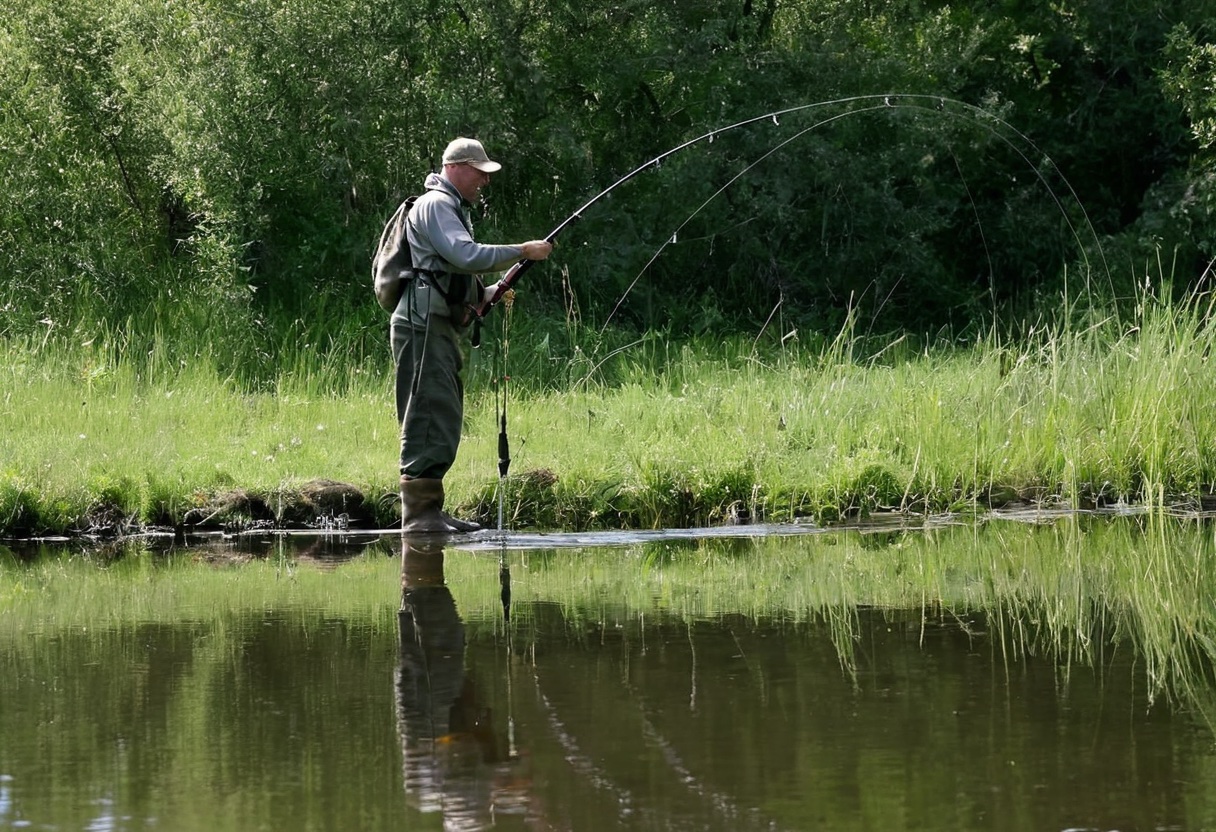
Now you’ve set the hook. The fish is on. What next?
You don’t just keep reeling. If you do, you’ll either break the line or pull the hook free. Instead, you use a technique called pump and reel — and it’s the single most important skill in fighting fish.
Here’s how it works:
- Pump: Lift your rod up to about a 45-degree angle. This uses the rod’s natural flex to pull the fish toward you. You’re not reeling during the pump — you’re letting the rod do the work.
- Lower and reel: Bring the rod tip back down toward the water and reel in all the slack line you just created. Your goal is to recover every inch of loose line before the next pump.
- Repeat: Pump, lower, reel. Pump, lower, reel.
This cycle gradually tires the fish out. Each pump steals a few feet of ground. Each reel removes the slack so your next pump is effective. Over time — typically 30 seconds to 2 minutes for a bass, 2 to 5 minutes for a catfish — the fish gets too exhausted to make powerful runs, and you can guide it in.
The cardinal sin: slack line. More fish are lost to loose line than to any other cause. When you lower the rod after a pump, you must reel in every bit of slack before your next stroke. A loose line gives the fish a chance to shake the hook, and once it gets a moment of freedom, most fish will throw the hook immediately. Keep the line tense with the rod tip up.
Don’t “horse” the fish. This is what beginners do when they get excited: they hold the rod straight up and just pull, trying to drag the fish in like a tow rope. This puts maximum pressure on the hook and line, and it almost always ends with a broken line or a pulled hook. Let the pump-and-reel cycle do its job.
Let the drag work during runs. When a fish makes a hard run, your rod will bend dramatically and you may hear the drag clicking. This is normal — and good. Don’t try to muscle through it. Hold the rod steady, let the drag bleed off the excess pressure, and wait for the run to end. Then resume pumping.
Body positioning matters. Stand or sit so the fish is in front of you, with your body behind the rod. This gives you leverage and keeps the fish from circling behind you. If you’re fishing from a bank, position yourself so you can guide the fish toward open water near your feet — not toward rocks, weeds, or structure where it can break free.
Now that you’ve mastered casting and you’re learning to fight, you’re developing the complete skill set that separates someone who holds a rod from someone who catches fish. How to Cast a Fishing Rod for Beginners covers the first half of this journey — bringing the bait to the fish. This is the second half.
Landing the Fish — Net It or Hand It?
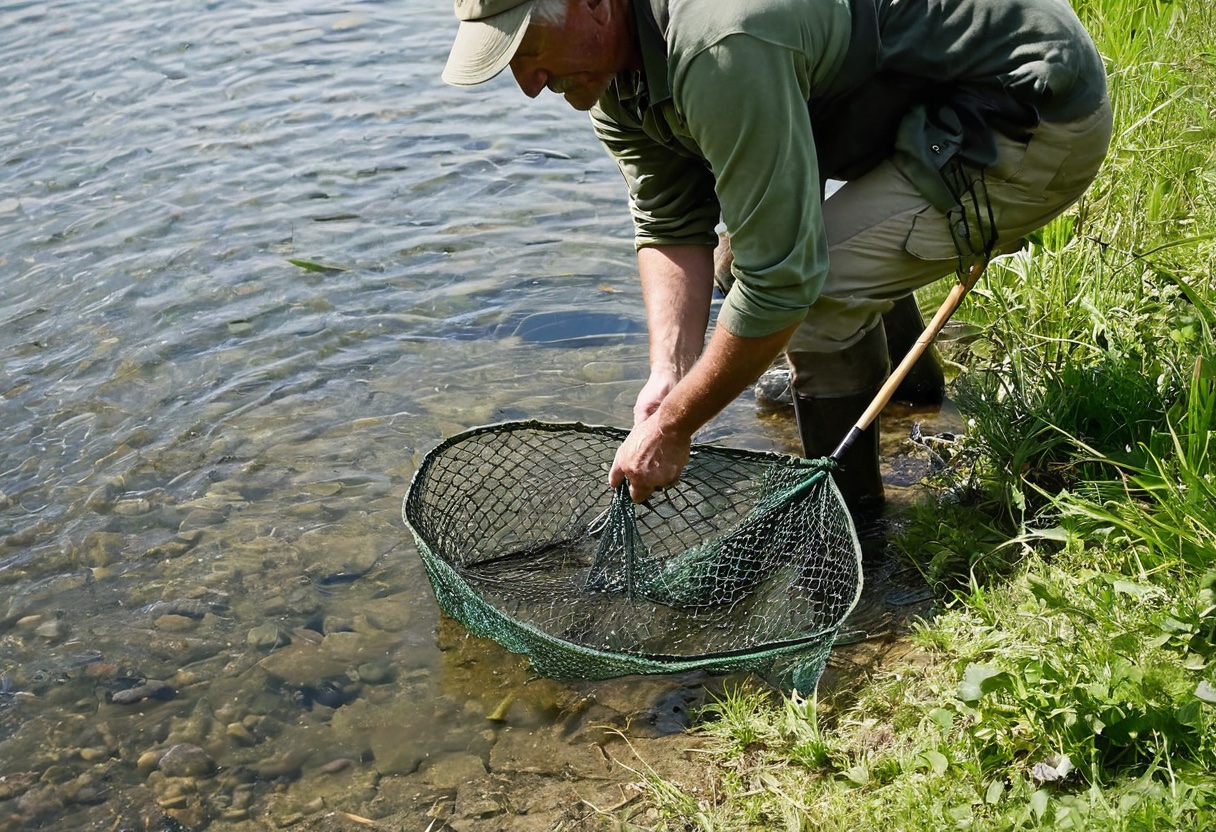
You’ve fought the fish to the edge. It’s tired, rolling on its side, and just a few feet away. Now comes the moment where beginners lose fish they’ve already won.
When to use a net. If the fish is longer than about 8 inches, or if you’re fishing from a boat, or if the bottom is rocky or weedy, use a landing net. Nets are cheap, lightweight, and they prevent the heartbreak of losing a fish in the final foot.
How to use a landing net. Enter the net into the water from the head end of the fish, not the tail. Scoop forward and up in one smooth motion. Don’t drop the net on top of the fish — it can startle it into a final burst of energy. If you have a partner, have them hold the rod while you net. If you’re solo, lay the rod down carefully (tip up) and grab the net with both hands.
Hand-landing small fish. Panfish (bluegill, sunfish) and small trout are easy to land by hand. Once the fish is right at your feet, reach down and grasp it firmly by the lower jaw, just behind the hook. Lift gently, keeping the fish as level as possible. Small fish have strong mouths relative to their size, and jaw-holding works great for them.
Lip-landing bass. For largemouth bass under about 12 inches, you can often lift them by the lower lip — their jaw structure is strong enough to support their weight. Fish bigger than that need a net. Their jaws simply aren’t built to hold the weight, and the hook will tear through.
Never lift a fish vertically by the line. No matter how tired the fish looks, lifting it straight up by the fishing line puts enormous stress on the hook hold. The hook can tear clean through the fish’s mouth, or the line can snap. Always bring the fish into a net or your hands before lifting it out of the water.
Proper handling once you’ve landed the fish matters whether you keep it or release it. Catch and Release for Beginners covers the best practices for getting your fish back in the water healthy.
Common Mistakes That Cost Beginners Their Catch
Here’s a quick reference of the most common mistakes and how to avoid them:
1. Drag set too tight. The line snaps on the first hard run. Fix: Set drag to one-third of your line’s breaking strength before you start fishing. Test it.
2. Yanking too hard on the hookset. The hook pulls free from the fish’s mouth. Fix: Use a firm sweep, not a violent jerk.
3. Letting line go slack between pumps. The fish shakes free. Fix: Reel in all slack after every pump before starting the next one.
4. Trying to lift the fish before it’s tired. The line breaks or the hook pulls. Fix: Keep pumping until the fish is rolling on its side and barely fighting back.
5. Not using a net when conditions demand it. The fish breaks free in the final foot. Fix: If the fish is over 8 inches, use a net.
6. Standing in the wrong position. The fish circles away from you toward structure. Fix: Position yourself so you can guide the fish toward open water near your feet.
7. Reeling through a hard run instead of letting drag work. The line snaps because you’re fighting the drag. Fix: Hold the rod steady during runs and let the drag click. Resume pumping when the run ends.
If you’re dealing with any of these, it usually comes down to two things: drag setting and patience. How to Choose a Fishing Reel for Beginners goes into how different reel types handle drag, which helps if you’re trying to figure out whether your gear is part of the problem.
Species-Specific Tips — Not All Fights Are the Same
Different fish fight differently, and knowing what to expect makes a huge difference in how you approach the fight.
Panfish (bluegill, sunfish, crappie). These are typically the first fish beginners catch, and they’re forgiving. They fight briefly — usually just a couple of runs — and tire quickly. Light drag is fine. Hand-landing is easy. These are the fish that build your confidence.
Largemouth bass. Bass are the quintessential fighting fish for freshwater beginners. They typically make one or two hard runs right after the hookset, then settle into a pattern of shorter runs and pauses. They tire within 30 seconds to 2 minutes under normal conditions. Moderate drag works well. Fish under 12 inches can be lip-landed; bigger ones need nets.
Catfish. Channel catfish — the most common species beginners encounter — are surprisingly strong for their size. They typically make long, powerful runs and don’t tire quickly. Use heavier drag settings. Always use a net. Their thick lips make lip-landing nearly impossible, and their whisker barbels can get caught in your line or net.
Trout. Rainbow and brown trout put up a spirited fight, but their mouths are relatively delicate. Use light drag to avoid pulling the hook through. They typically fight in short bursts rather than long runs. Hand-landing works well for smaller trout; use a net for fish over a pound.
The key takeaway: adjust your drag and your patience based on what you’re catching. A technique that works perfectly for bluegill will snap your line on a catfish, and a drag setting perfect for catfish will make fighting a small bass feel like hauling an anchor.
Final Thoughts
Reeling in a fish feels different every time, and that’s part of what makes fishing addictive. Some fights last 15 seconds. Some last five minutes. Some end in heartbreak, and some end with the best catch of your season.
The anglers who consistently land more fish aren’t necessarily the strongest or the most experienced. They’re the ones who set their drag correctly, keep the line tight, and have the patience to let the fish tire itself out. Master those three things, and you’ll find that the gap between “I hooked one” and “I caught one” closes fast.