
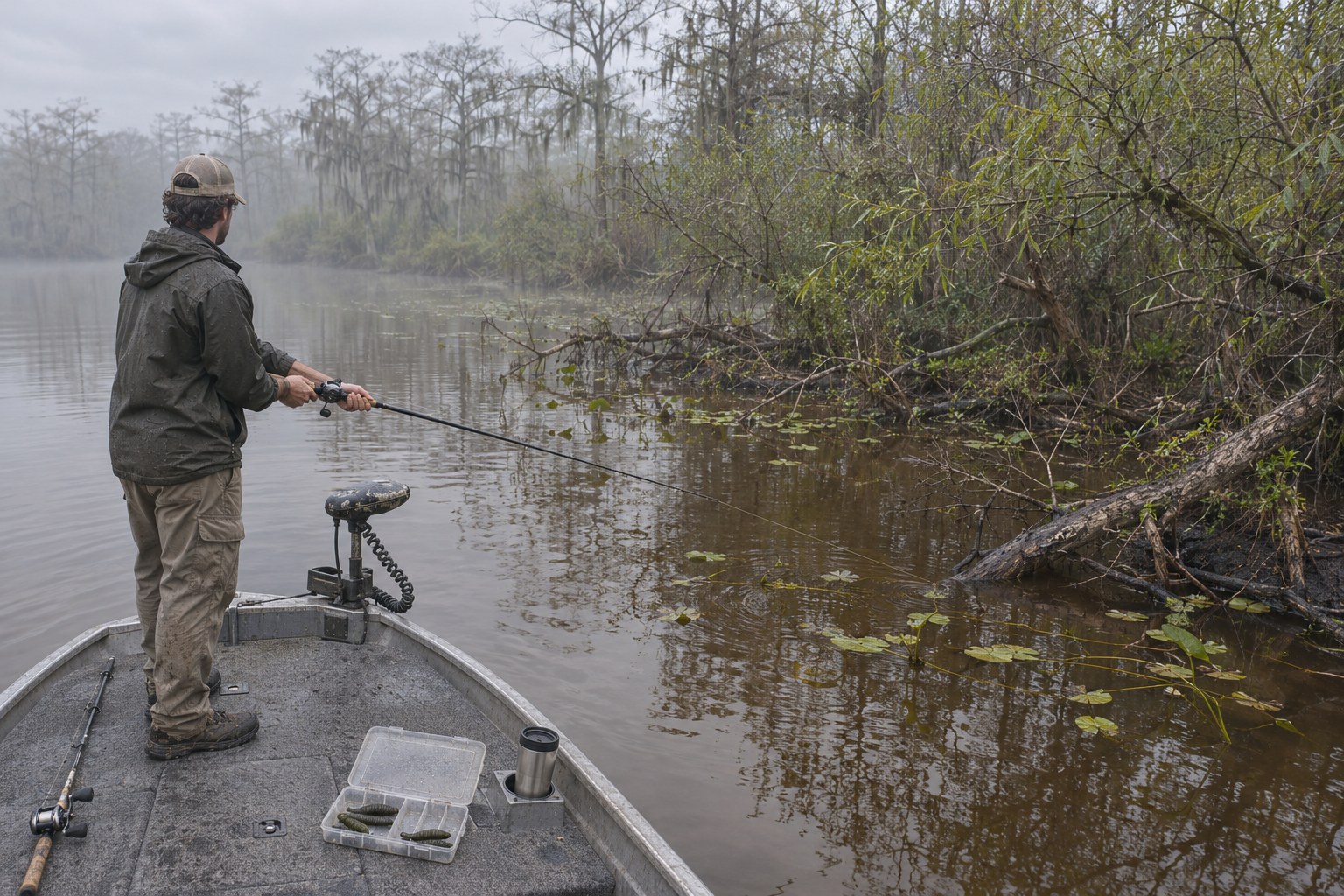
You slide up to a dock with a jig tied on, make a cast, and the bait lands a foot and a half short with a splash that sounds like a rock hitting a bathtub. Whatever was under that dock either left or went tight-lipped, and you’re not sure which.
That’s usually not a casting problem. It’s a naming problem. Most anglers say “flipping” when they mean pitching, rig for one and fish the other, then wonder why the bait lands wrong, the line won’t behave, or the fish that were there yesterday aren’t today. The two techniques share a pendulum motion. That’s about where the similarity ends.
Here’s what actually separates them, how to tell which one a piece of cover is asking for, and the line and weight to spool for each.
The Difference That Actually Matters
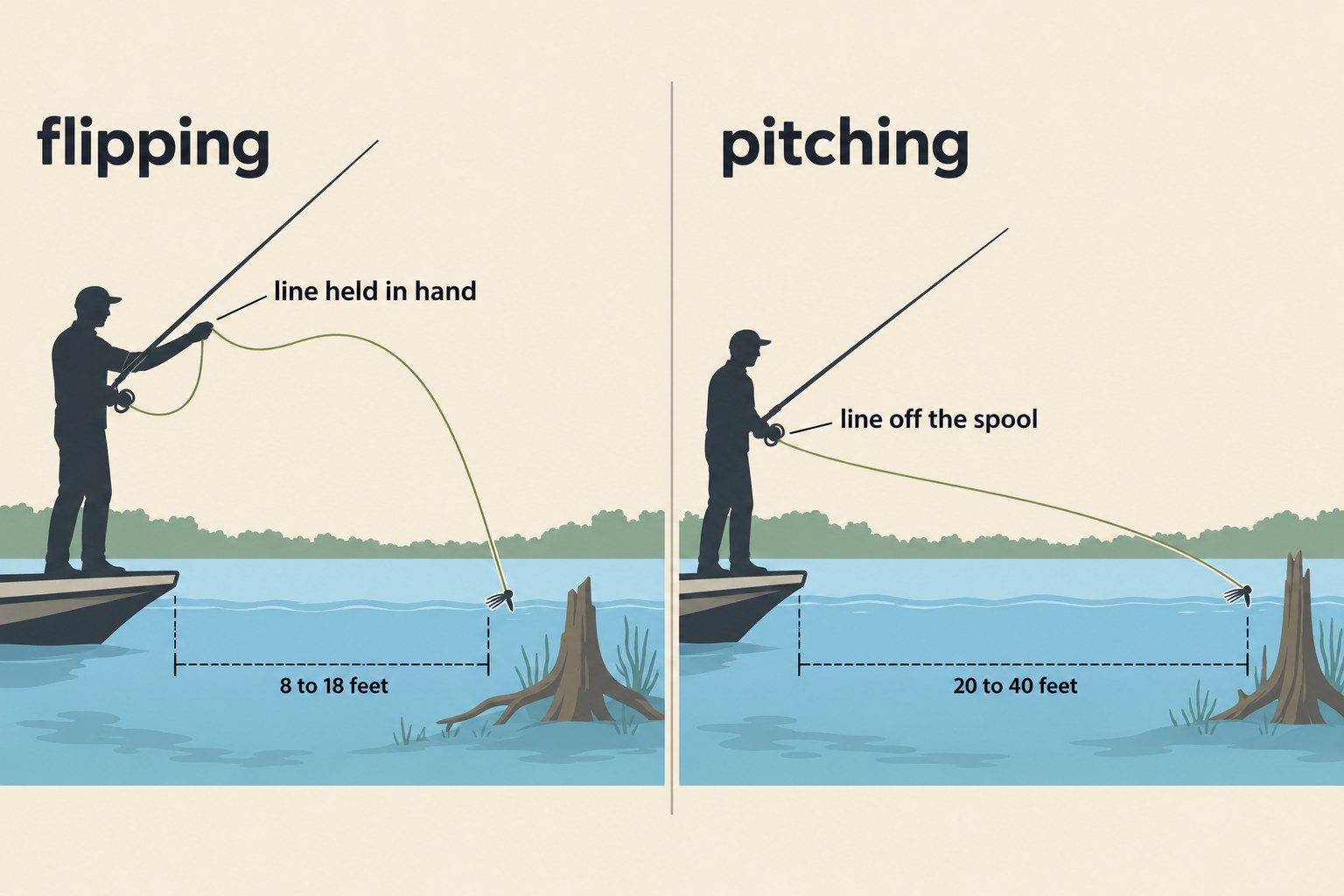
Flipping keeps the reel in gear and the line in your hand. You strip an arm’s length of line off the spool before the cast, hold it in your off hand, and feed it back out as the bait swings forward on the rod tip. The spool never turns. That’s why flipping is often called a fixed-line presentation.
Pitching lets the spool turn. You hold the bait in your off hand, drop the rod tip, swing the bait forward underhanded, and release the thumb bar so line peels off while your thumb rides the spool. Your thumb — not your off hand — sets how fast the bait travels and how softly it lands.
The one-line version: line in your hand means you’re flipping; line coming off the spool means you’re pitching.
That mechanical difference sets a hard range. A flip is good for somewhere between eight and eighteen feet, close enough that you can hand-feed line without running out of it. A pitch comfortably reaches twenty to forty feet, because the spool keeps paying out line as the bait flies. Professional anglers tend to describe their pitches as landing around thirty feet, and their flips as landing practically under the rod tip.
When to Flip: Dirty Water and Fish That Can’t See You
Denny Brauer, who built a career on the technique, sums up the decision simply: flip when the water is dirty, or when the fish doesn’t have a clear line of sight back to you.
Read that second condition carefully, because it’s the one most anglers miss. Before you cast, picture what the fish sees. If a laydown, a dock post, or a wall of grass sits between that fish and your boat, it can’t watch you — and you can move in tight and flip straight to it. Water color doesn’t matter in that case. Cover does.
So flipping earns its keep in close quarters: laydowns, mat edges, cane, reed lines, flooded brush, muddy riprap, and the small gaps behind a reed line where bass like to sit. You’ll typically work in three to five feet of water with the bow almost over the cover.
What flipping buys you is contact. With the line literally in your hand, you can feel the bait tick down the side of a limb, stop it in a hole the size of a coffee cup, and lift it over a branch without a splash. No other presentation gives you that much control at that distance.
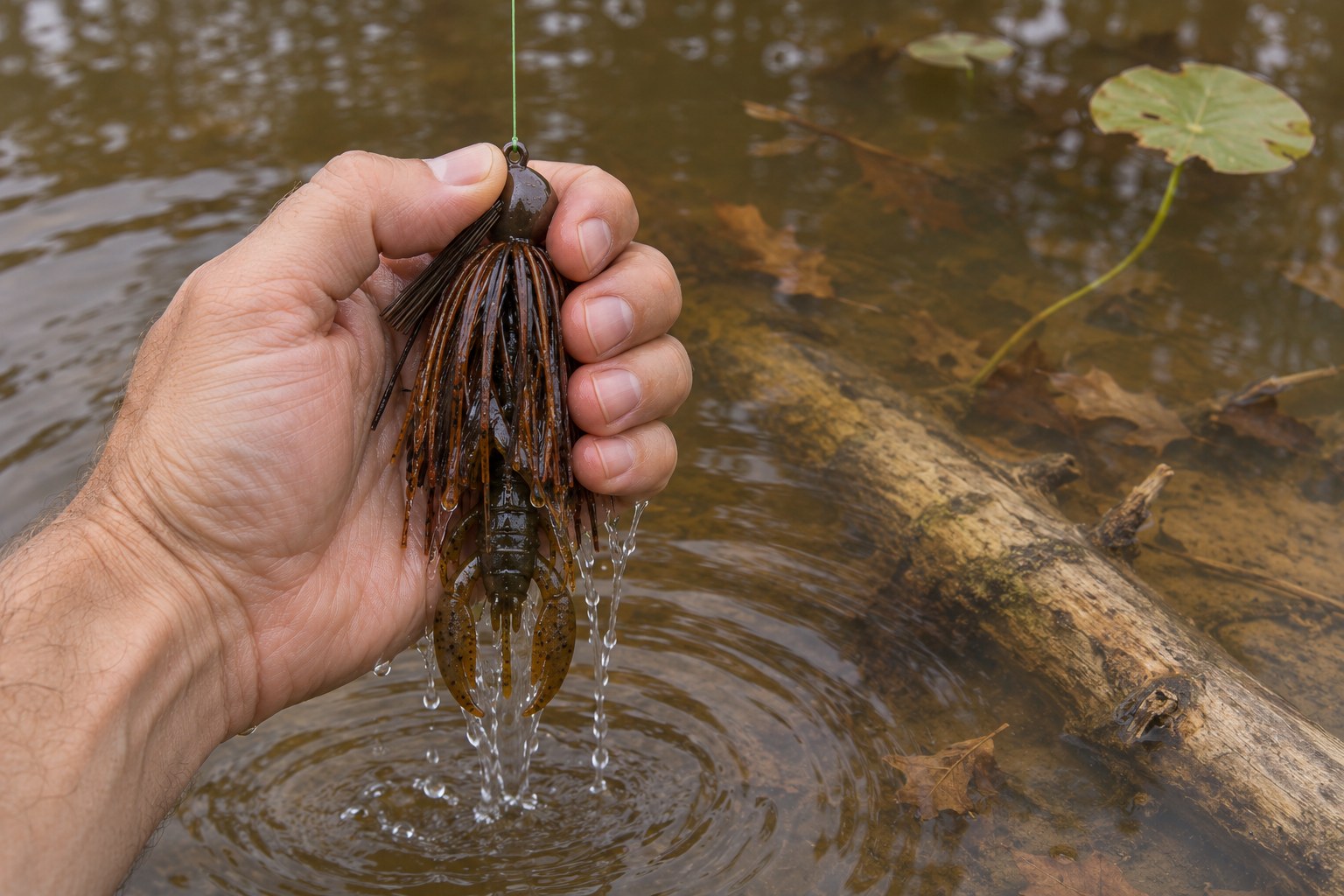
The trade-off is speed. Flipping covers very little water, so it only works when you’ve found something worth picking apart — and only if you’re willing to sit on top of the cover instead of fishing it from a polite distance.
When to Pitch: Clear Water, Wary Fish, and Targets Out of Reach
Pitch when a fish can see you, or when the target is farther than a flip can reach. That covers most of the day for most anglers.
Clear water is the clearest case. With two or three feet of visibility, bass get a long look at the boat, and the closer you sit, the worse your odds get. Pitching from twenty-five or thirty feet away keeps the hull out of their window, and the low, flat trajectory of the cast keeps the bait from telegraphing your position.
Docks are the other textbook example. A pitch skips and skims under an overhang that a standard cast can’t enter, and it lets you work the shaded strip behind the posts where fish actually hold. Depending on how the dock is built, that might mean working the bait two to six feet back into the shadow.
Pitching also covers water. It targets fish willing to eat a moving bait rather than a bait dropped on their nose, so it tends to draw a more aggressive strike. Baits that suit it: jigs, Texas-rigged worms, tubes, and compact creature baits. Crankbaits are not on that list — treble hooks and precise, obstacle-heavy targets don’t mix.
In practice, most good days use both. You flip the close cover, pitch the rest, and fill the gaps in between. Treat them as one system, not a decision you make once at the ramp.
Choosing Line: Wood and Rock Want Fluorocarbon, Grass Wants Braid
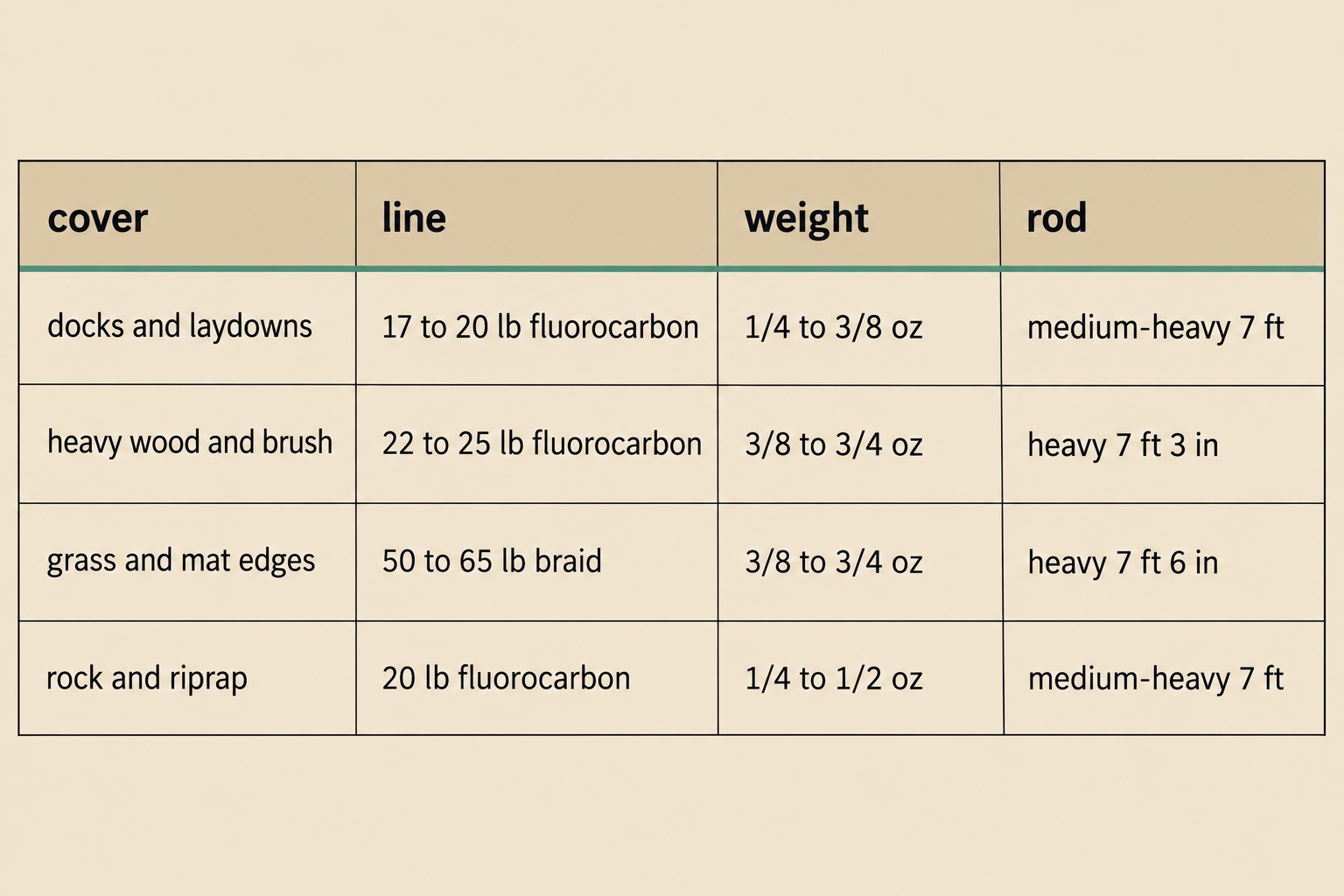
For docks, laydowns, brush, and rock, start with 17- to 20-pound fluorocarbon. It handles abrasion, it sinks, it’s less visible in clear water, and it has enough stretch to help you keep a fish from tearing off around a post. If the wood is big and you know you’ll have to lean on the fish, 22- to 25-pound fluorocarbon is reasonable. If you’re not clear on why one line wins in a given situation, how the three main line types behave is worth reading before you respool.
For grass, mats, and heavy vegetation, switch to 50- to 65-pound braid. Braid slices through stems instead of wrapping them, and it lets you turn a fish’s head up and out before it buries itself. It also runs far thinner than its rating suggests — 65-pound braid is roughly the diameter of 15-pound monofilament — which is a real casting advantage when you’re trying to feed line off a spool smoothly on a pitch.
Braid has costs, though. It’s more visible, it scuffs up on rock, and it can dig into itself under a hard hookset. If clear water and pressured fish are the story, fluorocarbon usually gets more bites. If you want braid’s strength with fluorocarbon’s invisibility, an eighteen- to twenty-four-inch leader works — just remember that every knot is a weak point, and the pros who skip the leader mostly skip it for that reason. If you do run one, learn a clean braid-to-leader connection instead of a stack of overhand knots.
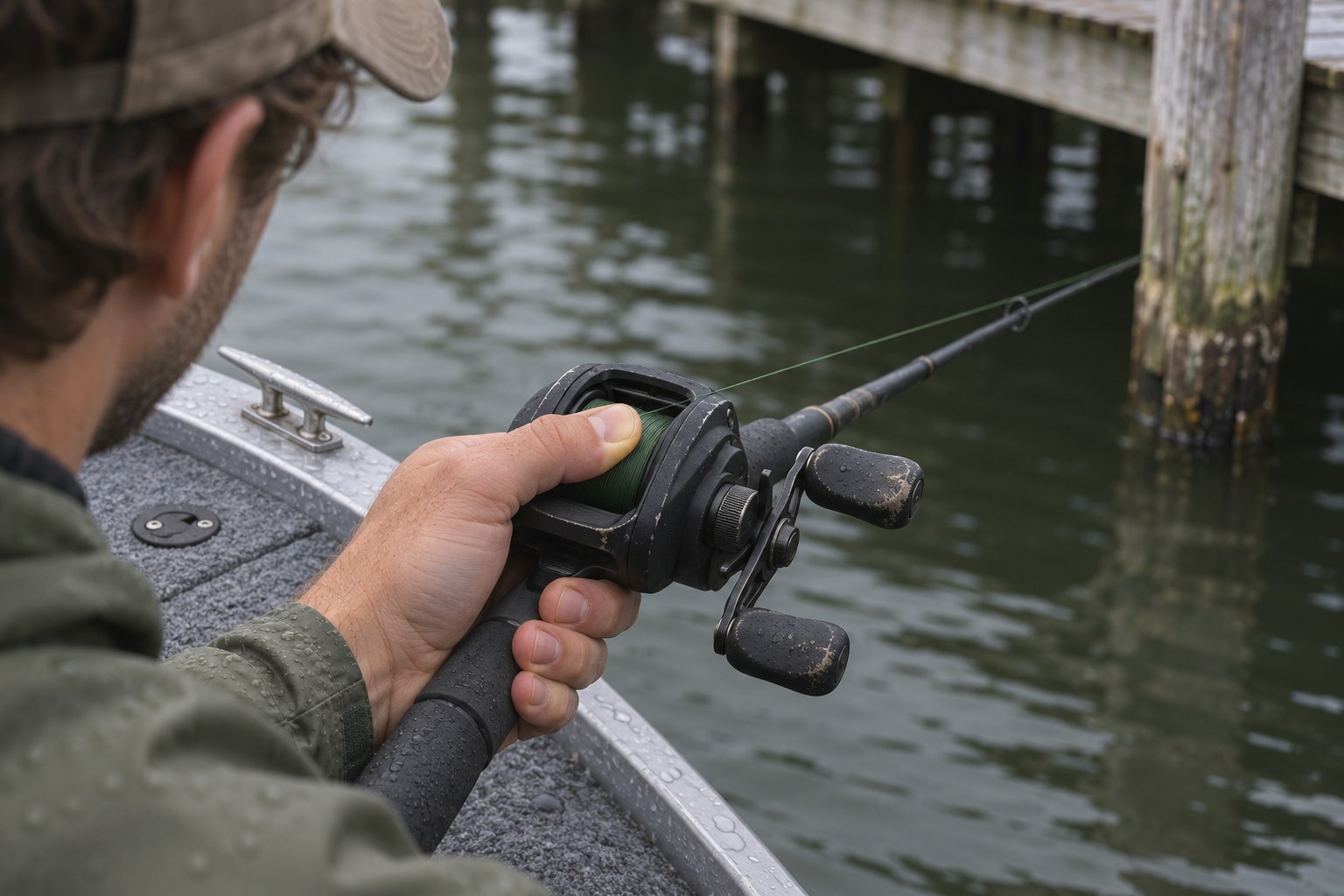
One more line note that matters for both techniques: you want line that flows off the reel easily. Stiff, high-memory line fights a soft underhand cast, and the pitch lands late and loud as a result.
Choosing Weight, Hook, and How to Peg It
Weight is where the two techniques start to look different again, mostly because cover density changes faster than anything else.
For pitching thin cover and fish that aren’t eating aggressively, 1/4-, 5/16-, and 3/8-ounce weights are the working range. The bait falls slowly, stays in the strike zone, and doesn’t bury itself in the bottom muck. In thicker grass and around aggressive fish, step up to 3/8 or 1/2 ounce.
For flipping rigs, 3/8 to 3/4 ounce is standard. Heavier than that and you’ve drifted into punching territory — a different presentation, built around penetrating matted vegetation, that needs much heavier gear than most anglers want to hold all day.
There’s a counterintuitive piece of advice that holds up across nearly every source: err heavier than you think you need. A heavier bait loads the rod, flies straighter, and lands with more accuracy, and accuracy is the entire point of both techniques. If the faster fall bothers you, slow it down with a bulkier bait or a thicker skirt rather than a lighter weight.
Peg the weight. A free-sliding bullet sinker separates from the bait on the cast and again on the fall, which changes where the bait enters the water and how it drops. A bobber stop or a screw-lock weight keeps the two together, so the rig falls as one piece. A small bead between weight and bait adds a click you can feel and hear.
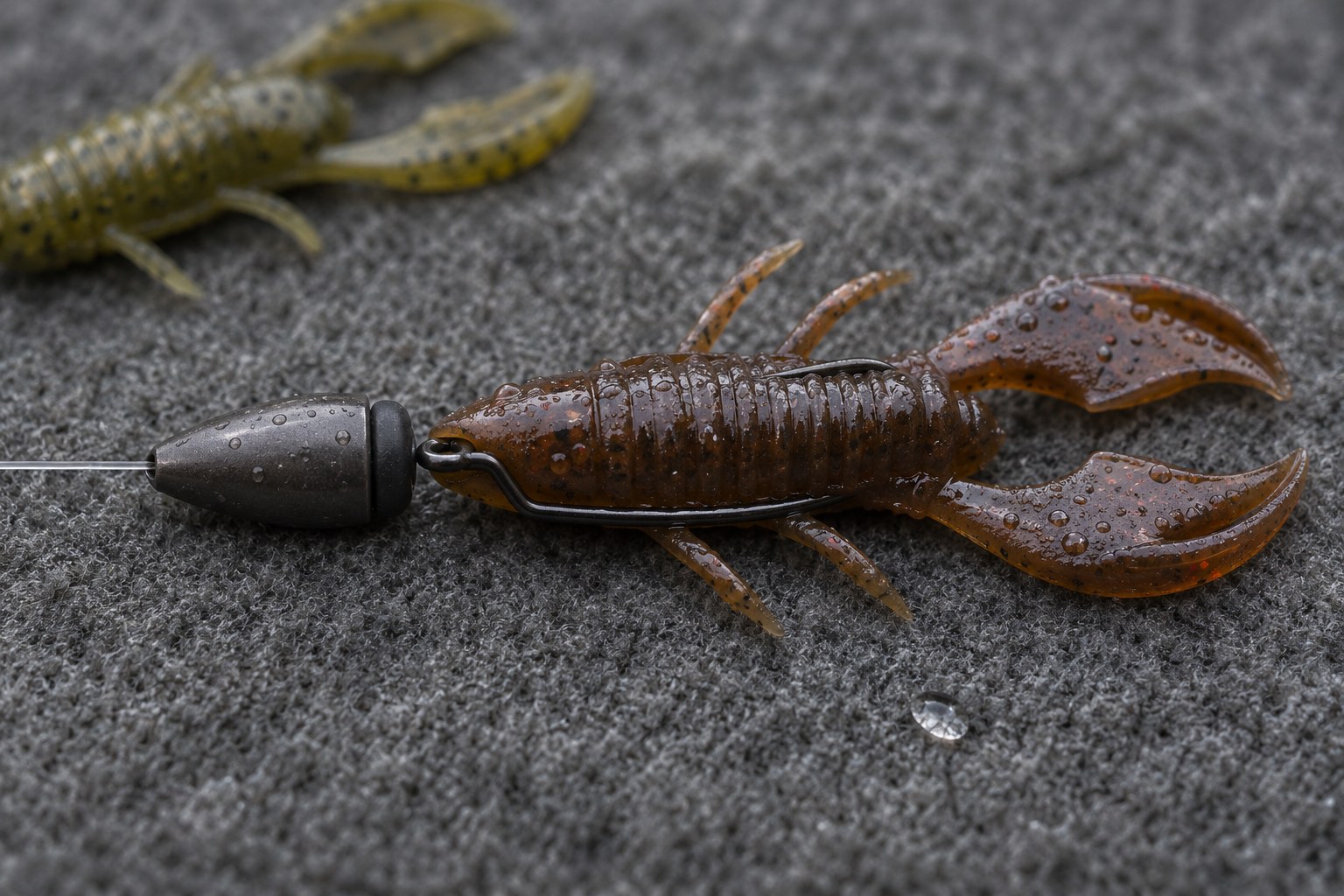
Match hook size to line, not just to bait. Around heavy cover, a 3/0 to 4/0 heavy-wire straight-shank flipping hook is the standard choice. A thin-wire hook with 50-pound braid and a locked-down drag will bend out on the first good fish. The hook is often the weakest link in a setup that’s otherwise overbuilt.
Rod and Reel: Reach, Leverage, and a Fast Retrieve
A 7-foot to 7-foot-6-inch medium-heavy baitcasting rod with a fast tip handles most flipping and pitching. Longer rods, 7-foot-6 to 8 feet, give you more reach on the pitch and more leverage to turn a fish away from cover — worth it if you fish grass and laydowns regularly.
Test this before you buy anything: a rod that loads in its top third pitches more accurately than one that’s stiff to the tip. The lure’s weight should bend the upper quarter of the blank, store that energy, and release it on the forward swing. A rod with no tip action feels powerful in the store and throws sloppy pitches on the water.
On the reel side, you want a baitcaster with a smooth free spool and a reliable drag. Something in the 7.1:1 to 8:1 range is the practical pick. You’re making hundreds of short presentations in a day, and a fast retrieve gets the bait back to the boat so you can make the next one.
The Quiet Entry Is the Whole Point
Everything above serves one outcome: the bait arrives without announcing itself. You’re dropping a lure into a fish’s living room, sometimes within a couple of feet of its face. A splash ends the conversation before it starts.
For a flip, the mistake is releasing the line too early. Feed line out with your off hand all the way until the bait touches down. Let go early and the bait free-falls, hits hard, and the presentation is wasted. Practice into a bucket or a bowl of water and aim for no splash. When there isn’t one, you’ve got it.
For a pitch, your thumb does the work. Feather the spool as the bait approaches the water so it lands with a tick rather than a clunk. The low trajectory helps — a bait that never gets high off the water doesn’t have far to fall.
Once it’s down, keep a semi-tight line and watch the line instead of the bait. A lot of these bites show up as the line jumping or stopping early, not as a thump. If nothing eats it within a few seconds, pick up and move. Working a flipping pattern quickly is part of the technique, not a shortcut around it.
When a fish does take it, reel down until you feel weight and drive the hook hard — a strong hookset that turns the fish’s head and gets it moving up and out of the cover, which is the whole fight in one motion. If it gets its head down and goes, the cover usually wins. Fighting fish out of shallow cover comes down to the first two seconds.
Quick Decision Guide and Common Mistakes
Run through it in this order.
If the water is off-color, or cover blocks the fish’s view of the boat, flip. If the water is clear, the fish can see you, or the target is past about twenty feet, pitch. If you’re not sure, pitch — it covers more water and works in more situations.
The mistakes that cost the most:
- Rigging for a flip and then pitching thirty feet. Seventeen-pound fluorocarbon on a long pitch is an invitation to a break-off. Match line to the distance and cover you’re actually fishing.
- Leaving the weight unpegged. Bait and weight split apart mid-cast and neither one lands where you aimed.
- Running braid on rock without a leader, or light fluorocarbon in grass. Both are the wrong tool for the abrasion in front of you.
- Fishing too fast past good targets and too slow across dead water. Flip and pitch reward precision and pace — both are about making a lot of accurate presentations, not soaking one bait.
The rest is practice. Flipping and pitching look like tricks, but they’re short, quiet, accurate casts. Once the line and weight match the cover, they stop being something you think about and start being something you just do.