
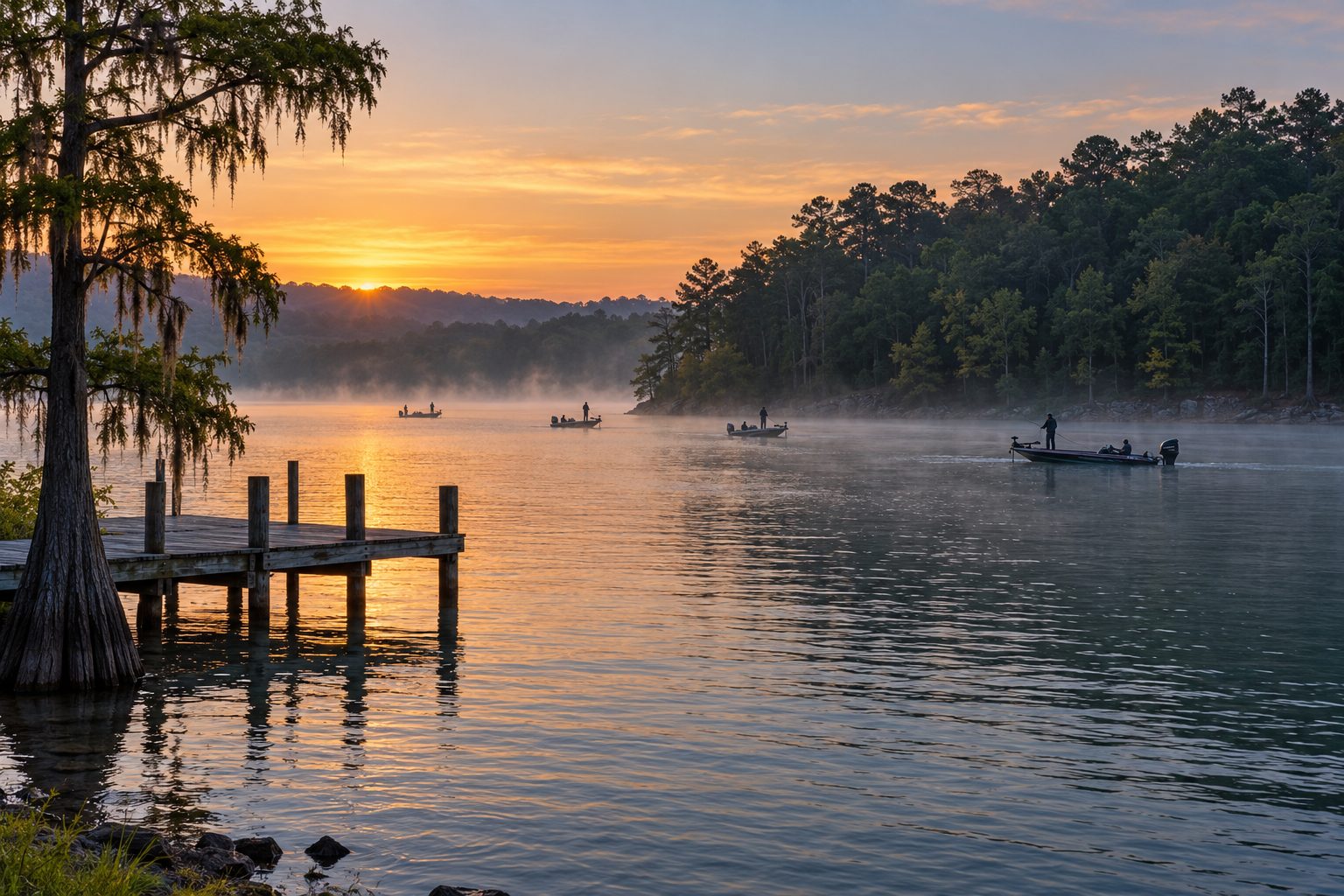
You pull into a public ramp on a Saturday morning and there are already eleven trucks in the lot. By the time you reach your first spot — a laydown on the east bank that always holds a fish — two boats have cast at it, and a third is sitting on it right now with the trolling motor humming.
So you keep fishing anyway. Nothing happens. By noon you’re telling yourself the lake is dead.
It isn’t. The fish are usually within a hundred yards of where you started. Pressure doesn’t empty a lake — it changes how bass relate to the water they’re already in, and it changes how willing they are to eat. Once those two shifts make sense, public water stops feeling like a dead lake and starts looking like a puzzle with a solvable answer.
Why Pressured Bass Aren’t Where You Think They Are
Bass treat people as predators. That’s not a figure of speech; it’s survival instinct. When something keeps passing overhead and dropping strange objects into their living room, safety wins over hunger. A bass that would normally feed along the edge of a grass bed tends to pull back and get defensive.
Two things happen, and they happen fast.
First, if heavy cover is nearby, bass push deeper into it. Not out of the area — tighter into the same cover. They bury in the grass, they tuck under the laydown instead of sitting beside it, they hold on the shaded side of a dock piling instead of in front of it.
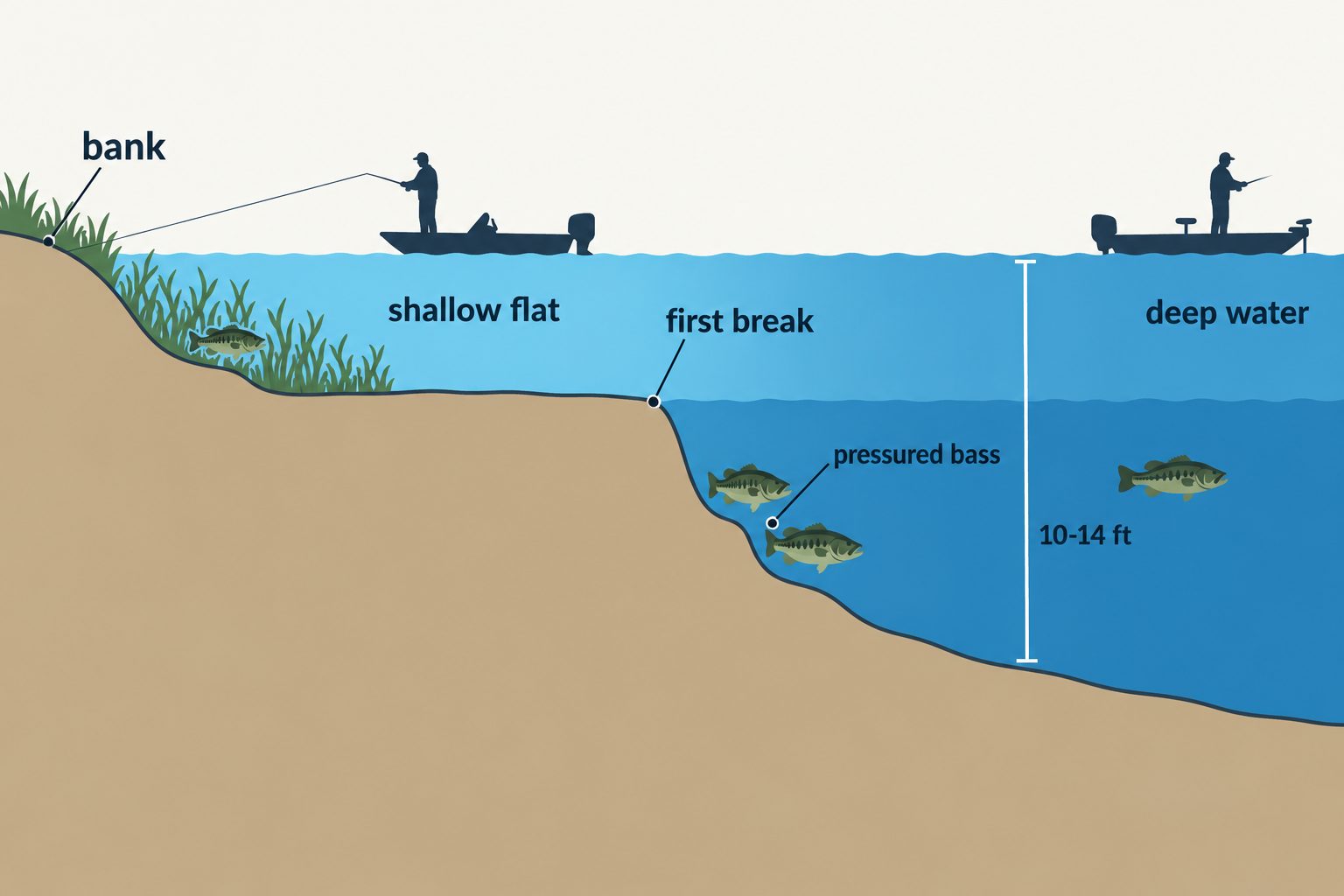
Second, if there isn’t much cover to hide in, bass slide out to the first structural change away from the bank, where the bottom drops and the noise of boats and lures thins out.
What almost never happens is a mass exodus. Anglers assume a pressured area is empty because they stopped getting bit there, but the fish are often still present and simply unreachable or unwilling on last week’s presentation. That distinction matters: “empty” tells you to drive somewhere else, while “there but suspicious” tells you to change how and where you’re casting.
Where the Crowd Actually Goes (Build a Pressure Map)
Before you think about structure, think about access. Fishing pressure is not evenly distributed, and it isn’t random. It follows the path of least resistance.
The crowds concentrate in predictable places:
- Launch ramps and marinas, plus the water immediately around them
- Docks and piers, especially where people live on the water
- Any bank with mowed grass, a parking area, or a short walk from the lot
- Visible shallow cover — the laydown you can see from twenty yards away
- Any cove holding a tournament that day
Those areas get hammered. Fish there see a dozen different lures in a weekend.
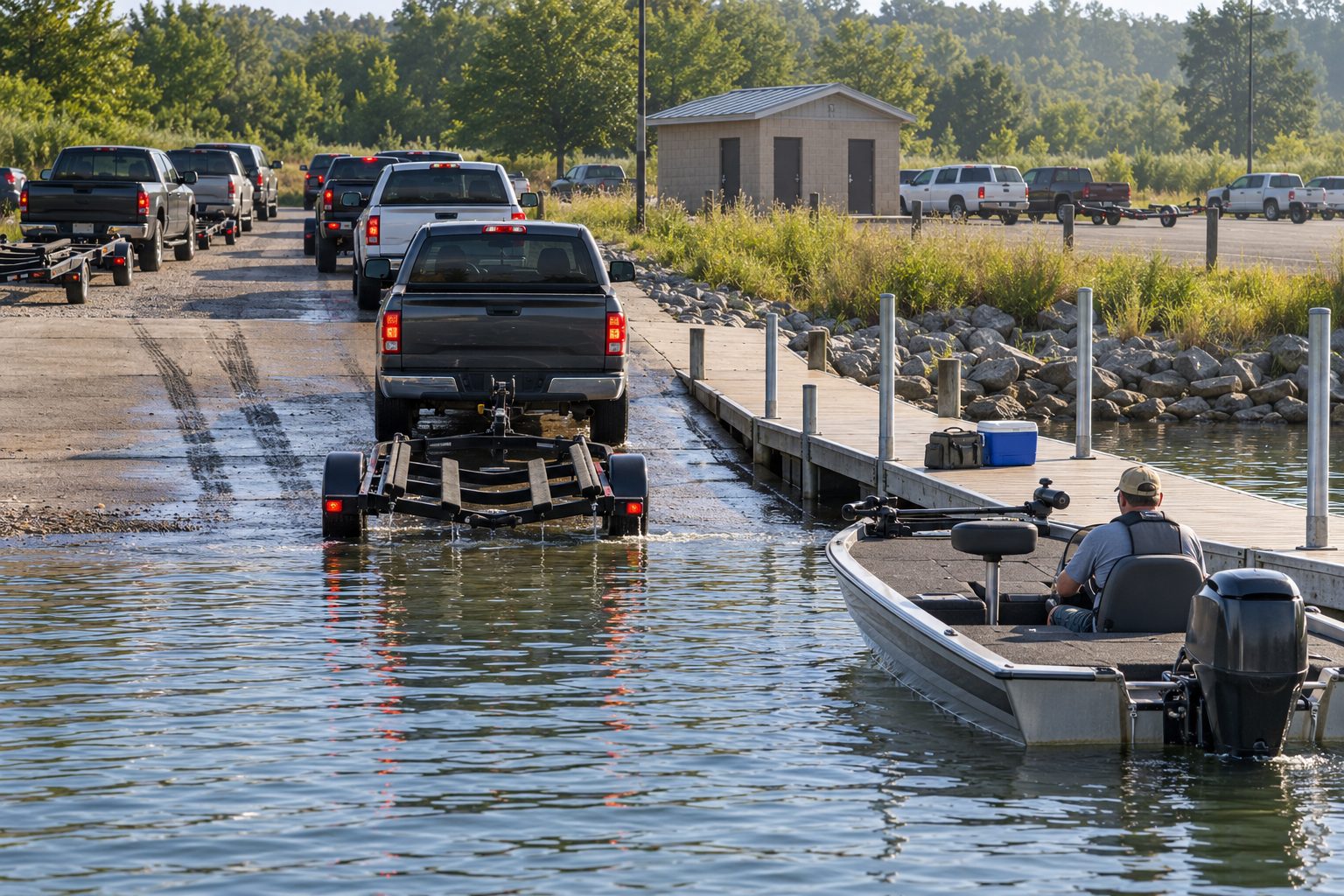
There’s a physical effect people miss, too. Heavy boat traffic chops the surface, muddies shallow water, and pushes fish off flats they’d otherwise use. On water with lots of recreational traffic, a shallow flat that looks perfect can be genuinely unusable by mid-morning — not because the fish are educated, but because the conditions are wrong.
So build a mental pressure map before your first cast. Name the three easiest spots to reach on that lake, then skip all three. You’re not avoiding them forever — you’re avoiding them at 8 a.m. on a Saturday, when they’re at their worst.
The First Break Outside the Bank (and the Structure Boats Skip)
Here’s the most useful pattern in pressured-water fishing: when pressure gets heavy, bass move to the first ledge, drop, or hump outside the bank. Guides who fish crowded water talk about it constantly, and they commonly find pressured fish holding somewhere in the 10- to 14-foot range — often directly under the boats that are casting at the shoreline.
That last detail stings. The fish are frequently below the boat, not in front of it.
Back off the bank. Instead of casting parallel to the shoreline, position outside the shallow flat and cast to the break where the bottom falls away. If you’re on foot, this is the water you reach with a long cast, or by wading to the edge of the flat and fishing the drop beyond it.
Submerged structure is the second half of the pattern. A point, hump, brushpile, or old roadbed that isn’t visible from the surface holds fish that have seen far fewer lures than visible bank cover does. Most anglers fish what they can see, which means the unmarked stuff quietly reloads.
If you’re still learning to read that kind of structure, our guide to reading a lake and finding where fish hold covers the fundamentals — points, breaks, and the depth changes that matter most.
One more thing about structure: be thorough instead of busy. Most anglers pull up to a brushpile or hump, make four casts, and leave. On pressured water, a high-percentage spot deserves twenty minutes and several angles — casting into it, along it, and across the deep side of it. Guides who make their living on crowded lakes sit on one spot and grind it while everyone else runs the bank.
Deep Fish Nobody Targets
Depth isn’t only a summer pattern. Outside the spawn, part of the bass population lives deep all year, and that segment is systematically under-fished — partly because it takes electronics to find, partly because most people would rather cast at something they can see.
Deep fish also tend to be less conditioned. They see fewer lures, and the ones they do see come from the small group of anglers willing to fish that way.
Typical deep presentations are slow and bottom-oriented: a football jig dragged across rock, a drop shot worked vertically under the boat, a Carolina rig pulled along a ledge. You’re not covering water; you’re presenting to fish you’ve already located on a screen.
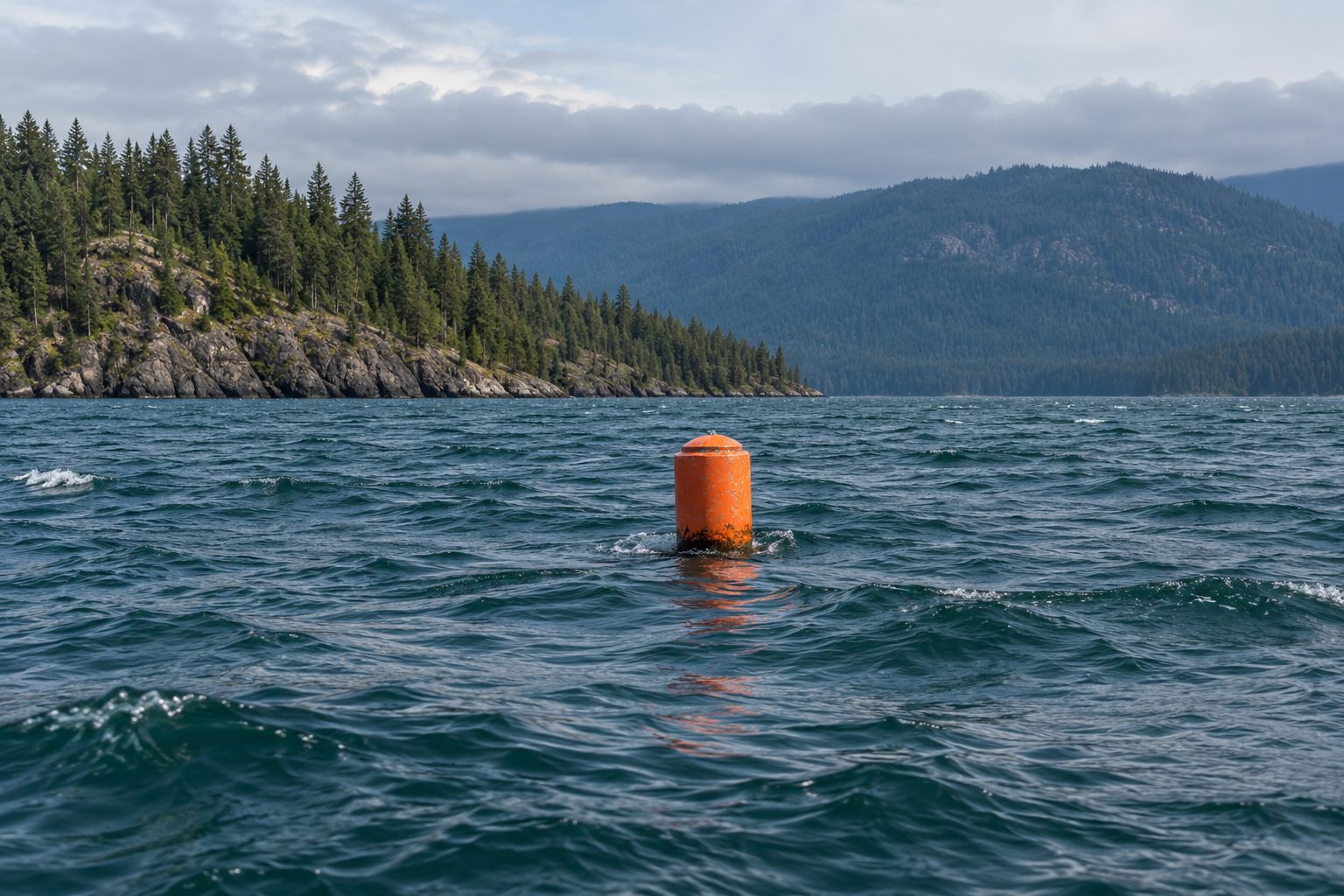
That’s the honest trade-off. Deep fishing takes longer to learn because you’re reading a fish finder instead of sight-fishing a bank. Start with one known point or hump rather than hunting the whole lake, and if you’re still getting comfortable with sonar, our breakdown of side imaging versus down imaging explains what each view is actually showing you.
There’s supporting evidence in how pressured lakes fish week to week, too. On public water with heavy traffic, the shallow bite often skews toward smaller males while bigger fish sit deeper — which is what you’d expect if the shallow zone is the part getting pounded.
Shallow Water Boaters Won’t Reach
The deep-water answer gets all the attention, but there’s a second refuge, and it’s the opposite: shallow water that’s too much work for anyone else.
The extreme upper ends of creek arms are the classic example. They’re often too skinny for recreational boaters, and plenty of bass anglers won’t make the effort to find the creek channel that threads around the mud flats guarding the entrance. Anglers who push up there routinely find fish that haven’t been worked over.
The same logic applies to stump flats, backwater pockets, and any stretch that requires idling through timber to reach.
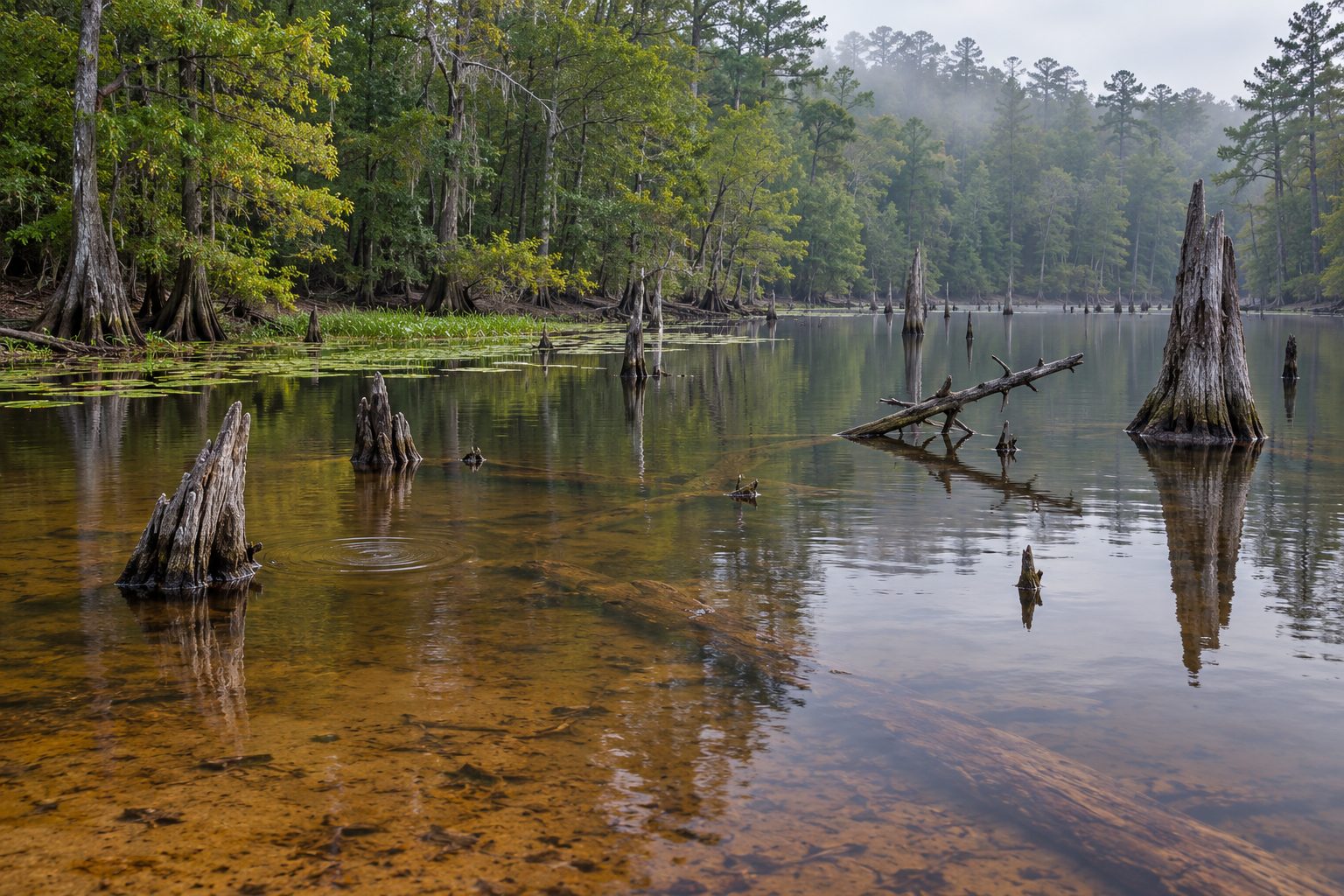
For bank anglers, the version of this is simply walking. If one stretch is mowed and thirty feet from the parking lot, and the other side of the pond sits behind a treeline with a steep entry, almost nobody fights through to the far side. That’s usually where the fish have retreated.
Two adjustments matter in shallow pressured water. Keep casts long and entries quiet, because spooky fish in two feet of water feel a lure land. And fish slowly — pressured shallow bass often hold tight to a single stump rather than roaming a whole flat.
Fishing the Clock: Timing Around Pressure
Timing is the cheapest adjustment available. It costs nothing, needs no new gear, and it can double your odds on water that gets hammered every weekend.
Casual pressure follows a schedule. The average weekend angler isn’t launching at 5 a.m., and isn’t fishing in wind, heavy overcast, or temperatures that aren’t comfortable. They fish the nice middle of the day, in good weather, on days off.
Fish the inverse:
- First light and last light. The crowd shows up late and leaves early relative to the bite.
- Ugly weather. Wind, rain, and gray skies send most people home while fish keep feeding.
- Midweek. A lake that gets pounded Saturday and Sunday fishes noticeably differently by Tuesday.
- After dark. On pressured summer water, nighttime is when big fish move shallow with far less disturbance.
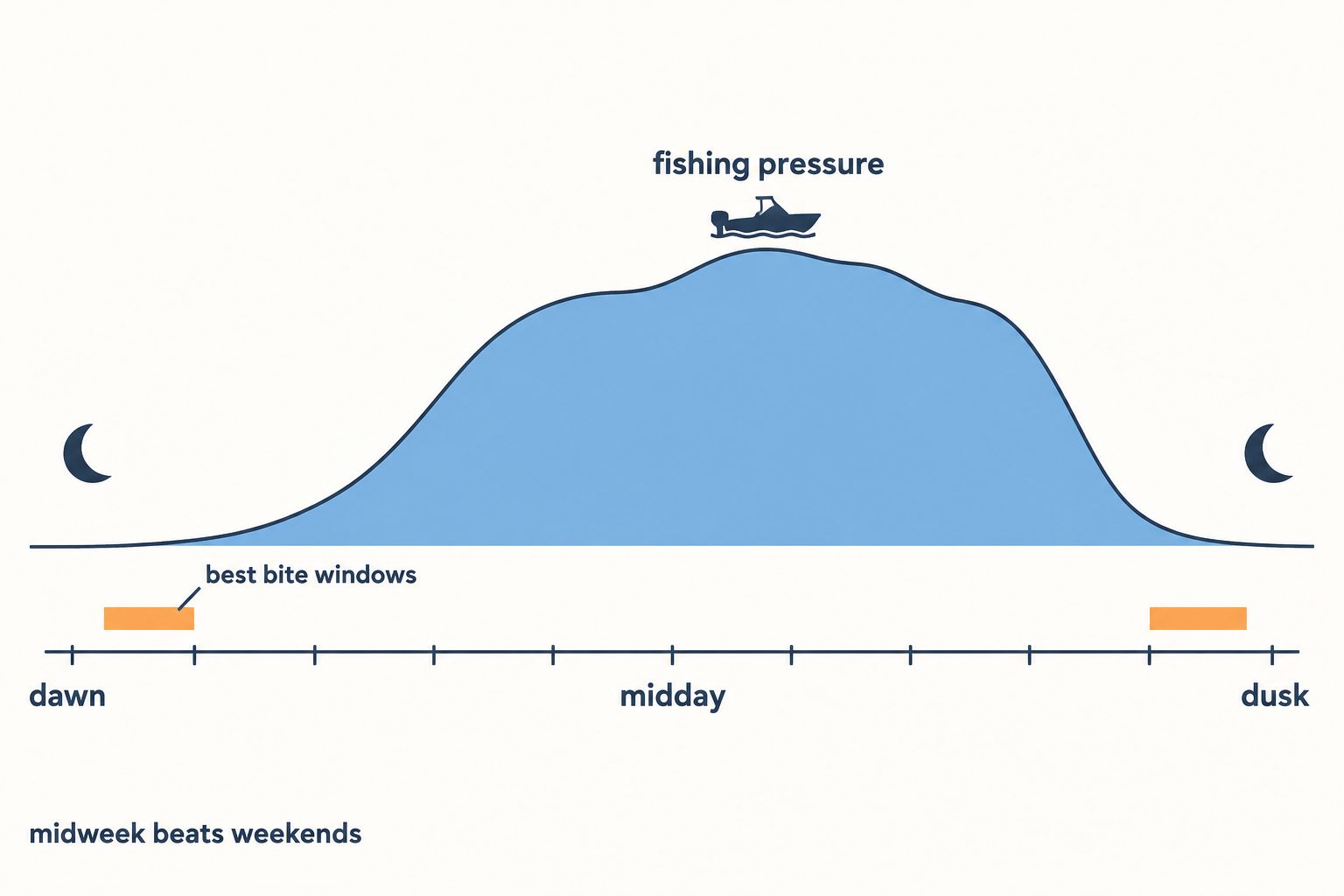
Lakes recover, too. Days without heavy pressure tend to restore a more normal bite on community water, which is why the angler who fishes Tuesday afternoon often out-fishes the weekend crowd on the same spots.
One habit worth stealing: fish the ramp. Weigh-in fish get released at the marina, and almost everyone leaves immediately to run somewhere else. Sometimes the best water of your morning is thirty yards from your trailer.
Refining Presentation for Conditioned Fish
Location gets you to fish. Presentation gets them to bite.
Conditioning is real, and it’s behind most “the lake is dead” complaints. Bass learn. Repeated exposure to the same bait shape, color, rattle, and retrieve speed in the same water dulls the response, because a fish’s survival instinct eventually flags “that thing again” as not-food.
The refinement levers, roughly in order of impact:
- Slow down and pause longer. Speed is the first thing conditioned fish reject. A bait that sits still three seconds longer than you’re comfortable with often gets eaten.
- Downsize the profile. Smaller baits with subtler action draw fewer refusals from fish that have seen the full-size versions all week.
- Go more natural on color. Subdued, forage-matching colors beat chartreuse and loud flake in clear, pressured water.
- Quiet the bait. Rattle-free versions and softer presentations help when fish are wary.
- Lighten the line. Eight-pound fluorocarbon is a reasonable default, down to six in extremely clear or deep water, up to ten around cover.
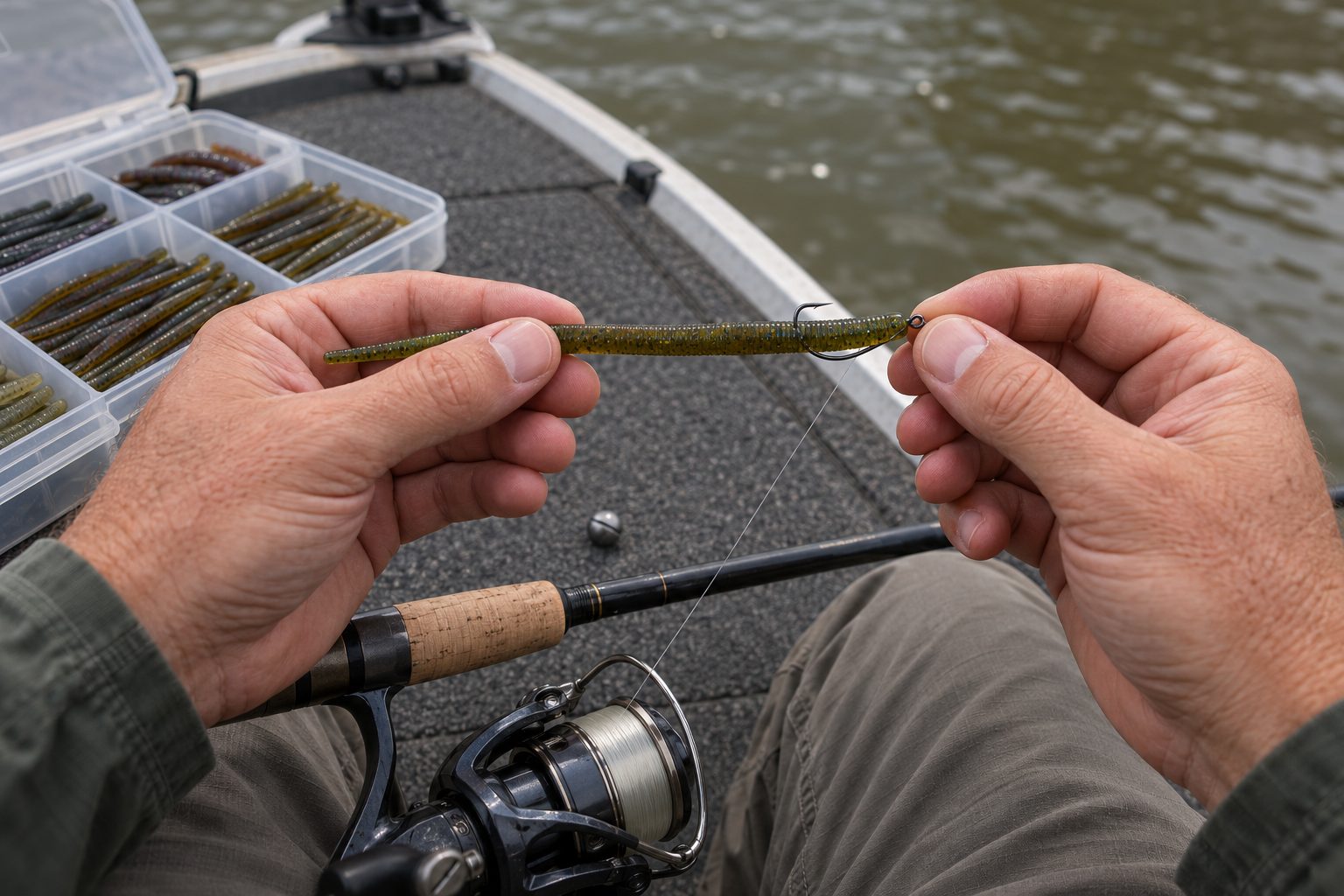
Worth understanding: finesse isn’t really a category of lure. It’s a way of presenting. You can finesse a crankbait by slowing the cadence, or a spinnerbait by killing it on the fall. If you want rigging details, our Ned rig setup guide walks through the tackle, and the finesse fishing breakdown covers when light line and small baits beat power fishing.
The last piece is precision. Fewer, better-placed casts beat spraying the water. When you’re casting to a specific piece of cover on pressured water, one quiet, accurate entry is worth ten loud ones — and the first cast to a piece of cover is usually the best one you’ll get.
Putting It Together: A Pressured-Lake Game Plan
Here’s the whole approach as a routine you can run on your next trip to crowded water.
1. Build the pressure map first. Name the three easiest spots to reach and skip them at peak hours.
2. Start on the first break. Fish the ledge or hump outside the bank — and remember the fish may be directly under the boat, not in front of it.
3. Fish fewer spots, more thoroughly. Twenty minutes and multiple angles on a high-percentage spot beats twenty spots with four casts each.
4. If that’s empty, expand in one direction. Either go deeper with electronics and a slow bottom presentation, or go shallower into water boat traffic can’t reach. Pick one and commit.
5. Fish the window, not the clock. Dawn, dusk, bad weather, midweek, after dark.
6. Refine before you relocate. Slow down, downsize, quiet the bait, lighten the line. Exhaust presentation before deciding a spot is empty.
7. Write down what produced. Pressured-lake patterns repeat. A ledge that gave up three fish in July is worth checking again next July.
Public water is never going to be easy, and no article changes that. But pressure is a variable you can plan around, and it follows rules — the crowd goes where it’s easy, so the fish don’t. Once you start fishing the second-best-looking water instead of the best-looking water, crowded lakes get a lot more interesting.