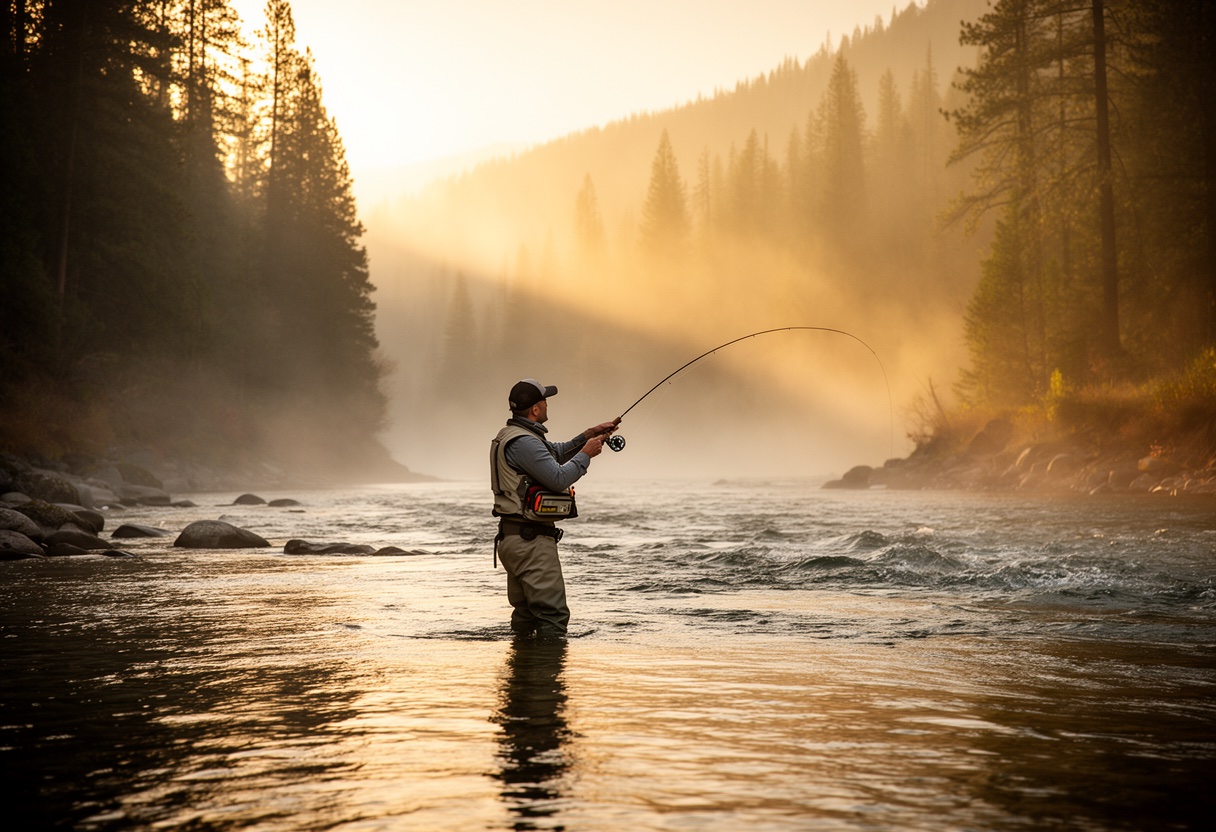
Fly fishing looks intimidating from the outside. There’s the expensive gear, the complicated knots, and casting that looks like it requires years of practice. Most beginners stand at the edge of a stream holding a fly rod and wonder where to even begin.
The good news is that fly fishing is simpler than it looks. You don’t need a $500 setup or a fishing degree to catch your first fish. This guide walks you through everything from choosing your first rod to landing fish on the water.
What Makes Fly Fishing Different (and Why It’s Worth Learning)
If you’ve ever gone spin fishing or used a baitcasting setup, fly fishing feels like a completely different sport. In conventional fishing, the weight of your lure or sinker pulls the line through the air. The rod is mostly there to hold the line and fight fish.
In fly fishing, the line itself is weighted. The fly — your artificial lure — weighs almost nothing. You’re casting the line, not the fly. The rod bends and stores energy like a spring, then unloads that energy into the heavy fly line to carry the fly forward.
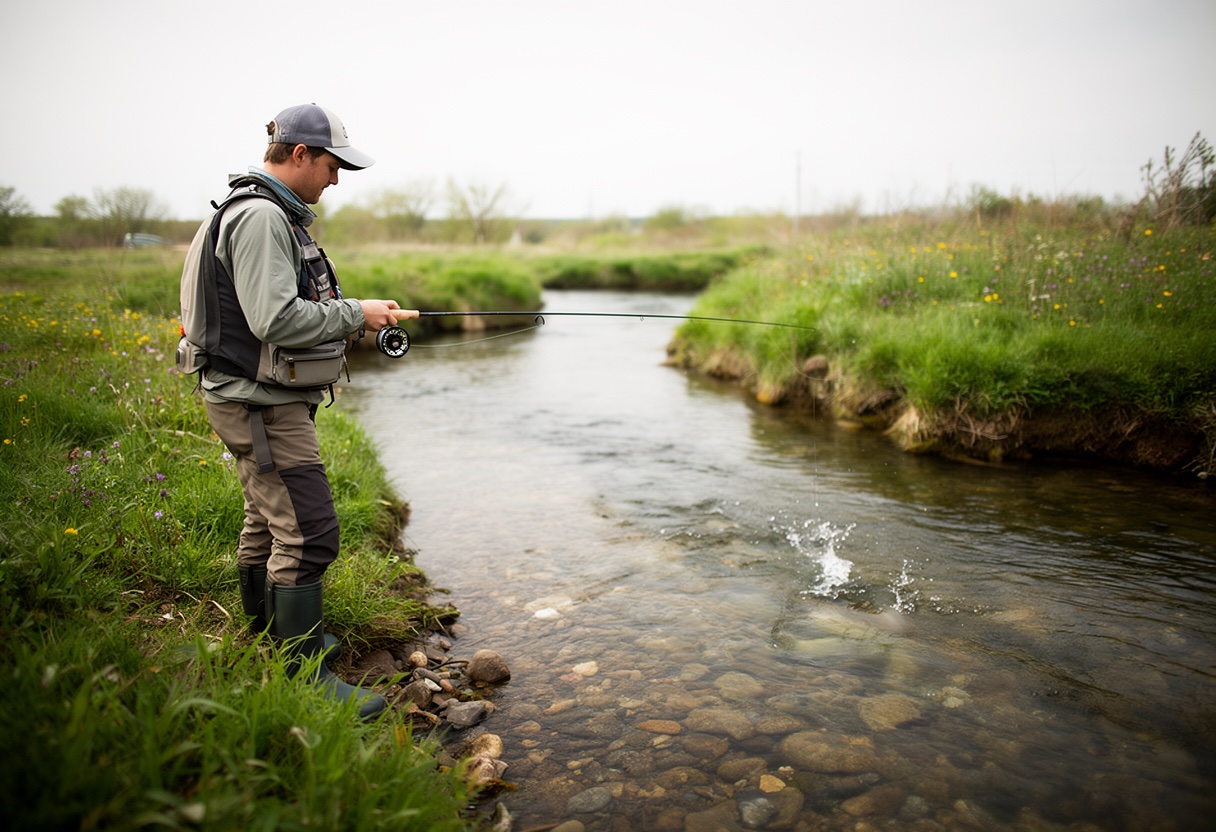
This is why fly casting feels so different from conventional casting techniques. Instead of a simple flick and retrieve, you’re managing the weight of the line with smooth strokes and deliberate stops. It takes practice, but the learning curve isn’t as steep as most people expect.
There’s also a practical reason to learn fly fishing. It opens up waters and species that are hard to reach with other methods. Shy trout in clear, shallow streams typically spook at the sight of a weighted lure splashing down. A fly drifting naturally on the surface is much less alarming.
The cost is another surprise. A complete beginner setup — rod, reel, line, leader, and a basic selection of flies — typically runs between $130 and $365. You don’t need to invest a fortune to start catching fish.
What Fly Fishing Gear Do You Actually Need?
Fly fishing stores can make the gear selection feel overwhelming. Rows of rods, reels, and lines in different weights and tapers can freeze anyone who’s never held a fly rod before.
Start with these essentials:
A fly rod. Fly rods are rated by weight (1 through 12+), not by power like conventional rods. The weight tells you what weight fly line the rod is designed to cast. A 5-weight rod is the universal recommendation for beginners. It handles trout-sized fish comfortably and works across most freshwater situations. Stick with a 9-foot rod — it’s the standard length for rivers, streams, and ponds.
A reel. The reel’s job is straightforward: hold line and provide drag when a fish runs. For trout and panfish, a basic reel with a smooth drag is more than enough. You don’t need a fancy reel to get started. A budget reel in the $30–$60 range handles everything beginners typically encounter. For more detail on what to look for, check out our guide to choosing a fishing reel.
A fly line. This is the thick, weighted line that attaches to your reel and does all the work of carrying your fly through the air. We’ll cover line types in the next section, but the short answer is: grab a Weight Forward Floating line and you’re covered.
A leader and tippet. These connect your thick fly line to your tiny fly. Pre-tied leaders are available and save beginners a lot of frustration. You’ll also need a small spool of tippet material to replace the section nearest the fly after each catch.
A selection of flies. You don’t need dozens. A basic box of 10 to 15 flies covering dry flies, nymphs, and one or two streamers will handle most situations.
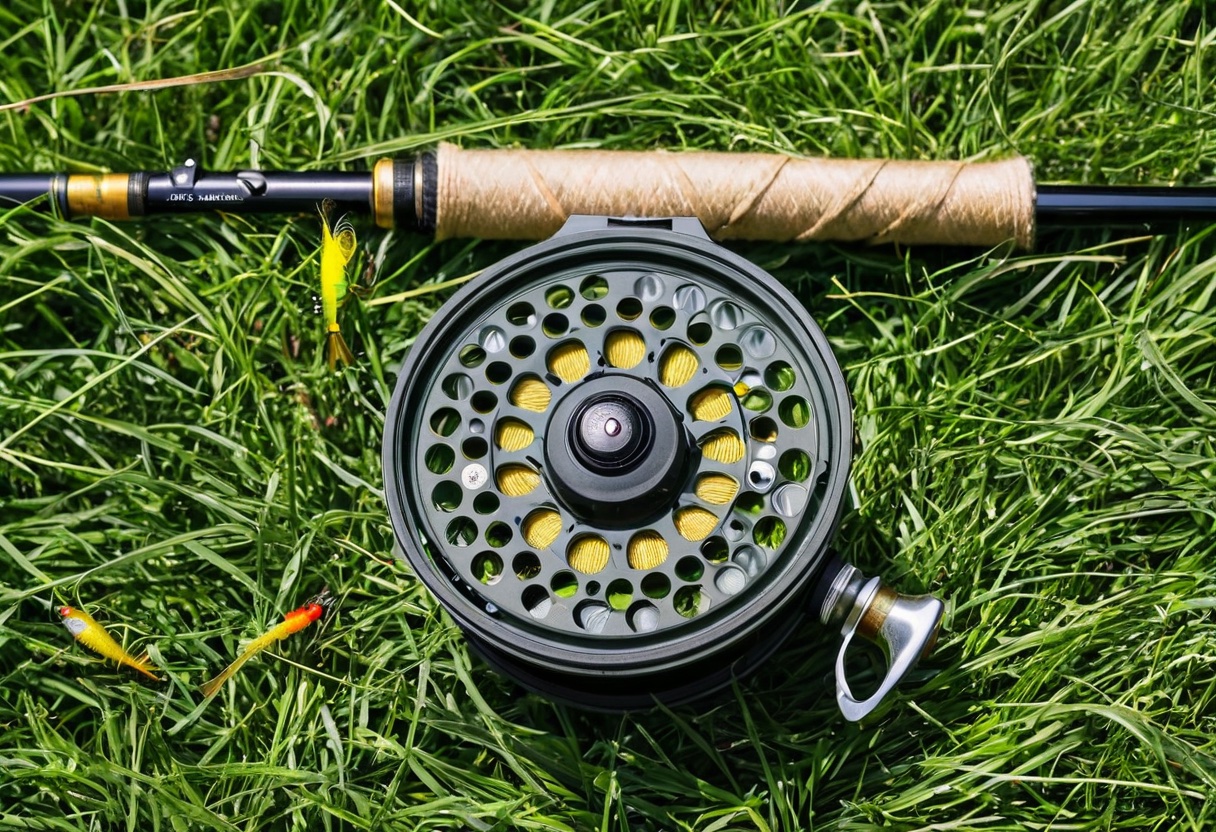
Here’s what a realistic first-time budget looks like: a combo rod and reel with line runs $100 to $300. Add $10 to $15 for leaders and tippet spools, and another $15 to $30 for a beginner fly selection. That’s $130 to $365 total for everything you need to get on the water.
Understanding Fly Lines, Leaders, and Tippet
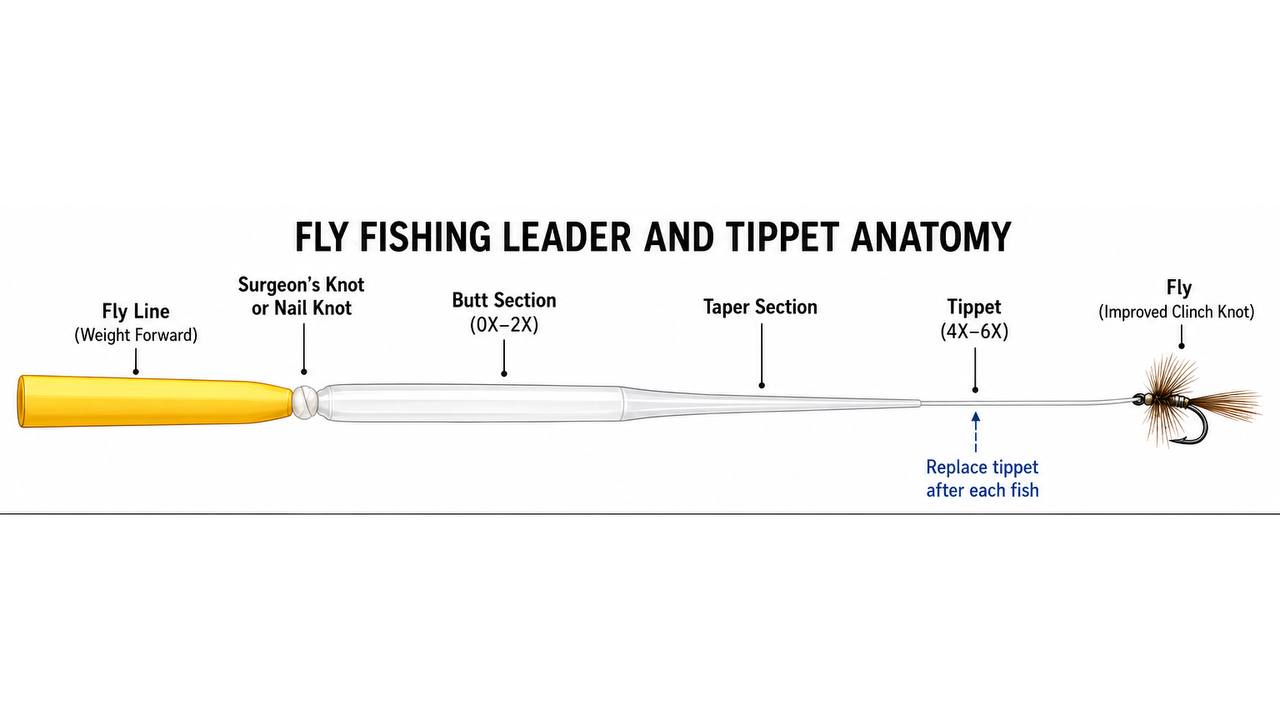
This is the part that trips up most beginners. Fly fishing uses three connected pieces of line, each with a different job. Understanding how they work together makes the whole system make sense.
The fly line is the thick, brightly colored line that sits on your reel. It has weight and density built in so you can cast it. Without a heavy fly line, there’s nothing to carry the weightless fly through the air.
The leader is a tapered piece of clear monofilament or fluorocarbon, typically 7.5 to 9 feet long. One end connects to your fly line, and the other end connects to your tippet. The leader gets progressively thinner from thick to thin. The thicker section near the fly line transfers casting energy, and the thin section near the fly helps it land softly on the water.
The tippet is the thinnest section, sitting directly above the fly. Tippet is sized using the “X” system, where a larger number means thinner material. A 4X tippet is roughly the thickness of a human hair. A 6X tippet is noticeably thinner. The thinner the tippet, the more natural your fly appears underwater — but also the more fragile it is.
Matching tippet to fly size follows a rough rule of thumb: divide your fly size by 3 to get your tippet X. A size 12 fly pairs well with 4X tippet. A size 18 fly works better on 6X. This isn’t a strict rule — there’s plenty of overlap, and fishing a size 14 Adams on 4X tippet is perfectly common.
A few notes on fly lines themselves. Weight Forward (WF) lines have their mass concentrated in the front section, called the head. This design carries the fly well and pulls the running line behind it. Weight Forward is the most versatile choice for beginners. Double Taper (DT) lines are symmetrical, with the same taper on each end. They’re traditional and work well for short casts and delicate presentations, but they’re less forgiving for someone still learning.
Floating lines are the place to start. They stay on the surface and let you fish dry flies, nymphs, and small streamers across most freshwater situations. Sinking lines exist for specialized applications, but beginners don’t need to worry about them yet.
Leaders are consumable. You don’t replace the entire leader after every fish. Instead, you cut off the worn tippet section near the fly and tie on a fresh piece of tippet material. The leader itself can last for many fishing sessions.
Your First Cast: Overhead and Roll Cast
Fly casting is fundamentally different from spinning or baitcasting, but the two basic casts you need to learn are straightforward once you understand what the rod is doing.
The overhead cast is your primary cast. Here’s what happens: you draw line back behind you, which loads (bends) the rod. The rod stores energy in that bend. Then you make a forward stroke with smooth, building acceleration — and stop abruptly. The stop is what matters. When the rod stops, all that stored energy transfers into the line and sends it flying forward.
Practice this in an open field before you ever hit the water. Aim for consistent 15 to 20 foot casts before worrying about distance. Watch what the line is doing. You should see the rod bend during your stroke and then straighten sharply at the stop.
The most common beginner mistake is jerking the rod instead of accelerating smoothly. A jerky stroke doesn’t load the rod properly, and the line never unloads cleanly. Think of it like swinging a whip — smooth buildup, then a hard stop.
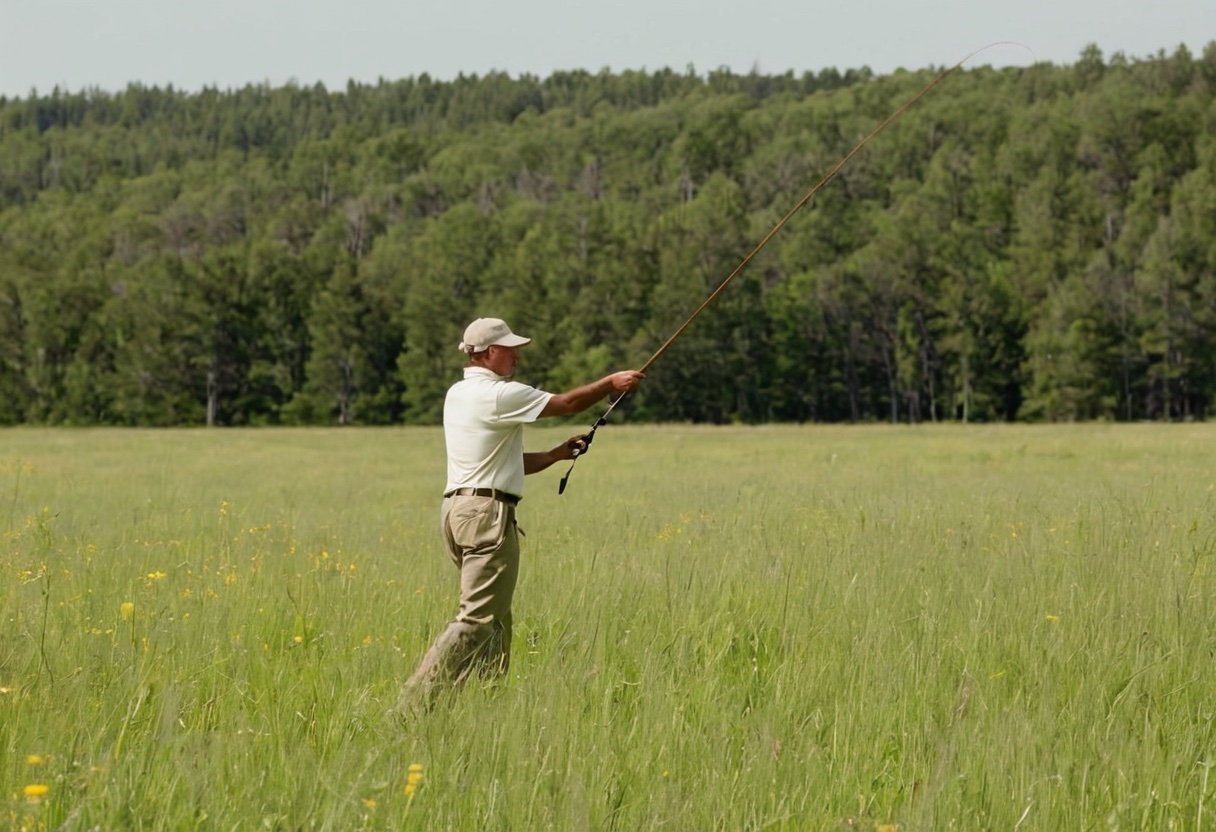
The roll cast is your second essential cast. You use it when there’s no room to cast behind you — trees hanging over the water, steep banks, or other anglers nearby. Start with the rod tip around 2 o’clock. Sweep the line to the side in a smooth motion, then make a short, firm forward stroke. The line rolls over the water’s surface and shoots forward without any backcast.
The roll cast is less efficient than the overhead cast for distance, but it’s incredibly practical. You’ll find yourself using it more often than you expect.
Both casts rely on the same principle: load the rod, accelerate smoothly, and stop deliberately. Once you feel that rhythm, fly casting starts to click.
Essential Knots for Fly Fishing
You only need to know two or three knots to fly fish effectively. These are the ones that matter:
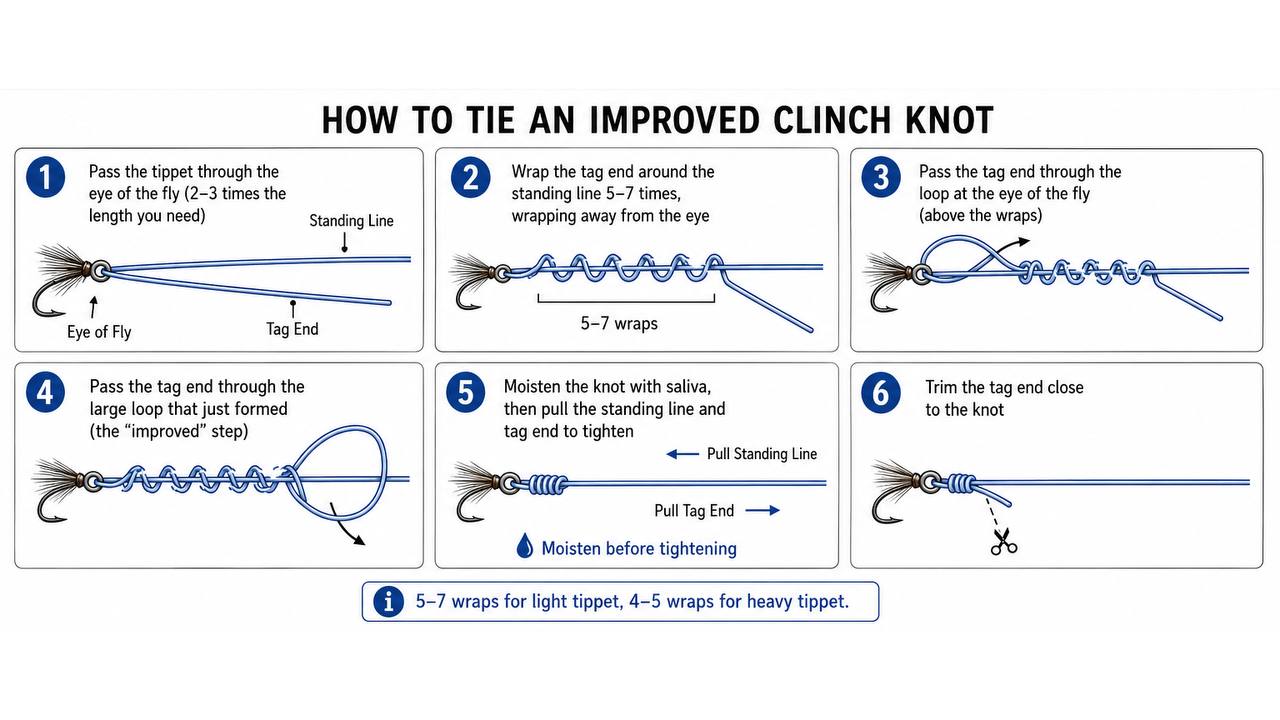
Improved Clinch Knot. This is the knot you’ll use most often — it ties your fly to your tippet. It’s simple, strong, and works reliably across different leader sizes. Pass the tippet through the eye of the fly, wrap the tag end around the standing line five to seven times, then pull the tag end through the loop near the eye. Moisten the knot before tightening — dry knots lose significant strength.
Surgeon’s Knot. Use this to splice on new tippet material to your existing leader. Overlap the two line ends, make two loops instead of one (that’s what makes it a “surgeon’s” rather than a “simple” knot), and pull tight. It’s quick and reliable for replacing worn tippet sections.
Nail Knot. This connects your fly line to your leader. Most beginners won’t need to tie this knot because pre-tied leaders handle the connection for you. As you get more comfortable, you can learn it for custom leader builds.
A good tip: always wet your knots before tightening. The friction of pulling a dry knot tight generates heat that weakens the line. A quick dip in water or a lick of your lips preserves knot strength. For visual learners, animated knot tutorials at sites like AnimatedKnots.com walk through each step clearly.
Essential Flies Every Beginner Should Own
You don’t need a fly box full of 50 different patterns to catch fish. Trout typically spend 70 to 90 percent of their feeding time eating nymphs — the underwater immature stages of insects. This means nymph fishing will produce more results for beginners than dry fly fishing.
Start with a focused selection:
Dry flies float on the surface and imitate adult insects. These are the iconic flies that most people picture when they think of fly fishing.
- Parachute Adams (size 14–18): A general-purpose dry fly that works in most situations.
- Elk Hair Caddis (size 12–14): Imitates caddisflies, which hatch frequently throughout the season.
Nymphs represent underwater insects and are where most of the action is.
- Pheasant Tail (size 12–16): A versatile nymph that works in nearly any stream.
- Hare’s Ear (size 12–14): Suggests movement and life in the water, effective across seasons.
- Zebra Midge (size 16–20): Small but deadly — midges are often the smallest insects fish feed on.
Streamers imitate small baitfish or large insects and trigger aggressive strikes.
- Woolly Bugger (black and olive, size 6–10): The most widely used streamer pattern. Works for trout, smallmouth bass, and even salmon.
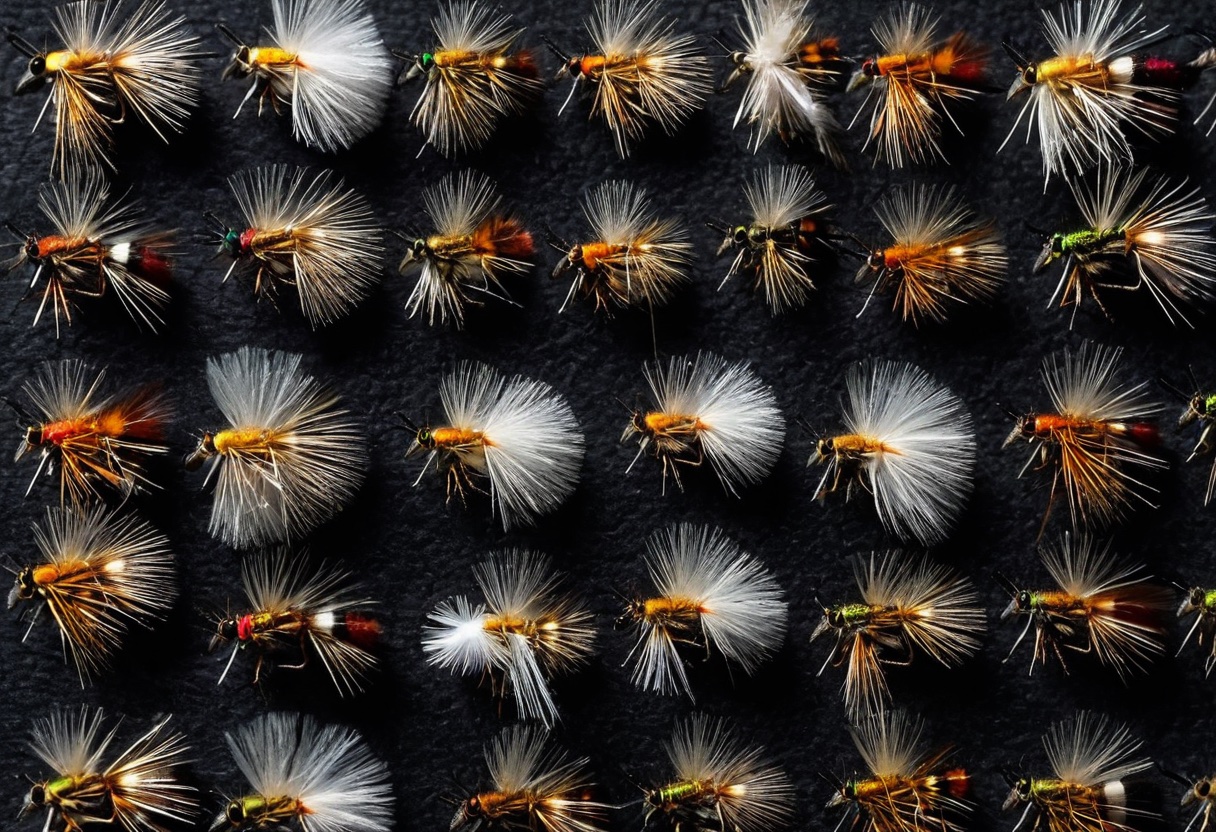
A pre-packaged beginner fly selection costs $15 to $30 and typically covers all three categories. This is a smarter first purchase than buying individual flies, which can add up quickly. Quantity matters less than having the right patterns in your box.
Catching Your First Fish on a Fly
You’ve got your gear, you’ve practiced casting in the field, and you’ve tied on your first fly. Now it’s time to actually fish.
Start where fish are easy to find. Stocked trout streams, small rivers, and local ponds are forgiving places to learn. These waters tend to hold fish in accessible areas, and the fish are often less wary than wild trout in remote streams. For more on targeting trout specifically, our trout fishing guide for beginners covers species behavior and habitat in detail.
Dry fly fishing is the most visual style. Watch the water for rising fish — small disturbances on the surface where a fish is coming up to eat. Cast upstream and slightly to the side of where you see activity. Let the fly drift downstream naturally, carried by the current. This is called a “dead drift,” and it’s the key to success. If the line pulls the fly unnaturally through the water, fish typically notice.
Nymph fishing is often more productive for beginners because trout spend most of their time feeding below the surface. You’ll typically use a small indicator — a floating bobber — to show when a fish picks up your nymph beneath the surface. Cast upstream, let the nymph drift downstream behind the indicator, and watch for a subtle twitch or a hard pull.
Setting the hook on a fly rod is different from a spinning rod. You don’t jerk violently. Instead, raise the rod smoothly and strip the line with a firm, deliberate motion. The loaded rod does the work.
When you land a fish, handle it with care. Wet your hands before touching the fish to protect its slimy coating. Minimize the time it spends out of the water. If you’re releasing it, hold it gently in the current until it swims away on its own. Our catch and release guide covers the details of handling fish safely.
Fly fishing rewards patience and practice more than expensive gear. Your first few trips might be more about learning the rhythm of casting and reading the water than filling the creel. That’s normal. Every angler starts exactly there, and the fish eventually start coming.