
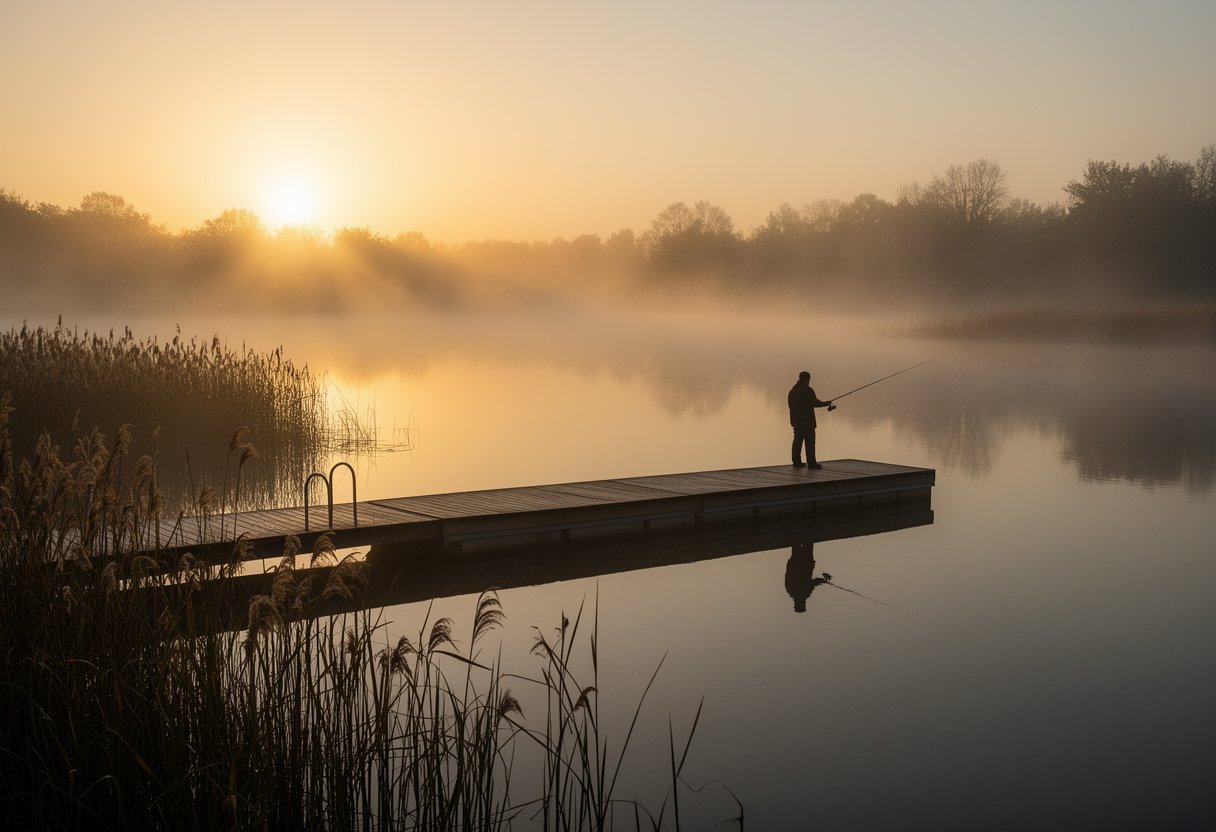
You’ve learned how to cast. You’ve tied your first knot. You’ve even landed a fish. But what do you actually do with it? What are the unwritten rules that separate someone who just fishes from someone who fishes well?
If you’re a beginner, you probably don’t know about the slime coat on a fish’s body, or why you need to keep your hands wet, or what “Clean, Drain, Dry” means. These aren’t complicated concepts — they’re just things that no one told you. This guide covers the practical side of fishing ethics: how to handle fish so they survive, how to share the water with other anglers, and how to protect the places you love to fish. Because the fish you release today are literally the fish you’ll catch next season.
Why Fishing Ethics Matter — It’s About Tomorrow’s Catch
Ethical fishing isn’t about being preachy. It’s about making sure there are still fish in the water when you come back.
When you damage a fish’s slime coat by handling it with dry hands, or leave it gasping on the bank for too long, that fish typically doesn’t survive long enough to reproduce. When you ignore size limits and take every fish you catch, you reduce the breeding population. When you trample the shoreline and destroy the vegetation where juvenile fish hide, you destroy the nursery that stocks that water.
Conservation funding comes from anglers. Your fishing license, your stamps, and your gear taxes fund the state agencies that stock fish, monitor water quality, and manage habitats. According to the U.S. Fish and Wildlife Service, anglers contribute over $1 billion annually to conservation programs through the federal Pittman-Robertson Wildlife Restoration Program. When you fish responsibly, you’re protecting the sport you enjoy.
The science backs this up. Waters with strong conservation practices and ethical angler behavior produce healthier, more abundant fish populations. Research published in the journal Fisheries found that waters with active conservation management showed significantly higher catch rates and better fish condition indices than unmanaged waters.
Now that you’ve learned the basics of casting and hooking fish, here’s how to fish responsibly — starting with the fish already on the line.
Catch and Release Done Right — Fish Handling That Works
The single most important thing you can do for fish populations is learn how to handle them properly. The numbers are striking: research from the Catch, Tag, and Unit (CTU) program found that catch-and-release survival rates drop from 88% when fish are never removed from the water to just 28% after being out of the water for one minute. In warmer water, those survival rates drop even further.
Here’s what you need to know:
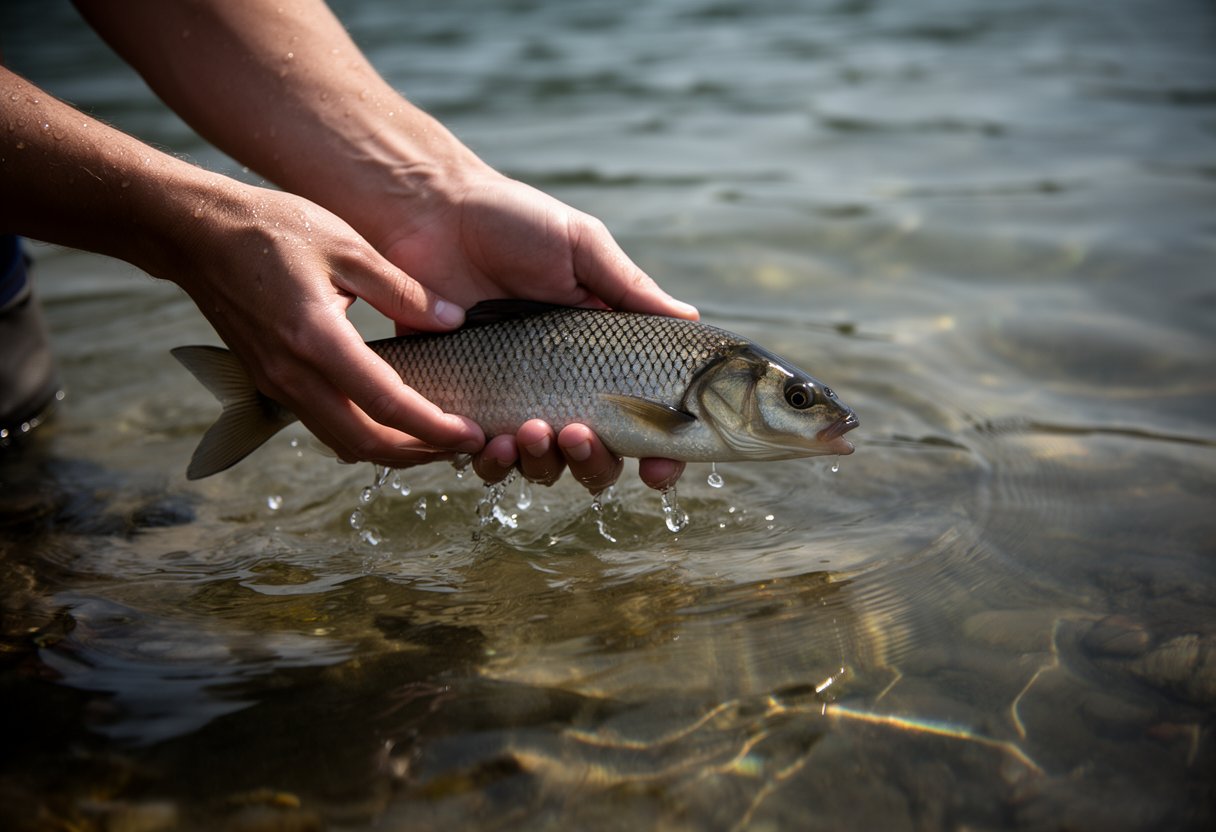
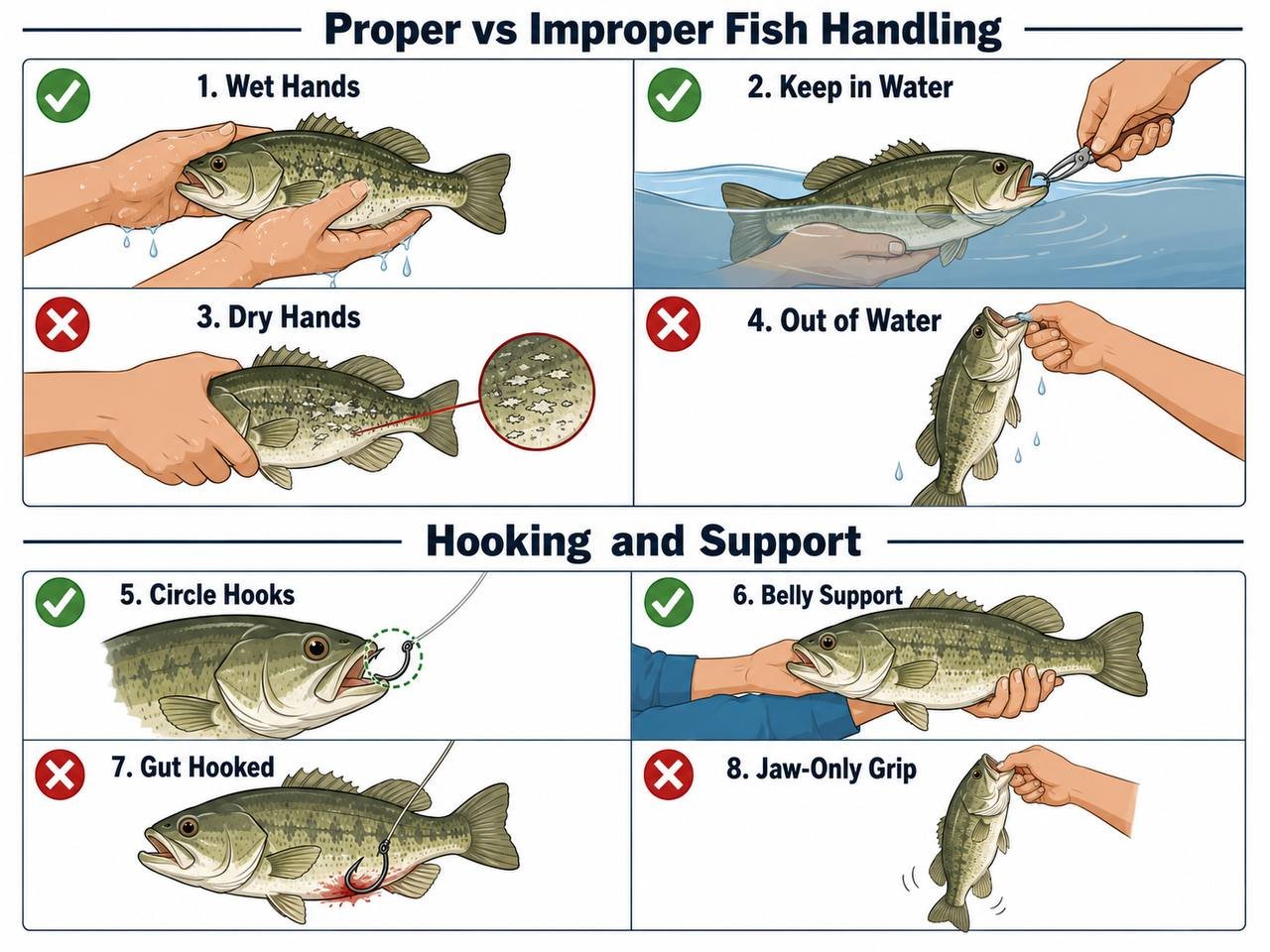
Wet your hands before touching any fish. Every fish has a slime coat — a thin layer of mucus on its skin that protects it from parasites, bacteria, and physical injury. Your dry hands strip this coating away, and the slime coat takes weeks to regenerate. If you can’t wet your hands, consider wearing a pair of gloves soaked in the same water.
Keep the fish in the water whenever possible. If you’re releasing a fish, unhook it while it’s still in the water. If you’re keeping it for a photo, hold it horizontally in the water with one hand supporting its body. Never hold a fish vertically by its jaw — the weight of its body can damage its spine.
Use circle hooks. Circle hooks are designed to hook in the corner of the fish’s mouth rather than deep in the throat. According to NOAA, circle hooks reduce gut-hooking by up to 80%. If you’re using a straight hook and a fish is gut-hooked — meaning the hook is embedded in its stomach or intestine — the best practice is to cut the line close to the hook and leave the hook in place. It will typically dissolve over time, and the fish will usually survive.
Fight time matters. Prolonged fights exhaust fish and flood their muscles with lactic acid. Studies show that fish fought for under 90 seconds have significantly higher survival rates than those fought for longer. Use heavier line than you think you need — it sounds counterintuitive, but reducing fight time saves more fish than any other single technique.
Revive tired fish before letting go. A fish that looks fine but won’t swim away on its own needs help. Hold it gently in the current, facing upstream, with water flowing over its gills. Wait until its movements become strong and coordinated, then let it go.
Water temperature affects everything. In cold water (below 50°F / 10°C), fish metabolism slows and recovery takes longer. In warm water (above 75°F / 24°C), fish need oxygen even more and are more vulnerable to stress. If you’re fishing in hot summer water and the fish looks exhausted after the fight, consider releasing it immediately — it may not survive.
Fishing Etiquette — Sharing the Water Like a Pro
Fishing is a social activity, even when you’re fishing alone. Every bank, every lake shore, and every public fishing pier has other people on it. How you behave around them matters.
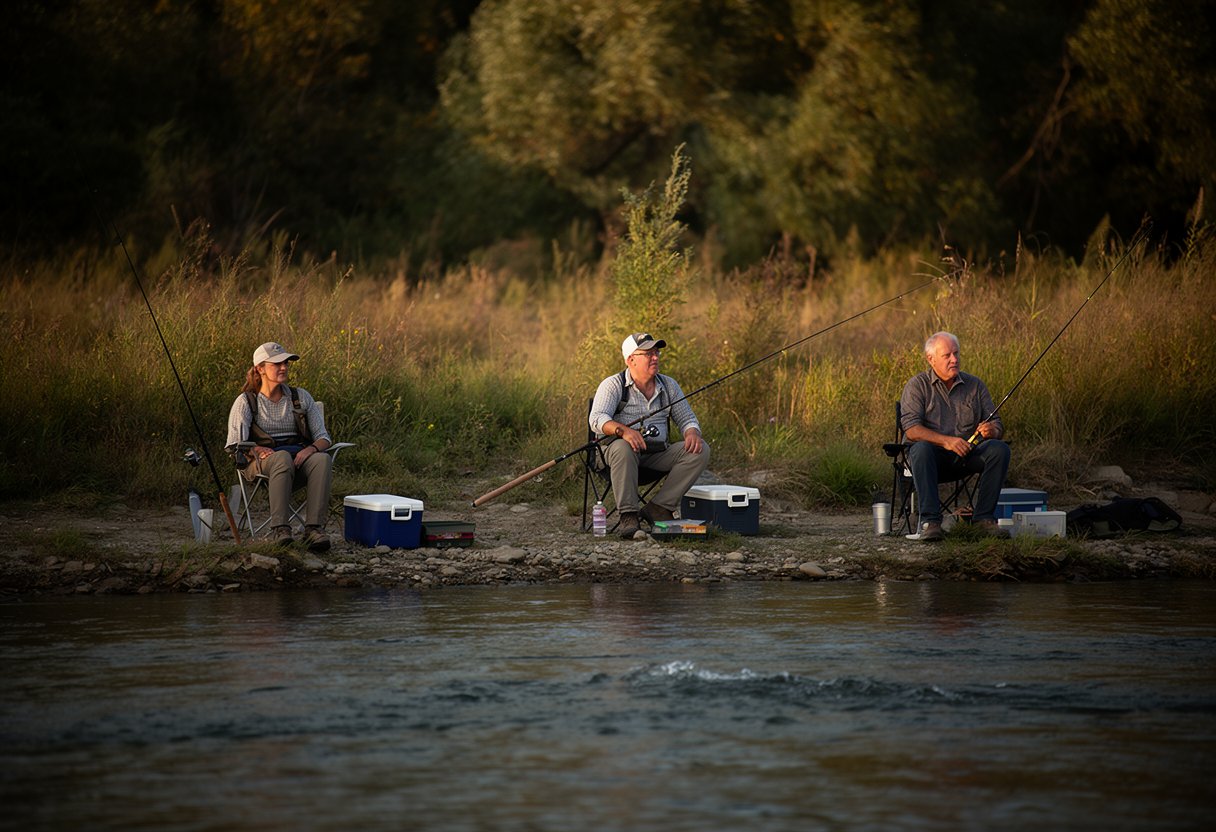
Give each other space. The generally accepted rule is to leave at least 10 to 15 feet between yourself and another angler. This prevents tangled lines and gives everyone room to cast and fight fish comfortably. If the bank is narrow or crowded, ask the person already there if you can fish closer. Most anglers are fine with it — you just need to ask.
Never cast behind or across someone else’s lines. This is the number one rule that beginners break without realizing it. Cast forward and away from other anglers. If someone is actively fighting a fish, stop casting and give them space. You don’t want to spook their fish or foul their line.
Be aware of right-of-way conventions. In most waters, boat anglers yield to bank anglers. If you’re in a boat and someone is fishing from the shore, don’t run past them or disturb the water where their line sits. Bank anglers also have the right to the space they’re fishing — boaters should give at least 100 feet of clearance when possible.
Keep noise to a reasonable level. Loud conversations, music, or shouting can spook fish and disturb other anglers. Keep your volume down, especially in areas where people are actively fishing.
Welcome new anglers. If you see someone who clearly doesn’t know what they’re doing, offer a quick tip or a friendly word. Fishing has a reputation for being unwelcoming to newcomers — be the angler who changes that.
Good etiquette isn’t about being perfect. It’s about being aware of the people around you and acting like someone who respects the water and the people sharing it.
Protecting the Habitat — Beyond the Catch
The places you fish didn’t happen by accident. Healthy rivers, lakes, and streams are the result of functioning ecosystems — and they’re more fragile than they look.
Banks erode from repeated foot traffic. When the same spot gets walked on day after day, the soil compacts and the roots of shoreline plants die. These plants filter runoff, prevent erosion, and provide shelter for juvenile fish. Research published in Springer journals found that concentrated angler activity on shorelines leads to measurable declines in bank stability and riparian vegetation cover. If you’re fishing a popular spot, vary your entry and exit points.
Submerged vegetation is fish habitat. The weeds and plants growing underwater aren’t just scenery — they’re the nursery where young fish grow and hide from predators. Don’t drag your boat through them, and don’t pull them out “to make room.” Leave them alone.
Leave no trace. Pick up every piece of trash you see — not just yours. Fishing line, especially monofilament and fluorocarbon, is deadly to birds and mammals that get tangled in it. Bait containers, tackle packaging, and beverage cans add up fast at popular fishing spots. Take more than you brought.
Protect water quality. Chemical runoff from lawns, fertilizers, and roadways pollutes waterways and kills fish. Use eco-friendly products at home, and if you have a yard near a waterway, plant native buffer vegetation that filters runoff before it reaches the water.
The habitats we protect today are the fishing spots of tomorrow. Treat every water body like it’s the last good fishing spot in your area — because for some species, it might be.
Clean, Drain, Dry — Your Role in Stopping Invasive Species
Aquatic invasive species are one of the biggest threats to freshwater ecosystems, and anglers are one of the primary ways they spread between water bodies.
Zebra mussels, hydrilla, New Zealand mud snails, and didymo (rock snot) are just a few examples. Once established in a new water body, these species typically outcompete native organisms, destroy habitat, clog water intakes, and can cost millions of dollars to control. According to the U.S. Fish and Wildlife Service, the economic damage from aquatic invasive species in the United States exceeds $5 billion annually.
Here’s how they spread: tiny eggs, larvae, and plant fragments cling to boat hulls, waders, fishing nets, and even bait buckets. When you move from one water body to the next, you carry them with you — usually without knowing it.
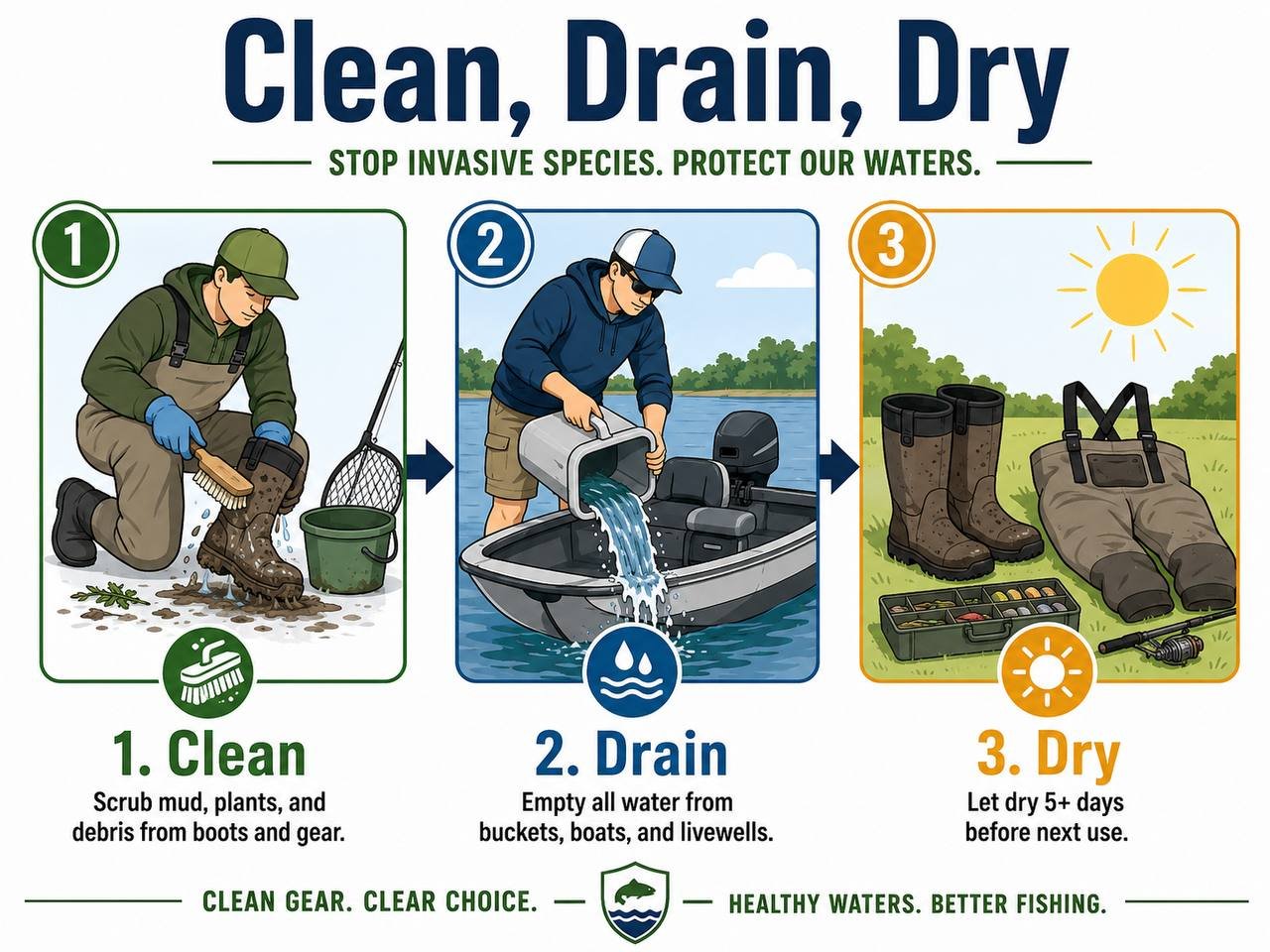
The Clean, Drain, Dry protocol:
- Clean. Before leaving any water body, scrub your boat hull, trailer, waders, nets, and any gear that touched the water. Remove visible plant material, mud, and debris. Pay special attention to hidden areas like bilge wells, livewells, and transom mounts.
- Drain. Empty all water from your boat, livewell, bilge, bait buckets, and any other container. Drain these items at the launch site — not in your driveway, parking lot, or at home.
- Dry. Let all equipment dry completely before visiting another water body. Most invasive species cannot survive more than 2 to 5 days in dry conditions. In warm weather, 48 hours is typically sufficient. In cold weather, allow at least a full week.
Even if you’re a bank angler who never uses a boat, Clean, Drain, Dry still applies to you. Rinse your waders, nets, and any gear that was in the water before heading to a different lake or river.
Three simple steps. Three minutes of effort. They protect every water body you’ll ever visit.
Understanding and Following Fishing Regulations
Fishing regulations aren’t arbitrary restrictions placed by people who don’t like fishing. They are science-based management tools designed to keep fish populations healthy.
Size limits exist for a reason. Minimum size limits ensure that fish reach maturity and reproduce at least once before they can be legally kept. Maximum size limits (also called slot limits) protect the largest, most productive breeders in a population. If a regulation says a bass must be at least 12 inches to keep, it’s because fish under 12 inches haven’t typically spawned yet.
Bag limits prevent overharvest. When a water has a daily bag limit of 5 fish, that number was determined by biologists who studied the population’s growth rate, spawning capacity, and angler pressure. Exceeding bag limits removes more fish than the population can replace.
Seasonal closures protect fish during spawning. Many waters close to fishing during specific months when fish are spawning. Spawning fish are typically vulnerable — they’re less likely to flee, they’re expending enormous energy, and removing a spawning female removes all the eggs she was carrying.
How to find regulations. Every state has a DNR or DFW website that lists current regulations. Most states publish an annual fishing regulation booklet that’s available for free online or at any license dealer. Check these before every trip — regulations change, and waters you’ve fished before may have new rules.
Report violations. If you see someone poaching, using illegal methods like electrofishing or poisoning, or dumping waste into a waterway, report it to the local wildlife agency. Most agencies have anonymous reporting hotlines. You’re not being a snitch — you’re protecting the fish that everyone else relies on.
For a complete guide to understanding your local rules, see our article on fishing licenses and regulations for beginners.
Being a Good Angler Starts Today
Fishing ethics boil down to habits, not lectures. Wet your hands before touching a fish. Give other anglers room to cast. Pick up the trash you didn’t drop. Follow the size limits even when no one is watching. Clean your gear between water bodies.
Every angler has a role in conservation. The fish you release today are the ones that will be waiting for you next season. The shoreline you protect today is the fishing spot your kids will fish tomorrow. The regulations you follow today keep the waters stocked and healthy for everyone.
Being responsible doesn’t make fishing less fun. It makes it last longer.