
# Winter Sheepshead on Pilings and Rock: Reading Structure and Beating Bait Thieves
Your redfish and trout spots went quiet three weeks ago. The water dropped into the sixties, the bait thinned out, and the fish you built your fall around either moved or sulked. Most inshore anglers take that as the end of the season and put the boat up.
Sheepshead mostly don’t care. They tolerate cold water better than snook, seatrout, and most snapper, and when the water cools they don’t leave — they bunch up tighter on hard structure, where the barnacles, mussels, and small crabs they eat are still growing. From November through March, a barnacle-encrusted piling in a creek or inlet can hold a dozen fish while the rest of the estuary looks dead.
The catch is that sheepshead don’t fish like anything else you’ve chased. You can drop a good bottom rig next to a piling that’s covered in fish, get picked clean six times, and never feel a single bite. That’s not bad luck and it’s not a subtle bite you’re failing to detect. It’s a different feeding mechanic, and once you understand it the rest of the approach makes sense.
Why Sheepshead Take Over the Winter Inshore Bite
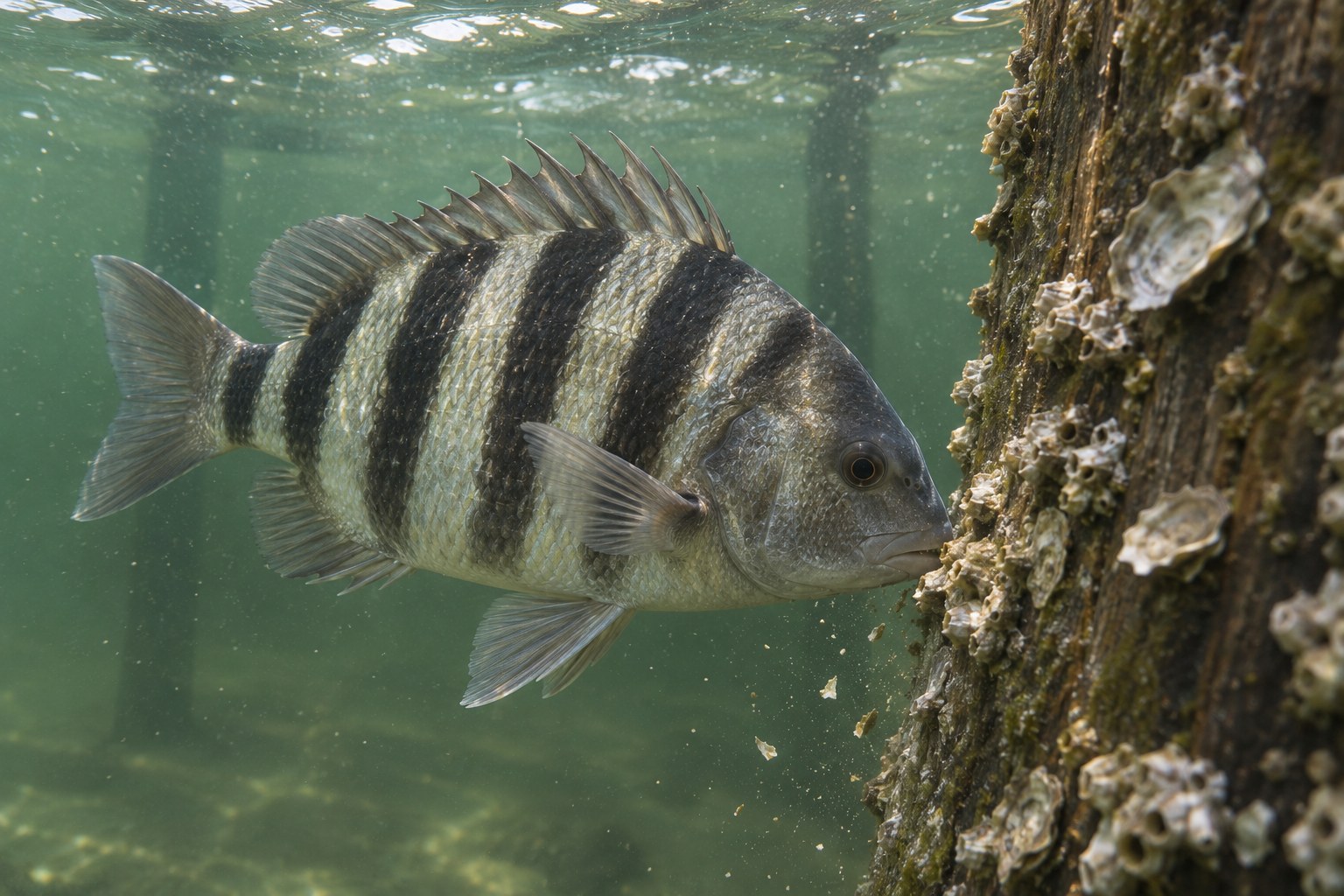
Sheepshead are the striped fish with the vertical black bars that get them called “convict fish.” They have a deep, laterally compressed body, a blunt head, and a set of teeth that looks unsettlingly human — flat incisors in front and rounded, molar-like crushers behind them.
Those teeth tell you everything about where the fish lives. Sheepshead don’t chase baitfish. They scrape barnacles off pilings, pick mussels and small oysters off jetty rock, and hunt fiddler crabs along marsh edges. Anything hard and crusty on a vertical surface is a meal.
That diet is why winter works in your favor. Snook and trout are cold-sensitive and slide into deeper, warmer water where they’re harder to reach. Sheepshead simply move to the nearest hard structure and keep eating. In Northeast Florida and the Carolinas, prime time runs roughly November through April, with the biggest fish often showing in January and February.
There’s also a size split worth knowing. The fish holding on bridge and dock pilings are usually smaller — a lot of males in the one-to-four-pound range. The big females tend to stage deeper, around ledges, rock piles, and wrecks in 12 to 30 feet of water, before spawning. If you want numbers, stay on the pilings. If you want a trophy, you may need to fish deeper structure.
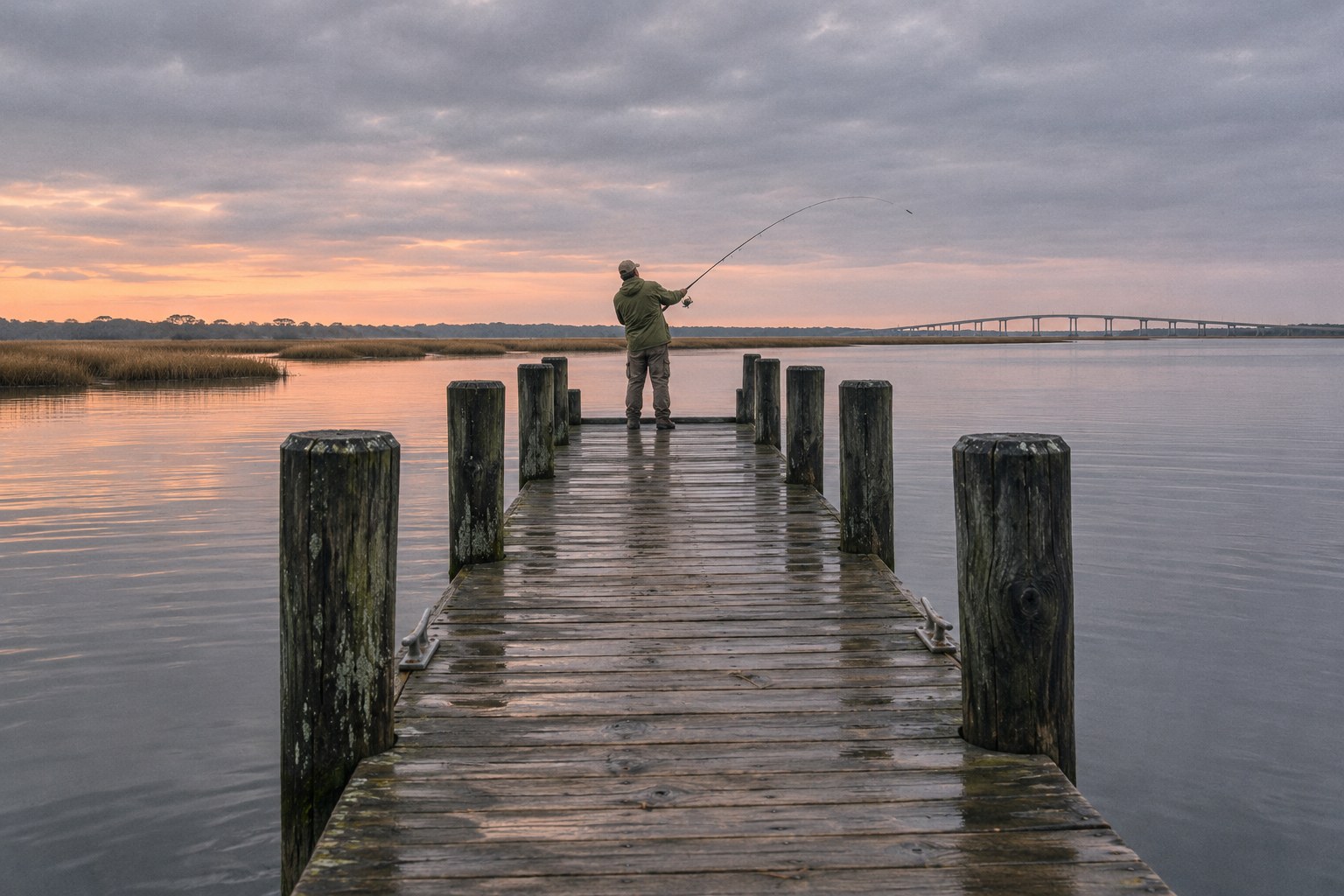
The good news for a bank or dock angler: sheepshead are one of the few quality saltwater species you can catch without a boat. Public piers, seawalls, jetty rock, and dock pilings you have permission to fish all hold fish in winter.
The Bite That Feels Like Nothing
This is the section that decides whether you catch sheepshead or just feed them.
A sheepshead doesn’t grab your bait and run. It approaches, sucks the crab into its mouth, settles against the structure, and grinds the shell apart with those crusher teeth — often without moving more than an inch. Then it spits the shell fragments out, and your hook comes back with it.
If your sinker is sitting on the bottom with slack in the line, none of that reaches your hand. The rod tip never moves. The line never loads. You reel in an empty hook and assume the crabs fell off or a pinfish stole them.
That’s the single most common reason anglers give up on sheepshead. They aren’t missing a bite — they’re missing an entire event.
What a Sheepshead Bite Actually Feels Like
Forget the tap-and-wait rhythm you use on redfish. A sheepshead bite usually reads as a series of small, sharp taps, then a subtle change in weight — the sensation of something settling onto the line rather than pulling it.
Two things matter more than the feel:
- Keep the line taut. Slack line is a sheepshead’s best friend. You want just enough tension that the bait hangs naturally but the rod tip is still communicating.
- Set the hook on the weight change, not the taps. The taps are the fish crushing the shell. By the time it’s done crushing, it’s done with your bait. When the rod tip gets that quiet heaviness, sweep the rod hard and fast.
Soft, parabolic rods hurt you here. They absorb the hookset and give the fish a moment to drop the bait. A fast-action rod transmits the set straight to the hook, which matters because you’re setting into a mouth full of shell-crushing hardware.
The Crab Test: Reading a Missed Bite
There’s a simple diagnostic that will teach you more in one trip than any article can.
When you reel up to check your bait, look carefully:
- Crab gone, hook intact, nothing felt — a sheepshead took it. You’re getting bites you aren’t detecting.
- Crab still there but mangled — something sampled it without committing, or you set too early.
- Crab still there, perfectly intact, after ten or fifteen minutes — no sheepshead at that spot. Move.
Losing a dozen fiddler crabs before you dial in the hookset is normal. Bring more bait than you think you need.
Reading Structure: Which Pilings and Which Rock
“Fish structure” is true but useless on its own. Here’s what actually separates a piling that holds fish from one that doesn’t.
Look for shell growth. Barnacles, small mussels, thin oyster crust — that’s the food supply, and sheepshead follow it. A clean, newly built dock with pressure-treated pilings and nothing growing on them is a poor bet. An old dock with a thick white-gray crust of barnacles is prime.
Rank your options by age and texture. Old dock pilings first, then bridge abutments and fender pilings, then jetty rock and riprap, then seawalls. Mangrove roots and sunken structure work too if you can reach them. Anywhere shell grows on something vertical is worth a cast.
Fish the whole water column, not just the bottom. This trips up almost everyone. Sheepshead rise and fall along a piling, scraping barnacles as they go. Many fish are a few feet off the bottom, some are near the surface. Drop to the bottom first, then work your bait up in two-foot increments if nothing happens.
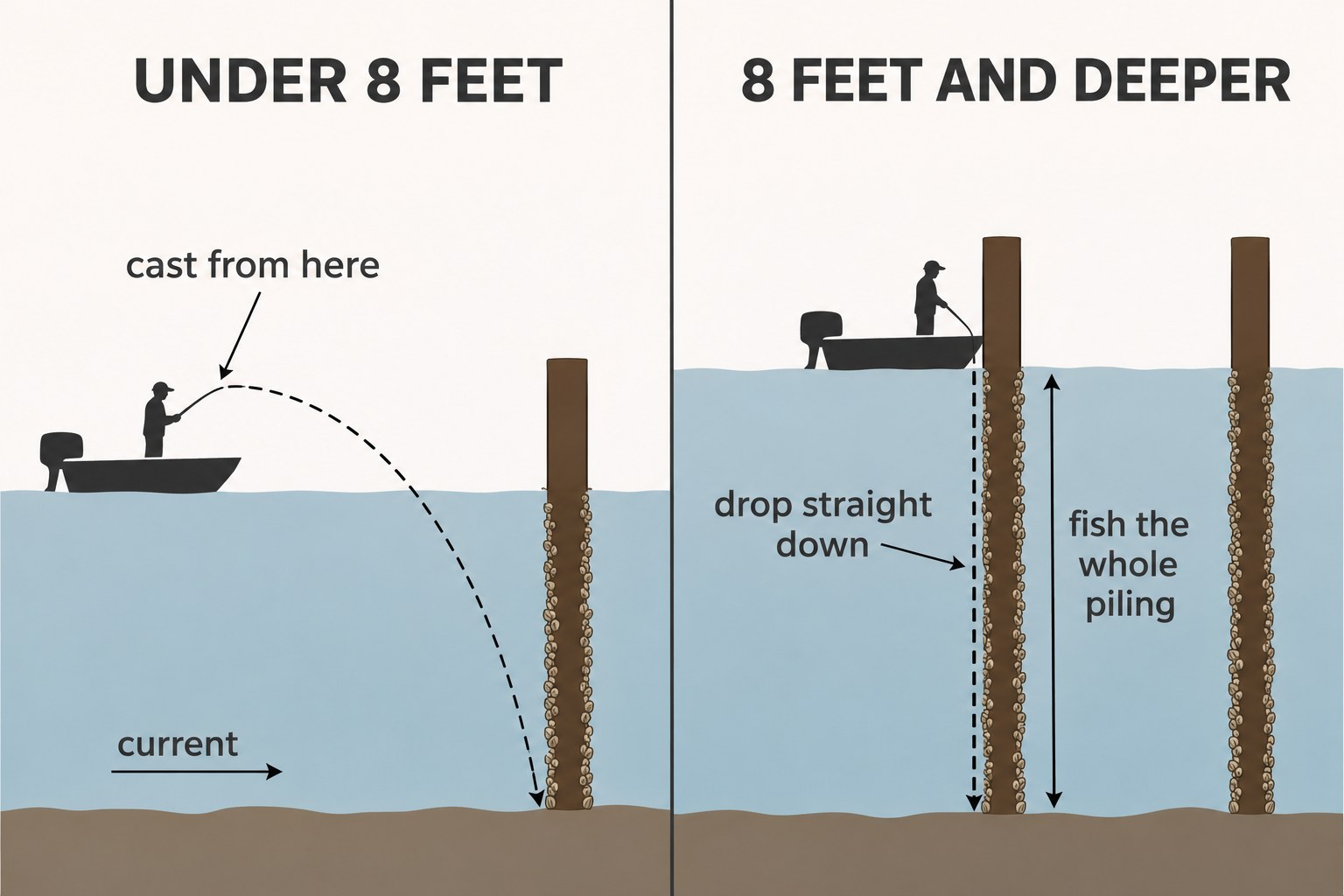
Match your approach to the depth. In less than about eight feet of clear water, don’t pull right up to the piling — sheepshead spook. Anchor or stand at the edge of casting range and throw to the structure. In deeper water, the opposite works: tie off, use the trolling motor’s spot lock, or anchor close and drop straight down the wood.
Run and gun. A piling with fish on it usually produces within a few minutes of your bait arriving. Fifteen or thirty minutes at one dock is wasted time. Give a spot five or ten minutes, then move to the next piling in the row.
Three Rigs That Actually Work
All three of these rigs solve the same problem in different ways: keeping you in contact with a fish that doesn’t move. Your baseline is 15-pound braid on the reel, a 20- to 25-pound fluorocarbon leader for abrasion against shell and wood, and a single hook.
That last part is not a preference. In Florida, using multiple hooks with natural bait to take sheepshead is prohibited, and it’s a good rule everywhere — sheepshead hook in the corner of the mouth and a second hook just creates problems.
Weight discipline matters too. Use enough to reach bottom and hold in the current, not so much that your sinker bangs against the piling and spooks fish.
The Knocker Rig (Best All-Around)
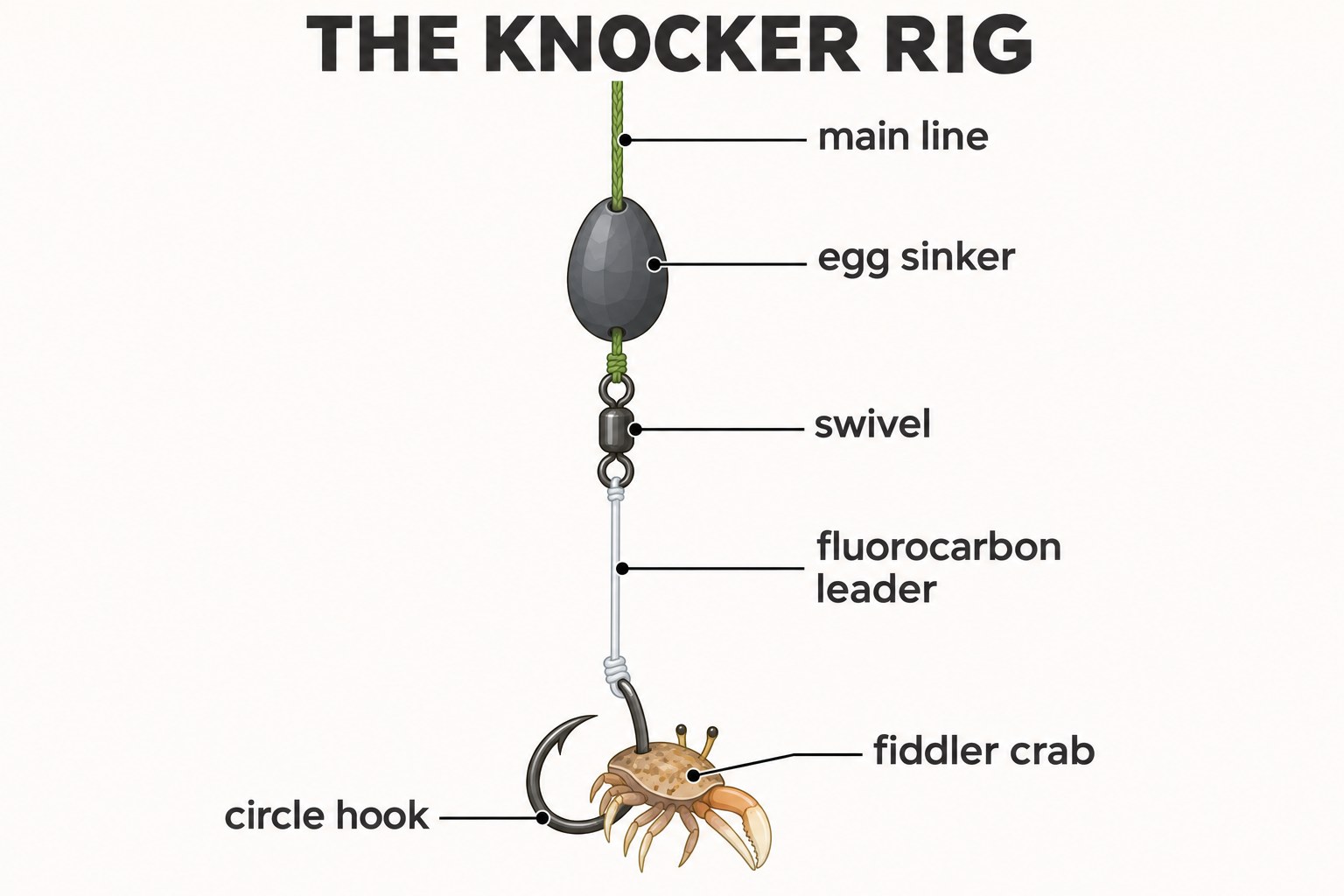
A sliding egg sinker on the main line, a small barrel swivel, and 18 to 24 inches of fluorocarbon leader down to a 1/0 to 2/0 circle hook. Some anglers call this a fish-finder or slip-sinker rig; the sheepshead crowd tends to call it a knocker.
Why it works: the weight rides down against the bait instead of sitting above a long leader, so your line stays in direct contact with the hook. That’s the whole point. Half an ounce to one ounce of weight covers most inshore situations.
The Bare Jig Head (Best for Tight Piling Work)
A one-eighth to a quarter-ounce jig head with a 1/0 or 2/0 short-shank hook, no plastic body, with a fiddler crab threaded onto it. Fish it straight down the side of a piling.
The jig head reaches bottom fast, which is good, but the real advantage is constant contact. With a slip-sinker rig and a long leader you can lift a foot and feel nothing while a fish is holding your bait. On a jig head, any lift transmits immediately. There’s also a swing-jig variant where the hook hangs from a ring so it moves independently of the lead, which is excellent around rock.
The Float Rig (Best When You Can See the Fish)
A small cigar float above a 1/0 to 2/0 hook, set so your bait rides at the exact depth where fish are feeding against the piling. Use this when you can watch sheepshead working a piling and pinpoint their depth — set the float so the crab sits at nose level and let the current do the work.
On the rod side: a 6’6″ to 7′ medium-heavy fast-action spinning rod with a 2500-class reel handles everything from dock fish to the occasional big one that tries to get back under the structure. A stiff tip helps on the hookset; a medium-heavy backbone helps you turn a fish away from the pilings before it wraps you.
Baits: Fiddler Crabs and the Backups
Fiddler crabs are the standard for a reason. They’re small — roughly three-quarters of an inch to an inch and a half — they live in the same marsh the sheepshead feed along, and they’re tough enough to stay alive and kicking on a hook.
Where to get them. Walk a marsh edge or mud flat at low tide and you’ll see thousands. Fiddlers bolt for burrows when disturbed, so move slowly and scoop them into a bucket with a little wet sand. Otherwise, most coastal bait shops sell them by the dozen, and they keep fine in a cool, damp container out of direct sun.
How to hook one. Take the large claw off first if it’s a male. Then push the hook point through the back of the shell, behind the eye stalks, or through the joint where a rear leg meets the body. Leave the legs hanging free — the movement is the attractant. Threading through the back of the shell keeps the crab alive and intact much longer than running the hook through the whole body.
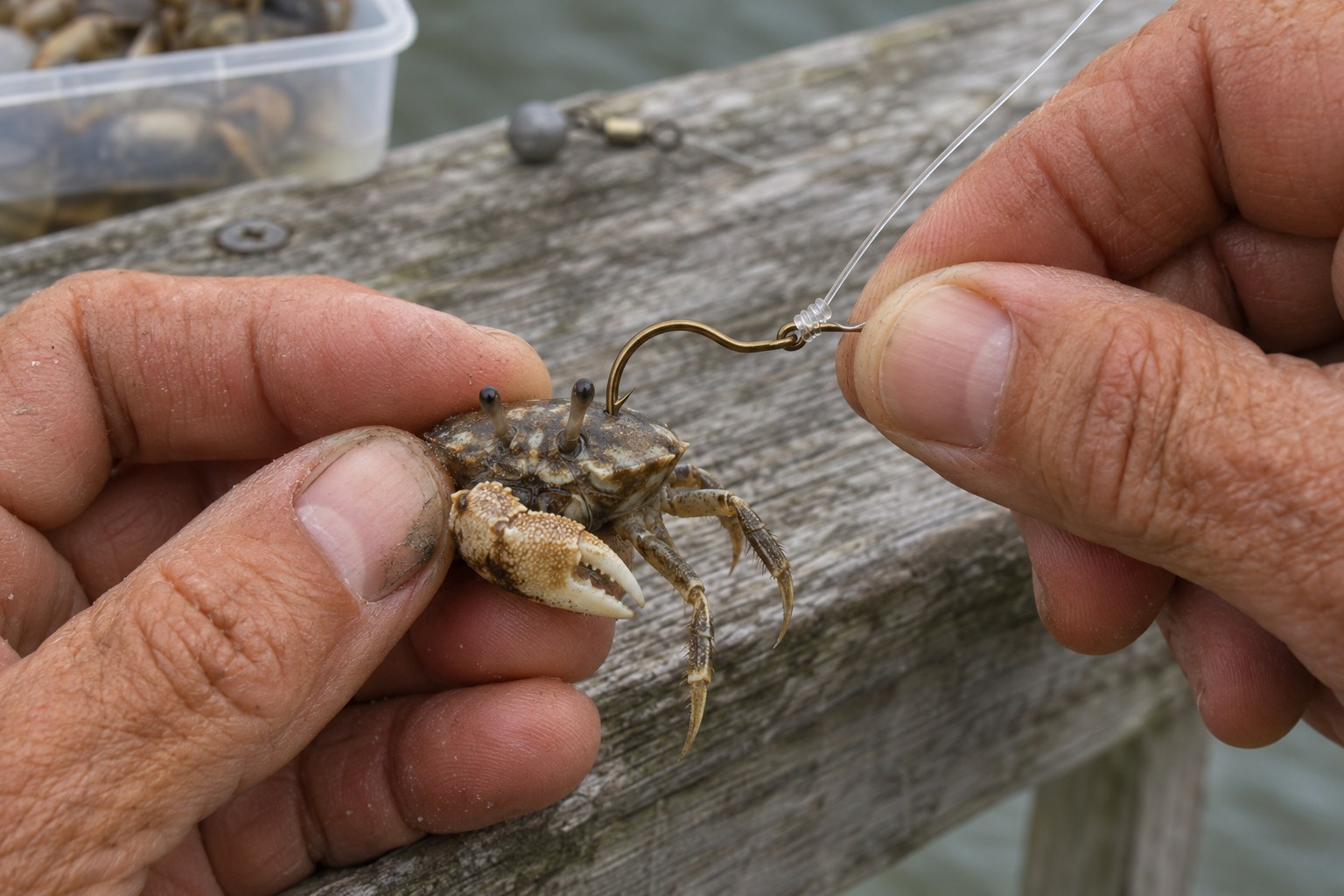
Backup baits that work. Live shrimp is the most common substitute: thread it tail-to-head with the hook point exiting near the head, or pinch the tail fan off and thread from the tail. Sand fleas (mole crabs), small pieces of fresh dead shrimp, small mussels plucked from riprap, clam meat, and barnacle scrapings all catch fish. Some anglers chum with crushed barnacles and then free-line a shrimp into the cloud.
One caution: barnacles and oysters are not the same thing under the rules. In Florida, barnacles have no size or bag limit and up to 100 pounds per person per day may be taken for chum. Oysters have seasons, size limits, and harvest-area restrictions, and taking them for chum can be illegal. If you can’t tell them apart with confidence, don’t scrape.
Tide, Timing, and Chumming
Ask five sheepshead anglers about the best tide and you’ll get three answers. That’s not because they’re wrong — it’s because tide does two different things, and both can work.
Moving water concentrates food. A falling tide pulls crustaceans and loose shell off the pilings and flushes them down-current, and sheepshead feed on that flush. Many experienced anglers specifically target the latter half of the falling tide for this reason.
Slack water makes precision easier. Around bridge pilings and tight dock structure, current is what makes placing a bait difficult and hangs you up. When the tide goes slack, you can work a piling carefully and stay in contact without the boat swinging. Some of the best piling fishing happens in that window.
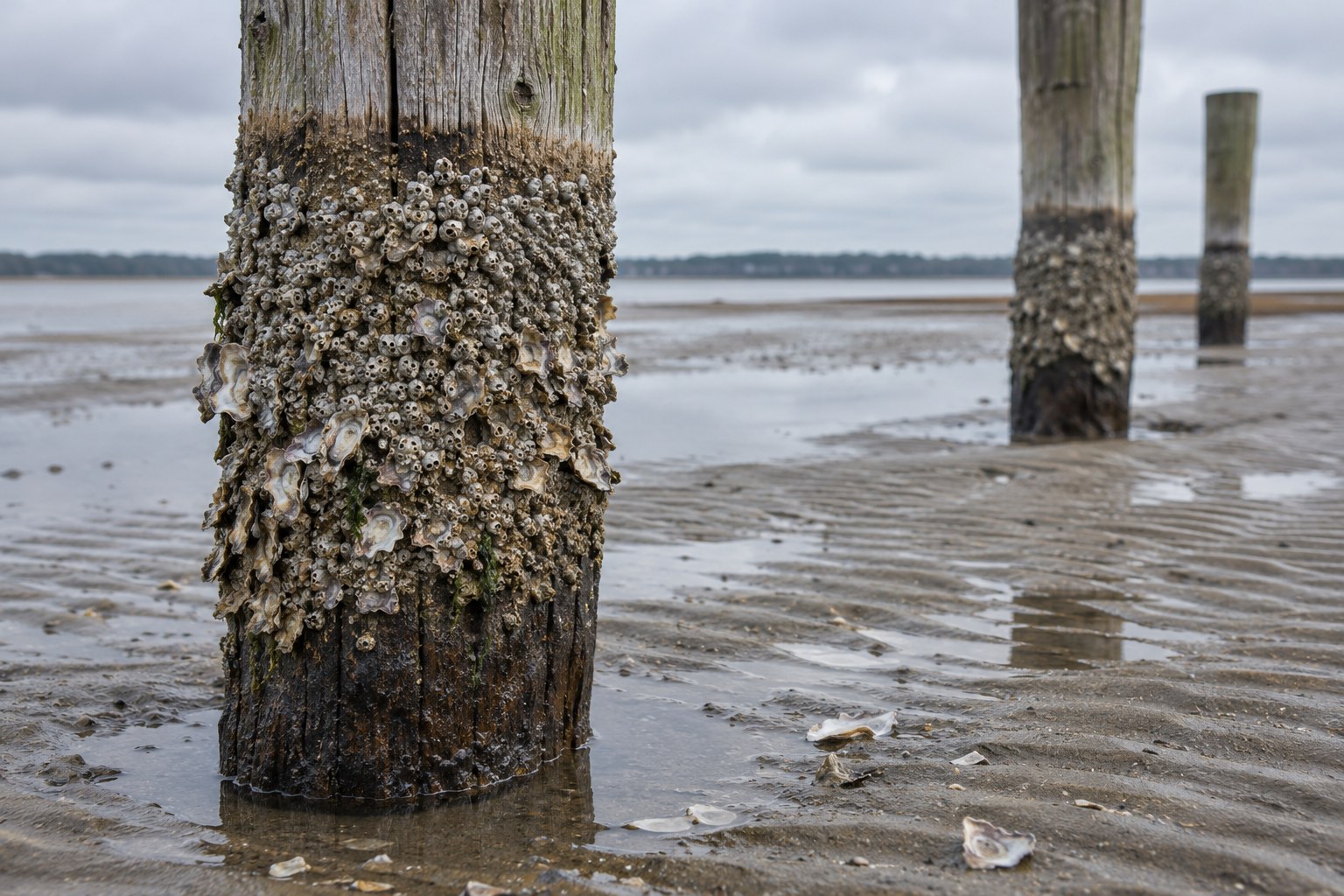
Practical approach: plan the day around a tide change, treat moving water as your primary window, and use slack water to pick apart pilings you couldn’t work in current. Flat, calm, overcast days tend to help — sheepshead are less cautious when the light is soft.
If your tide planning is rusty, reading a tide chart is worth ten minutes before you launch, and the same logic that applies to saltwater bottom rigs for piers and surf applies here: you’re trying to keep natural bait in a specific zone relative to structure.
Chumming is the multiplier. Scrape barnacles off a piling into the water — a scraper, a spud, or the back of a rake works — and let the fragments drift down. Sheepshead respond fast, and fish that are actively feeding are bolder and easier to hook. In moving water, chum pulls fish in from down-current pilings too. Two rules: only scrape barnacles, not oysters, and never scrape a private dock or seawall without the owner’s permission.
Landing and Handling a Toothy, Spiny Fish
Sheepshead fight like they’re angry about it — short, powerful runs straight back to the structure. Your job is to turn them before they get there, which is why the medium-heavy backbone matters.
Don’t lip them. Sheepshead have sharp, stout spines along the dorsal and anal fins, and the dorsal spines are easy to drive into a hand when a fish flares them on the deck. They also have rows of flat crushing teeth. Net the fish at the side of the boat, then use long-nose pliers or a dehooker to turn the hook out rather than reaching into the mouth.
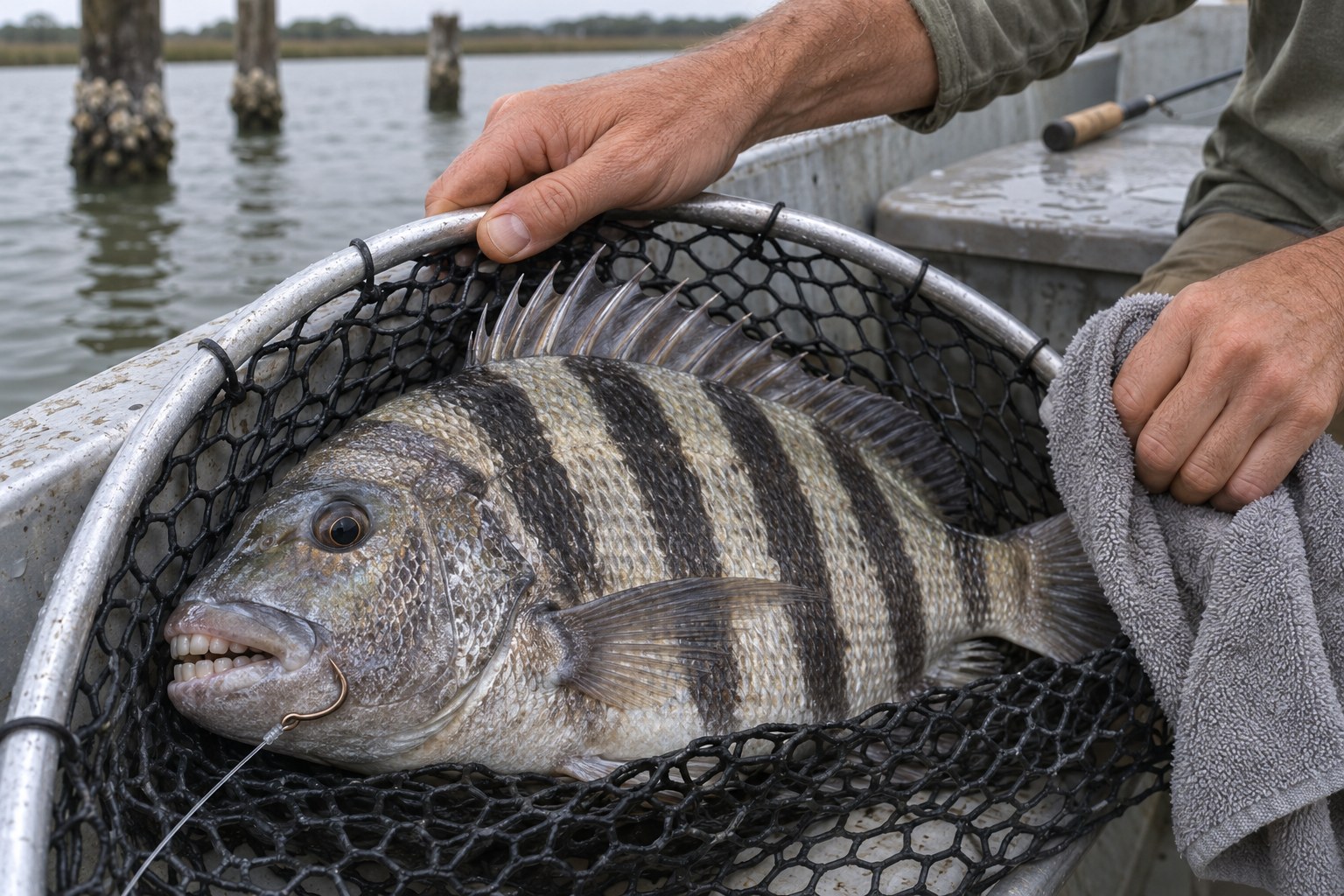
If you’re keeping fish, check your regulations before you go. In Florida, sheepshead have a 12-inch total length minimum, a daily bag limit of 8 per person, and a 50-fish vessel limit during March and April, with the season open year-round. Florida rules also require sheepshead be landed in whole condition — you can gut and gill them, but not fillet or remove the head while on the water. Other states set their own limits, so verify locally.
A quick word on eating: sheepshead are excellent on the table, mild and firm. They’re also a chore to clean thanks to big scales and thick spines, so a sharp fillet knife and a pair of gloves earn their keep.
Putting a Winter Pattern Together
Here’s the trip plan that pulls all of this into one loop.
Timing. Pick a day with a tide change you can fish, and plan to be on the water for the last half of the falling tide. Overcast and calm beats bright and windy.
Where to start. Hit the deepest available hard structure first — bridge pilings, inlet jetty rock, or old docks in the lower estuary. Work toward shallower creeks and docks as the tide drops.
How to fish each spot. Pull up or cast within range depending on depth, drop a knocker rig or jig head with a fiddler crab to the bottom, and work it up in two-foot increments. Watch the line as much as the rod tip. Set hard on any weight change. Five to ten minutes per piling; if you lose a crab without feeling anything, stay one more pass and then move.
What to bring. More fiddler crabs than you think you need, a couple of backups (shrimp, sand fleas), 20-25 pound fluorocarbon leader, a fast-action rod, pliers, a net, and a scraper for chumming legal barnacles.
The reason this pattern matters beyond December is that it’s a skill, not a season. Learning to feel a bite that doesn’t move, to fish an entire piling instead of just its base, and to set the hook with authority on a fish that’s already spit the bait will make you better at every inshore species you chase.
Sheepshead are not the most glamorous fish in the estuary. They’re ugly, they’re spiny, and they’ll steal your bait six times before you land one. But when the water turns cold and everything else shuts down, they’re the fish that still bite — and once you can feel that weight change, you’ll wonder why you ever wrote off winter.