

You make one bad cast and your baitcaster spool explodes into a bird’s nest — a chaotic tangle of loops hanging off the spool. It feels random, like the reel is cursed. It isn’t.
A backlash is a mechanical problem with a mechanical fix. Once you understand why the line loops off the spool, you can adjust three controls — the tension knob, the brake system, and your thumb — so the tangles mostly stop. And when one does happen, you can clear it in a minute or two without cutting your line.
This guide covers both halves: fixing the nest you’re staring at right now, and dialing in your reel so the next one never happens.
What a Backlash Actually Is (and Why It Isn’t Bad Luck)
Here’s the whole problem in one sentence: a backlash is a spool over-run — the spool keeps spinning faster than the lure can pull line off it, so the surplus line loops off and tangles.
A spinning reel’s spool doesn’t rotate during the cast, so line just peels off in an orderly way. A baitcaster’s spool spins like a wheel, throwing line out with every rotation. That spinning spool is what lets you cast accurately and handle heavy lures — and it’s also what creates backlashes.
Over-runs happen at two moments:
- At launch. You snap the rod hard, the spool spins up instantly, and the lure can’t pull line fast enough to keep up. Loops fly off before the lure even leaves the guides.
- At splashdown. The lure hits the water (or a tree) and stops dead, but the spool’s inertia keeps it spinning. All that leftover rotation dumps line onto itself.
Every backlash traces back to one of those two moments. That’s why they’re fixable — you’re not fighting luck, you’re matching spool speed to lure speed. If you’re still deciding whether a baitcaster is even the right tool for your fishing, our spinning reel vs baitcaster comparison walks through the tradeoffs.
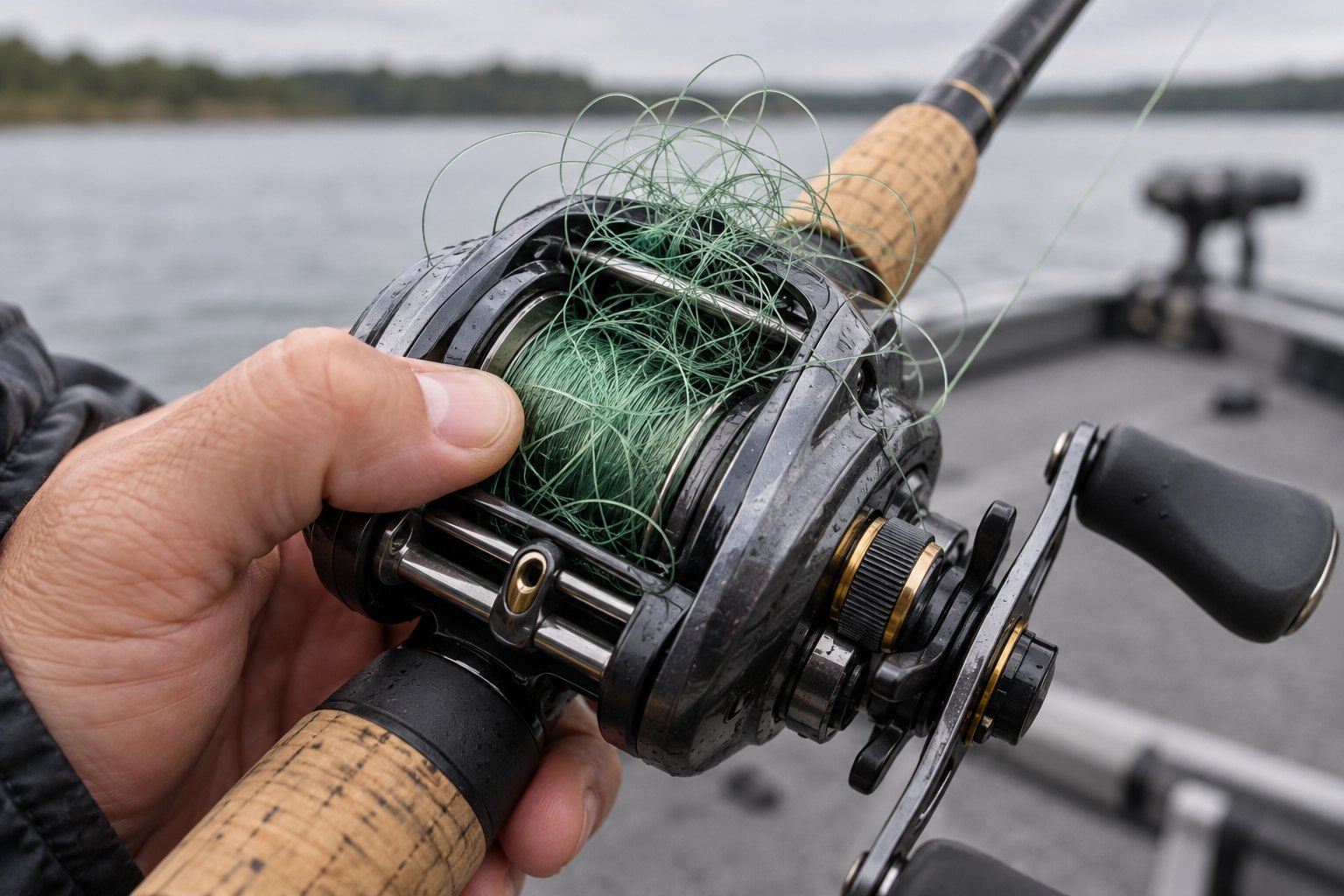
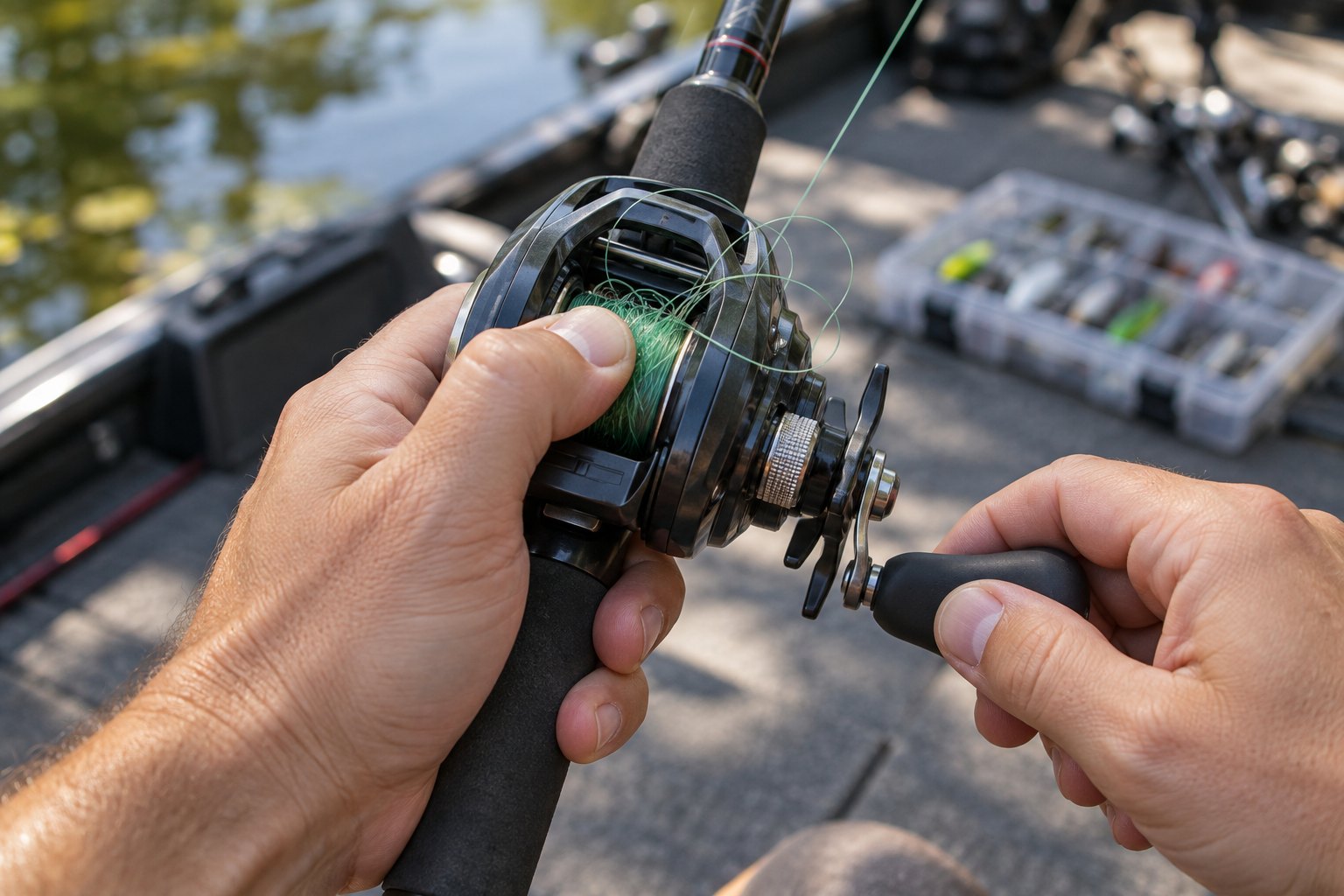
Fix the Bird’s Nest You Have Right Now
If you’re mid-tangle, don’t yank the loose loops. Pulling hard digs them deeper between the wraps on the spool and turns a two-minute job into a respool.
Work the nest with this sequence:
- Press your thumb firmly on the tangle to stop the spool from spinning.
- Reel two or three turns of the handle while holding thumb pressure. This seats the loose loops against the spool instead of letting them sink under fresh wraps.
- Press the thumb bar (free spool) and pull the loose line out steadily until it stops.
- Repeat — reel under thumb pressure, free-spool and pull — until the nest comes apart. Most clear in a minute or two.
- Check for underwraps. An underwrap is a loop that slipped under the fresh wraps on the spool. Pull line off and inspect it after clearing any nest, and after any hard cast. An ignored underwrap blows up on your next cast.
Cutting is the last resort. If the line is badly damaged or the nest is hopelessly locked, cut it off and respool — fishing damaged line risks losing fish to a weakened knot. Thin, soft line (light mono or thin braid) digs between wraps and locks tangles in, which is one reason heavier starting line makes life easier while you’re learning. For general tangle skills that transfer to every reel, see our guide to untangling fishing line.
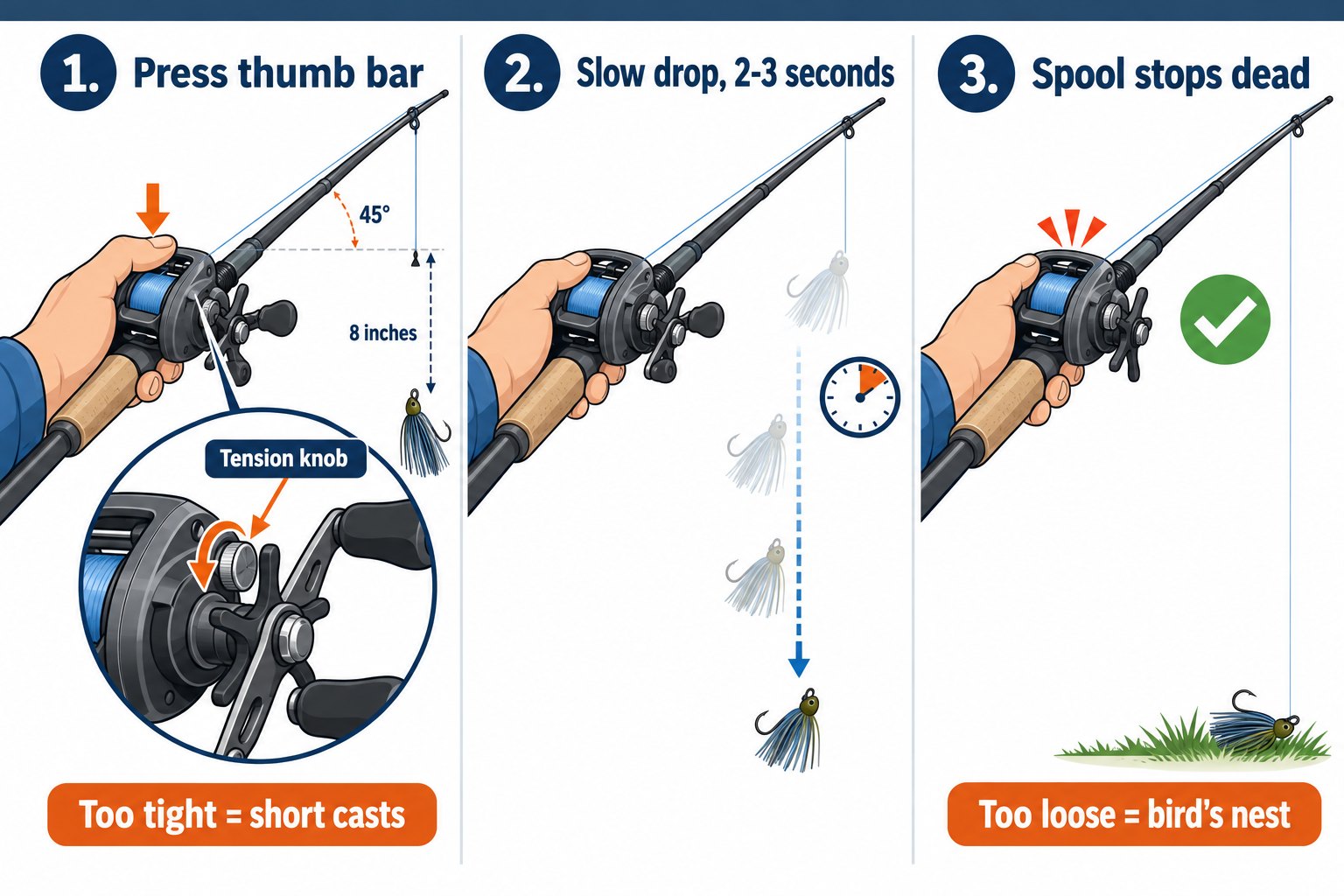
Setting 1: The Spool Tension Knob (Drop Test)
The spool tension knob is the small knob on the handle side of the reel, under the star drag. It squeezes the spool shaft to add friction, which controls how fast the spool can start spinning at the launch of the cast. It is not a brake and it is not your drag — it’s the launch control.
Most new baitcaster users either never touch it or crank it down too tight. Here’s the calibration that works, called the drop test:
- Tie on the lure you plan to throw.
- Hold the rod at about a 45-degree angle, pointing at the ground.
- Press the thumb bar so the spool free-spools, letting the lure dangle a foot or so from the water or ground.
- Tighten the knob until the lure barely falls, then back it off until the lure descends slowly and steadily — roughly 2–3 seconds to fall for a 1/2 oz lure.
- The key detail: when the lure hits the ground, the spool should stop dead. If it keeps spinning and dumping loops, the knob is too loose.
Two rules that matter more than the exact numbers:
- Re-run the drop test every time you change lure weight. A knob setting dialed for a 3/8 oz crankbait is wrong for a 1/4 oz jig. Surprise bird’s nests usually mean the lure changed and the knob didn’t.
- Don’t over-tighten. A locked-down knob kills casting distance — often 30–40% — and tempts you to cast harder, which causes worse over-runs. Tighter is not safer.
And while you’re on that side of the reel: the tension knob has nothing to do with fighting fish. If your drag feels wrong, that’s a different dial — our drag setting guide covers it.
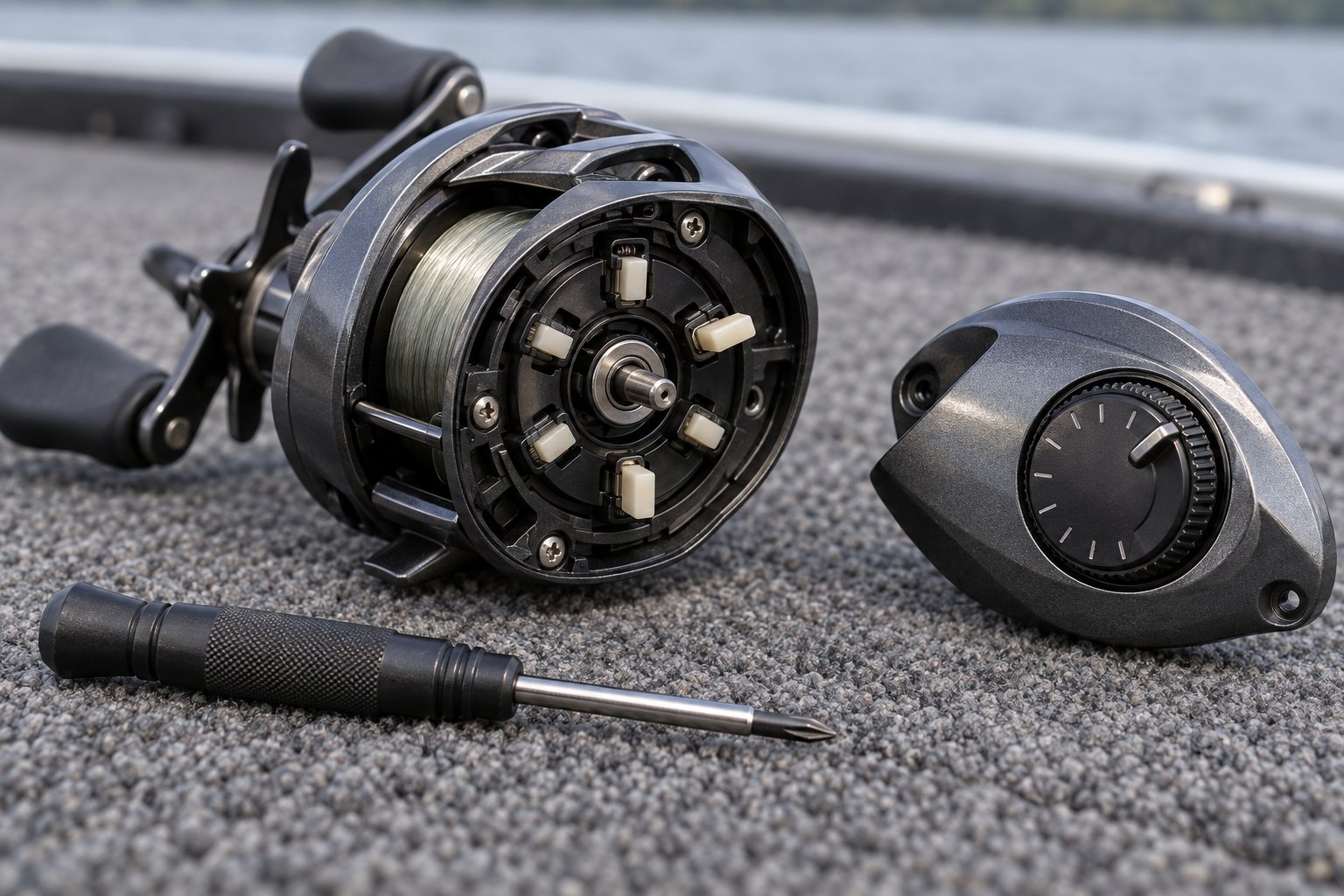
Setting 2: Your Brake System, Dialed Right
If the tension knob handles the start of the cast, the brake system handles the middle and end — it slows the spool as the lure decelerates in flight. Baitcasters use one of two designs:
- Magnetic brake: an external dial (usually 0–10 or 0–20). It slows the spool with magnetic drag, consistent through the whole cast, and behaves predictably in wind. Most modern reels use this.
- Centrifugal brake: internal pins or weights behind a side plate. It’s strongest at the very start of the cast, when spool speed is highest. Older and budget reels often use it, sometimes alongside magnetic braking.
The starting point for a learner is simple: set the brake high — 70–80% of its range. On a 10-click magnetic dial, that’s 7–9. On a 6-pin centrifugal system, engage 4 pins.
Then match braking to lure weight:
- Light lures (1/4 oz or less): more braking. Light lures can’t pull much line, so the spool over-runs easily.
- Heavy lures (1/2 oz and up): less braking. Heavy lures pull line hard and need the spool free to spin.
- Pitching and short flips: more braking than distance casting, because the lure stops sooner.
After about 10 clean casts in a row, back the brake off one notch and cast again. Keep backing off one notch at a time until you feel a hint of a tail-end tangle, then go back one click. That’s your dialed-in setting for that lure.
Setting 3: Your Thumb Beats Every Dial
Settings reduce backlashes. Your thumb eliminates them. Every experienced baitcaster angler you’ve watched is quietly controlling the spool with their thumb through the entire cast.
The technique:
- Light contact from the start. Rest your thumb lightly on the spool the moment you pull the lure back, and keep it there through the cast.
- Add pressure as the lure slows. The spool spins fastest at the start and coasts after the lure peaks. Increase thumb pressure as the lure decelerates.
- Clamp down before splashdown. The instant before the lure hits the water, press firmly and stop the spool. This single habit kills most end-of-cast nests.
Your stroke matters as much as your thumb. Cast with a smooth, loaded rod sweep — not arm speed. Muscling the cast spins the spool faster than any lure can pull line. Keep the rod tip from nose-diving at the end of the stroke: a dropping tip stops the lure while the spool is still spinning, which is an instant backlash. Stop the rod pointing at your target and let the thumb finish the job.
Practice this in the backyard with a 3/8 oz or heavier plug — no hook, or a lure keeper — for ten minutes a day. Sub-1/4 oz baits backlash on most beginner reels no matter how well they’re set, so don’t learn on them.
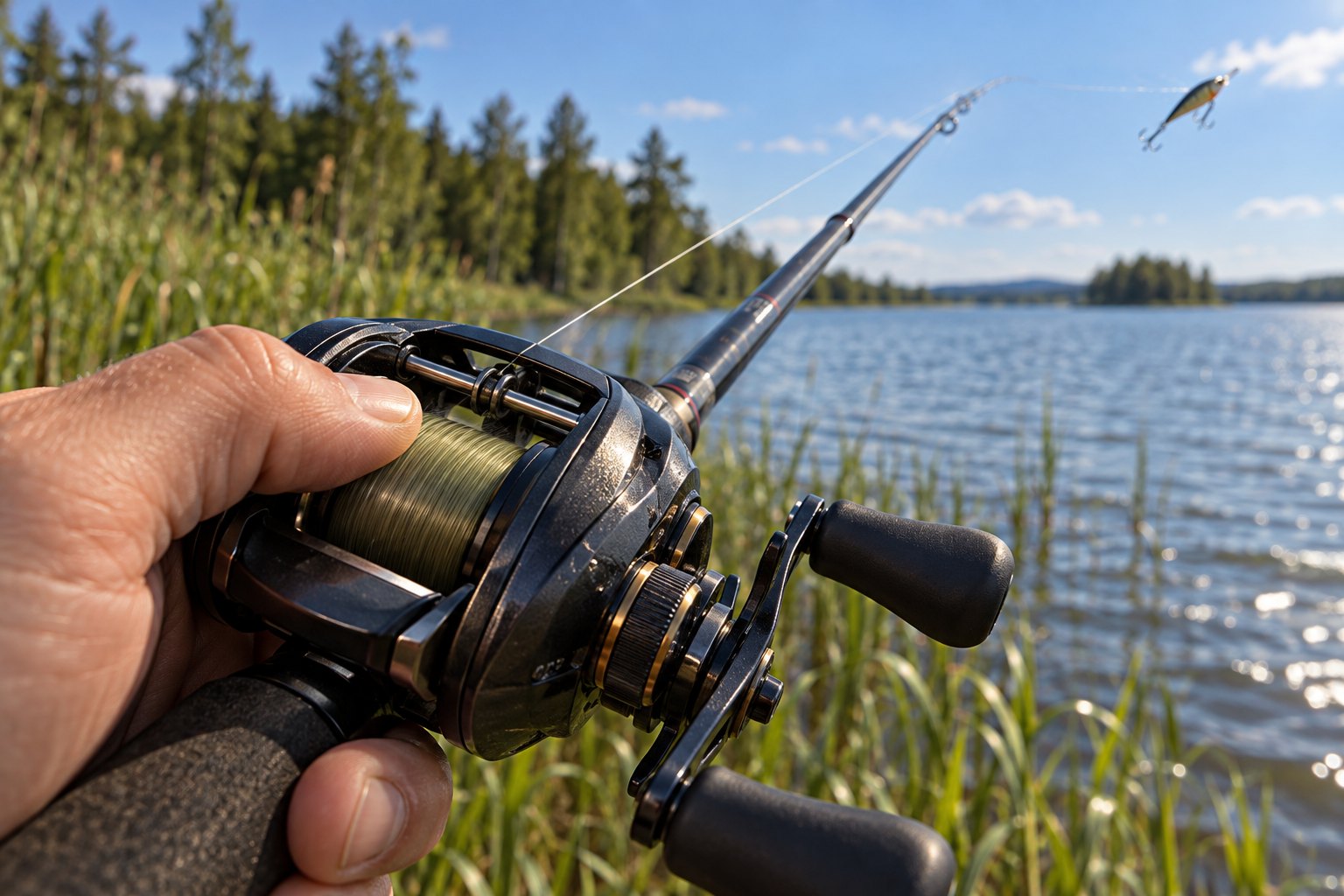
Wind, Line, and Spool Fill: The Silent Backlash Causes
You’ve dialed the knob, set the brakes, used your thumb — and you still get occasional nests. Three quiet culprits explain most of the rest:
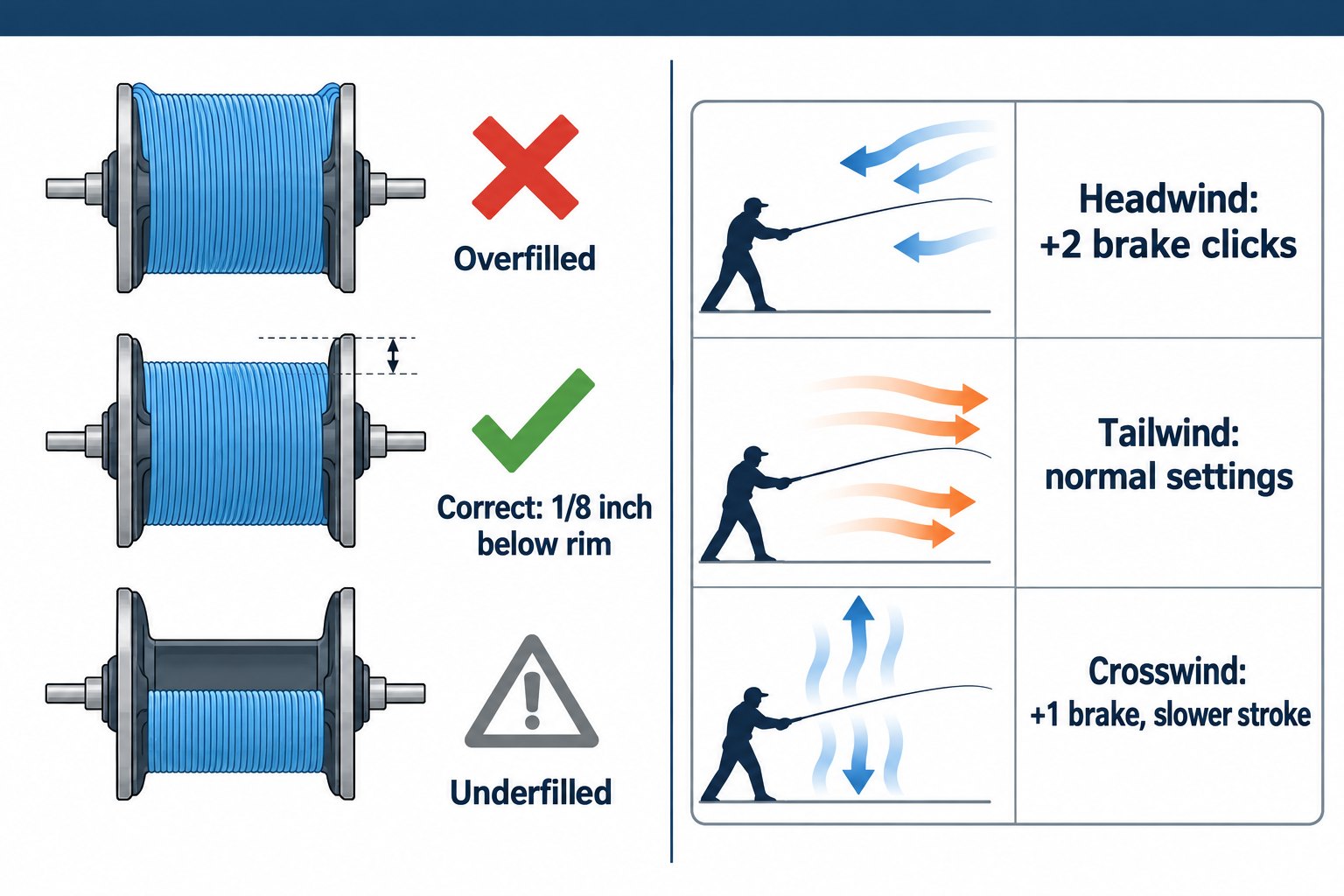
Wind. A headwind slows the lure mid-flight while the spool keeps spinning at lure-speed-from-before-the-gust. The mismatch dumps line. Backlashing into a 12+ mph headwind is roughly four times more common than in calm air. The fix: add braking (and sometimes a click of tension) when casting into wind, and prefer casting with the wind at your back. A crosswind hitting your casting-arm side is the worst case.
Line. Thin, soft line digs into the wraps below it under a backlash and locks the tangle in. Starting on 15 lb fluorocarbon or 40 lb braid with an appropriate leader makes nests easier to pick out and less damaging.
Spool fill. Line should sit about 1/8 inch below the spool rim. An overfilled spool sheds loose loops on top of itself and backlashes constantly; an underfilled spool creates extra friction against the rim and casts short. Check fill level after every respool.
A 30-Cast Drill That Ends Most Backlash Problems
Here’s a practice plan that takes one evening and fixes most chronic backlashes:
- Rig up with a 3/8 oz or heavier lure, brakes at 80%, tension set by drop test.
- Cast 10 times at a target 25–30 feet away — a bucket, not a distant shoreline. Lob, don’t launch.
- Back the brake off one notch, cast 10 more.
- One more notch, 10 more. Stop the moment you get a tail-end nest and go back one click.
Now diagnose from where any nest happens:
- Nest at the start of the cast: tension knob too loose (or you’re snapping the rod). Tighten a quarter-turn or smooth the stroke.
- Nest at the end of the cast: brakes too light, or your thumb isn’t clamping before splashdown.
- Constant nests at every setting: check spool fill and line type before touching the knobs again.
Work through the ladder until you find the lowest brake setting that stays clean. That’s your reel’s real baseline — everything above it is insurance you can spend on windy days.
And if you fish mostly sub-1/4 oz baits, accept the truth: a spinning reel is simply the better tool for ultra-light presentations. No amount of dialing makes a baitcaster happy on weightless plastics.
Quick Fixes, Real Answers
Why am I still backlashing after adjusting everything? Almost always one of three things: the tension knob wasn’t re-set for the lure you switched to, the spool is overfilled, or the rod tip is dropping at the end of the stroke. Check those before touching the brakes again.
Magnetic or centrifugal — which is easier for beginners? Magnetic. The external dial gives you instant, repeatable adjustments, and it behaves more predictably in wind. Centrifugal systems work well but mean opening a side plate to change settings.
Does line type really matter for backlashes? It matters for recovery more than prevention. Stiffer, heavier line picks out of a nest cleanly; thin soft line locks in and often has to be cut. Either way, set your spool fill to 1/8 inch below the rim.
A bird’s nest isn’t a verdict on your skill — it’s your spool telling you exactly which phase of the cast went wrong. Read the moment, adjust the matching control, and the tangles fade fast.