

You picked up a rod-and-reel combo — or inherited one from a grandparent’s garage — and the reel on top is a rounded thing with a button on the back. No bail. No spinning arm. Just a button. That’s a spincast reel, and if you’ve ever wondered whether it’s worth using or whether you should just swap it for something else, you’re not alone. It’s the most common first reel in fishing, and it gets a bad reputation it didn’t earn.
The good news: a spincast is genuinely the easiest reel to get working. If you can press a button and swing a rod, you can cast with it — no timing tricks, no training your finger, no backlash. The bad news: it has real limits, and knowing them up front saves you frustration.
Here’s what you’ll learn in the next few minutes: what the button actually does, how to load line without a mess, how to cast it properly, how to set the drag, and the few mistakes that cause the tangles people blame on “cheap reels.”
What a Spincast Reel Is (and Why You Probably Own One)
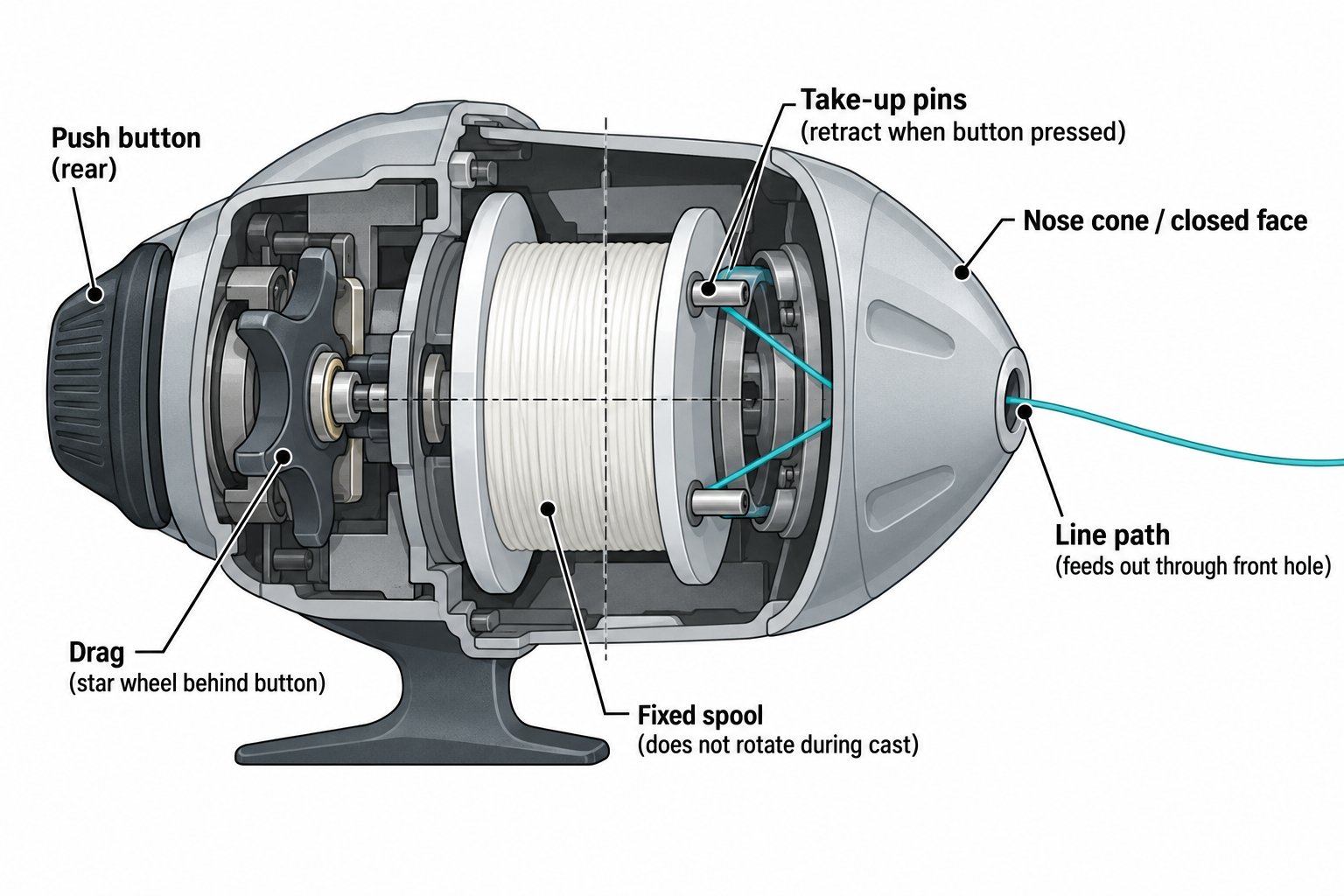
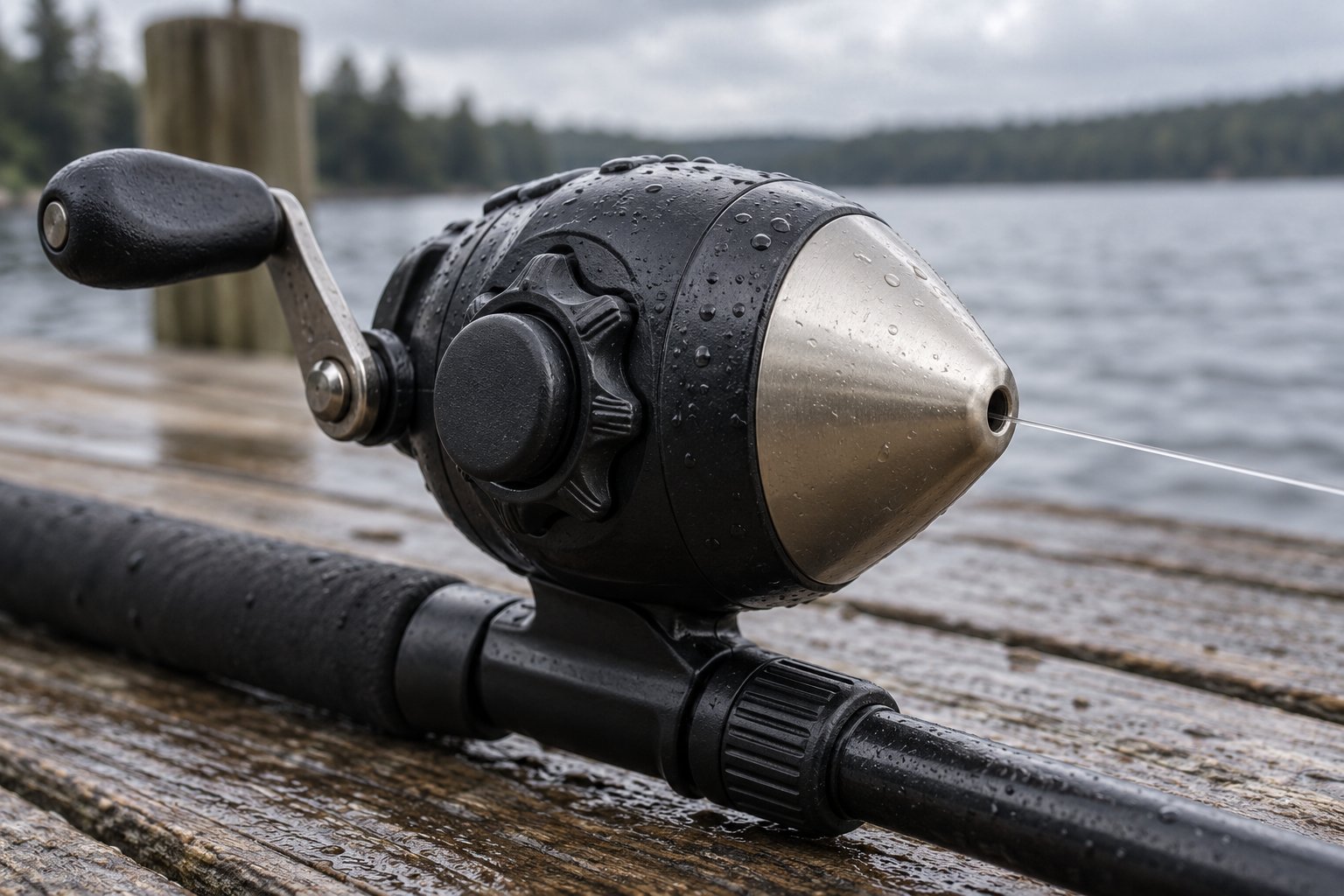
A spincast reel — also called a closed-face or push-button reel — is a small reel that mounts on top of the rod, with the line spool hidden inside a plastic housing with a nose cone at the front. The whole mechanism is enclosed, and the only thing you touch is a push button on the back of the reel.
That design is deliberate. Spincast reels were invented in the 1940s as an answer to one specific problem: baitcasting reels constantly tangle into “bird’s nests” when a beginner gets the timing wrong. The spincast solved it by hiding everything behind a closed face, so there’s nothing to mismanage.
You’ve probably already met one. Most starter rod-and-reel combos sold at big-box stores and tackle shops come with a spincast reel — it’s the cheapest, simplest option, and it’s the one that gets handed to kids and first-time anglers. So if your first rod came with a little button reel on top, that’s exactly what it’s for. If you’re curious about where it fits in the bigger picture, our guide on spinning reel vs. baitcaster walks through the tradeoffs between the major reel families.
How the Button Actually Works
Here’s the whole trick, and it’s simpler than it looks: the spool inside a spincast reel never rotates during a cast. It sits fixed in the housing. When you press the button, a set of small internal take-up pins retract, and the lure’s weight simply pulls line off the fixed spool through a small hole in the front of the nose cone. When the lure hits the water and stops pulling, the line stops feeding.
Because the spool can’t spin, it can’t over-rotate — which means the classic baitcasting backlash, where the spool outruns the lure and dumps a tangle of line, is physically impossible on a spincast. That’s the entire design philosophy: no moving spool, no tangle.
When you turn the handle, the take-up pins pop back up and catch the line, winding it back onto the spool. Press the button to let line go out; turn the handle to bring it back in. That’s the complete operating model.
There’s one variation worth knowing. Most spincast reels you’ll see have the button on the back and mount on top of the rod. A smaller family of closed-face reels — called underspin or triggerspin reels — hangs under the rod like a spinning reel and uses a little trigger lever near the front instead of a rear button. They work the same way; you just hold the trigger instead of pressing a button. If you have one of those, everything below still applies — only the hand position changes.
Loading Line: Spooling a Spincast Reel Without Tangles
Before you can cast, the reel needs line — and spooling a spincast is where most beginners make their first mistakes. The process is straightforward, but a few details matter.
Pick the right line weight first. Check the line weight recommendation printed on the reel body — most spincast reels are designed for roughly 4 to 12 pound-test monofilament, with 6 to 8 lb being a common sweet spot for small freshwater species. Stick to the printed range. Two things to note:
- Don’t go too light. Line that’s lighter than the reel is designed for can wrap and tangle inside the nose cone — the most common cause of the internal “bird’s nests” people complain about with budget spincast reels.
- Braid may not work. Some spincast reels don’t handle braided line well, because the take-up pins are designed around the diameter and texture of monofilament. If your reel’s instructions or packaging don’t mention braid, use mono.
The spooling steps:
- Remove the front cover. On most spincast reels (Zebco included), you unscrew the nose cone cover by turning it counterclockwise. Hold the handle so it doesn’t spin while you turn.
- Thread the line through. Pass the tag end of the line through the first rod guide (the one closest to the reel) and through the hole in the front cover.
- Tie it to the spool. Secure the line to the center post (arbor) of the spool with a simple knot — an overhand knot works; an arbor knot is the standard if you want something neater.
- Replace the cover and wind slowly. Put the cover back on, then wind line on by hand or with the handle, keeping light, even tension with your fingers. Stop and peek inside periodically.
- Fill to the right level. The line should sit about 1/8 inch below the top lip of the spool. Overfilling causes tangles; underfilling costs you casting distance.
One more detail: line memory. Monofilament comes off its factory spool with a coiled curl, and if you wind it on too fast or without tension, that curl stays and causes tangles at the first cast. Wind slowly and evenly, and if your reel came pre-spooled with memory-heavy line, soaking the spooled line in a bucket of water for a few minutes before your first outing will relax it.
When the line is spooled, thread it through the remaining guides to the rod tip and tie on a hook or small lure — a Palomar knot is the easiest reliable choice and takes about ten seconds.
Casting With the Push Button: The Right Way
Now the part everyone actually wants to know: how do you cast it? The technique is a standard overhand cast with one modification — your thumb works the button.
The five-step cast:
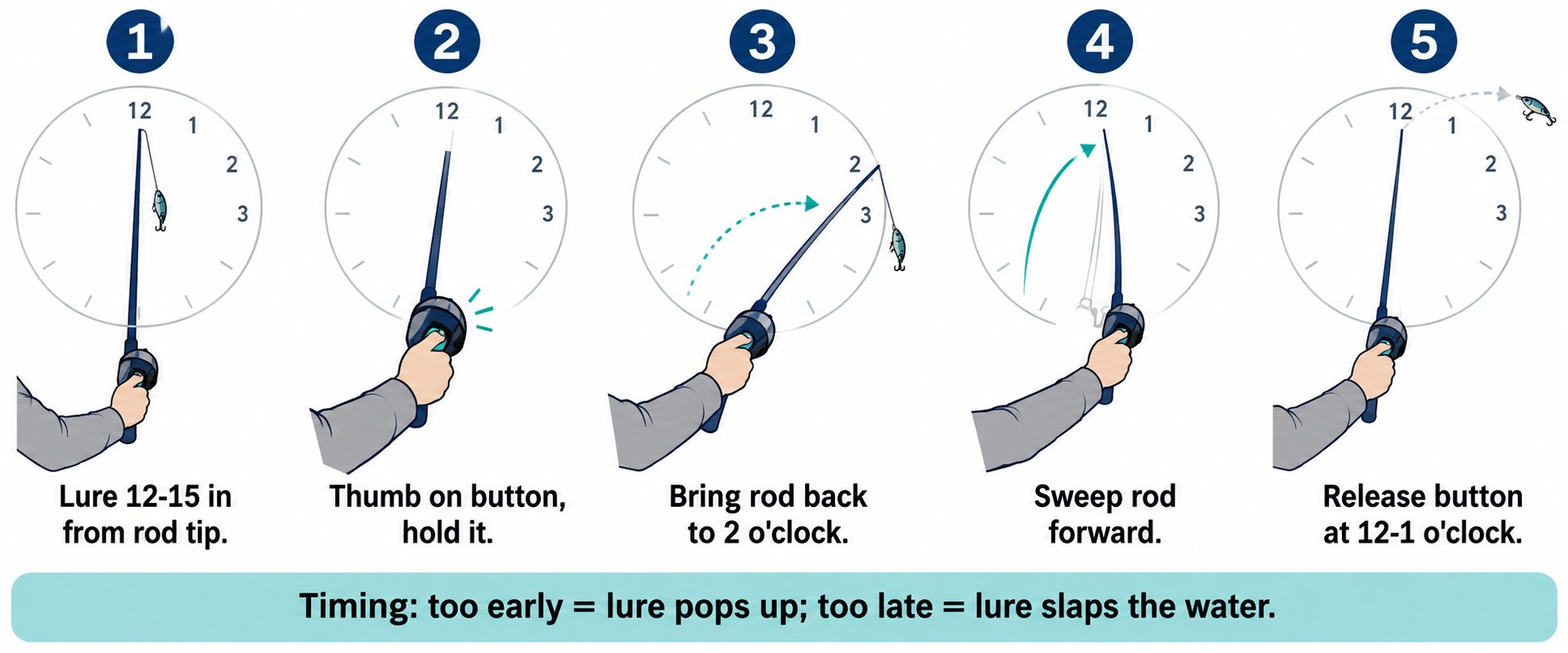
- Reel in so your lure hangs about 12 to 15 inches in front of the rod tip.
- Grip the rod in your dominant hand, with your thumb resting on the push button at the back of the reel.
- Press and hold the button. The line disengages — it may drop a few inches, and that’s normal. If it drops a lot, you’re not holding the button down firmly enough.
- Bring the rod back smoothly to about the 2 o’clock position (over your shoulder).
- Sweep the rod forward toward your target, and release the button as the rod tip points at where you want the lure to land — roughly the 12 to 1 o’clock position.
When the lure hits the water, press the button again (or simply stop the motion) to re-engage the pins, and start cranking. That’s it. One motion, one button.
Diagnosing your timing. Your first twenty casts will teach you a lot fast, and there are two classic tells:
- Lure pops up in the air and lands next to you → you released the button too early.
- Lure flies flat and slaps the water like a bullet → you released too late.
Move your release point a little earlier or later between the two, and you’ll find the spot quickly. Practicing in the yard with a coin or a small lure on the end beats trying to dial it in on the water.
The broader casting fundamentals — stance, grip, the forward sweep — are the same on any rod, and our guide on casting a fishing rod goes deeper on form if your casts feel sloppy.
Setting Drag and the Anti-Reverse
Two small controls on a spincast reel prevent more lost fish than almost anything else, and they’re easy to get right.
The drag. On most spincast combos, the drag is a star-shaped wheel just behind the push button. The drag is what lets line slip out when a fish pulls — instead of yanking your hook or breaking your line. Set it to roughly one-third to one-half of your line’s test strength: on 6 to 8 lb line, that’s a drag set to slip at about 2 to 3 lb of pull. A simple test: with the rod tip angled down, pull the line steadily with one hand — it should slip smoothly under steady pressure, not snap or drag freely. If it slips too easily, tighten it a click; if the line barely moves, loosen it. If you want the mechanics in more depth, our drag setting guide covers the same principle for any reel.
The anti-reverse. Somewhere on the reel body there’s a small switch — this is the anti-reverse. It stops the handle from spinning backward when a fish pulls. You want it on (engaged) for almost everything. Without it, a hooked fish just reels your line back out through the spool, and your hookset has no leverage. If the handle ever feels like it’s grinding or won’t turn at all, check that the anti-reverse is in the right position before you assume the reel is broken.
Hookset. When a fish takes, lift the rod tip up and turn the handle firmly — the anti-reverse keeps the spool from spinning back, so the lift drives the hook home. No fancy moves needed.
Common Mistakes and How to Fix Them
Even with a spincast, things go wrong. Here are the failures we see most often, and what’s actually causing them.
| Symptom | Likely cause | Fix |
|---|---|---|
| Line tangles inside the nose cone | Line too light for the reel, or line memory | Use the recommended line weight; soak line to relax memory |
| Spool tangles when casting | Spool overfilled | Trim spool back to 1/8″ below the lip |
| Lure won’t cast / line won’t feed | Too little line, or line tangled behind the internal mechanism | Respool; remove the front cover and clear any snarled line |
| Reel won’t pick up line when reeling | Not enough tension on the line | Pull the line lightly with one hand while cranking |
| Button feels sticky or line won’t release | Dirt or grit in the button mechanism | Rinse the reel with fresh water after each use; dry it before storage |
| Line keeps dropping while holding the button | Button not held firmly down | Press the button all the way in and keep it there during the backswing |
General maintenance takes two minutes after each trip: rinse the reel with fresh water (especially after any saltwater or muddy-water session), let it dry, and store it somewhere cool and dry. A drop of reel-specific oil on the moving parts once a year is plenty — skip the WD-40, which attracts dirt.
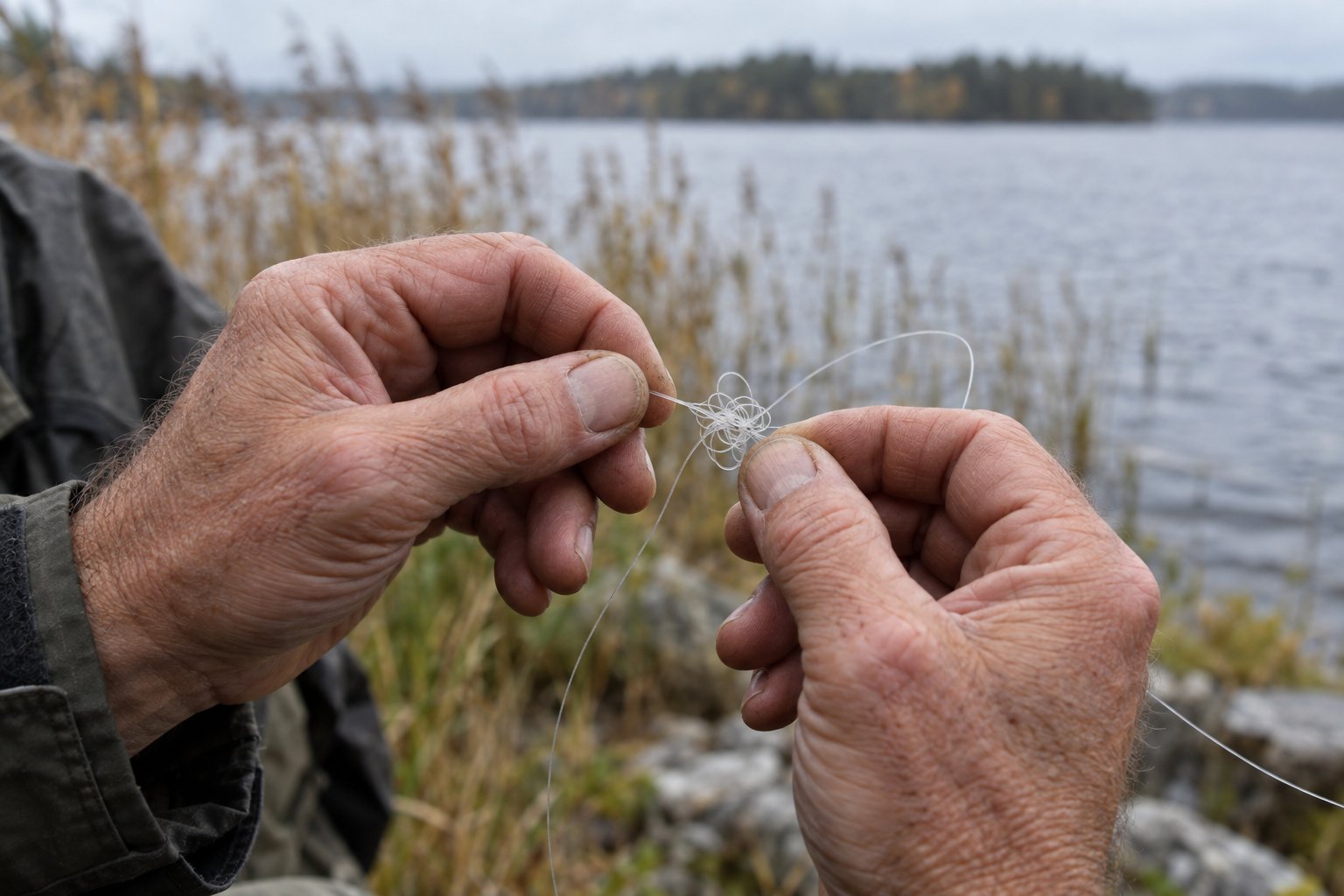
And if you do end up with a tangle that won’t come apart: wet your hands first (skin oils weaken line, and wet hands let the knot slide more), work the loops gently apart with a toothpick if needed, and never yank. A tangle that takes ten minutes to pick apart beats a cut line and a lost lure.
When a Spincast Is Enough — and When to Switch to Spinning
Here’s the honest part, because the spincast does have real limits:
- Casting distance. The small enclosed spool holds less line and feeds it less freely than a spinning reel, so your casts will be shorter. That’s fine for ponds and small lakes; it’s less ideal for bigger water.
- Line capacity. The spool is small. If you’re targeting bigger species that run or fight hard, you’ll want more line behind them.
- Drag. The drag on a spincast is functional but not smooth. It’s perfectly adequate for panfish, small bass, trout, and perch — the species beginners typically catch — but a hard-running fish can overwhelm it.
- Lure range. Spincast reels handle light lures best — roughly 1/16 to 3/8 ounce. Heavier lures start fighting the small mechanism.
So who is the spincast actually for? If you fish occasionally, fish mostly small ponds and lakes, or you’re teaching a kid, a spincast is a genuinely good tool. Its one-button cast is the fastest path to “lure in the water without a tangle,” and for casual trips that’s worth more than raw performance. The reel that gets you fishing beats the “better” reel that gets you frustrated.
When to switch: once you find yourself wanting to cast farther, fish bigger water, or use a wider range of lures, a spinning reel is the natural next step — farther casts, more line, smoother drag, and broader species coverage. The transition is easy: the casting motion is the same, and you swap the button for an index-finger line release. Many anglers keep a spincast for the kids and a spinning reel for themselves; that’s a perfectly reasonable setup.
For the kinds of water and species where a spincast shines — calm ponds, small lakes, panfish and small bass — it still puts more fish in the water than frustration in your line.

The short version: load the reel with the right line weight, fill the spool to 1/8″ below the lip, cast with a smooth sweep and a timed button release, set the drag to a third or half of your line’s strength, and keep it rinsed after every trip. Do that, and the spincast does exactly what it was designed to do — get a beginner casting, catching, and still enjoying the water on day one.