
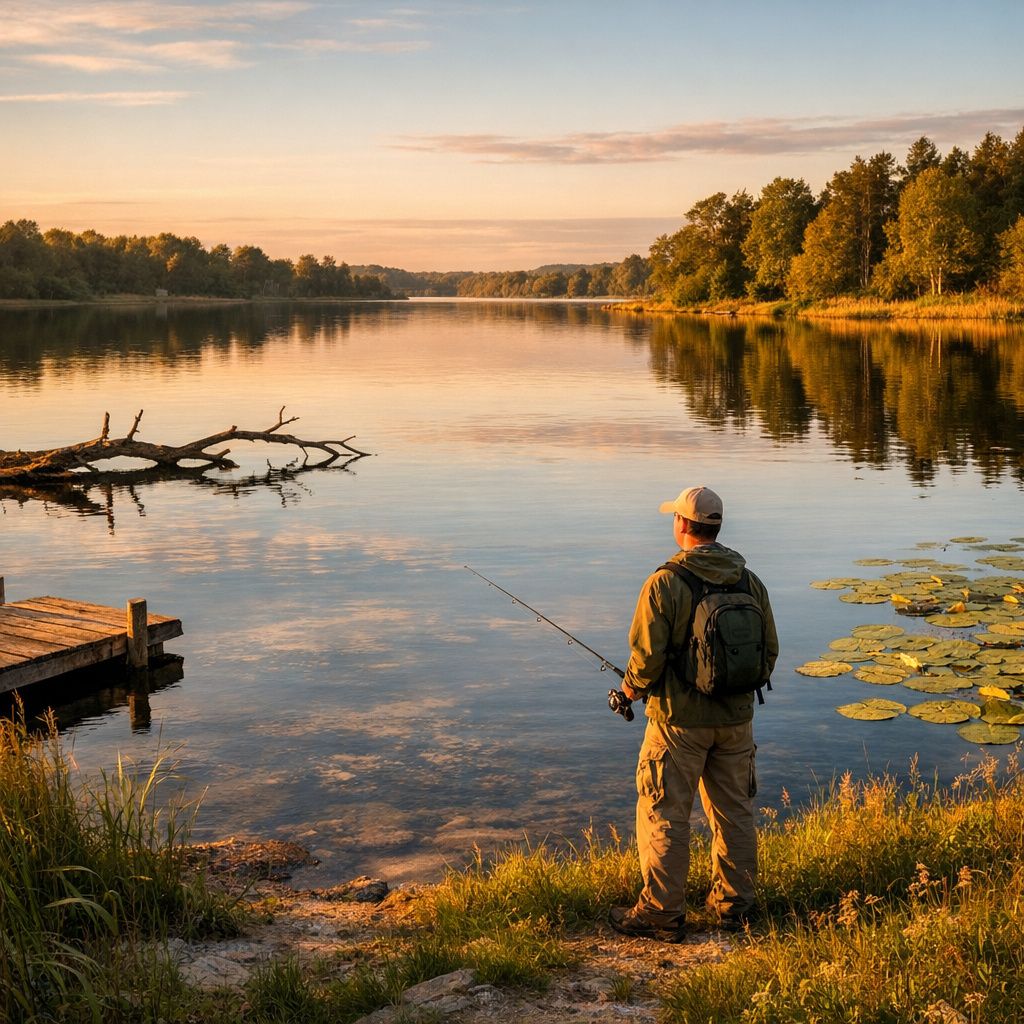
You’ve got your rod, your line, a few lures in the box, and you’re standing at the water. Everything just looks like… well, water. Where do you cast?
It happens to every beginner. You hear experienced anglers talking about “fishing structure” and “reading the water,” but from the bank those phrases don’t translate into anything you can actually spot. So you pick a spot at random and cast. Nothing bites.
That’s not bad luck. It’s a skill you can learn. Fish don’t hide randomly — they hold in specific spots driven by food, cover, depth, and current. Once you start recognizing what those spots look like from the surface, you stop fishing blind.
This guide shows you how to scan a lake or river the way experienced anglers do — so you know where the fish are before you even cast.
What Is “Reading Water” Anyway?
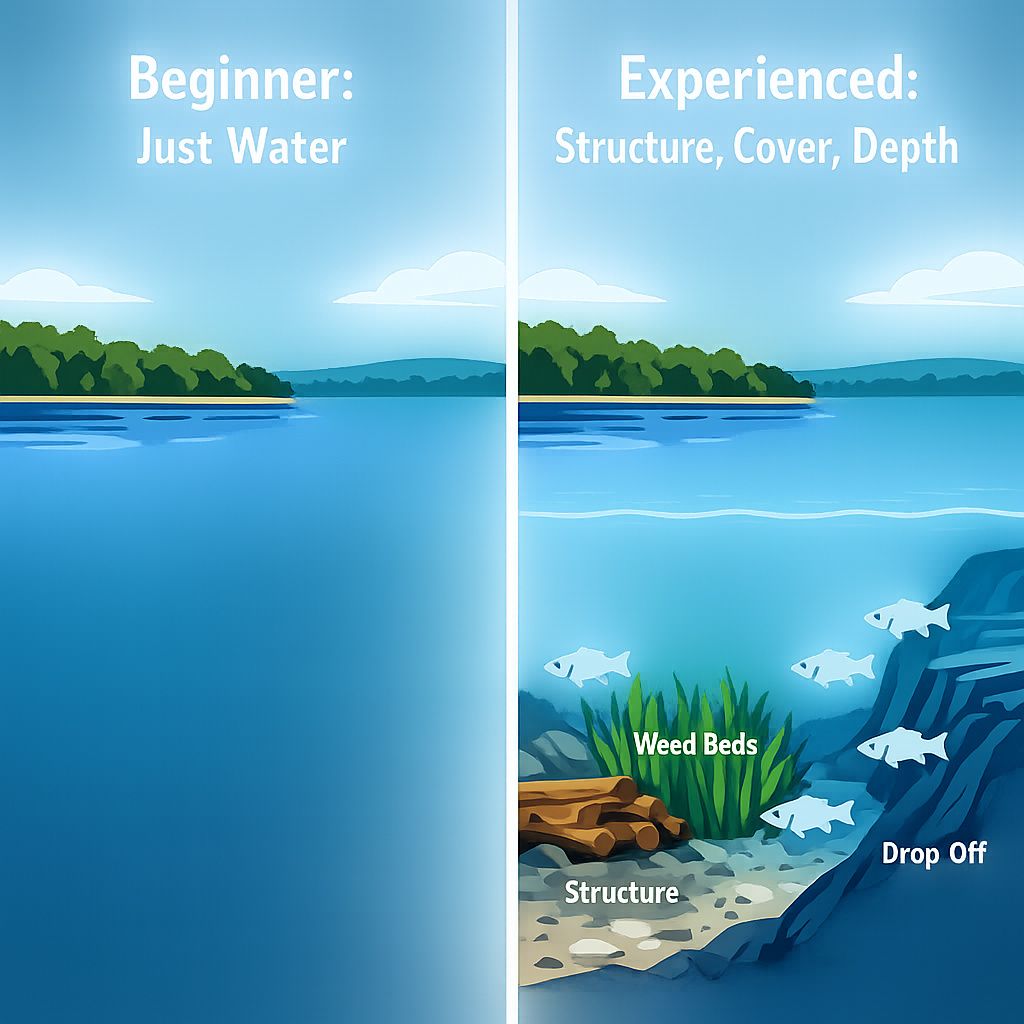
Reading water means looking at a body of water and identifying the features where fish tend to hold. You scan the surface, the shoreline, and everything between them to build a mental picture of what’s happening below.
You already know more than you think. Birds diving near the shore? A fallen tree sticking out of the water? A patch of lily pads? Those are all clues. Reading water is just about learning to spot those clues on purpose instead of hoping one jumps out at you by accident.
The goal is simple: before your first cast, you should be able to point to two or three spots and say, “Fish are probably near there.”
Why It Matters
Casting at 20 random spots rarely beats fishing three good spots with purpose. Beginners tend to blame their gear when they don’t catch anything — but the real problem is usually where you’re casting, not what lure you’re using. Great lures in empty water don’t catch fish. Decent lures in the right spot do.
What Is “Structure” and How to Spot It
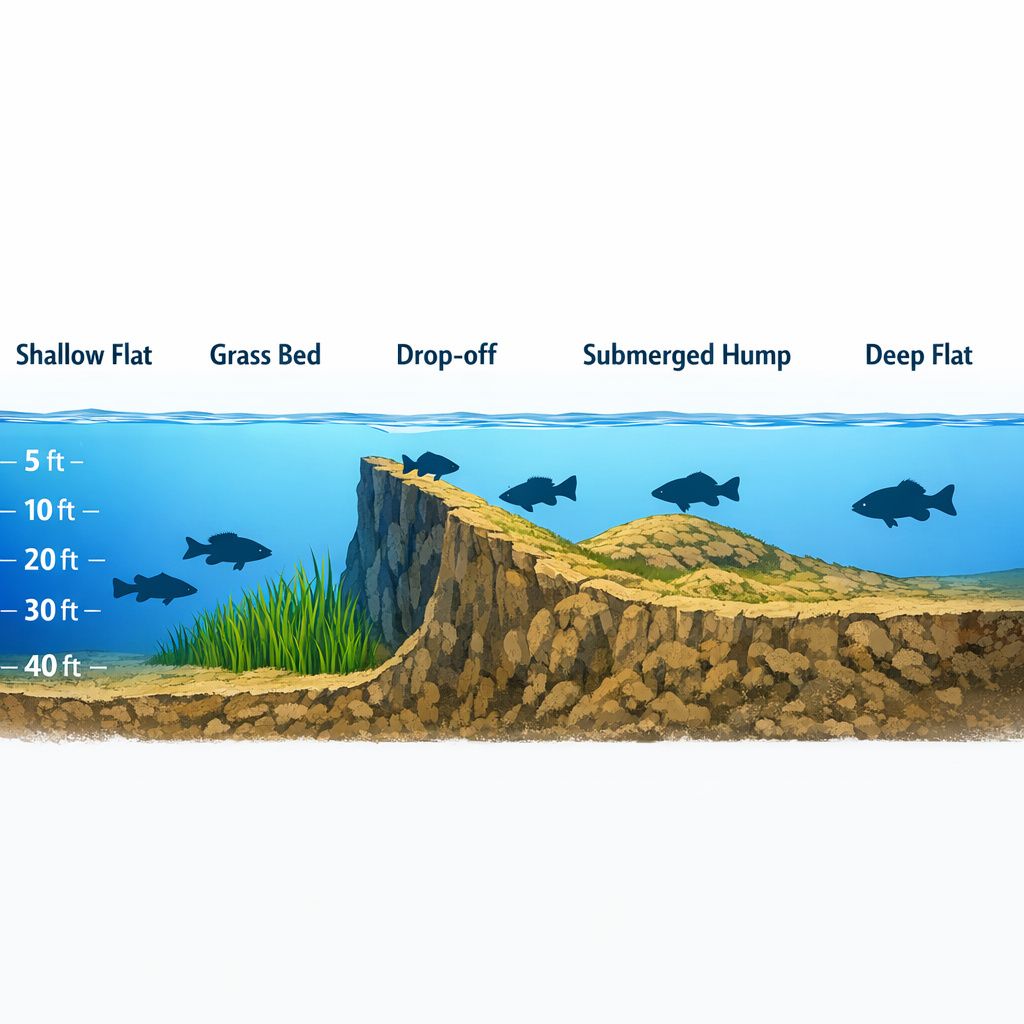
Structure is the most important concept in freshwater fishing. It’s any underwater feature that breaks up the bottom — rocks, slopes, humps, gravel beds, submerged timber, sandbars. Structure matters because it pulls in food, gives predators ambush points, and creates temperature and oxygen differences that fish seek out.
Fish use structure for three reasons:
-
Food — Structure attracts insects, crustaceans, and baitfish. Those attract the fish you want to catch.
-
Cover — It gives fish a place to hide from predators.
-
Energy conservation — Fish hold near structure instead of swimming around looking for food.
The catch is that most structure sits underwater, invisible from the bank. But you can still detect it by learning what each type looks like from the surface.
Drop-offs and Shelves
A drop-off is where the bottom suddenly slopes from shallow to deep — basically an underwater cliff. Fish love them because they can move between shallow and deep water quickly, responding to temperature changes, light levels, and baitfish movement.
From the bank, a drop-off often shows up as a sharp shoreline change. Steep land usually mirrors steep underwater terrain — a high bank or cliff often means the bottom drops off right behind it. Look for areas where the water goes from clear and shallow to noticeably darker within just a few feet. That color shift means the bottom is falling away.
You can also spot drop-offs by watching where boats run. Boaters naturally follow deeper channels, and the areas where their wakes show up darker are usually riding along drop-off edges.
Humps and Pinnacles
Humps are underwater mounds rising from deeper water. They work like islands under the surface — fish circle them, ambush prey along their edges, and use them as staging points.
Humps are harder to spot from shore since they can sit right in the middle of a lake. On a windy day, look for subtle ripples or slight discoloration on the water surface — wind creates standing waves when it hits underwater obstacles, so faint chop in an otherwise flat area can signal a hump or rock pile below.
Rock Piles and Gravel Beds
Rock piles show up as dark, irregular patches near the shoreline, especially in clear water. Even when the water’s stained, a rocky or cliff-like shoreline almost always has rocky structure extending underwater.
Gravel beds appear as lighter, tan-colored patches along the bottom, especially after rain. Gravel attracts baitfish and small crustaceans, which brings in panfish and bass. Look near creek channels or runoff entries.
Submerged Timber
Downed trees underwater are some of the most productive fishing spots in a lake. Fish use submerged timber for cover, and it attracts baitfish that cling to the branches.
From the surface, you can spot submerged timber by looking for dark, horizontal lines under the water — especially near shore. In shallow water you might see the actual branches. Deeper out, the timber creates a shadow or a slightly darker area in the water column. Check along the edges of weed beds too — fallen trees often wash into vegetation zones and settle there.
Types of Cover Fish Use
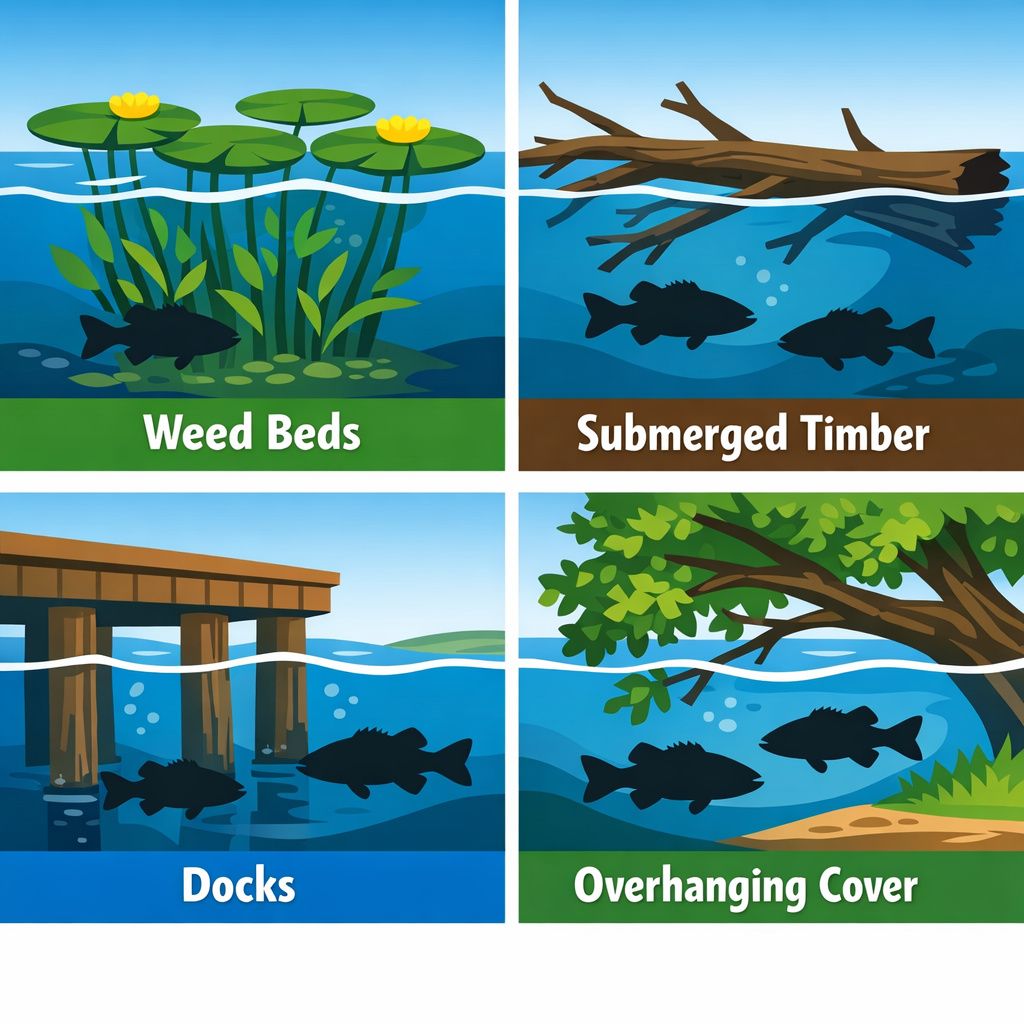
Cover is different from structure in one key way: structure is about the bottom and terrain, while cover is about anything that provides hiding places. In practice, the two overlap constantly — a fallen tree is both structure and cover. But keeping the distinction in mind helps you think through what fish need under different conditions.
Aquatic Vegetation
Plants are the single biggest draw for fish in a lake. Vegetation provides food, cover from predators, and spawning habitat. Fish hold in thick vegetation, along the edges of it, and just outside it — so weed beds are one of the first things you should scan for.
From the bank, different plants look different:
-
Lily pads show up as flat, green, circular pads on the surface. They’re obvious and they’re great — bass, sunfish, and catfish all hang around them. Look for gaps between pads or along the outer edge where fish ambush prey.
-
Coontail and hydrilla sit mostly underwater but create a visible greenish-brown tint. In shallow areas, you can see the feathery texture of coontail. Hydrilla tends to form thicker, more solid-looking mats.
-
Duckweed appears as a thin green carpet on calm water, usually near the edges. It doesn’t provide much cover itself, but fish cruise along its edges looking for insects.
Fallen Trees and Standing Timber
From a cover perspective, fish don’t just hold near a submerged tree — they hold in the branches. If a tree falls partially in the water with branches overhanging the surface, that’s one of the best spots on any lake.
Look for trees with trunks angled into the water. Even half-submerged, the underwater portion is holding fish. Upright trees still sticking out of the water create vertical cover — fish hold along the trunk and root structure.
Docks and Man-Made Structures
Docks create shade, provide structure underneath, and attract baitfish. Fish congregate under docks in nearly every season, especially in summer when the shade and deeper water offer relief from surface heat.
See a dock? Fish it. Cast along the edges, around the pilings, and just outside the shaded area. The transition from sunlit water to shade is a natural ambush line for bass and other predators.
Overhanging Branches and Banks
Trees that hang over the water drop leaves, insects, and food directly into the fish’s feeding zone. Fish hold below overhanging branches because food literally falls in front of them.
Look for tree lines along the shore where branches extend over the water, especially during spring and fall when insects are active. The water surface under those branches often looks slightly darker from the shade — that’s your target zone.
Depth Transitions Explained
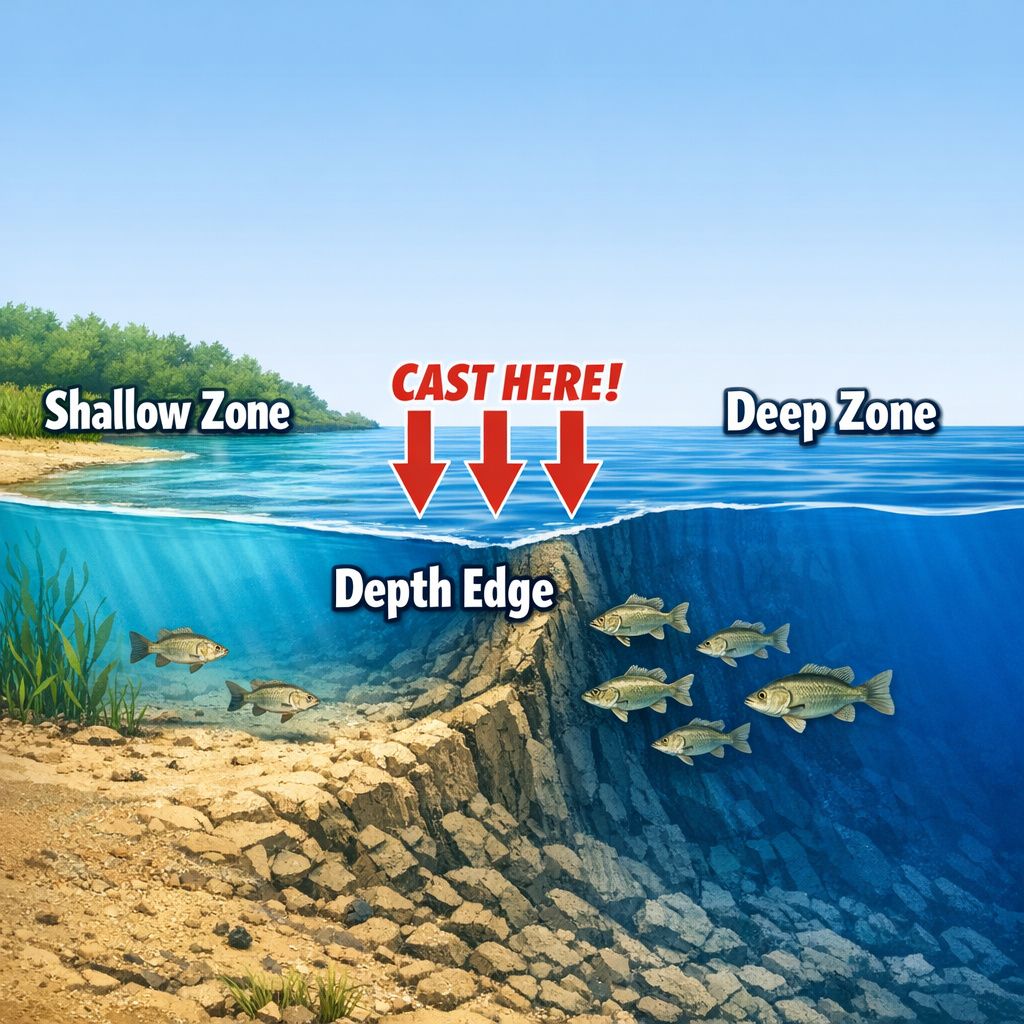
Depth transitions are where shallow water meets deeper water. They’re one of the most consistent fish-holding features you’ll find, and they’re easy to understand once you see the pattern.
Fish move between shallow and deep water constantly. Morning and evening, they move shallow to feed. Midday on a bright day, they move deeper for cover and stable temperature. A depth transition gives them a “highway” between the two zones.
How to Spot Depth Changes
Look for these visual indicators:
-
Color change — Clear shallow water near shore transitions to darker, deeper-looking water. That boundary line is your depth transition.
-
Weed edge — Where aquatic vegetation ends is usually a depth change. Plants grow to a certain depth and stop, so the outer edge of a weed bed almost always marks a transition.
-
Shoreline shape — A gently sloping shore usually has a gradual depth transition. A steep bank creates a sharp one. Both hold fish, just in different patterns.
-
Boat traffic patterns — Areas where boats seem to slow down or turn often sit near depth changes, since boaters tend to stay in deeper channels.
Why Fish Concentrate at Edges
A depth transition works because it gives fish access to both shallow and deep water without committing to one. If baitfish move shallow, the predator follows. If the sun gets too bright, the predator drops deeper. They hold along that edge line and wait.
Your casts should target the transition itself, not the shallow side or the deep side alone. Cast to the line where the two depths meet.
Reading Rivers and Streams
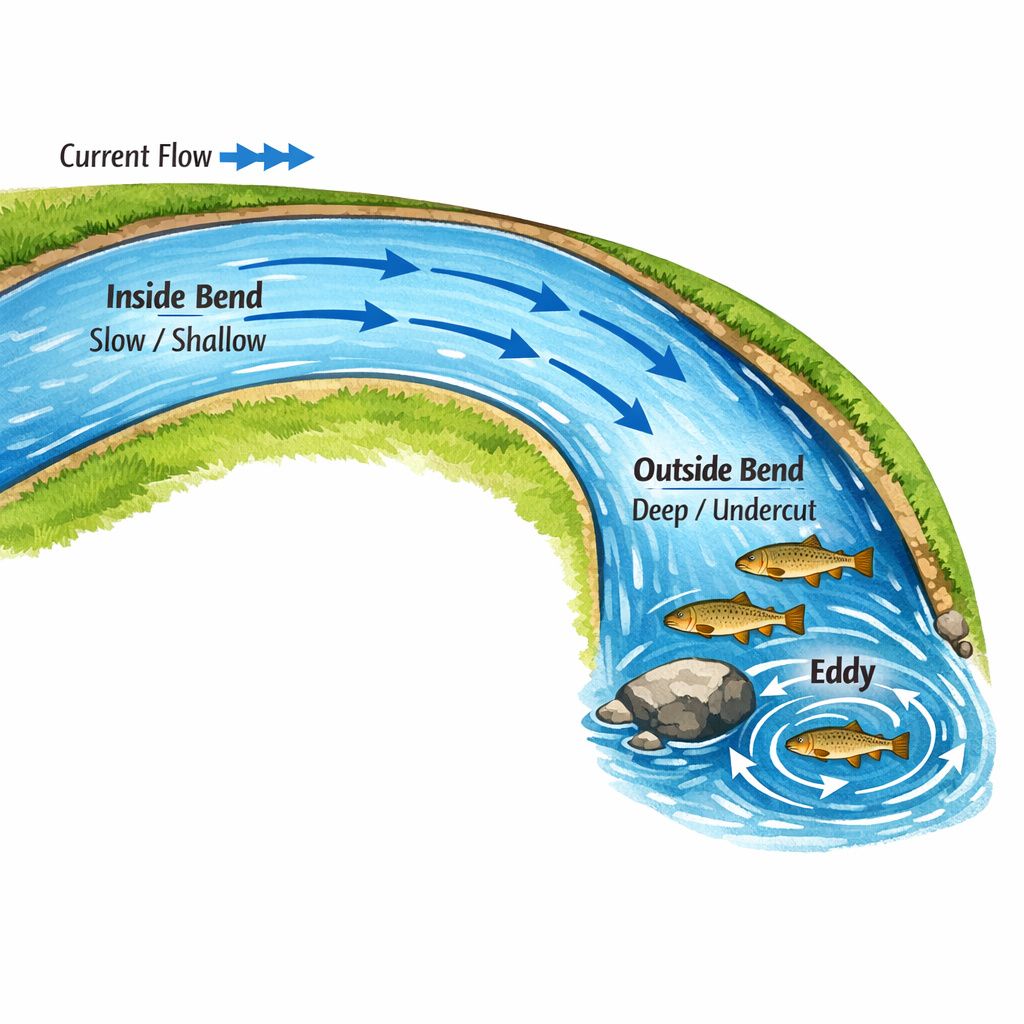
River fishing adds a variable that lakes don’t have: current. Flow changes everything about where fish hold and how you find them. Fish in rivers position themselves to maximize food intake while minimizing the energy they spend fighting the current.
Current Breaks and Eddies
A current break is any spot where the main flow slows down or diverts. Fish sit in these breaks because food floats past them on the current, but they’re not wasting energy fighting the flow.
Eddies are circular currents that form behind obstacles — behind a large rock, a log, or the inside of a river bend. Some of the best spots in any river. Look for leaves or debris collecting in a swirl pattern near the bank. That’s an eddy, and fish are sitting right at its edge, waiting for food to drift in.
Inside vs. Outside Bends
River bends create two very different zones:
-
Outside bends — The current pushes against the outside of a curve, creating a deeper, faster channel. It cuts into the bank over time, so you’ll often see steeper, undercut banks on the outside. Fish hold along these banks, especially at the edges where deep water meets slower water near shore.
-
Inside bends — The current slows on the inside of a curve, creating a shallow, slower area. Sandbars and gravel bars form here. Panfish and smaller predators cruise these areas looking for insects. In slower seasons, these spots can produce well.
Pools, Runs, and Riffles
These are the three basic river structures:
-
Pools — Deep, slow water. Fish hold here, especially larger fish looking to conserve energy. Look for pools behind large rocks or below drops.
-
Runs — Moderate depth, moderate speed. The most productive zone for many species. Fish hold along the edges where the run meets a pool or riffle.
-
Riffles — Shallow, fast, turbulent water over rocks or gravel. They oxygenate the water and attract baitfish. Fish don’t sit in riffles, but they sit right next to them, waiting for food to wash downstream.
Surface Signs of Fish Activity
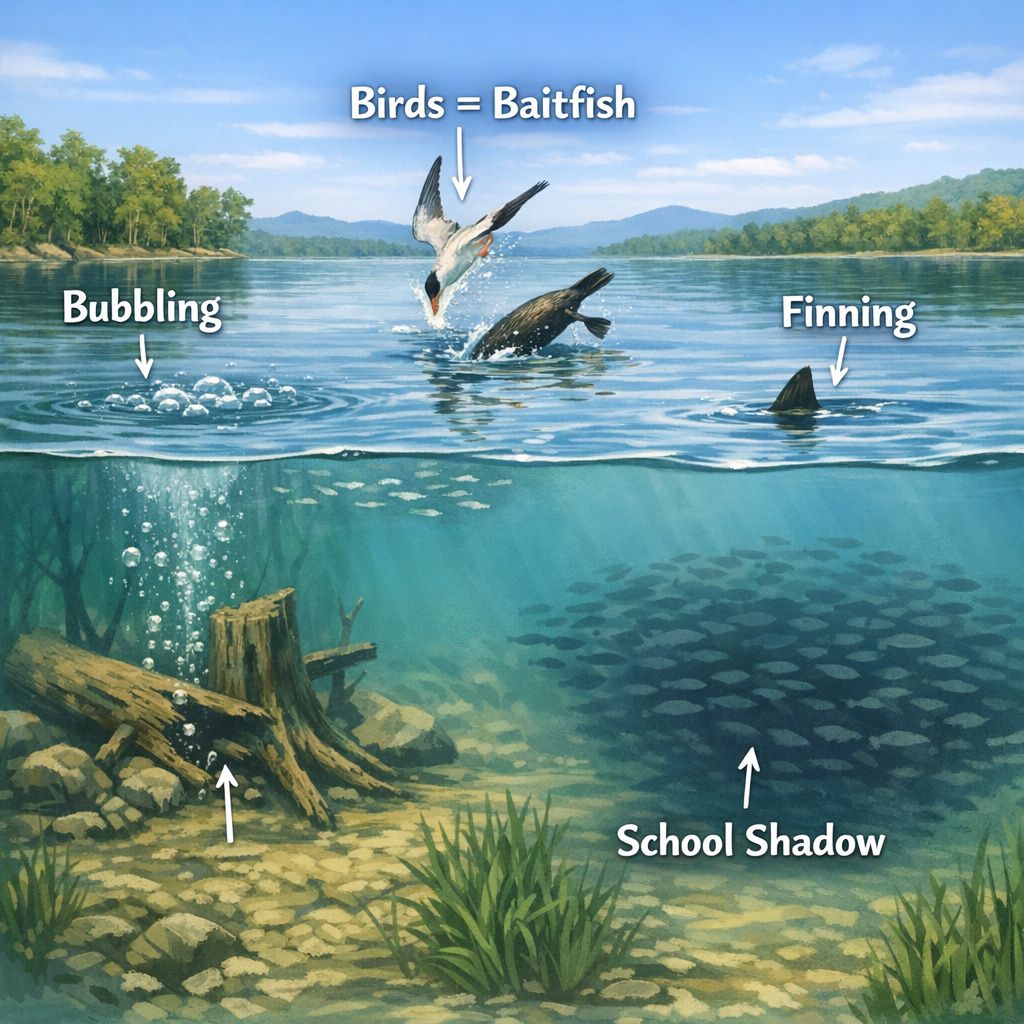
Sometimes the fish tell you exactly where they are. Here’s what to watch for:
Bubbling
Small bubbles rising from the bottom can indicate fish foraging near the substrate. Catfish disturb the bottom as they feed, releasing trapped gas from mud or decaying vegetation. A cluster of bubbles in one spot suggests something is stirring the bottom.
Finning
Finning is when a fish breaks the surface with its tail fin or back, creating a small fan-shaped disturbance. Most common in warm weather and calm conditions. A finning fish is actively feeding — cast immediately toward the disturbance.
Jumping Fish
A jumping fish is the clearest possible signal. It’s either chasing baitfish or reacting to something. Either way, food is in that area. Cast toward the splash zone on your next cast.
Bird Activity
Birds are excellent fish finders. Herons standing along the shoreline have already identified where fish are holding. Diving birds — terns, mergansers, gulls — indicate schools of baitfish right below the surface. Cast near diving birds.
School Shadows
In clear, shallow water on a sunny day, you can sometimes see the dark shadow of a school of fish moving under the surface — especially in spring and fall. A school shadow moving parallel to shore means active fish. Cast just ahead of the school’s path.
Water Clarity and Its Effects
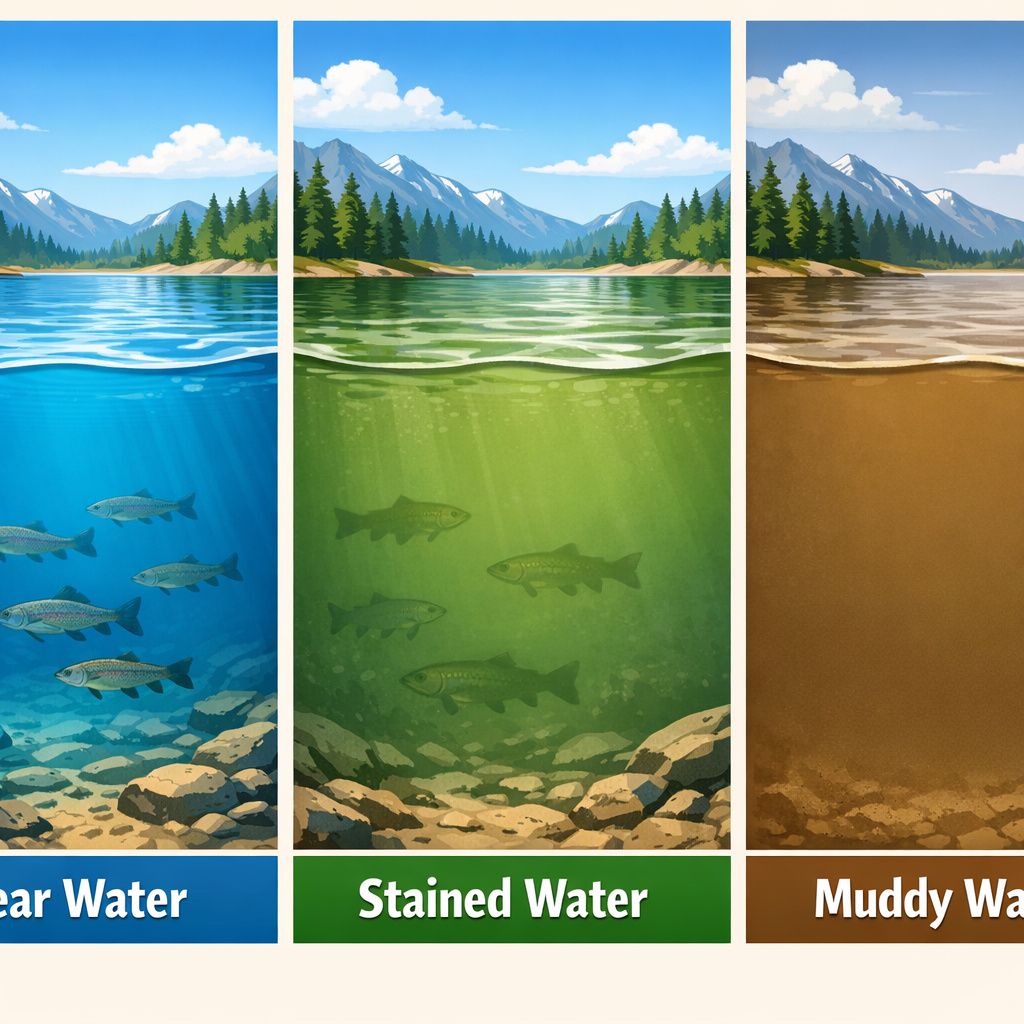
Water clarity changes everything about how fish behave and what you can see from the bank. Learning to assess clarity when you arrive lets you adjust what you look for and how you fish.
Clear Water
Clear water means fish can see well, which means they’re more selective and more cautious. They hold closer to cover and structure because they can see you approaching. The upside is that in clear water, you can actually see underwater structure — rocks, weed edges, drop-offs — which makes reading the water much easier.
Look for fish along the edges of cover rather than in the middle of it. Cast slightly farther and work your lure more slowly, since fish in clear water have more time to see and reject a lure that looks wrong.
Stained Water
Stained water has a greenish, tea-colored, or slightly muddy tint. You can still see a few feet down. Fish are less cautious in stained water and will venture farther from cover. You can still spot major features like weed edges and docks, but fine detail gets lost.
Muddy Water
After heavy rain or spring runoff, water can get so muddy you can’t see the bottom at all. Fish rely less on sight and more on vibration and sound, tending to hold closer to shore where baitfish wash in from runoff.
In muddy water, surface scanning gives you less information. Focus on shorelines, creek channels, and obvious cover like docks and overhanging trees. The structure is still there even if you can’t see it.
Tools That Help You Read Water
Your eyes are the primary tool for reading water, and you should rely on them first. But a few tools make the job noticeably easier.
Polarized Sunglasses
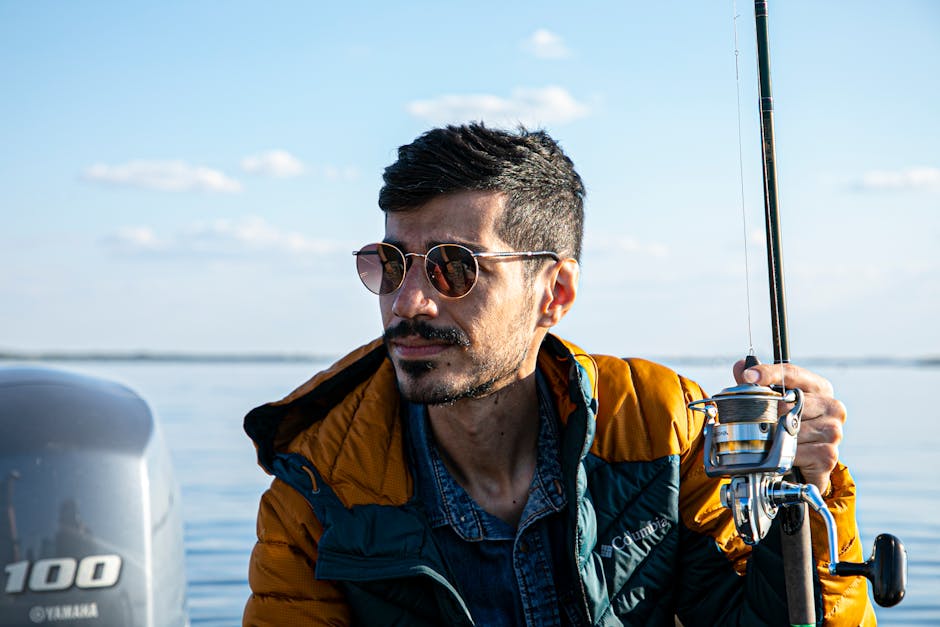
Polarized sunglasses are the single most useful piece of gear for reading water — and most beginners don’t realize why. They cut surface glare and reflection, which lets you actually see below the water surface. Without them, the water acts like a mirror in bright sunlight, and you can’t see structure, fish shadows, or weed edges underneath.
With polarized lenses, you can often see rocks, submerged timber, drop-offs, and even fish themselves in water that looks completely opaque without them. They’re not a luxury — they’re a requirement if you want to scan effectively.
Fish Finders and Depth Finders
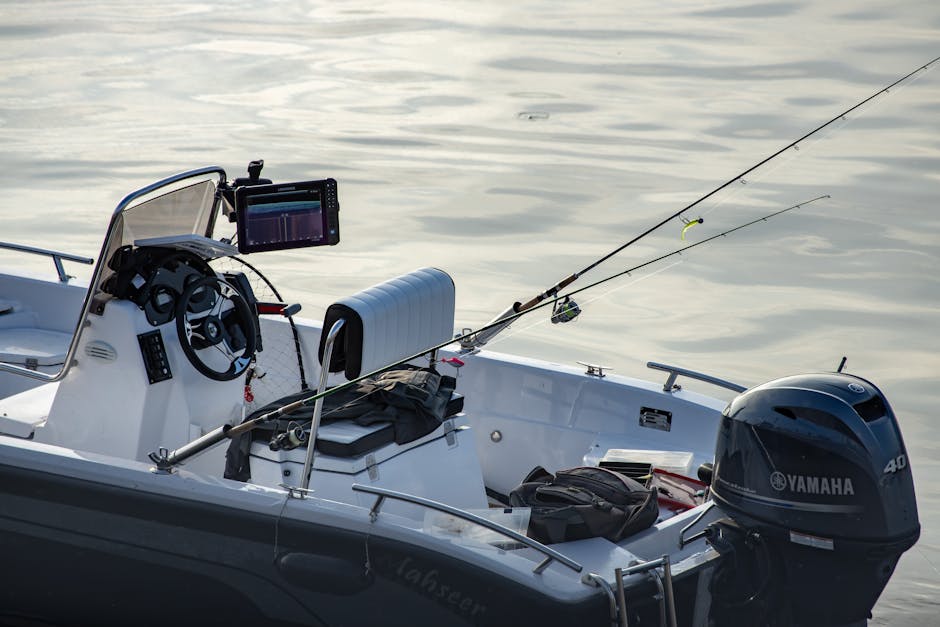
A fish finder sends sonar pulses into the water and displays bottom contour and fish icons at various depths. Entry-level portable models are affordable and easy to use — drop a small transducer in the water and the screen or phone app shows you what’s below.
Fish finders are a supplement to visual scanning, not a replacement. They tell you what’s directly below you — useful for confirming a depth change or checking if fish hold near structure you spotted visually. But they don’t replace the skill of reading water. The finder shows you what’s under the boat. Reading the water tells you where to put the boat.
Your Scanning Checklist
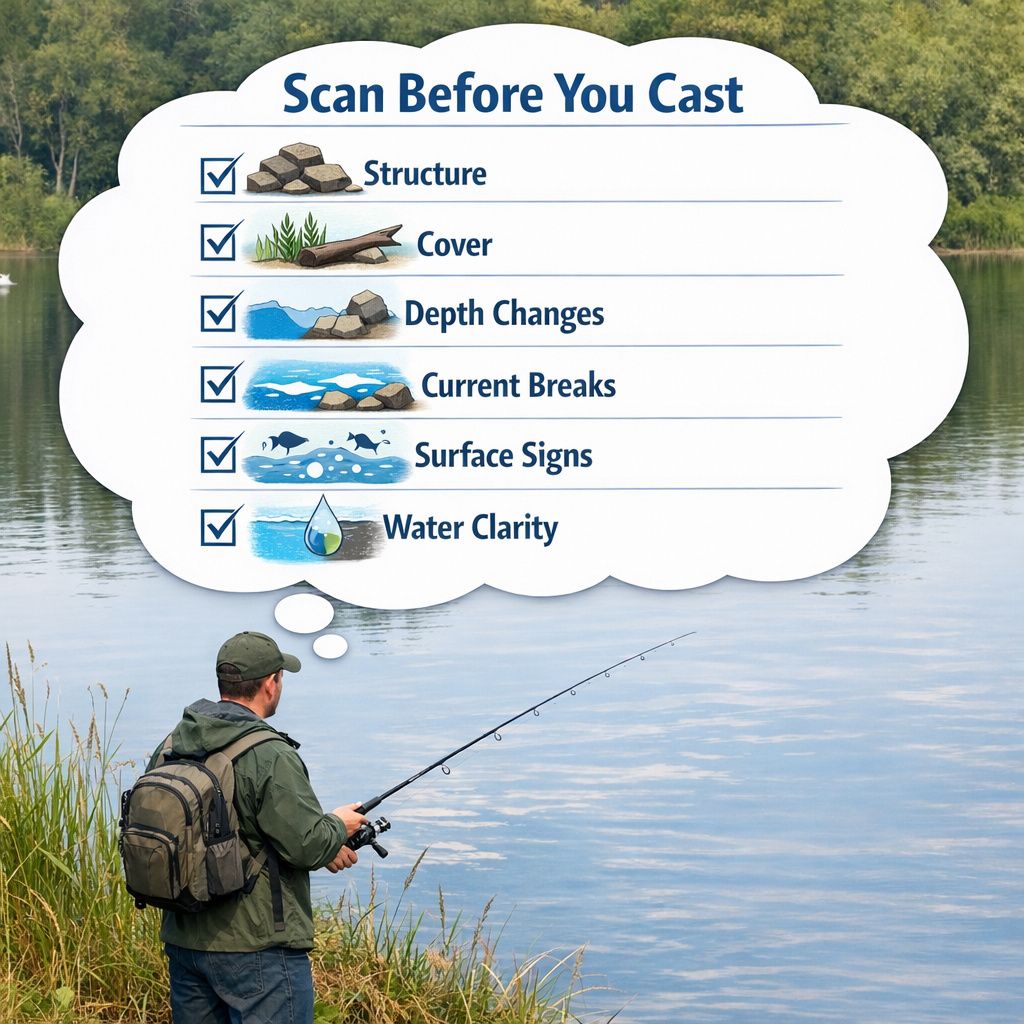
Before you cast your first lure, take 60 seconds and run through this checklist. It walks you through the water in a logical order so you don’t miss the obvious features.
1. Scan the shoreline. Walk the bank and look for fallen trees, overhanging branches, docks, and steep banks. Anything that breaks up a smooth shoreline is worth noting.
2. Look for vegetation. Weed beds, lily pads, and grass edges are the most consistent fish-holding cover. Identify where they start, where they end, and whether there are gaps you can cast into.
3. Spot depth changes. Look for color shifts in the water — where light, clear water transitions to darker water. That line is a depth transition and it’s a prime target.
4. Watch for surface signs. Are birds diving? Is there bubbling? Do you see a fish jump or fin near the surface? Any of these means fish are active in that area.
5. Identify structure near shore. Can you see rocks, a rocky ledge, or a gravel bar? Even if you can’t see underwater, a rocky or steep shoreline almost always has structure extending below the surface.
6. Check water clarity. Is the water clear, stained, or muddy? This tells you how far from cover fish are likely holding and what kind of visibility they have. Adjust your targets based on what you see.
You don’t need more than two minutes to run through this. Once you’ve identified your top two or three spots, start casting.
Where to Cast: Targeting What You See
Finding a feature is only half the skill. The other half is knowing where to cast relative to it. Cast too far into thick cover and you’ll hang up. Cast too far away and you’ll miss the fish entirely.
Near Cover, Not In It
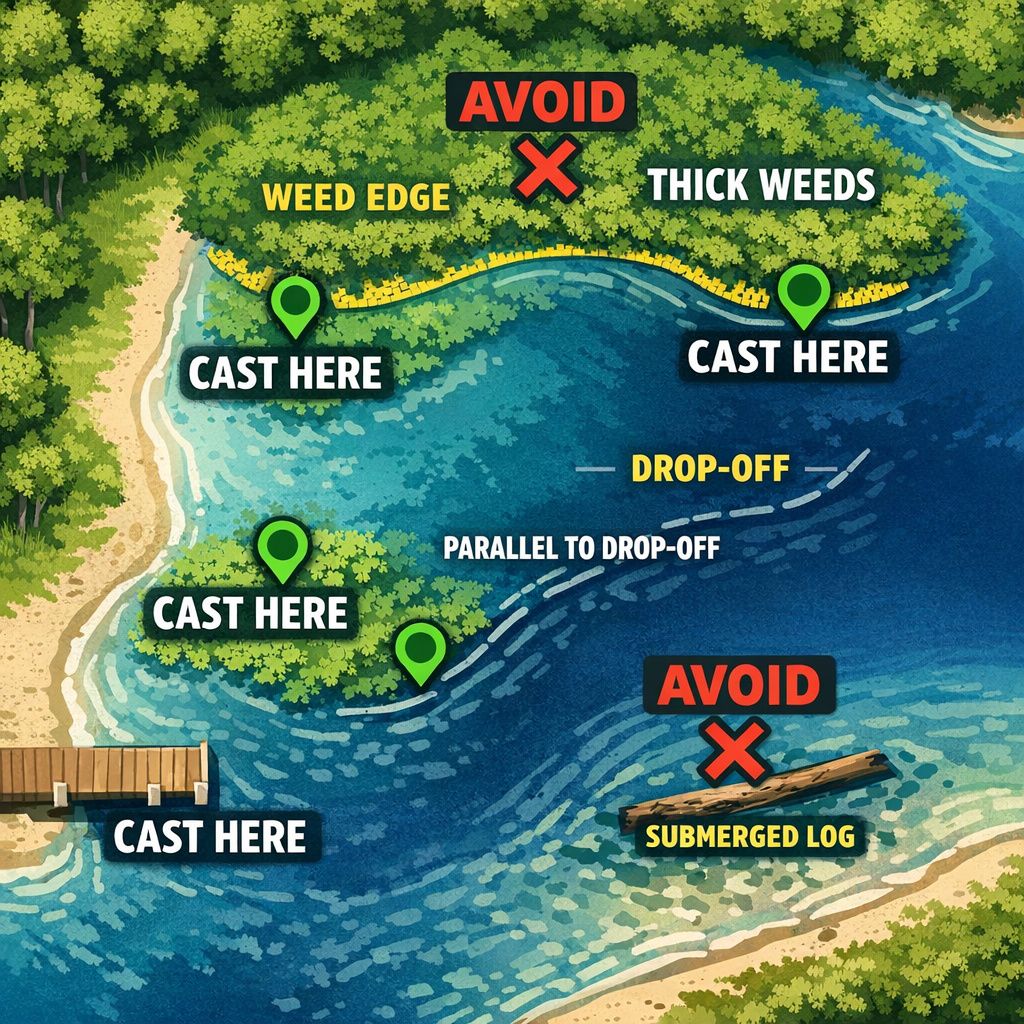
The general rule is to cast to the edge of cover, not into the middle of it. Fish hold along the boundaries — between the weeds and open water, between the submerged tree and clear water, between shade and sun. Your lure should travel along that boundary line.
If you’re fishing a weed edge, cast just outside the weeds and work your lure parallel to the edge. If you’re fishing a submerged log, cast to the open water just beside it and let your lure drift close without getting tangled.
Along Drop-offs
When you’ve identified a drop-off, cast along the transition line. Work your lure just above the drop so it stays in the zone where fish are holding. If the drop-off runs parallel to shore, cast parallel to it. If it runs perpendicular, cast across it.
Around Current Breaks
In rivers, cast upstream of the current break and let the current carry your lure into the zone where fish are sitting. Fish face into the current and ambush food floating past them, so presenting your lure on the downstream edge of a break or eddy is your best shot.
Under Overhanging Cover
When fishing under overhanging branches or docks, cast as close to the cover as you can without snagging. Work the lure slowly under the shade line. Fish in these spots are used to food dropping in from above, so a slow, deliberate presentation works better than a fast retrieve.
Frequently Asked Questions
Can I read water from the bank, or do I need a boat?
From the bank. Most of the features you’ll look for — shoreline structure, weed edges, docks, overhanging trees, depth changes near shore — are easier to see from the bank than from a boat. A boat gives you access to mid-lake features, but the edges hold plenty of fish for bank anglers.
How long does it take to learn to read water?
You’ll start noticing patterns within your first few trips. Becoming consistently good takes a season or two. Slow down and look before you cast. Every time you catch a fish, notice where it came from relative to the features you spotted. That builds your reading skills faster than anything else.
Does reading water work in ponds, or only lakes?
Ponds too. The same features apply — structure, cover, depth changes, surface signs. Ponds are smaller, so the features are closer together, but a pond with a depth change, a weed bed, and a few fallen branches follows the exact same fish-holding patterns as a lake.
What if the water is too muddy to see anything?
Structure is still there. In muddy water, focus on shoreline features you can identify — docks, steep banks, creek inlets, and areas where the bottom seems shallower or deeper from prior visits. Fish finders become more useful in muddy conditions since they show structure your eyes can’t detect.
Should I fish deeper or shallower if I can’t find structure?
Start shallow and work deeper. Fish tend to hold in the shallowest water that provides cover or food. Cast near the shore first — particularly near overhanging trees, grass edges, or undercut banks — and move farther out if you’re not getting bites.
Putting It All Together
Reading water is a skill, not a talent. It requires standing still, looking systematically, and connecting what you see on the surface to what’s likely happening below it.
On your next trip, take sixty seconds before your first cast. Walk the shoreline. Run through the checklist. Identify two or three spots before your lure hits the water. The difference between casting randomly and casting to identified features is the difference between fishing blind and fishing with purpose.
If you’re still building your overall fishing knowledge, Beginner Fishing 101: Everything You Need to Know Before Your First Cast covers the basics of gear, knots, and getting on the water so you can focus on applying these scanning techniques right away.
Note: Fish placement by depth and structure varies by species, season, and water temperature. The patterns described here reflect general tendencies for common freshwater species like bass, panfish, and catfish. Always adjust for local conditions and what you actually see on the water.