
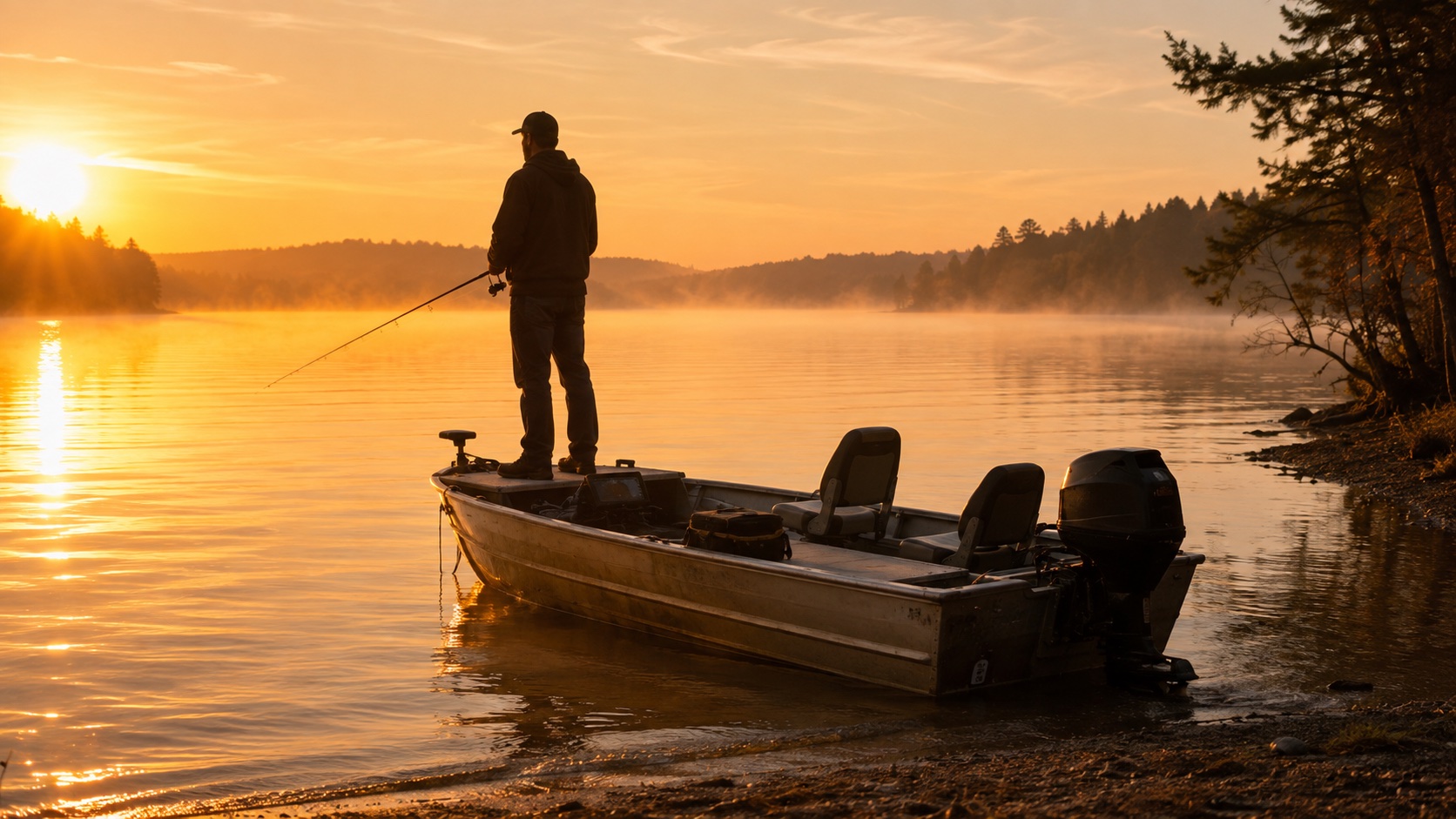
You’ve caught fish from the bank. You know how to tie on a lure, how to cast, how to feel a bite through the rod. Now you’ve got access to a boat — maybe a small aluminum skiff, a jon boat, or a rental — and you’re wondering if boat fishing is a whole different sport.
It’s not. What changes is the platform under your feet, the direction you cast, and the water you can reach. Everything else — the knots you’ve tied, the lures you’ve rigged, the way you read a bite — carries over. This guide covers the three things that actually change when you move from the bank to the bow: keeping yourself safe on a moving platform, setting up your boat so you can actually fish, and the casting and fighting adjustments that make your first trip productive instead of frustrating.
Safety First: The Non-Negotiables Before You Leave the Dock
Here’s a fact that might sting: most boating drownings don’t happen in storms. They happen on calm, sunny days — the exact conditions that make a beginner feel most comfortable. The water looks flat, the air is warm, and nobody’s thinking about a life jacket because it doesn’t seem necessary. That’s exactly when it matters most.
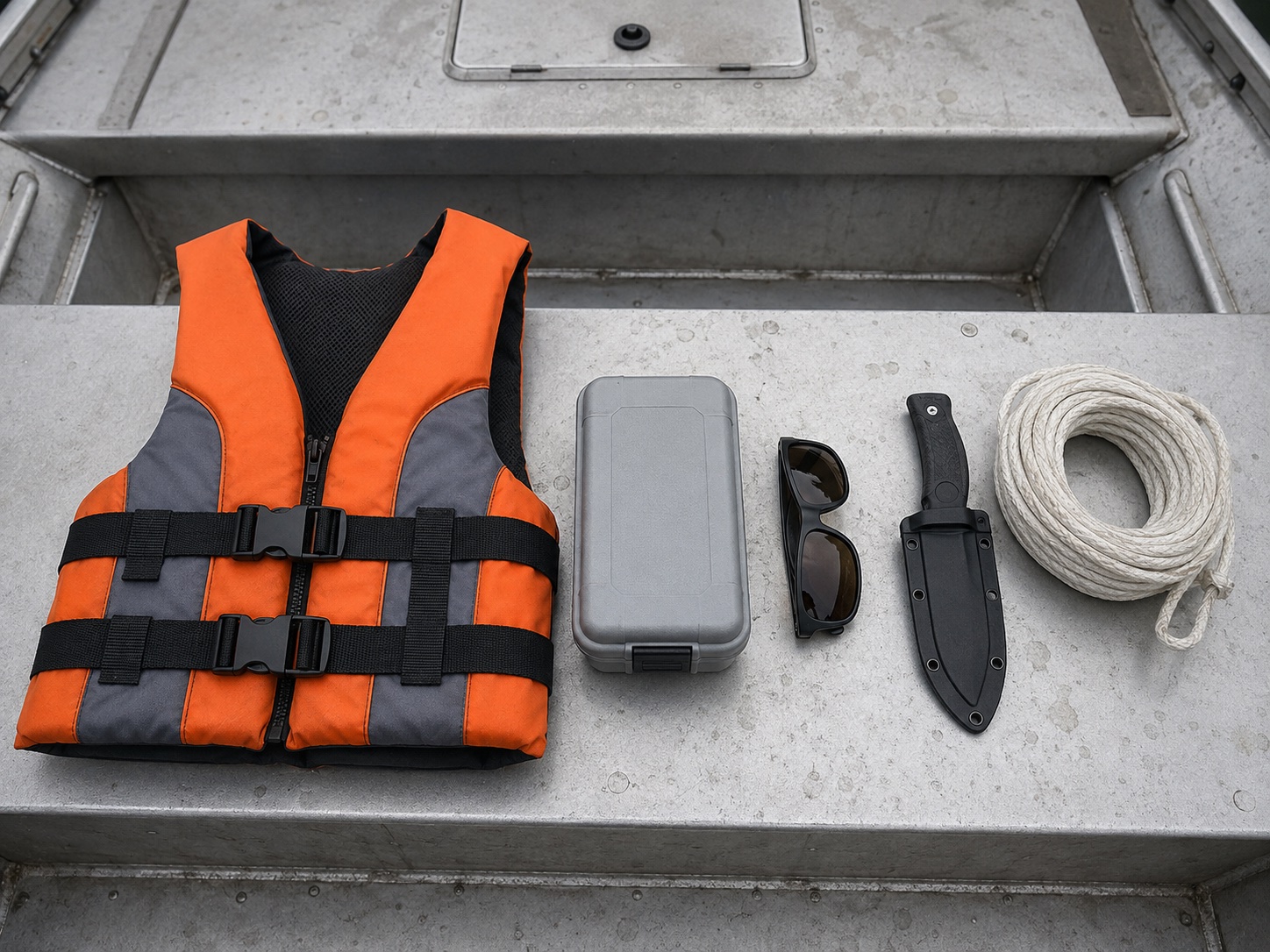
Wear a USCG-approved life jacket. Every person on board, every time. For calm lakes and ponds, a Type II (near-shore) life jacket is the right choice. It’s lightweight, provides solid buoyancy, and is designed for situations where rescue is close by. Put it on before you leave the dock, not when the weather turns. A life jacket in a bag is not a life jacket.
Check the fit every time. It should sit high on your chest without riding up over your chin. Look for tears, fading, or stretched straps. If you have an inflatable model, check for leaks every two months and replace spent CO2 cartridges immediately.
Beyond the life jacket, a few items make the difference between a safe trip and a risky one:
- A tacklebox with a secure latch. An open tacklebox on a rocking boat is a projectile. The tackle slides, the box tips, and hooks and split rings scatter across the deck where they become foot hazards.
- A sheathed knife. A loose bait knife on an aluminum deck is a laceration waiting to happen. Keep it in its sheath when you’re not using it.
- A hook remover or long-nose pliers within reach. Unhooking a fish from a boat is harder than from the bank — you don’t have a stable surface to set the fish on.
- Closed-toe, grippy shoes. Wet aluminum is slick. Sandals and bare feet are how people slip.
- A phone in a dry bag, and tell someone where you’re going and when you plan to be back.
Before you leave the dock, check the weather. Rough water multiplies every risk — the deck gets wet, the boat rocks harder, and your balance becomes a constant negotiation. If the forecast looks questionable, postpone. The fish will still be there next week.
Setting Up Your Boat for Fishing
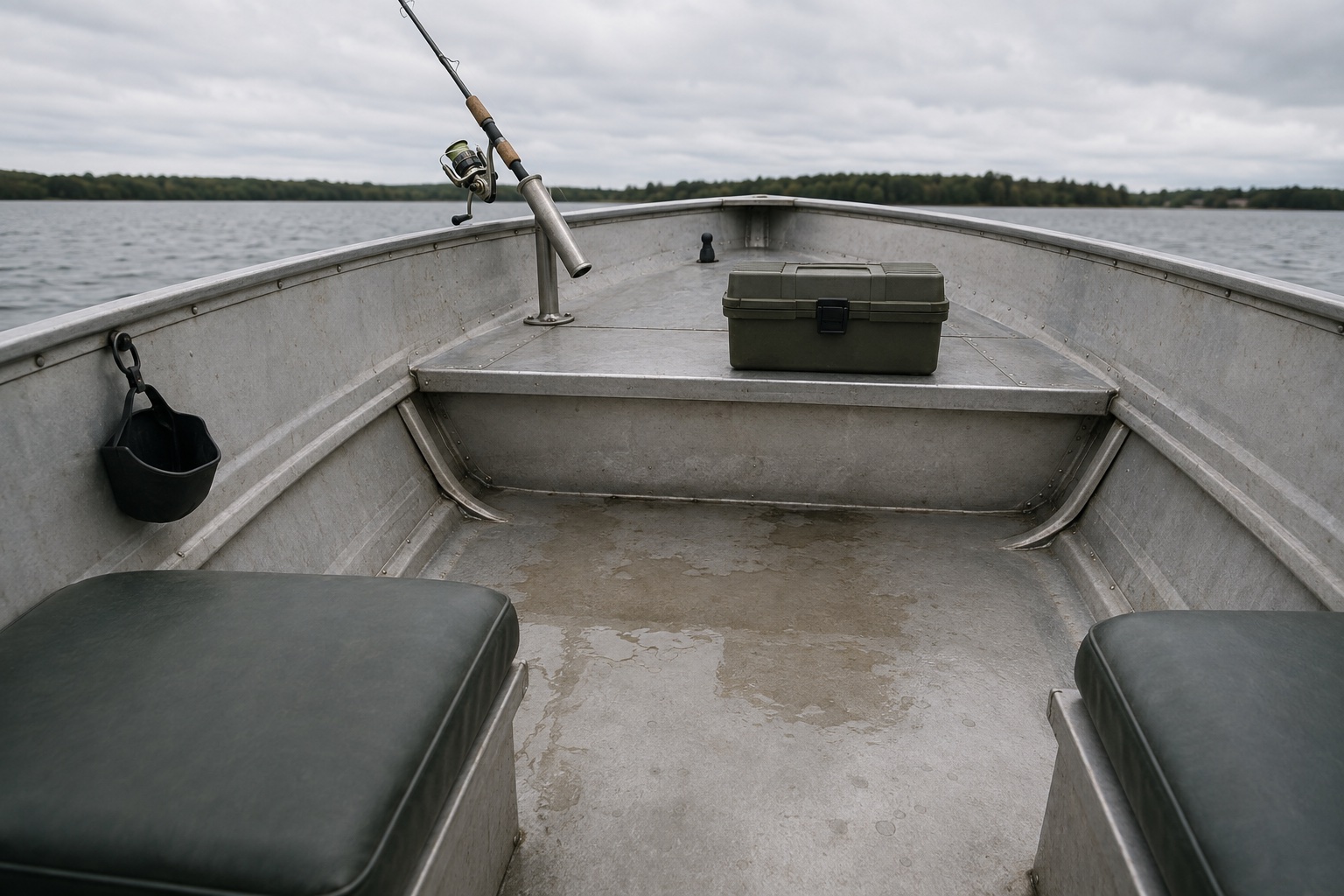
You don’t need a center console with a fish finder and a livewell to fish from a boat. A small aluminum boat with a trolling motor is the most common beginner platform, and it works perfectly well. Here’s what to set up before your first cast.
Rod holders are the single most useful upgrade for a small fishing boat. Even one rod holder changes how you fish — it keeps your rod secure while you work the anchor, grab bait, or fight a fish. If your boat doesn’t have a rod holder, a simple rod rest or a cleat can hold a rod for a first trip. You don’t need to drill into the hull.
Sit low and near the center of the boat. The lower your center of gravity, the more stable the platform feels. The center of the boat is where it rocks the least. The bow and stern are where the movement is most pronounced. If you’re standing, stay near the center. If you’re sitting, the center seat is your spot.
Keep your tackle on a flat surface. The bench seat or a flat deck area is where your tacklebox belongs. Don’t leave it on the floor of the boat where it can slide when the boat rocks or takes on water.
Manage the water. Small boats collect water in the bilge from waves, rain, or the anchor line dragging across the floor. Keep a bailer or a small bilge pump within reach. A boat that’s taking on water is a boat that’s losing buoyancy, and you don’t want to be dealing with that while you’re focused on a fish.
Know where the prop is. This sounds obvious, but it’s the most important rule. Never reach across the prop area. Keep your hands and feet clear of the prop at all times — especially when the engine is running. When you need to move something from the stern, shut the engine off first.
How to Anchor Your Boat
Anchoring is the one skill that shore anglers don’t have to learn, and it’s the one that matters most when you’re off the bank. Without an anchor, your boat drifts with the wind and current, and you can’t work a specific spot. You might cast the same lure into the same area ten times, but the boat has moved each time, so you’re not actually fishing the same water.
Here’s the core technique:
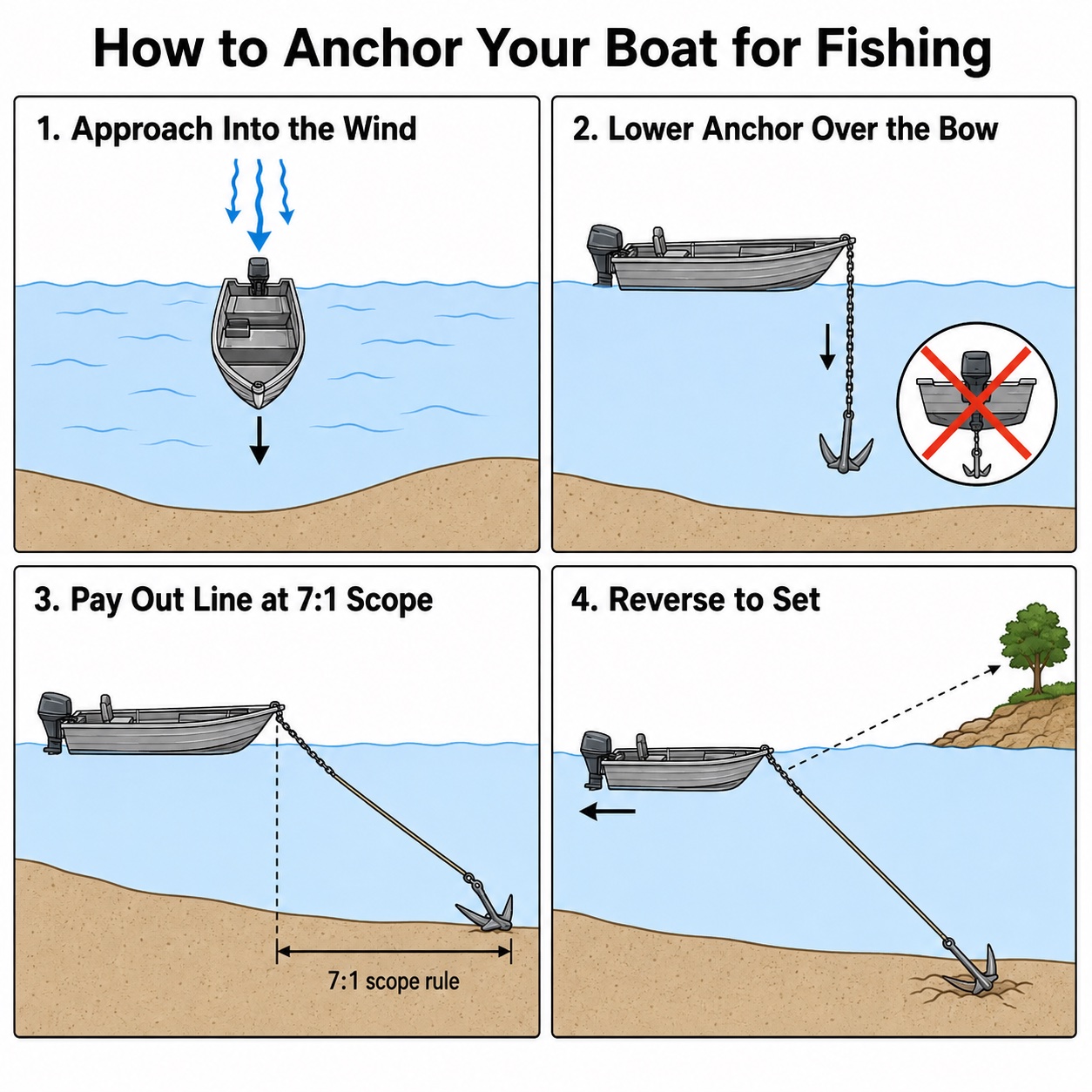
Pick your spot first. Look for sand or mud bottom — these hold anchors best. Avoid busy channels and areas where other boats are actively moving. If you have a depth finder or GPS, use it to check the bottom and the depth. If you don’t, look for a spot where the water color changes from light (shallow) to dark (deeper) — that transition is often where the fish are holding.
Approach into the wind or current. Whichever is stronger, point your bow into it. You want the boat to drift backward, toward the shore, when you drop the anchor. If you approach downwind, the boat will drift into the wind and the anchor won’t set properly.
Stop the boat and lower the anchor over the bow. Never throw the anchor — lower it gradually so it lands on the bottom without tangling. And never anchor from the stern. A stern anchor can swamp the boat because the square transom catches waves, and the motor’s weight makes the stern sit lower. The bow is the only safe anchor point.
Let out line as the boat drifts back. The rule of thumb is the 7:1 scope — seven feet of anchor line for every one foot of water depth. In a spot that’s 10 feet deep, you need 70 feet of line. In 5 feet, you need 35 feet. If you’re not sure about the depth, use more line rather than less. You can always pull in extra line, but you can’t add more once the anchor is set.
Gently reverse the engine to dig the anchor in. Once the anchor hits the bottom, a short, gentle reverse helps it dig into the sand or mud. Don’t power hard — that can drag the anchor instead of setting it. A few seconds of gentle reverse is all you need.
Tie off and check your position. Once the anchor is set, pick a fixed landmark — a tree on the shore, a buoy, a distinctive rock. Watch it. If you start drifting toward or away from that landmark, your anchor is dragging. Add more line, or reset.
A fluke-style anchor is the best choice for a small boat on a sandy or muddy bottom. If you’re fishing rocky water, a grapnel anchor works better. Use nylon anchor line — it’s strong, flexible, and won’t snap under load. If you can, add a short chain between the anchor and the line. The chain adds weight at the bottom and helps the anchor dig in.
Casting from a Boat: What’s Different
Here’s the part that surprises most shore anglers: you cast in the opposite direction.
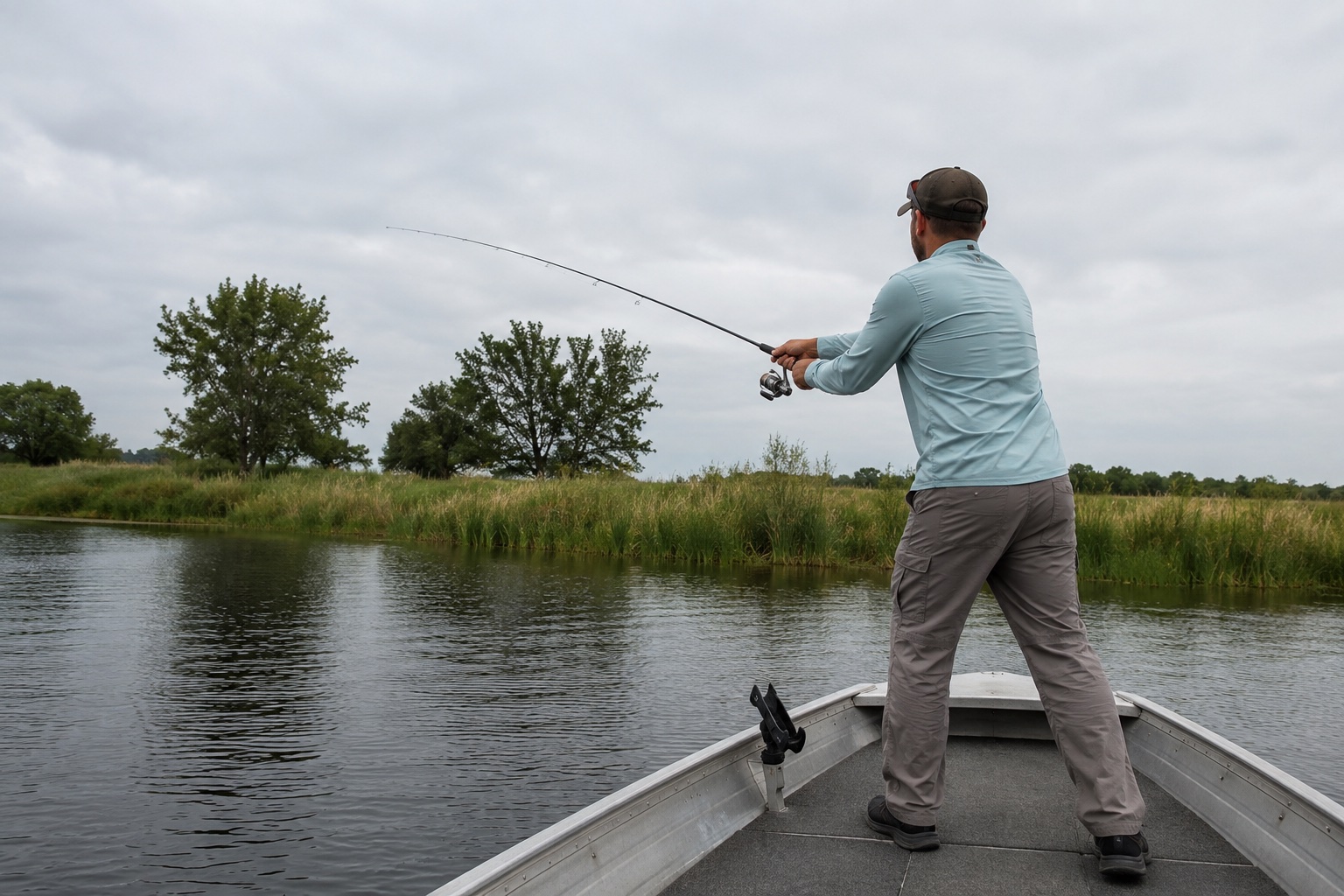
From the bank, you cast away from shore — as far as you can, toward the deeper water where the fish are holding. From a boat, you do the opposite. You cast toward the shore, and you retrieve your lure back out into the deeper water.
Why? Because the fish are typically holding along the transition — the drop-off where the shallow water meets the deep. When you cast from deep water toward shore and retrieve your lure back, you’re working that transition zone on the retrieve. The lure moves from shallow to deep, which is a natural feeding pattern. Many fish follow that movement.
The other adjustment is space. On the bank, you have a wide, open arc to swing your rod through. In a boat, you’re hemmed in by the gunwales, the seats, and the other angler if there is one. A long, sweeping cast that works fine on the bank can get you tangled in the boat or send your line into the prop.
Here’s how to adapt:
- Cast shorter and more controlled. You don’t need to cast far from a boat. A 20- to 30-foot cast toward the shore is often all you need. The point is to get the lure into the water near the structure, not to cover maximum distance.
- Practice side-arm casts. When the boat is too tight for a standard overhand cast, a side-arm cast — swinging the rod to one side — gets your lure in the water without a full backswing. It’s less accurate, but it works in tight spaces.
- Keep your back to the open water when you can. If you’re casting from the bow, face the bow, not the open water. Your body is your balance, and facing the open water means you’re leaning in the direction the boat is moving.
- Feet shoulder-width apart, knees bent. This is the same stance you’d use for any cast, but it matters more on a boat because the platform moves under you. A wide, low stance absorbs the boat’s rocking.
- Don’t cast from the edge. Stand near the center of the boat. If you’re at the bow, stay a few feet back from the edge. If you’re at the stern, keep well clear of the prop and motor.
The boat will move under you while you cast. That’s normal. The key is to let the boat do its thing and focus on the arc of your rod. You don’t need to fight the rocking — you just need to keep your center of gravity stable and let the rod do the work.
Fishing Structure from a Boat
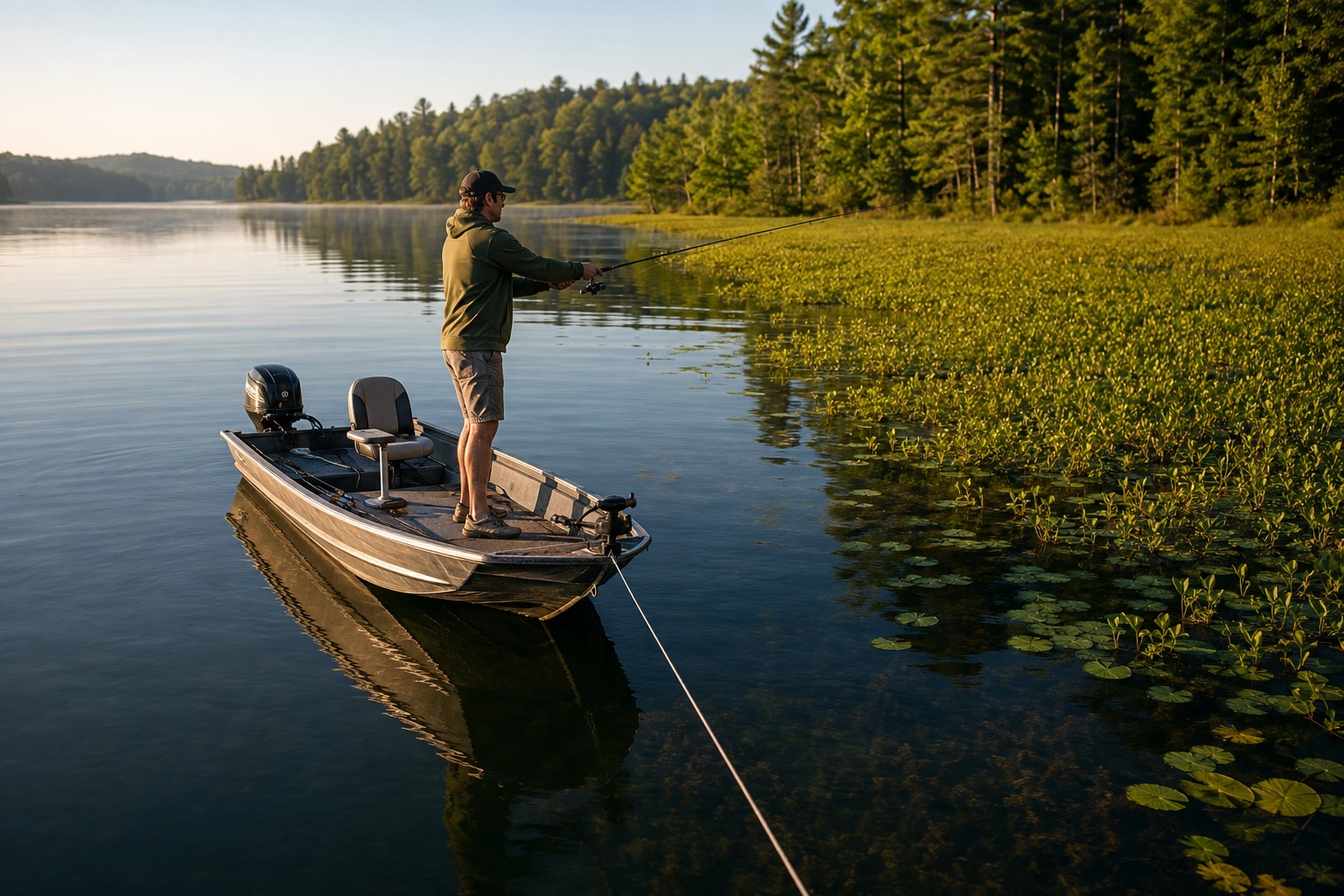
The biggest advantage of a boat over the bank is access. From the shore, you can only fish the water you can reach with your cast. From a boat, you can be in the water, right at the structure, and work it from any angle.
Here’s how to use that advantage:
Drop-offs. Anchor your boat over the deep side of a drop-off. Cast toward the shore, and retrieve your lure back out across the drop-off. The lure moves from shallow to deep on the retrieve, which is exactly where fish are looking. You can work a drop-off all day from a boat — cast, retrieve, recast — and you’re always in the right water. From the bank, you might only be able to reach the drop-off from one angle, and even that might be a stretch.
Weed lines. Weed lines are one of the best fish-holding features on a lake. Fish hold in the clear water just outside the edge of the weeds, waiting for bait to move through. From a boat, you can anchor just outside the weed line and cast toward it. Retrieve your lure along the edge of the weeds, not through them. The fish are on the outside, not inside. From the bank, you might not be able to reach the weed line at all, or you might only be able to cast over it and retrieve through it, which means you’re constantly snagging.
Creek arms and coves. These are natural fish holding areas. Anchor at the mouth of a creek arm or a cove, and work the water inside. Fish use creek arms as travel routes and feeding areas, especially in the early morning and late evening. A boat lets you be right at the mouth of the arm, casting into the shallows where the fish are staging.
Culverts and bridges. These are structure that holds fish, but they’re often hard to fish from the bank. From a boat, you can approach from the deeper side and cast into the structure. The water under a bridge is often deeper and cooler, and fish hold in those spots.
Move when a spot isn’t working. This is the thing that shore anglers can’t do. If you’ve been casting the same spot for 20 minutes and nothing’s happening, you’re stuck — you can only reach so far from the bank. From a boat, you can motor to the next spot. Twenty minutes of no bites is a sign to move. The fish are somewhere; you just need to find them.
Fighting Fish from a Boat
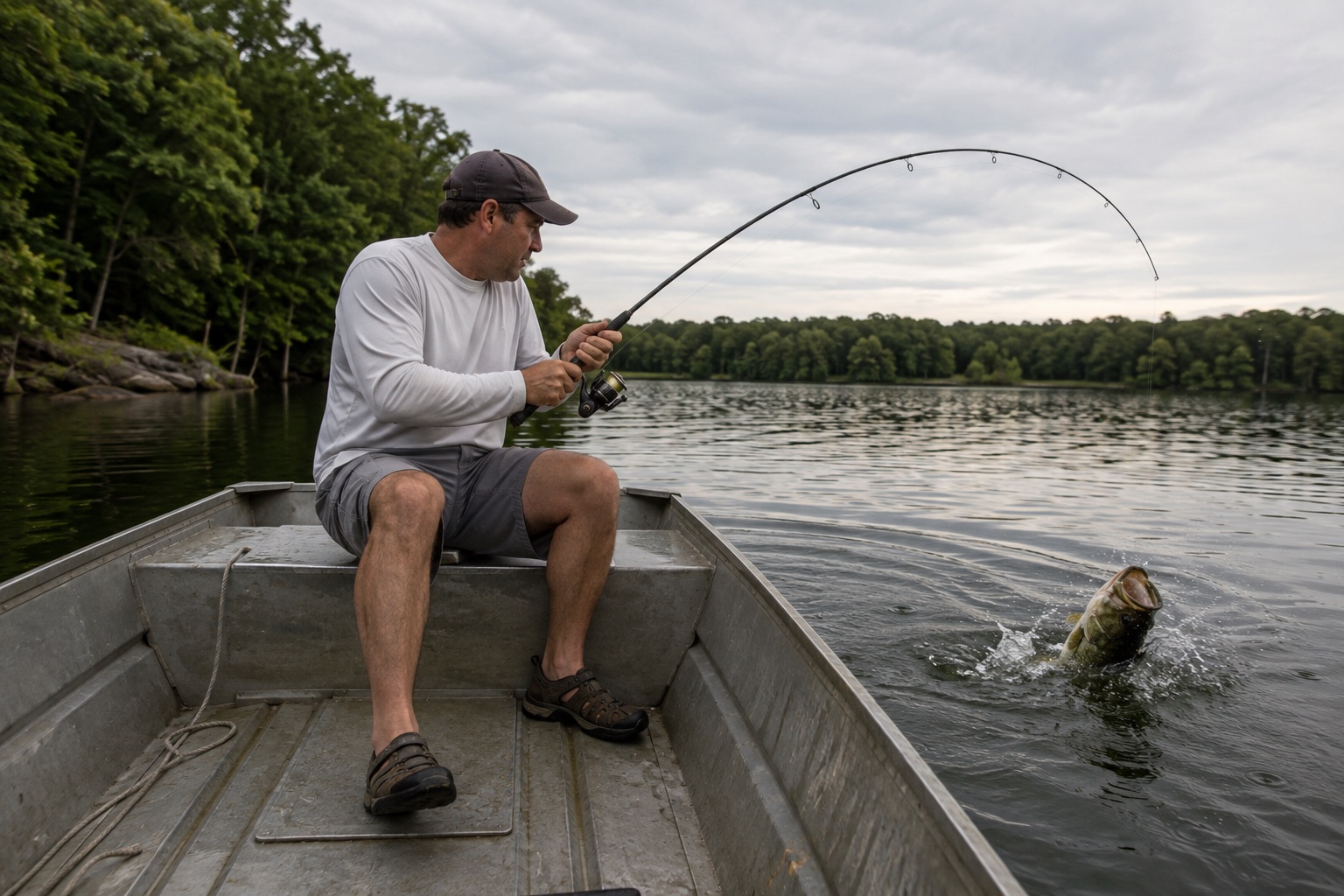
Fighting a fish from a boat is different from fighting one from the bank. On the bank, you’re stable. You can stand, plant your feet, and use your body weight to control the fish. In a boat, the ground moves. The boat rocks, bobs, and shifts under you, and every movement the fish makes adds to that motion.
The number one rule: don’t stand up.
Standing on a rocking boat while you’re fighting a fish is how people go in the water. The fish pulls, the boat shifts, and suddenly your center of gravity is outside the boat. You stay seated. The center seat is the most stable spot. Keep your center of gravity low — knees bent, torso relaxed.
Keep the fish in front of you, not to the side. A fish pulling you sideways is a rollover risk. If the fish runs to the left, turn the boat slightly so the fish is in front of you, not to the side. You want to use the boat’s stability against the fish, not fight the boat’s movement.
Reel steadily, not aggressively. The instinct when a big fish runs is to crank the reel. Don’t. Let the fish run. When it stops, reel it in. Reeling hard while the fish is running can flip the boat, especially if the fish is pulling at an angle. The fish will tire. Your job is to keep the line taut and steady, not to muscle it.
Use a net if you have one. From a boat, lifting a fish by its line is risky. The fish can pull you off balance, and if you slip, the fish goes back in and you might go in with it. A net keeps the fish controlled and gives you a stable way to bring it aboard. If you don’t have a net, at least have a landing mat or a towel to grip the fish with.
Stay relaxed. The fish is not going anywhere. Take your time. Keep the line taut, keep your center of gravity low, and let the boat’s stability do the work. The more you fight the boat’s movement, the more likely you are to lose the fish — or worse, yourself.
Your First Boat Trip: A Quick Checklist
Before you leave the dock:
- Life jackets on for everyone. USCG-approved, properly fitted.
- Weather checked. If it looks rough, postpone.
- Phone in a dry bag. Someone knows where you’re going and when you’ll be back.
- Tacklebox latched. Knife sheathed. Hook remover within reach.
On the water:
- Anchor set. Boat stable. You’ve picked a fixed landmark to watch.
- Gear secured. Nothing loose on the deck.
- Feet clear of the prop. Engine off if you’re moving anything from the stern.
Fishing:
- Cast toward the shore. Retrieve back out through the drop-off.
- Work the structure: drop-offs, weed lines, creek arms.
- If a spot isn’t working after 20 minutes, move.
Fighting:
- Stay seated. Knees bent. Center of gravity low.
- Fish in front of you, not to the side.
- Reel steadily. Let the fish run, then retrieve.
- Use a net. Don’t lift by the line.
After:
- Bail the bilge. Check for water.
- Check the anchor line for fraying.
- Rinse your gear with fresh water if you fished saltwater.
You already know how to fish. The boat just gives you a different vantage point and access to water you couldn’t reach from the bank. The safety fundamentals are simple — life jacket, secured gear, weather check. The techniques are adjustments, not a new sport. Cast toward the shore, anchor where the fish are holding, stay low when you fight, and move when a spot goes quiet. That’s boat fishing in a nutshell.
If you’re still learning the basics from the bank, our bank fishing for beginners guide covers the fundamentals that carry over. If you’re more comfortable on a kayak, the transition to a small boat is a natural step up — our kayak fishing for beginners guide covers the basics of fishing from a floating platform. For a broader look at safety on the water, see our fishing safety for beginners guide.