
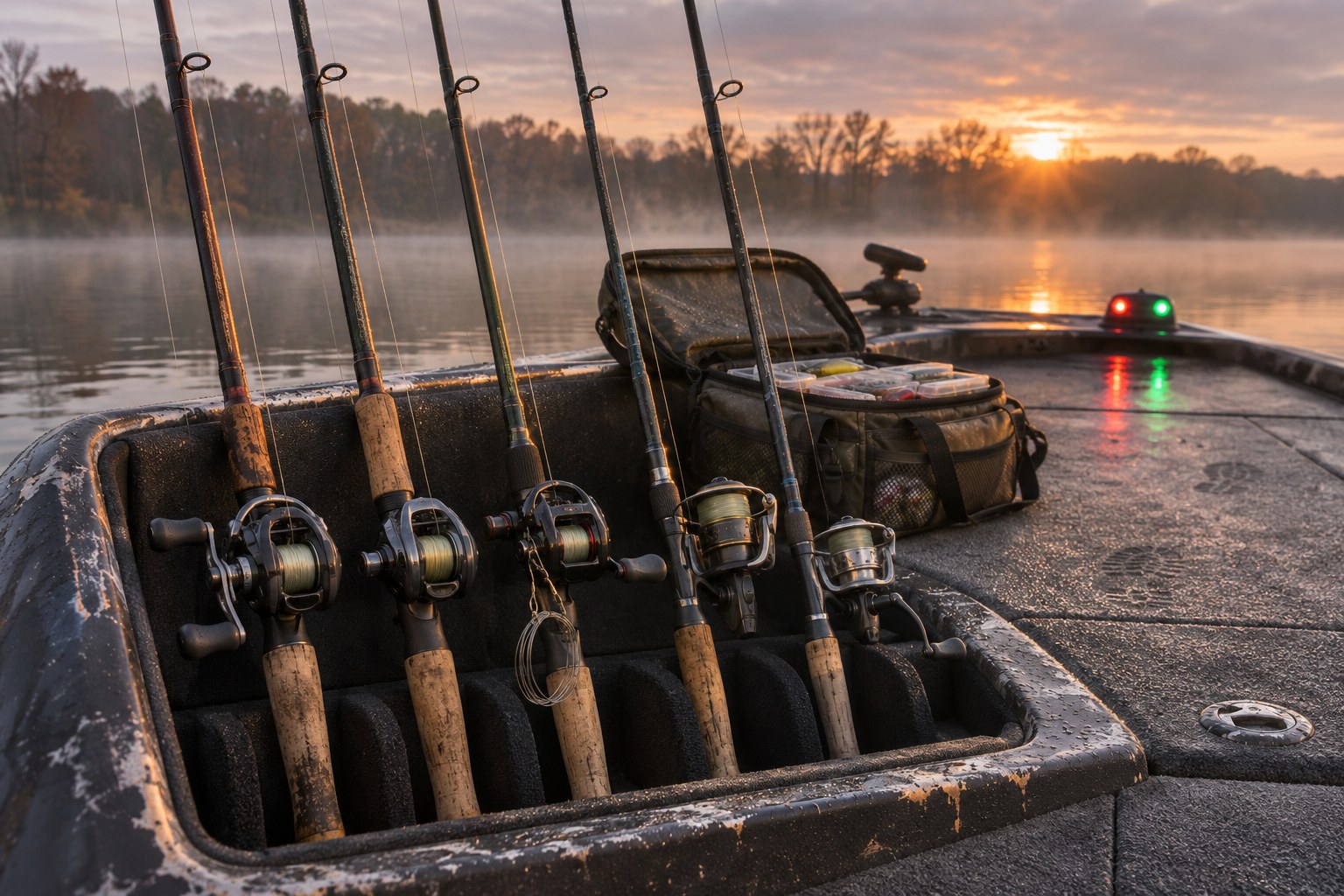
You are standing in a tackle shop holding two rods that both say “7’0″ Medium-Heavy, Fast Action” on the blank, and they feel completely different. One loads smoothly into the middle when you bend it. The other stays stiff almost to the tip and then hinges. Same label, different rod.
That happens because those two labels measure separate things, and most anglers read them as one rating. Power is how much force it takes to bend the blank. Action is where the bend happens and how fast the blank returns to straight. You can have a light fast rod and a heavy fast rod that bend at exactly the same point. You can have two medium-power rods where one feels crisp and the other feels soft and slow.
Once you separate the two, the spec sheet stops being noise and becomes a map from what you are throwing to what the rod needs to do.
That map is worth building before you spend money on another rod.
Power: How Much Force It Takes to Bend the Rod
Power is the rod’s resistance to bending. It is the number most people call “backbone,” and it runs from ultralight up through light, medium-light, medium, medium-heavy, heavy, and extra-heavy.
Here is the part the marketing copy skips: power is really a window, not a strength class. The manufacturer prints a recommended line weight and lure weight near the handle, and that window is what the power rating actually means. A rod marked light might read 4–8 lb test and 1/16 to 1/4 oz. A medium-heavy might read 12–20 lb and 3/8 to 1 oz. Those printed numbers are the most objective specification on the entire rod, because they are the only ones the builder has to stand behind.
What power does in practice comes down to three jobs:
- It sets the range of lure weights the rod can load and cast without feeling dead or overloaded.
- It determines how much force you can put into a hookset without the blank folding.
- It determines how hard you can pull a fish away from cover before the rod runs out of room.
Notice that fish size is only part of it. You can land a big bass on an ultralight rod with a small finesse bait in open water, because nothing in that situation requires lifting strength. Put the same fish in matted grass and the ultralight is the wrong tool, not because of the fish’s size but because you need to drag several pounds of vegetation along with it.
Power also decides whether you should be holding a spinning rod or a baitcaster at all. A workable rule of thumb: if you are throwing 10 lb test or lighter with lures at 3/8 oz or under, spinning gear handles it better. At 1/2 oz and up, a baitcaster starts to make more sense.
Action: Where the Rod Bends and How Fast It Comes Back
Action describes the shape of the bend and the speed of its recovery. The two are connected, which is why the same word covers both.
A fast action rod bends mostly in the top quarter or third of the blank. The rest stays relatively straight, and because only a short section is moving, the rod snaps back to straight quickly. An extra-fast blank concentrates the bend even closer to the tip. A moderate action rod bends down toward the middle. A slow action blank bends nearly to the handle.
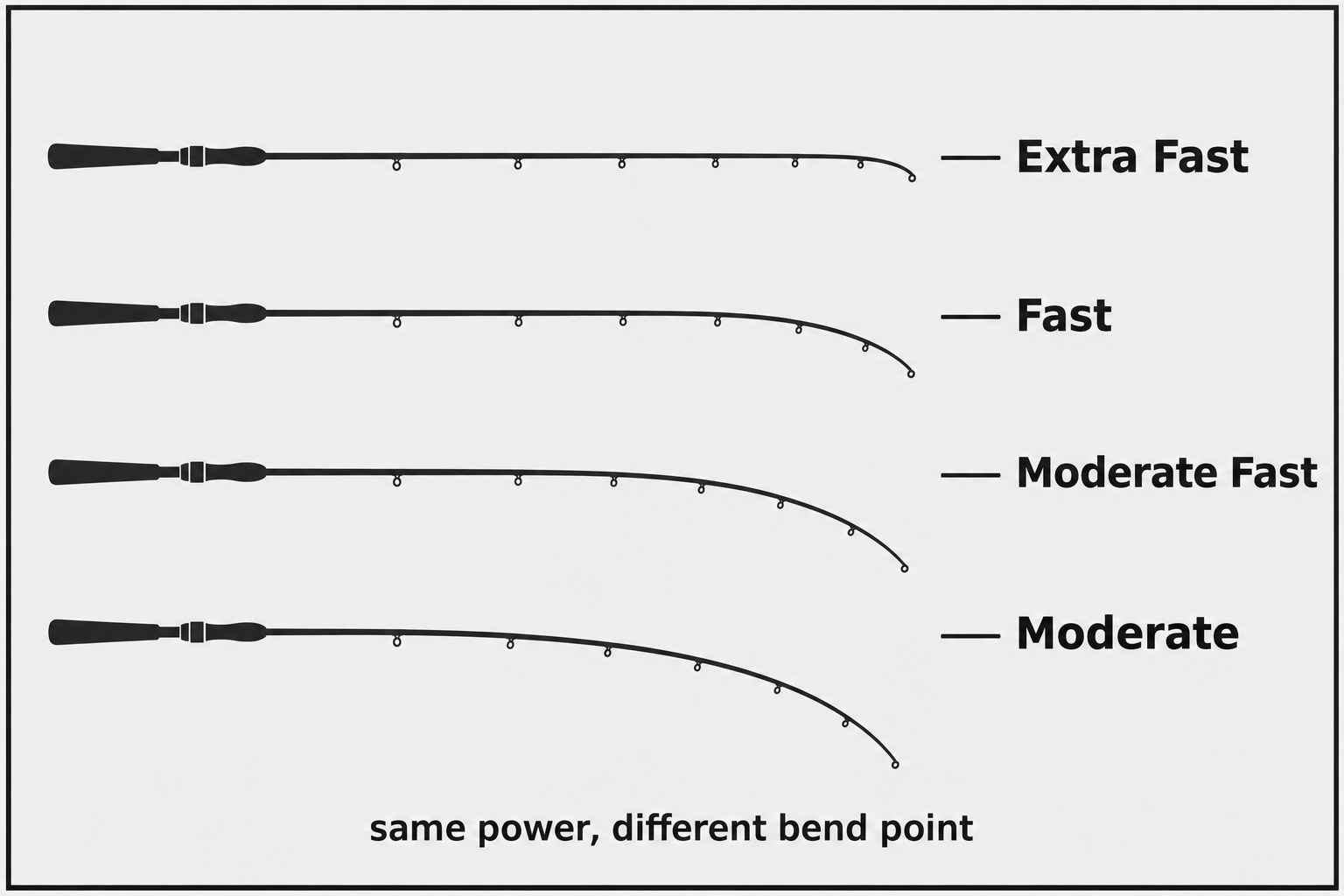
Here is the physical picture that makes it click. A fishing rod is a lever and a spring at the same time. Bend it and you store energy; release it and the rod returns that energy into the line. A fast action rod is a short, stiff lever. When you snap it, the energy arrives at the hook almost instantly as a sharp pulse. A moderate action rod is a longer, softer spring. It takes longer to load and gives the energy back over a longer period, which spreads the force out instead of spiking it.
That single difference explains almost every rod recommendation you will read. The sharp pulse of a fast rod drives a hook point through plastic and jaw. The long, spread-out push of a moderate rod holds a hook in place without tearing a bigger hole.
It also explains why sensitivity and forgiveness trade against each other. A fast blank keeps more of the rod stiff, and stiff material transmits vibration to your hand efficiently. That is why bottom-contact anglers prefer it: you feel gravel, wood, and the soft tick of a bite. A moderate blank flexes more, and flex absorbs vibration. You lose some feel and gain shock absorption.
The Rule That Does Most of the Work: Hook Type Decides Action
If you remember one rule from this guide, make it this one. The hook on the end of your line decides the action you want. Power comes later, set by lure weight and cover.
Treble hooks and single hooks are opposite tools in almost every way.
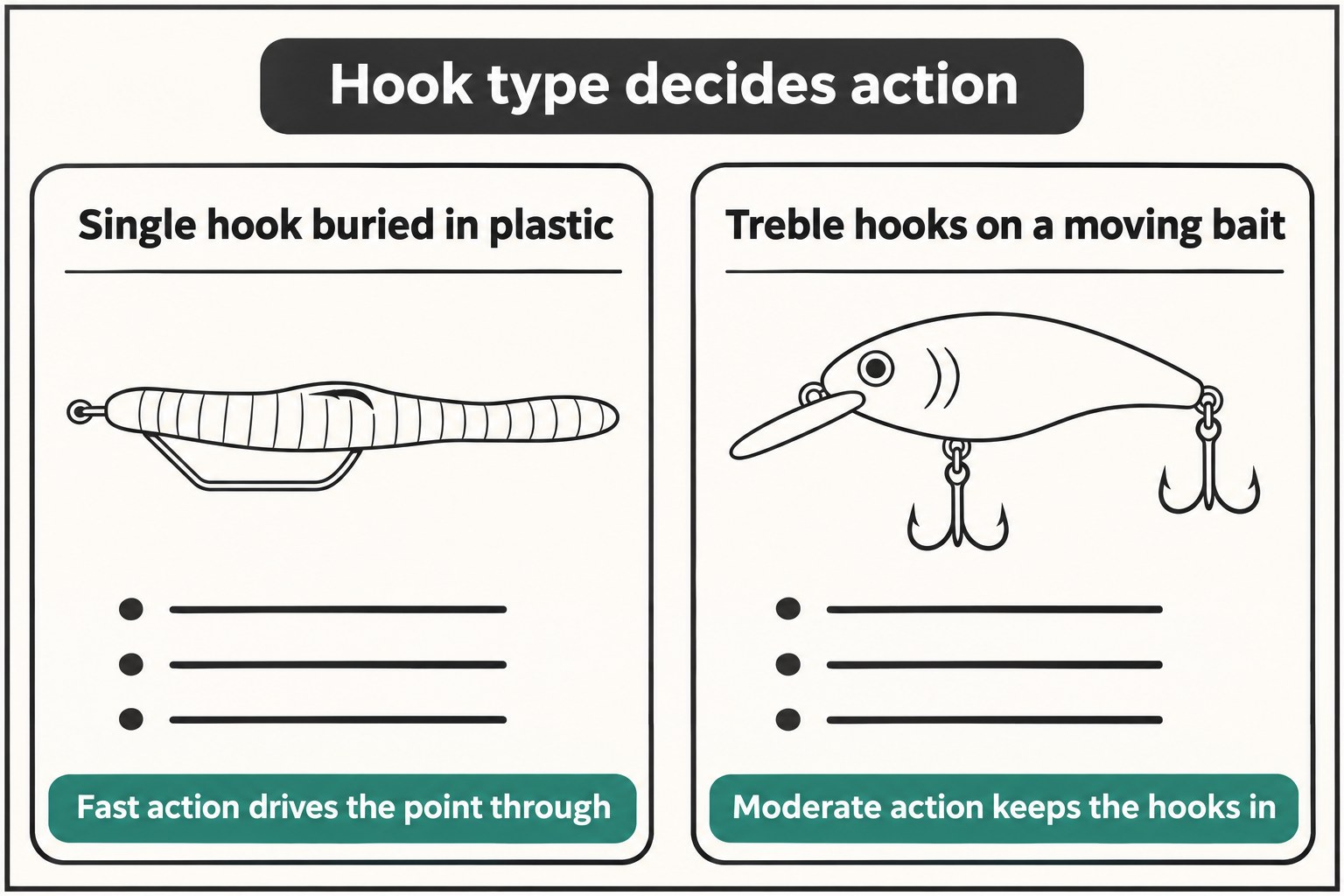
A treble hook is small, sharp, exposed, and there are usually two or three of them. It does not need help penetrating. It needs the rod to avoid ripping it back out. When a bass surges or shakes its head at the boat, a stiff fast blank converts that movement into leverage against a small hook in soft tissue. The hole enlarges, the barb loses its grip, and the fish comes off. A moderate or moderate-fast blank absorbs that surge and keeps tension instead of hammering the hook.
A single hook buried in plastic is the reverse. Before it can do anything, it has to be driven out of the bait body and then through the jaw. That takes force delivered fast, at the exact moment you feel the fish. A moderate blank cushions the strike and spreads the force, and the point never fully clears the plastic. A fast or extra-fast blank delivers the punch you need.
The mismatch shows up in predictable ways, and you can diagnose your own rod from how you lose fish:
- The fish comes to the boat and its mouth just opens, or the hook pulls free at the net. The hook never fully penetrated. Your action is probably too moderate for that hook style.
- The fish jumps or shakes once and comes off, and the hook point looks like it was barely in. Your action is probably too fast or your power too heavy for a treble bait.
- The fish surges and pulls free on a run. There is not enough give in the system, which can be the rod, the line, or drag set too tight.
- Hooksets feel mushy and you keep bumping fish without connecting. You are on a soft blank with a bait that needs a driven hookset.
That also means the hookset technique changes with the rod. Single-hook baits get a snap, an upward drive with the rod. Treble baits get a sweep, a firm sideways pull that keeps reeling and does not change the lure’s direction of travel. Snapping a crankbait with a fast rod is how you tear the hook out of a fish you had already hooked.
Power Follows Lure Weight and Cover
Once the hook type picks your action, power gets set by two things: how much the lure weighs and what you have to pull the fish through.
Lure weight is the honest test. Every blank has a window where it loads properly on the cast. Below that window you cannot feel the lure load the rod, your casts fall short, and your accuracy falls apart. Above the window the blank feels mushy or overloaded and you start losing distance and control. If you are constantly casting a 1/4 oz bait on a rod rated 3/8 to 1-1/2 oz, that rod is not wrong, it is just wrong for that lure.
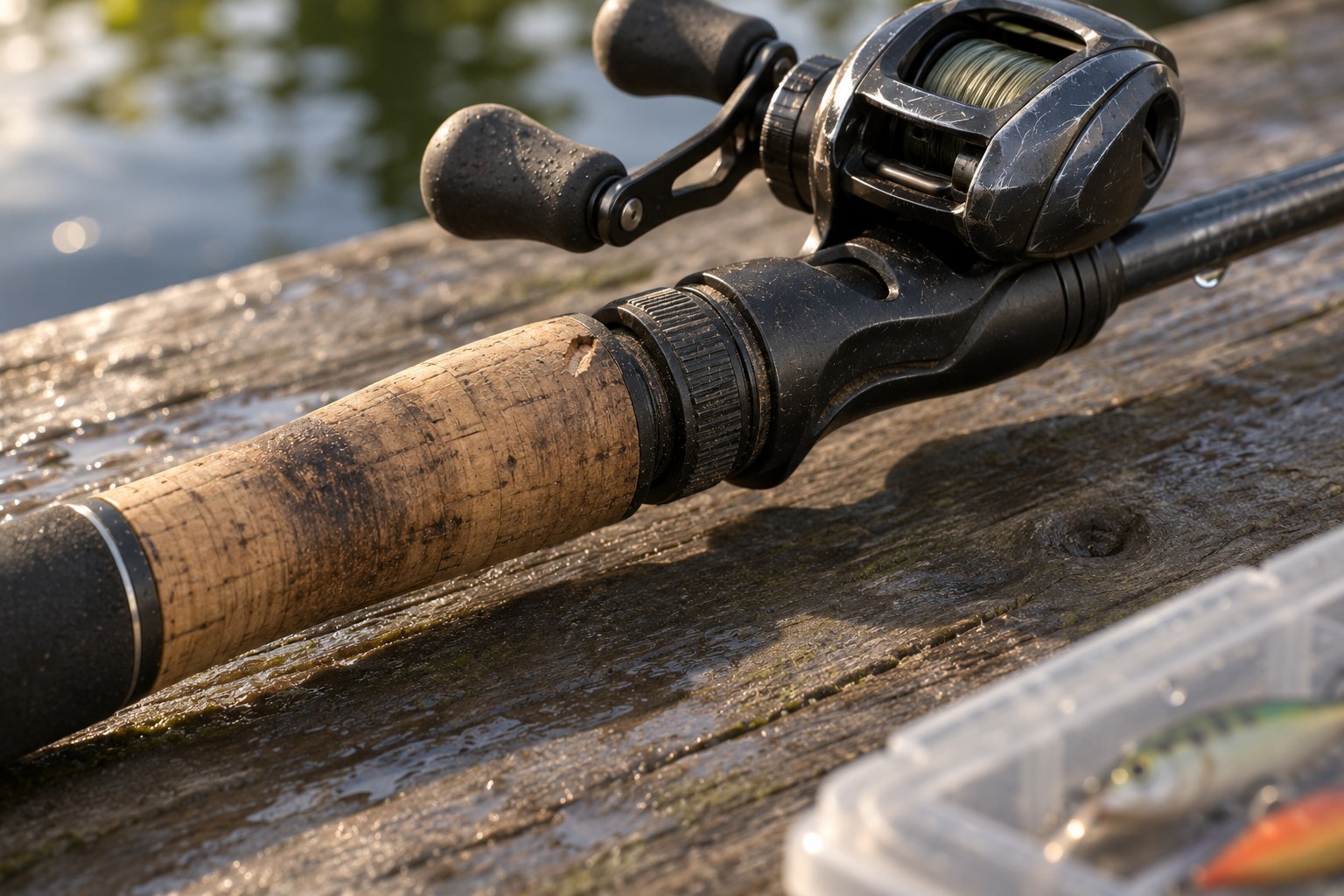
Cover is the other half. A hollow-body frog weighs around half an ounce, which any medium rod can cast. But a frog lives in matted vegetation, and when a fish eats it you have to drive a heavy-gauge hook through plastic and then drag that fish and a mat of weeds back to the boat. That job needs heavy power, sometimes extra-heavy, regardless of how light the bait is.
The same logic applies to flipping and pitching. You are not casting a heavy weight because you want distance. You are using it to punch through a canopy, and the rod needs the backbone to both set a big hook and haul the fish out of the mess. Line test follows along: heavier cover means heavier line, and heavier line needs a rod rated for it.
The Technique-to-Rod Map
Here is where the framework turns into a shopping list. Treat this as a starting point, not a law, and expect small brand-to-brand differences in how a given rating feels.
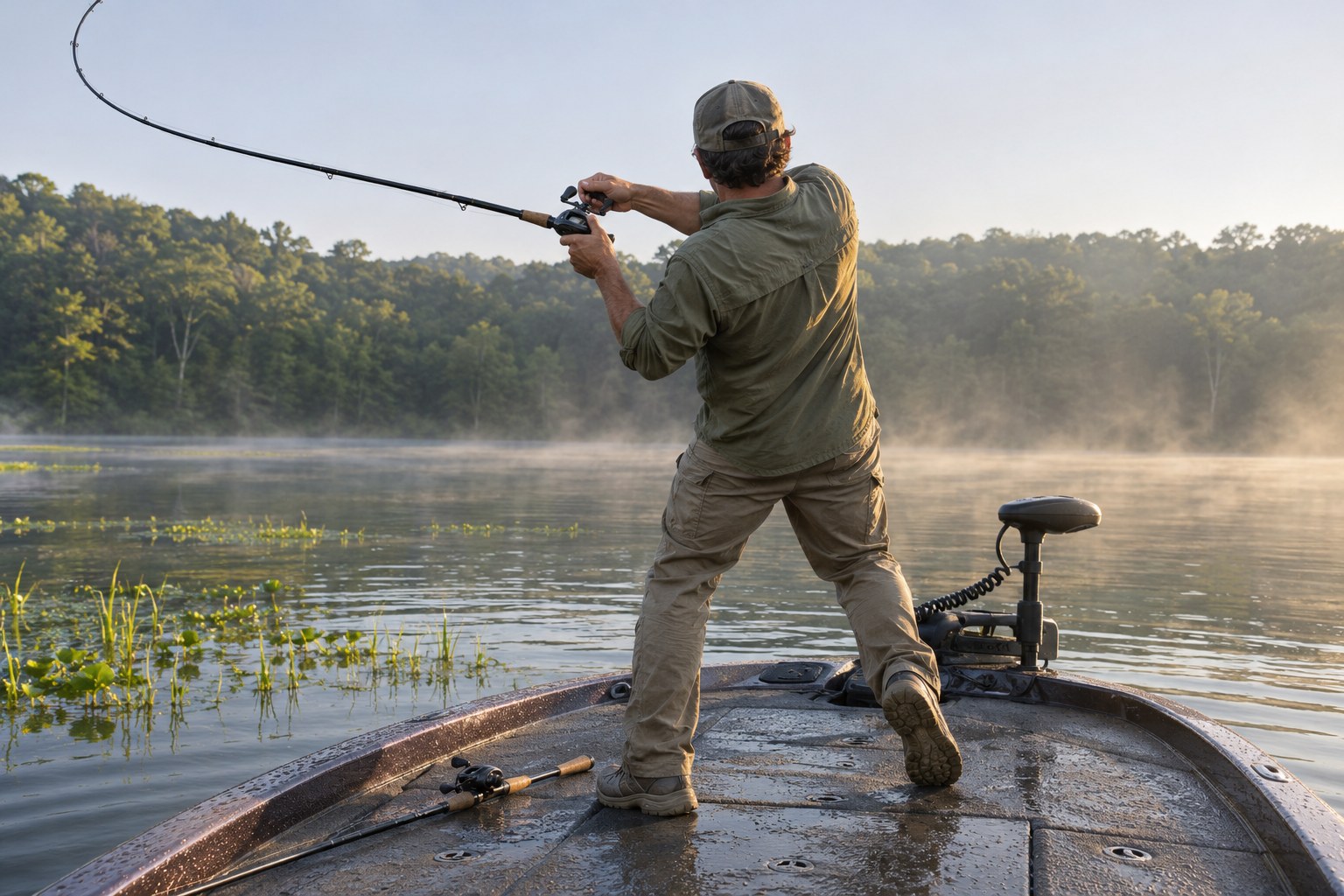
- Texas rig, jigs, creature baits: medium-heavy power, fast action. Buried single hook plus cover.
- Flipping and pitching: heavy to extra-heavy power, fast action. Big cover, big hook, short range.
- Hollow-body frogs: heavy power, fast action. The action drives the hook, the power hauls the fish out.
- Crankbaits: medium power, moderate action. Treble hooks and a straight retrieve.
- Jerkbaits: medium power, moderate-fast to fast action. You need a crisp snap to work the bait, but some give for trebles.
- Walking topwater and poppers: medium-heavy power, moderate action. Heavy enough to cast the bait, soft enough for trebles on a surface strike.
- Spinnerbaits and bladed jigs: medium-heavy power, moderate-fast action. The bait hunts on a straight retrieve, and the hook is a single but sits out in the open.
- Chatterbaits in grass: medium-heavy to heavy power, moderate-fast action. Vibration transmission plus enough backbone to rip it free of weed.
- Football jigs on rock: medium-heavy to heavy power, extra-fast action. Long casts, deep water, lots of line out.
- Drop shot: medium-light to medium power, fast tip. You need to shake a small bait in place and set the hook at distance.
- Ned rig and wacky rig: light to medium-light power, fast tip. Small baits, small hooks, gentle sets.
- Swimbaits: power scales with bait weight. A 1/2 oz paddletail is medium-heavy territory; a 2 oz glide bait is not.
- Catfish, still fishing: medium-heavy power, moderate-fast action. Circle hooks set themselves on load, so a soft, forgiving blank is an asset.
- Panfish jigs: ultralight power, fast tip. You need to cast 1/32 to 1/8 oz and feel a subtle take.
Read down the action column and the pattern is hard to miss. Every treble-hook bait lands on moderate or moderate-fast. Every bait with a single hook buried in plastic lands on fast.
Reading a Rod Before You Buy It
The label on the rack is a claim. The blank is the reality. You can check the reality in about a minute.
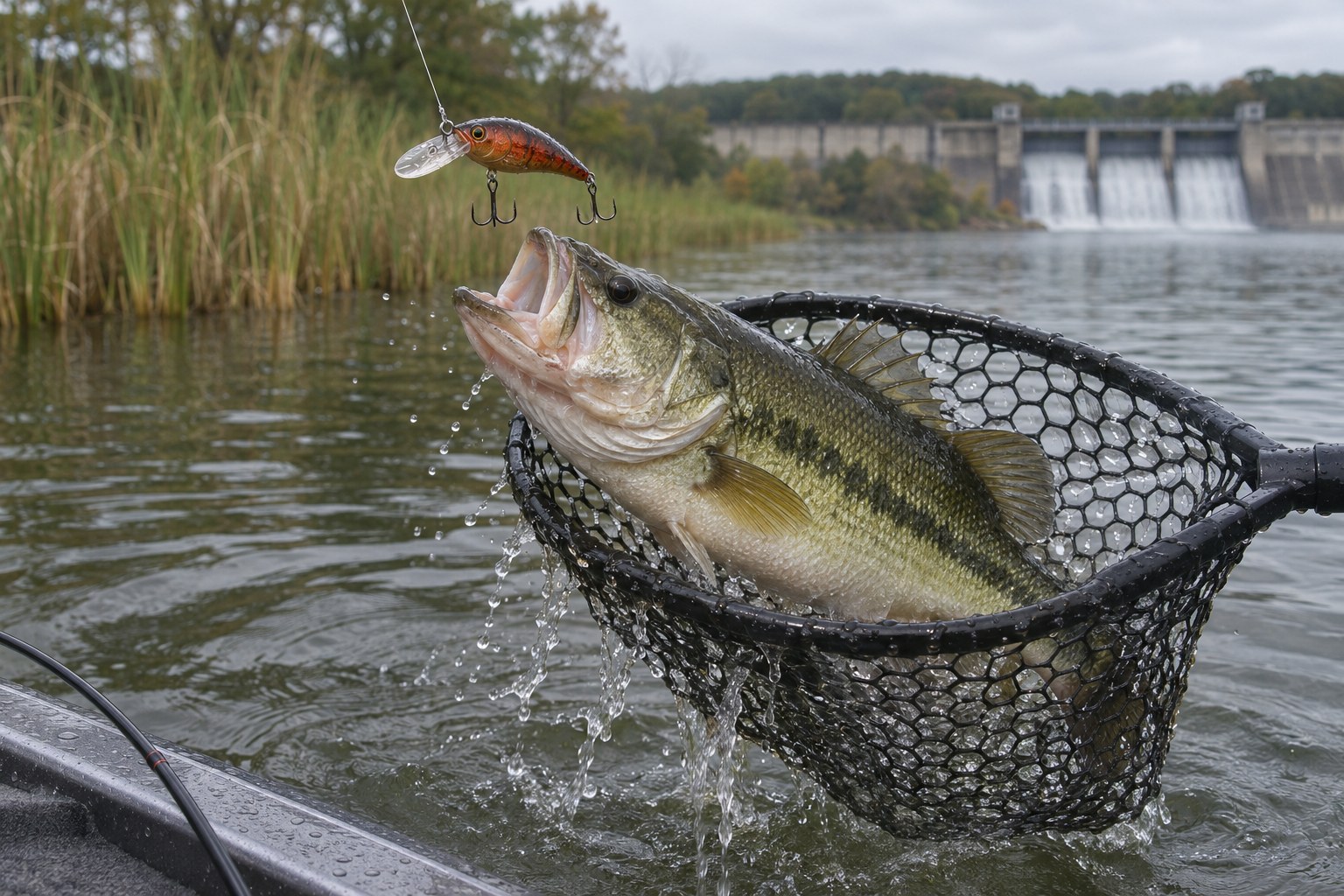
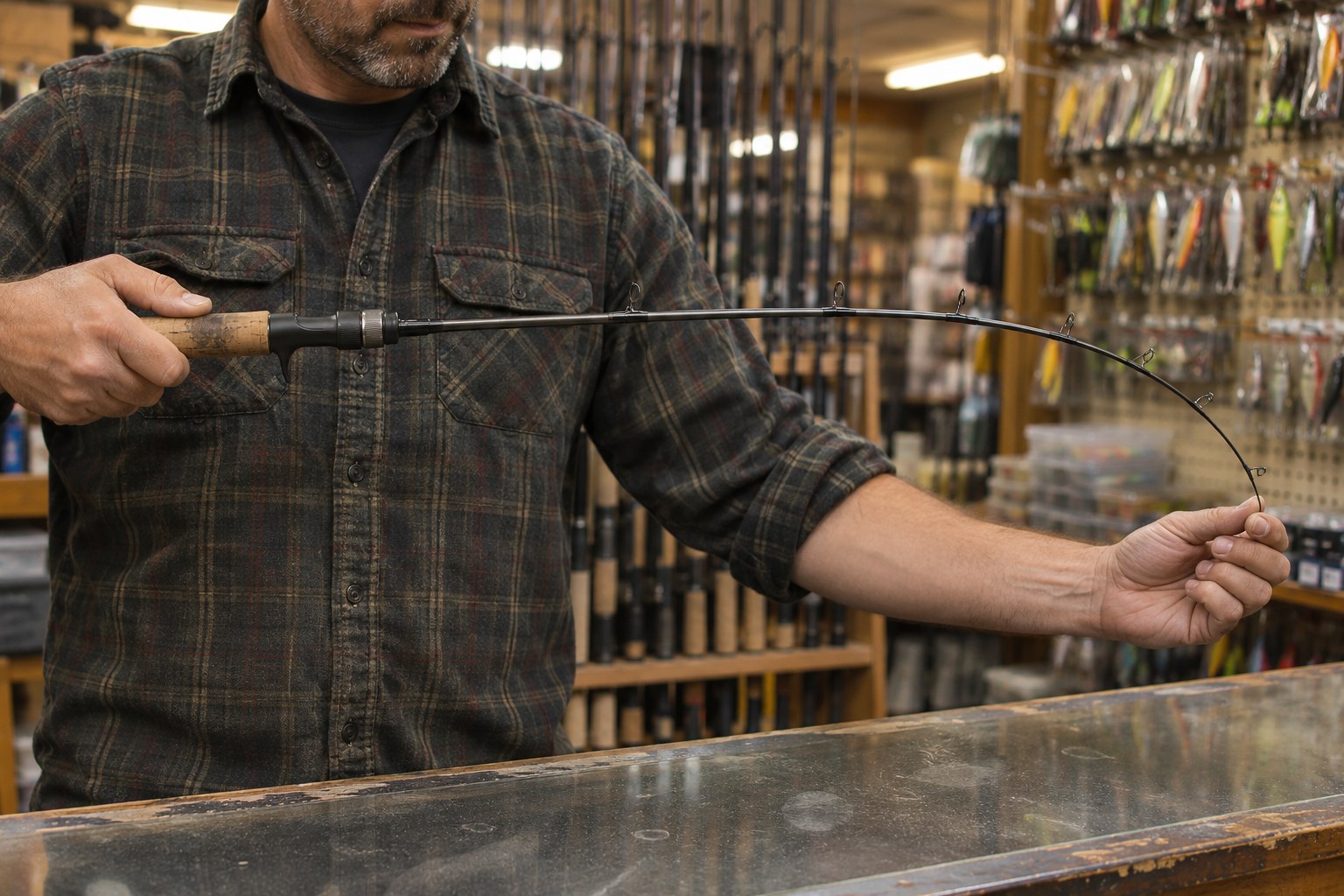
Bend the rod. Hold the grip and pull the tip down slowly, watching where the curve starts. If nearly the whole upper half bends, you are holding a moderate or slow blank no matter what the sticker says. If the bend is concentrated in the last few inches, it is fast or extra-fast.
Let it go and watch the tip. A fast blank snaps back and stops. A moderate blank returns more slowly and may oscillate briefly. That recovery is the part most people never check, and it is the part that decides how the rod feels on a hookset.
Check the printed window. Look for three numbers: power word, line test range, and lure weight range. If the lure weight range does not contain the lures you actually throw, move on. No action rating will fix a rod that is outside its casting window.
Grip it with the reel mounted if the shop allows, and check balance. A rod that is tip-heavy will wear you out over a long day of working a jig, and a rod that balances right at the reel seat feels lighter than it weighs.
Finally, check length against your use. A longer rod gives you more leverage on a hookset, more casting distance, and a longer sweep for moving baits. A shorter rod is more accurate in tight quarters and easier to work around docks and overhangs. Length does not change power or action, but it changes how both feel.
Line, Length, and the Variables That Bend the Rules
The framework above assumes a typical setup. Line choices move the goalposts.
Braid does not stretch. That means it transmits the rod’s impulse straight to the hook with nothing lost in between, which sharpens a fast rod’s hookset and makes it even less forgiving on treble baits. Braid is the right call for driving heavy hooks through cover and for feeling bottom at distance, and it is why the standard frog setup is heavy braid on a heavy fast rod. Read more on picking that line in braid size for frogging and heavy cover.
Monofilament and fluorocarbon both stretch, and that stretch effectively softens your rod’s action. A moderate blank plus a stretchy monofilament can be too much cushion for a Texas rig at long range, because the force you put into the hookset keeps getting absorbed before it reaches the point. Conversely, a fast rod with a fluoro leader on braid main line is about as direct as freshwater gets.
That is also why stepping down in power while keeping a fast action is such a common fix. If an extra-fast heavy rod is throwing treble baits but you need a crisper tip for casting and working the lure, a medium-heavy fast blank gives you the tip without the board-stiff backbone that pops hooks out.
Line and drag settings do the rest. A fast rod with a locked-down drag and heavy line is three strikes against a treble hook. The rod is not solely responsible when a fish comes off, but it is the most visible variable.
If You Only Own Two Rods
Most anglers do not want a rod locker of twelve. They want two rods that cover 90 percent of what they fish, and they want to know what they are giving up.
A 7-foot medium-heavy fast baitcaster is the standard first pick for freshwater. It handles Texas rigs, jigs, spinnerbaits, bladed jigs, and most creature baits, and it has enough backbone to fish a frog in light cover. What it gives up: crankbait distance and treble retention, because the fast action and heavy backbone are the wrong tools for both.
A 7-foot medium fast spinning rod is the natural second. It casts lighter baits well, handles drop shots, Ned rigs, small crankbaits, jerkbaits, and finesse presentations, and it is forgiving enough for trebles on the smaller end. What it gives up: heavy cover, punching, big swimbaits, and any situation where you need to win a tug-of-war with structure.
Buy the third rod for the technique you actually fish most, not the one you think you should fish more. If you throw crankbaits all summer, a medium moderate cranking rod will land you more fish than a better jig rod ever would, because it lets the hooks do their job. If you fish deep rock with a football jig, the extra-fast heavy rod is the one that pays off.
If hooksets are where you are losing fish, the rod is only one variable. How you set the hook and how you manage drag matter just as much, and both are covered in how to set the hook and fight fish. If cranking is where you want to specialize, crankbait depth control assumes you have already matched the rod to the bait.
Power tells you what the rod can throw and lift. Action tells you what it does at the moment of the strike. Match the action to the hook, set the power to the lure and the cover, and most rod confusion disappears at the rack.