
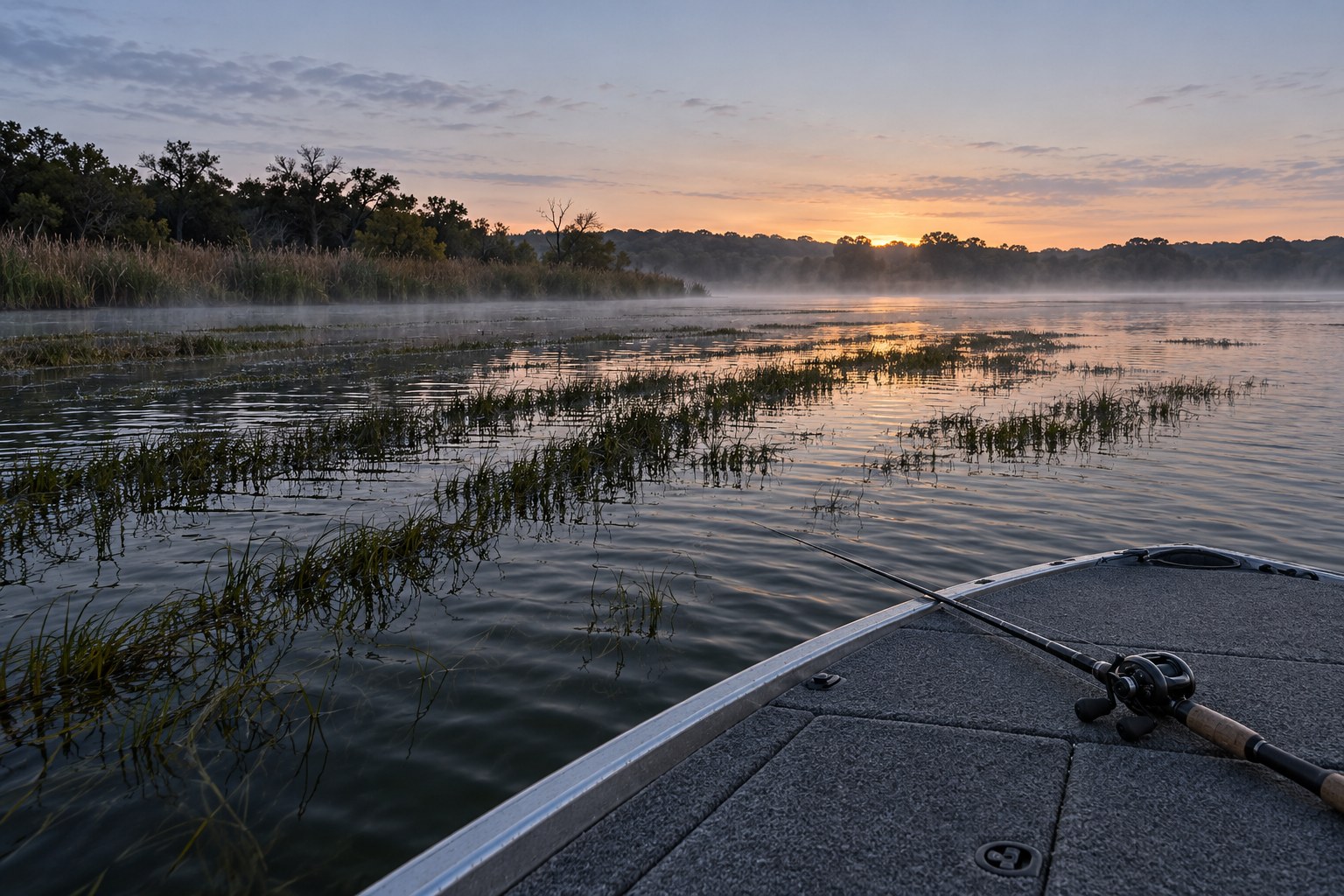
You’re standing on the deck with two rods rigged — one with a chatterbait, one with a spinnerbait — looking at a bank that has grass on the left and laydowns on the right. Both baits are skirted. Both have blades. Both are built to be cast, reeled, and knocked into cover. One of them is going to get bit and the other probably won’t, and the difference isn’t luck.
That’s the trouble with these two lures. They look like cousins, so they get thrown like they’re interchangeable. They aren’t. They’re built for different jobs, and once you can see which job each one does, the choice on the water stops being a coin flip.
Short version first; the rest of this article is the reasoning behind it.
The 60-Second Answer
Grass, docks, and a stop-and-go retrieve: throw the chatterbait.
Wood, current, cold water, and slow-rolling: throw the spinnerbait.
In open water with active fish, either one works. Tie on whichever you can feel working and cover water with it.
Neither bait is an upgrade over the other. A spinnerbait didn’t become obsolete when chatterbaits got popular, and a chatterbait isn’t a “better spinnerbait.” They’re two tools that overlap in the middle and separate at the edges. Your job is noticing which edge you’re standing on.
What Each Bait Is Actually Doing Underwater
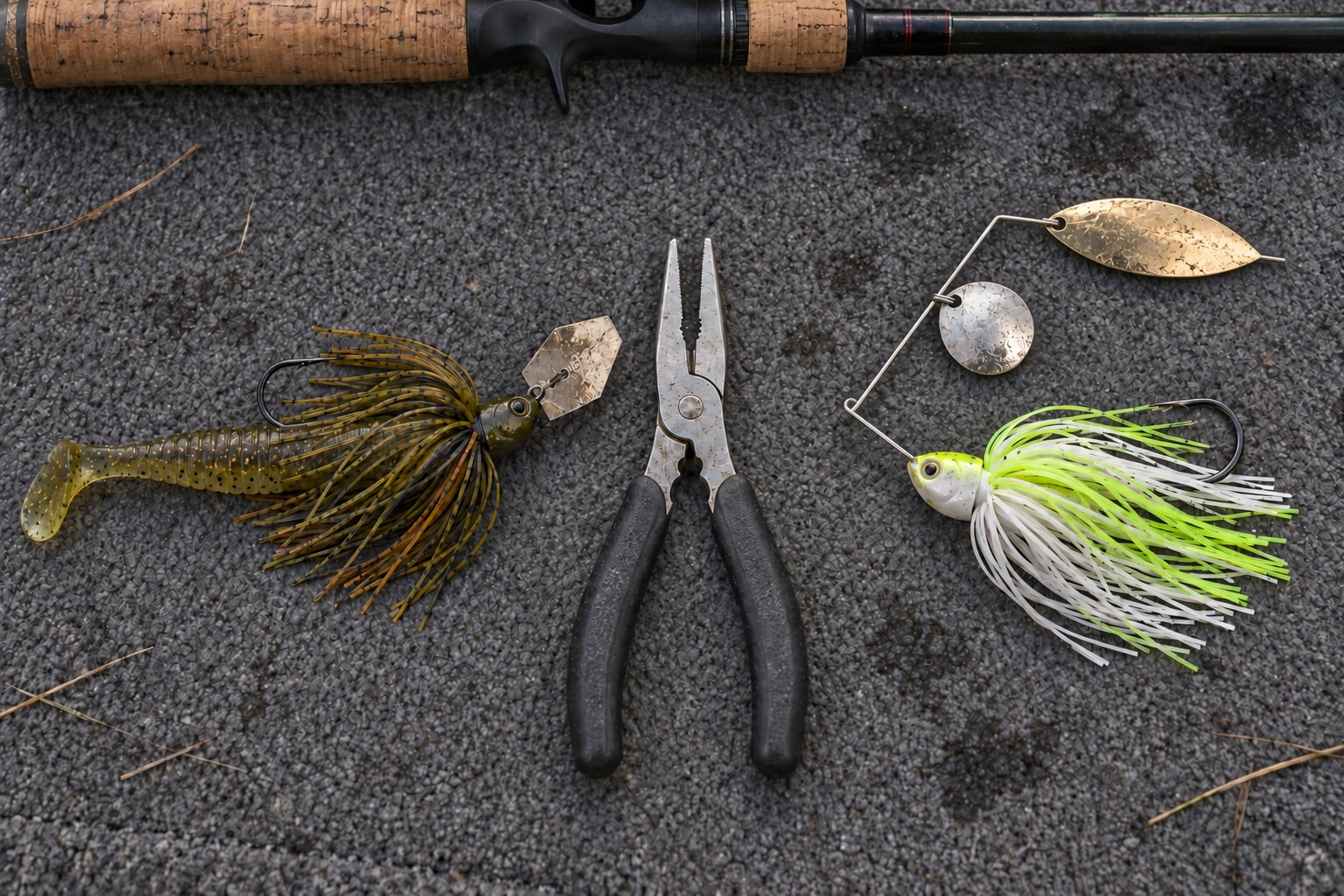
A chatterbait — also called a bladed jig or vibrating jig — is a skirted jig head with a thin hexagonal metal blade attached right at the nose of the head. That attachment point is the whole design. The blade can’t swing freely. It knocks side to side against the head, trapped between two stopping points, so it starts vibrating the instant you turn the handle.
The vibration is fast and tight, more of a hum than a thump. Bass pick it up through their lateral line — the sensory organ running along their side that reads pressure waves — which often happens before they ever see the bait. And because the blade kicks the head sideways whenever it touches something, the lure “hunts”: it darts off line for a moment, then corrects. That flicker reads as a baitfish losing its balance, and it’s why fish that ignore a straight-tracking lure will still eat a bladed jig.
There’s no wire frame on a chatterbait. It has one single jig-style hook, point up, with a skirt and a soft-plastic trailer.
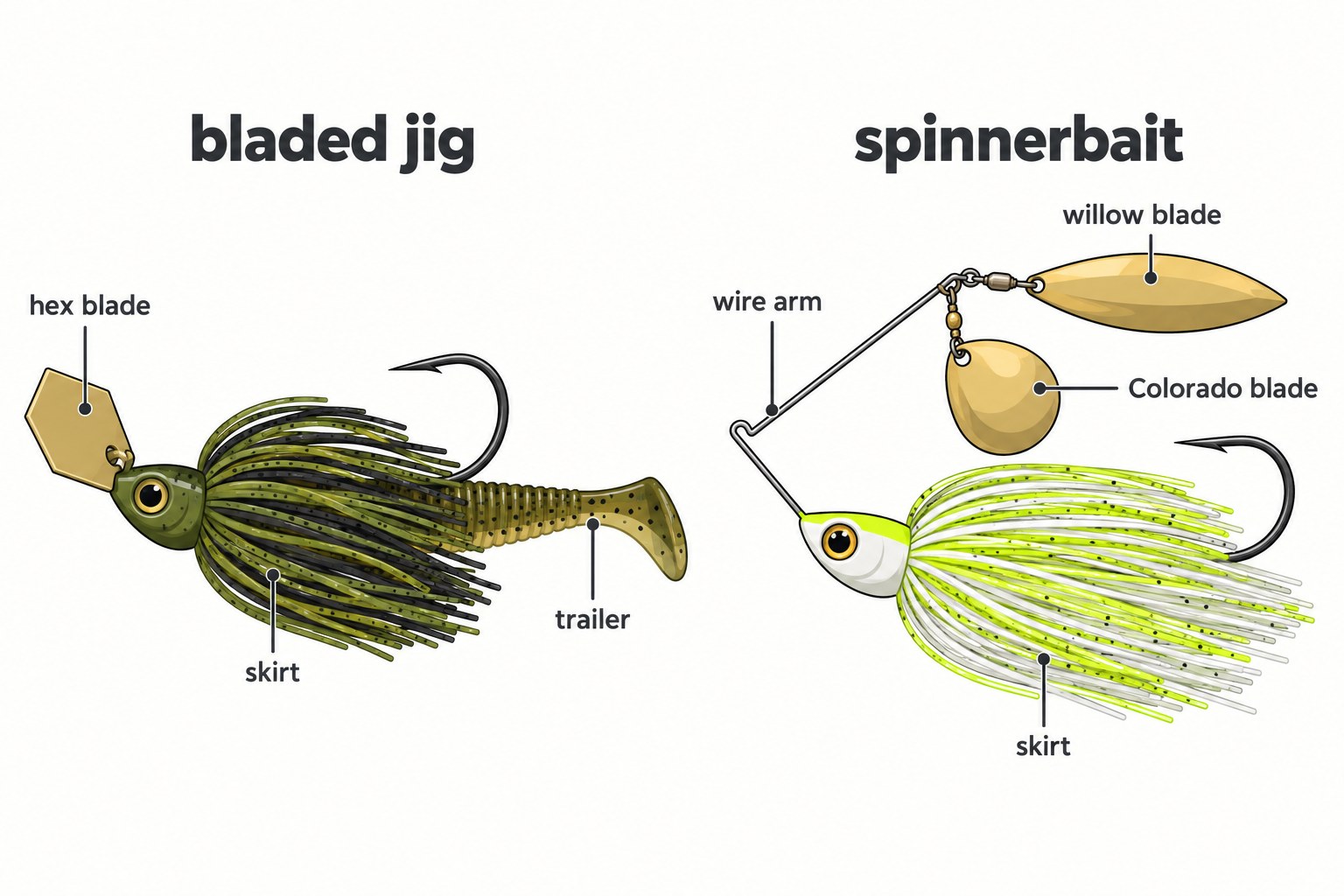
A spinnerbait works differently. It’s an L-shaped wire arm rising off a painted lead head, with one or two blades riding that wire above the head, a skirt around the head, and a single hook trailing behind.
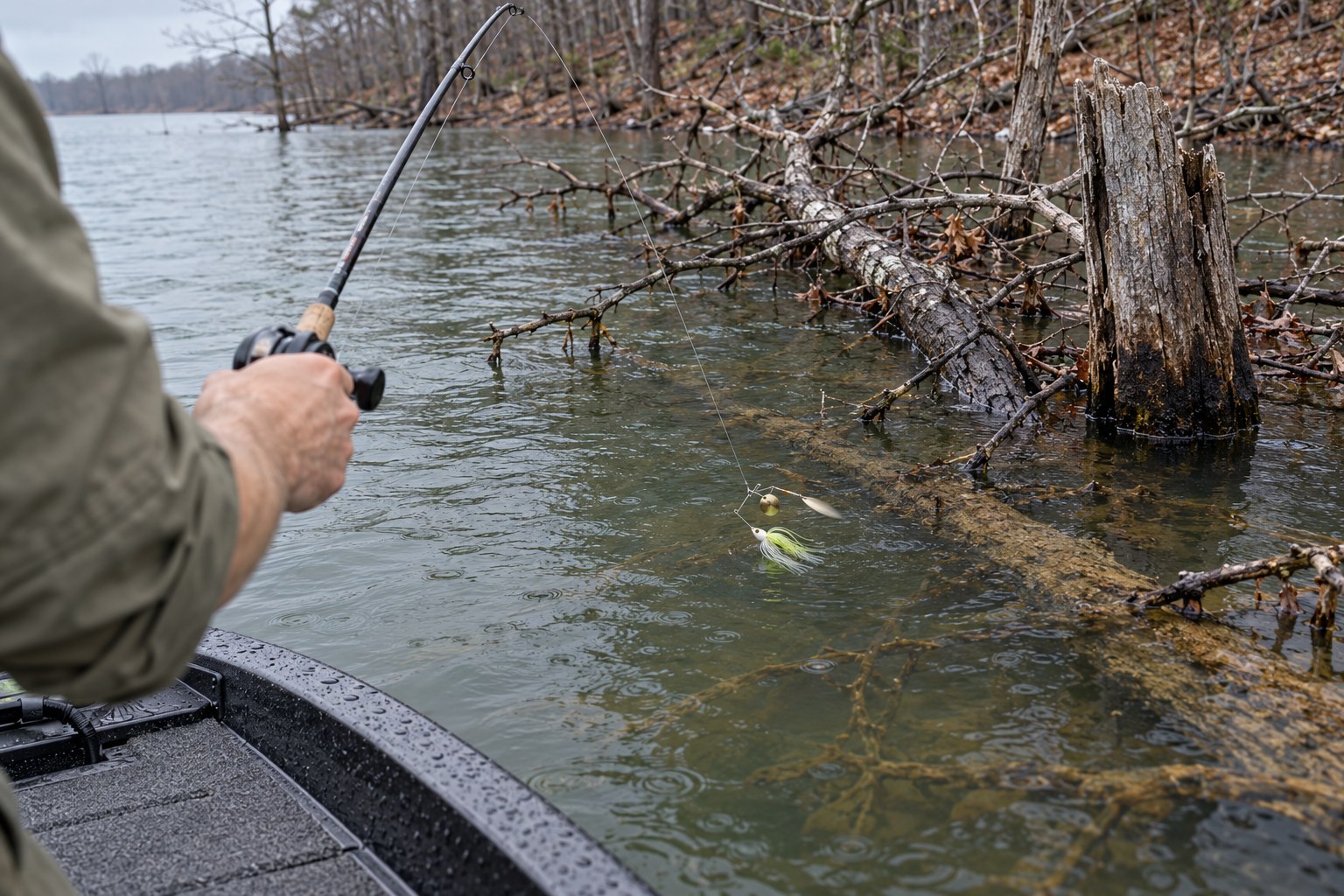
The wire isn’t only a blade holder. It’s a bumper. When a spinnerbait rolls over a limb or a grass stalk, the arm and blades take the contact and roll the hook away from the snag instead of into it. That’s why a lure that looks like a bent coat hanger full of hardware comes through wood better than most baits that look far more streamlined.
Blade shape sets the presentation, and this part is worth memorizing:
- Colorado blades are round and broad — maximum vibration, most water displacement, and the deepest-running of the three. Cold water, muddy water, low light.
- Willowleaf blades are long and narrow — most flash, least vibration. Clear water, bright skies, fast retrieves.
- Indiana blades are the teardrop middle ground: some flash, some thump, and the safe pick when the conditions aren’t pointing anywhere.
So: one bait is a jig with a blade bolted to its nose, built to shake. The other is a wire frame carrying spinning blades above a head, built to push water and deflect off cover. Every condition below comes straight out of that difference.
When the Chatterbait Wins
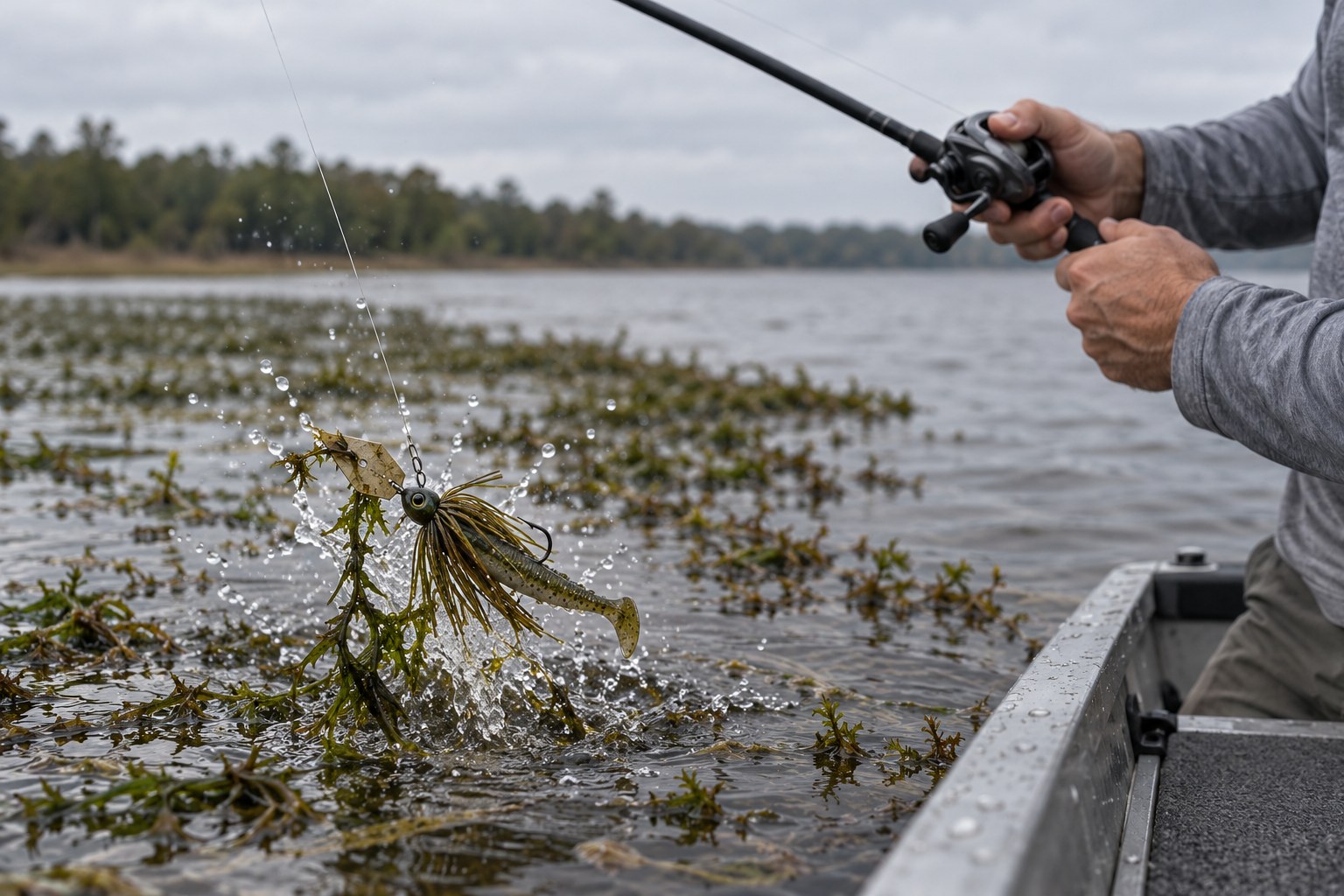
Grass — any kind of grass. This is the chatterbait’s home water. It runs over the tops of submerged vegetation and along the edges in a way a treble-hooked crankbait can’t, and it does it without fouling on every cast. Hydrilla, milfoil, coontail, the thin stuff fringing a flat — all of it.
The retrieve that catches fish here isn’t a smooth swim. It’s a swim with contact. Get the bait down until you feel it ticking the grass tops, and when it loads up, don’t drag it through — snap the rod and rip it free. That sudden change of direction is where a large share of bladed-jig strikes happen. If you never touch grass, you’re running the bait too high.
Docks. A chatterbait skips; a spinnerbait mostly doesn’t. Around pontoon boats, floating docks, and low walkways with shade underneath, you can skip a bladed jig back into water nothing else reaches.
Fish that are following instead of committing. Bladed jigs are strong on the fall. Stop reeling and the bait helicopters down with the skirt opening, which reads like a bluegill gliding toward bottom. Plenty of bites come on the slack line right after you stop, so watch the line rather than assuming the lure is still swimming.
Stained water with active fish. One to three feet of visibility is close to ideal. Fish lean on vibration more than sight in that water, and they tend to commit harder once they decide to eat.
Weights: 3/8 ounce in three feet or less, 1/2 ounce as the everyday size for covering water, 3/4 ounce when you need to get below eight feet or push into wind.
When the Spinnerbait Wins
Wood. Laydowns, stumps, brush piles, standing timber, dock pilings. The wire frame does the work. It absorbs contact, holds the hook away from the snag, and lets you fish tight to cover that would eat a bladed jig.
Current. Rivers, creeks, tailraces, the mouth of a feeder creek. A bladed jig hunts side to side in still water, and that’s exactly what stops working when water pushes at it from an angle — cross-current retrieves can kill the blade’s action entirely. A spinnerbait’s wire frame and rotating blades keep working no matter which direction the water moves. If you fish rivers at all, this one settles the argument.
Cold water and slow retrieves. A bladed jig’s action lives in the middle of its speed range. Retrieve it too slowly and the blade goes flat and quiet. A spinnerbait with a Colorado or Indiana blade can be crawled along the bottom and still rotate. That makes it the better cold-water tool: a big 1-ounce spinnerbait slow-rolled in 16 to 18 feet is a legitimate winter presentation, and there’s no bladed-jig equivalent that fishes that depth with the same control.
Muddy water. Colorado blades move more water and create more pressure. Spinnerbaits also give you more blade, skirt, and blade-color combinations to tune a profile for low visibility. Solid painted blades — white, black, chartreuse, orange — show up better than plated ones when the water looks like coffee.
A wide speed range in general. You can crawl a spinnerbait along bottom, then turn around and burn it just under the surface without it blowing out or rolling over. That range is the honest reason so many anglers call it the more versatile lure of the two.
If you want the fundamentals of the bait itself — blade configurations, skirts, hooksets — the spinnerbait basics guide covers the ground this comparison assumes.
Reading the Conditions: A Decision Table
Six situations, and what to tie on.
Shallow grass flat in spring. Chatterbait. 3/8 to 1/2 ounce, steady retrieve with grass contact, rip it free when it loads. Fish the outside edge first, then work across the tops.
Wood-filled creek arm. Spinnerbait. 3/8 to 1/2 ounce with a Colorado/willow tandem, cast tight to the laydowns, let the frame do the deflecting.
Cold front, water in the high 40s. Spinnerbait, slow-rolled. Colorado blades, heavier head, retrieve just fast enough to keep the blades turning along bottom.
Muddy runoff after rain. Spinnerbait with a big Colorado blade and a solid painted color, fished slowly along the mud line. A bladed jig still catches fish here, but the spinnerbait gives you more ways to make noise.
Clear, pressured lake with a bright sky. Willowleaf spinnerbait for flash and speed, or a natural-colored bladed jig with a slim trailer fished faster and less predictably. Both work; the question is which one the fish haven’t seen all morning.
Dock-lined bank. Chatterbait, skipped. Not close.
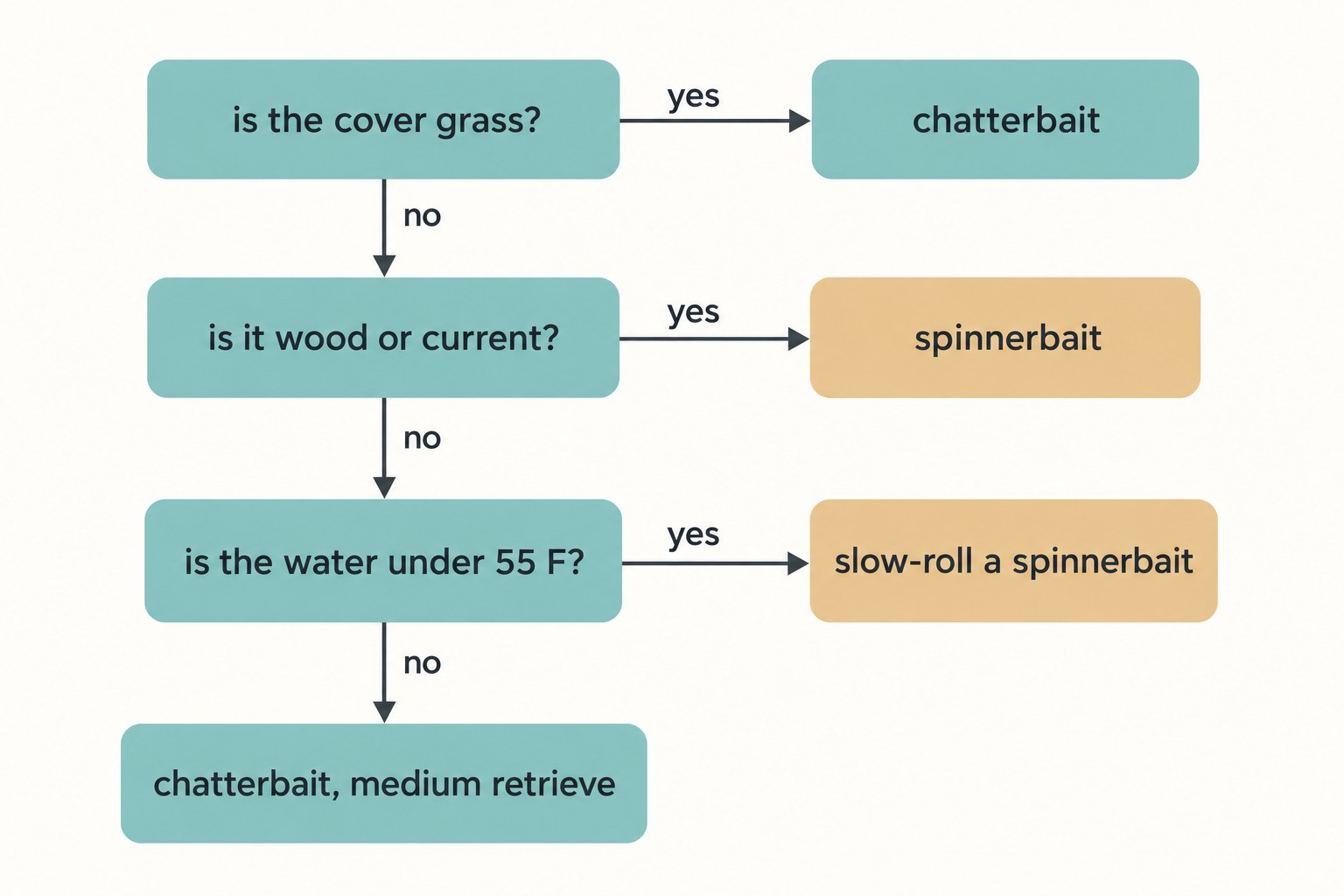
Two more patterns worth building into your instincts. Wind helps both baits, because it breaks up the surface and pushes bait onto banks and flats. And water under roughly 55 degrees shifts the advantage toward the spinnerbait almost every time, because it rewards a slower presentation.
Sizing, Trailers, and the Tackle That Makes Either Bait Work
Most fish people lose on these two lures are lost to tackle, not to picking the wrong bait.
Rod. A 6’6″ to 7’3″ medium or medium-heavy with a moderate or moderate-fast action. Both baits carry one large hook and a heavy head, and fish throw that combination on a jump. A softer tip lets the fish take the bait deeper before you feel it and cushions the head shakes. A stiff, fast worm rod pulls hooks.
Line. 15 to 20 pound fluorocarbon is the default for both. It sinks, which helps a spinnerbait stay deep, and it resists abrasion around wood. Braid in the 20 to 30 pound range is the grass answer — no stretch helps the rip — but then the softer rod matters even more.
Trailers. On a bladed jig, the trailer sets the action: a thin soft jerkbait for maximum hunting, a paddle tail to add lift over grass, a craw for slow-rolling. On a spinnerbait, a single-tail grub adds bulk and lets you slow the bait down, which is what cold, muddy water asks for. A trailer hook converts short strikes, and a deer-hair trailer hook adds profile without adding lift.
Hookset. Reel until the rod loads, then sweep to the side. Don’t swing on the first tap. The most common bladed-jig mistake is setting the hook the instant you feel the strike, before the fish actually has the bait. The second most common is a hard upward snap that tears a single hook out of soft mouth tissue.
What Actually Doesn’t Matter (And One Myth)
Blade color is a distant third behind weight, retrieve, and whether you’re touching cover at all. Color sells baits; contact catches fish. If you’re stuck choosing between two colors and you haven’t decided how deep you’re running the lure, you’re working on the wrong problem.
Chatterbaits are not weedless. They’re weed-resistant. One strand of grass wrapped around the blade kills the vibration, and a bait that isn’t vibrating is just a jig you’re reeling. If the thump stops, clear the blade or recast. Some models accept a weed guard, which helps but doesn’t make the lure snag-proof. Neither bait replaces flipping or punching heavy cover either — that’s a different tool for a different job.
Carrying both is the real answer. These two are genuinely interchangeable in a lot of water. Anglers who fish both for a living describe days when one outfishes the other three to five times over, and days when the reverse is true. The people who struggle are usually the ones who stopped carrying one of them.
Both baits also reward the same habit: fishing them into things. Cast past the grass edge and bring the bait through it. Bounce the spinnerbait off the stump instead of casting beside it. Most strikes on either lure come at the deflection, the rip, or the restart — the instant the bait stops doing what it was doing. Fish the cover, not the open water next to it.
If grass and vegetation are newer ground for you, the cover and grass fishing guide covers how bass use it. One terminology note while you’re here: a bladed jig is not the same lure as a metal blade bait, even though both get called “blade baits” in some parts of the country. A metal blade bait is a lipless vibrating plug fished vertically in cold water — different tool, different technique.