
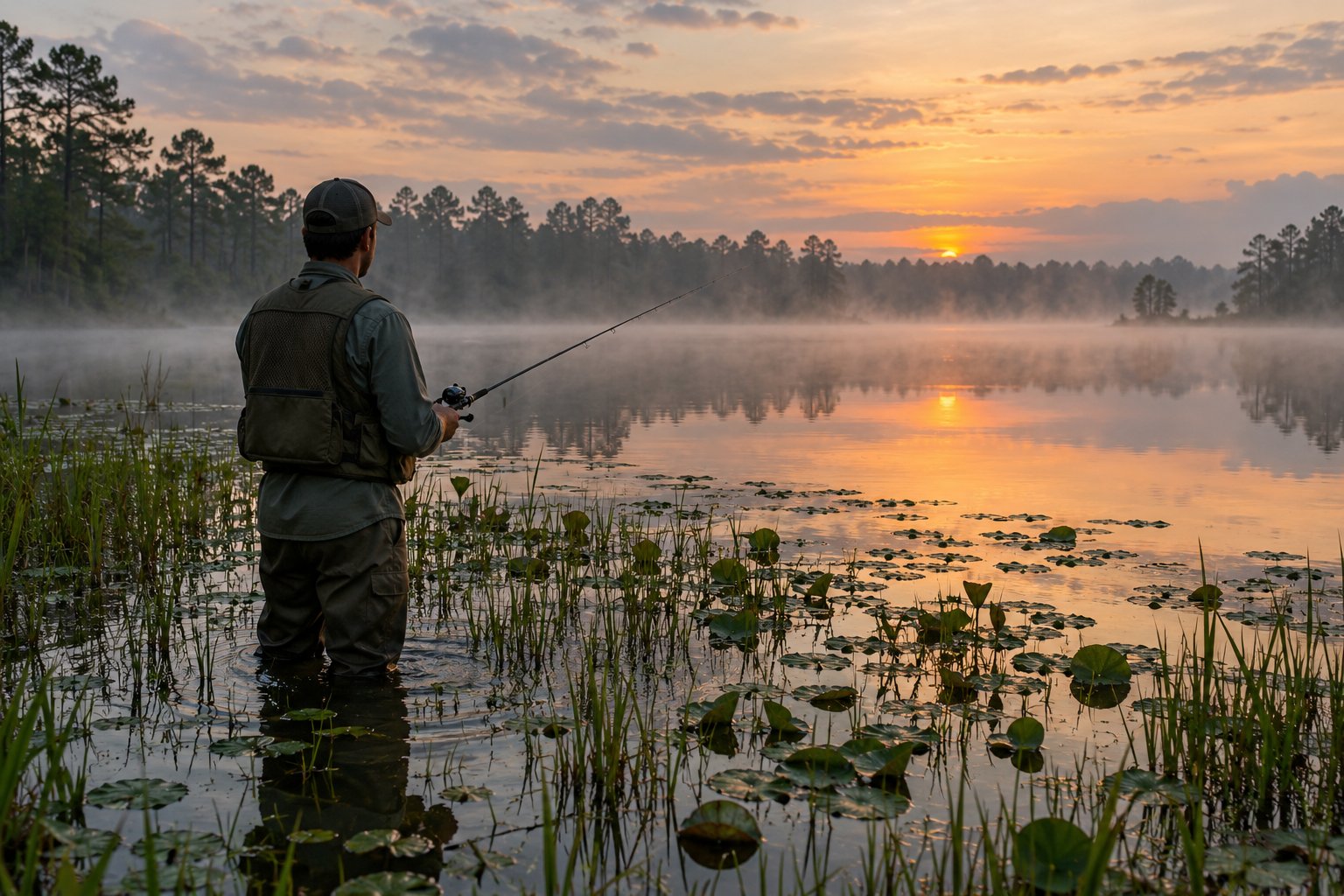
You cast your walking bait across a grass edge and a bass explodes on it — a huge splash, a boil you can see from the boat. You swing hard and… nothing. The bait comes back dry, and the water goes quiet.
If that scene sounds familiar, you’re in the middle of the most common topwater problem: treating the splash as the moment to set. It isn’t. The splash is just the beginning of the interaction, and how you handle the two seconds after it decides whether you land the fish or tell the story later.
This is a level-up piece, so we’ll assume you can already walk a bait and cast accurately. What we’ll cover is what blow-ups actually mean, how to time your hookset for each type of surface bait, and how to convert the fish that swipe short.
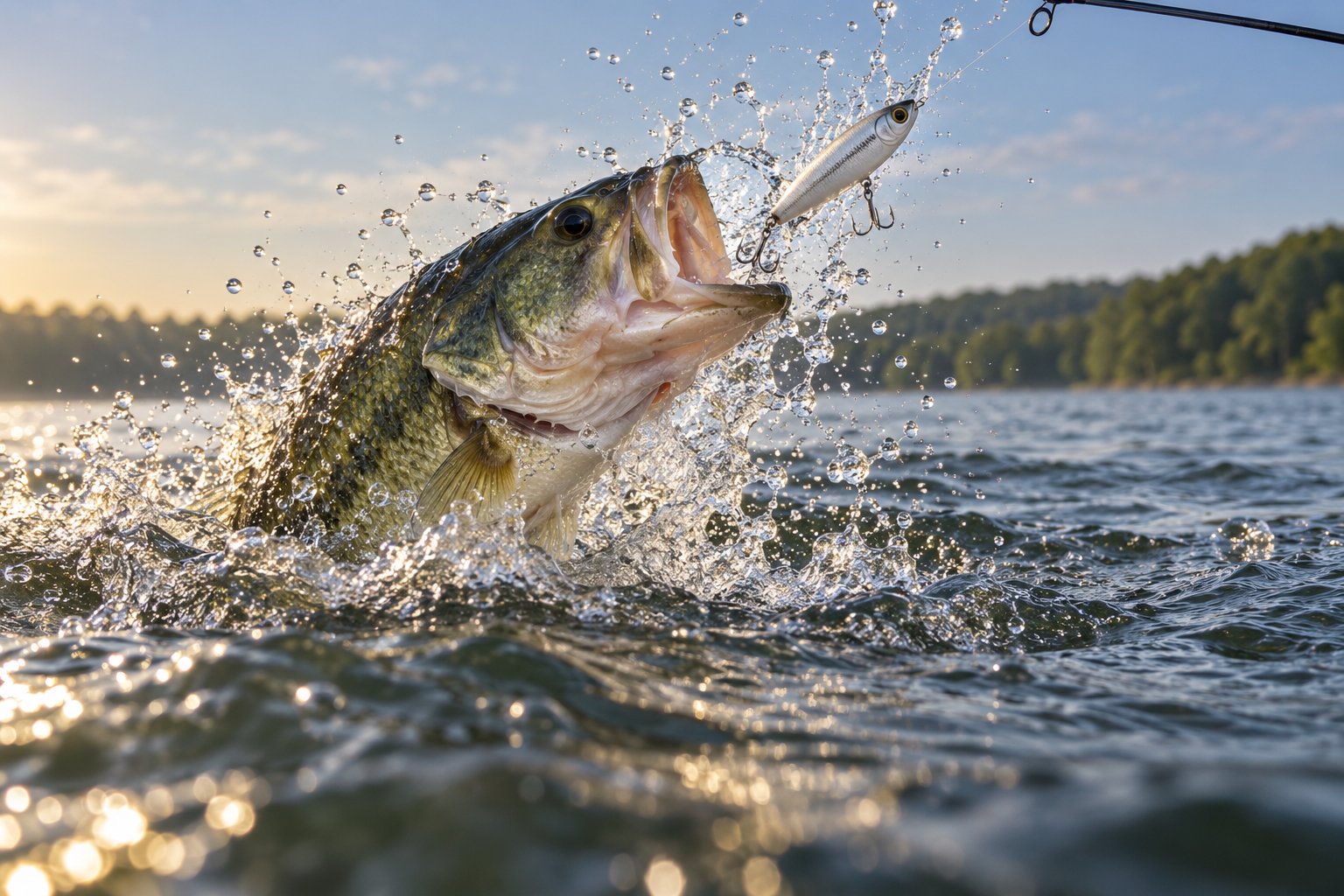
Why the Splash Is a Lie — What a Blow-Up Actually Tells You
When a bass blows up on your bait, your brain gets one frame of information: fish, here, now. That’s it. It doesn’t tell you whether the bait is in the fish’s mouth, and in a surprising number of cases, it isn’t.
Bass hit surface baits for two different reasons. Sometimes they’re feeding — actively chasing baitfish that are fleeing across the surface. But plenty of blow-ups are reaction strikes out of aggression or curiosity. A bass that’s ambushing rather than feeding will often push at, nip at, or roll on a surface bait without ever fully engulfing it. The disturbance looks identical from the bank. The hook position does not.
There’s also biology working in your favor and against you. Bass have upward-angled eyes that evolved to scan the surface for silhouettes, and warm water revs their metabolism, which is why topwater action typically peaks in summer and early fall. But even an aggressive bass takes a surface bait with an upward inhale that’s easy to disrupt — the moment you swing, the bait moves away from a mouth that may have only been near it.
So reframe the blow-up: it’s a report that says “a fish is here and interested.” Your job is what happens next.
The Pause: Your Most Valuable Topwater Technique
Here’s the drill that fixes more topwater misses than any lure change: when a bass blows up and misses, stop everything. Let the lure sit completely still on the water.
Don’t reel. Don’t twitch. Don’t set. Just stop.
A bass that misses will almost always turn and look at the bait again, often within two or three seconds. It circles back, and from that stationary position it frequently commits properly — a real inhale, with the bait inside the mouth. Many anglers describe their best topwater hookups as happening on this second attempt, after the pause, not on the first explosion.
The pause matters for a second reason too. Big bass will often track a moving lure for a long time without committing, and the strike frequently comes the moment the bait stops or twitches after a long dead stop. The stillness makes the bait look exhausted and vulnerable. If you’re burning the retrieve, you’re robbing yourself of the most committed strike window.
Fighting this is hard because the splash triggers an involuntary swing. Train it deliberately: the next ten blow-ups you see, count “one-one-thousand, two-one-thousand” before your hands move. It will feel late. It isn’t. If the basics of working a topwater bait are still new to you, our topwater fishing for beginners guide covers the retrieves themselves — this article is about the two seconds after the fish shows up.
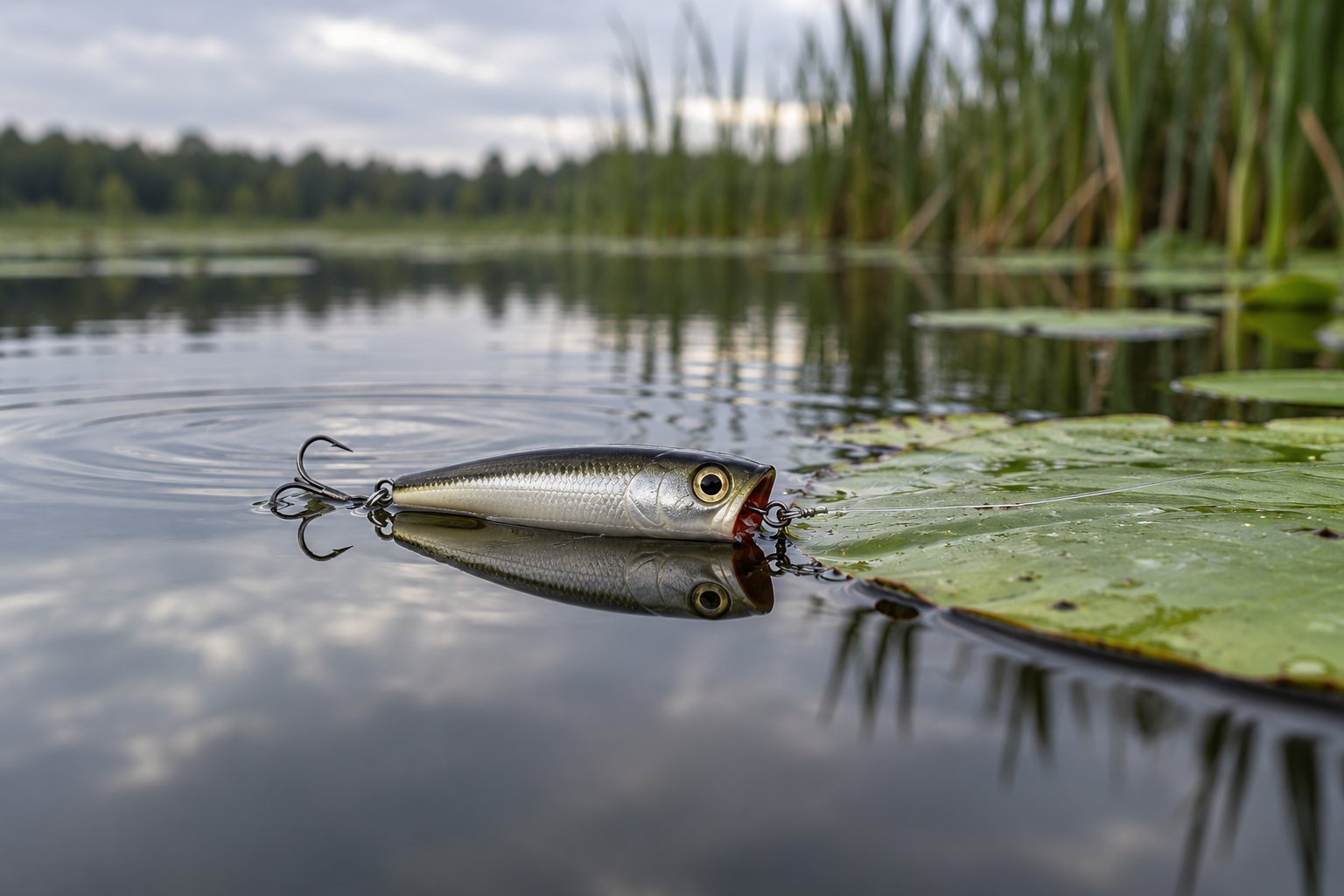
Hookset Mechanics by Bait Type
Once you’ve waited for weight, the set itself depends on what’s tied on. One hookset rule doesn’t fit every surface bait.
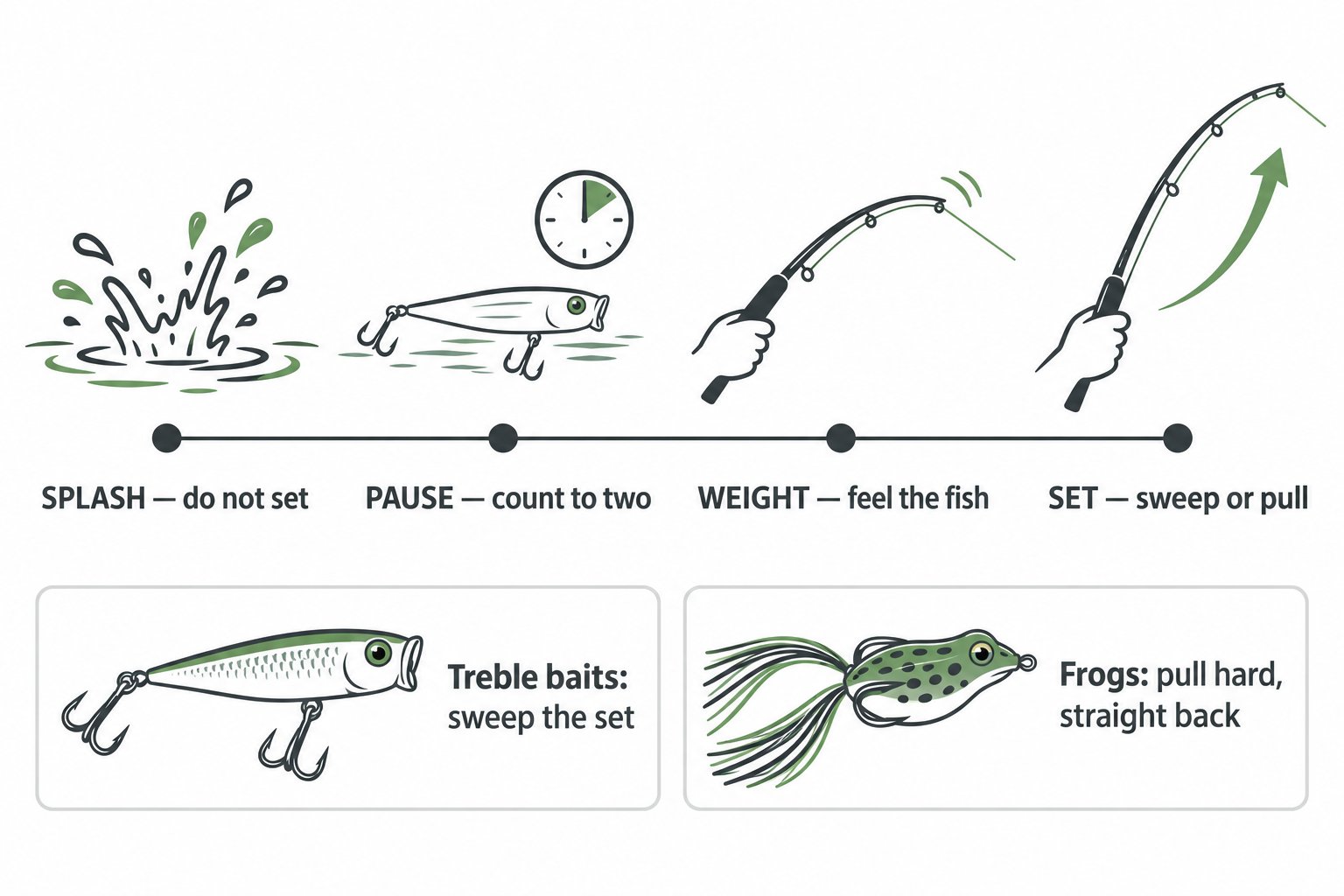
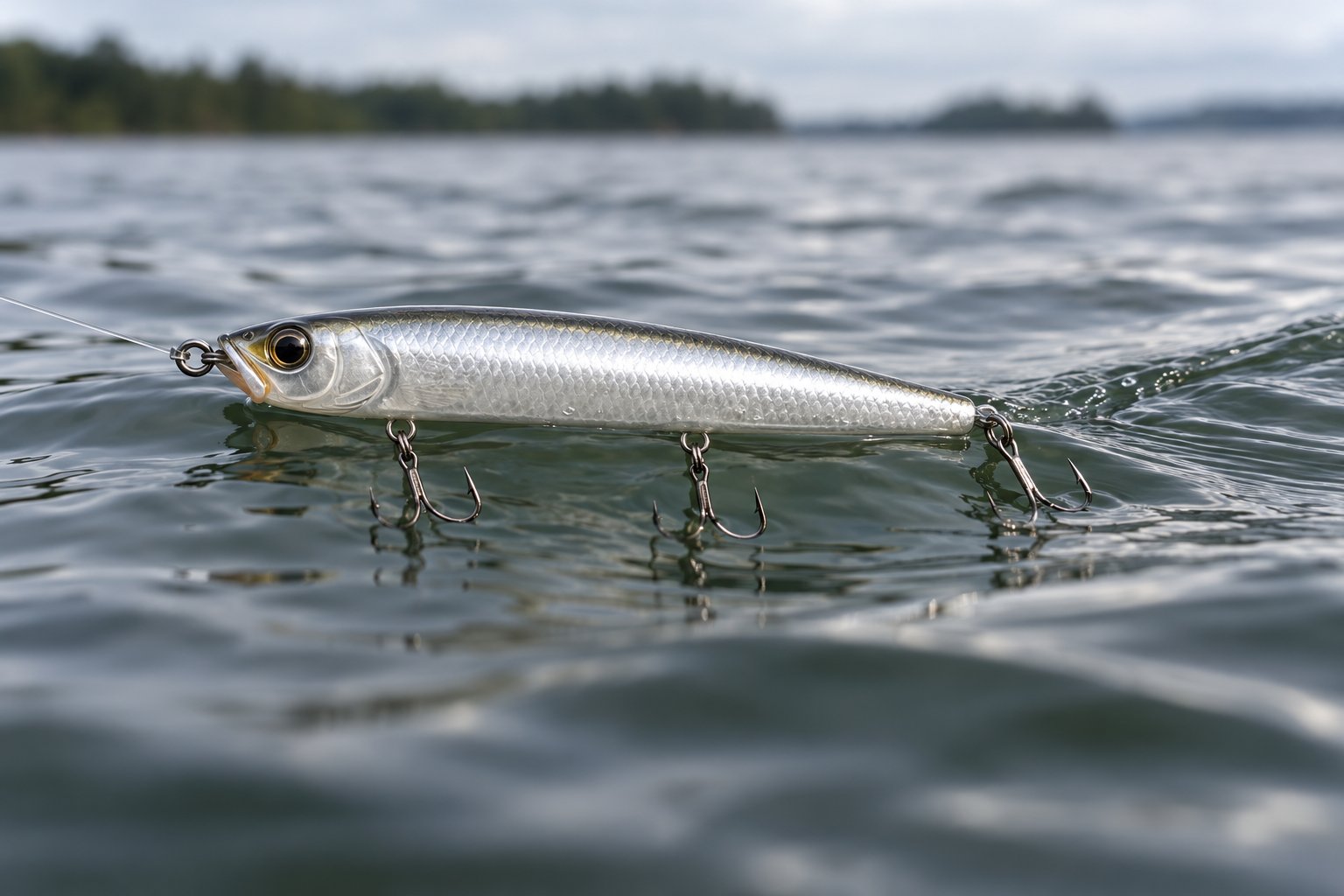
Walking baits and poppers (treble hooks). These carry small trebles that need a sweeping, sideways set rather than a straight-up yank. A rod with some give helps, and many anglers run monofilament on purpose: the stretch absorbs the violent head-shakes of a missed strike and helps keep treble points pinned in the corner of the mouth. Keep your rod tip low and sweep toward the fish — snap the slack out of the line, not the lure out of the water.
Hollow-body frogs. Frogs have fewer, much heavier hooks, and they’re usually sitting in thick vegetation. A sweeping treble set won’t pull a single hook through a frog body and a matted grass pad. You need a hard, straight-back pull with real pressure — braid is the standard line here because it transmits that pull directly and cuts through vegetation.
Buzzbaits. The strike on a buzzbait is often a compressive crush rather than an inhale, and the bait is moving faster than most topwaters. Set on the weight of the fish, not the sound of the blade churn. And start the retrieve the instant the bait touches down — a buzzbait that plunges sinks its blade and loses the surface.
The pattern: treble baits get a sweep, single- and double-hook baits get a pull, and every one of them gets the set only after you feel weight.
When Bass Swipe Short (and What That Means)
Sometimes you don’t get a blow-up at all — you get a swipe. A little roll behind the bait, a tap, a ripple, and the fish is gone. Short strikes are information, and the most important thing they tell you is this: slow down.
The instinct after a short strike is to speed up, to make the bait more exciting. That almost always drives the fish away. A bass that’s following but not committing is usually reacting to a bait that’s moving faster than it wants to chase. Slow the cadence, shorten your pulls, and pause near every piece of cover — a lot of big bass strike on a dead stop, not during the walk.
If short strikes keep happening across several casts, change the sound profile before you change anything else. Switch from a loud rattle bait to a single-knock or silent version. Sound is a big part of why bass commit or bail, and it’s the variable most anglers never touch.
Two more fixes worth knowing. First, profile: if the fish are swiping rather than inhaling, a smaller bait often converts them. Second, hardware: stock treble hooks on walking baits sit close to the body, and a partial strike can catch nothing. Many anglers open the hook points slightly (bend them a few degrees outward) to improve hookups on skin-hook takes — just keep it modest so you don’t lose weedlessness.
Reading Surface Conditions Before You Pick a Bait
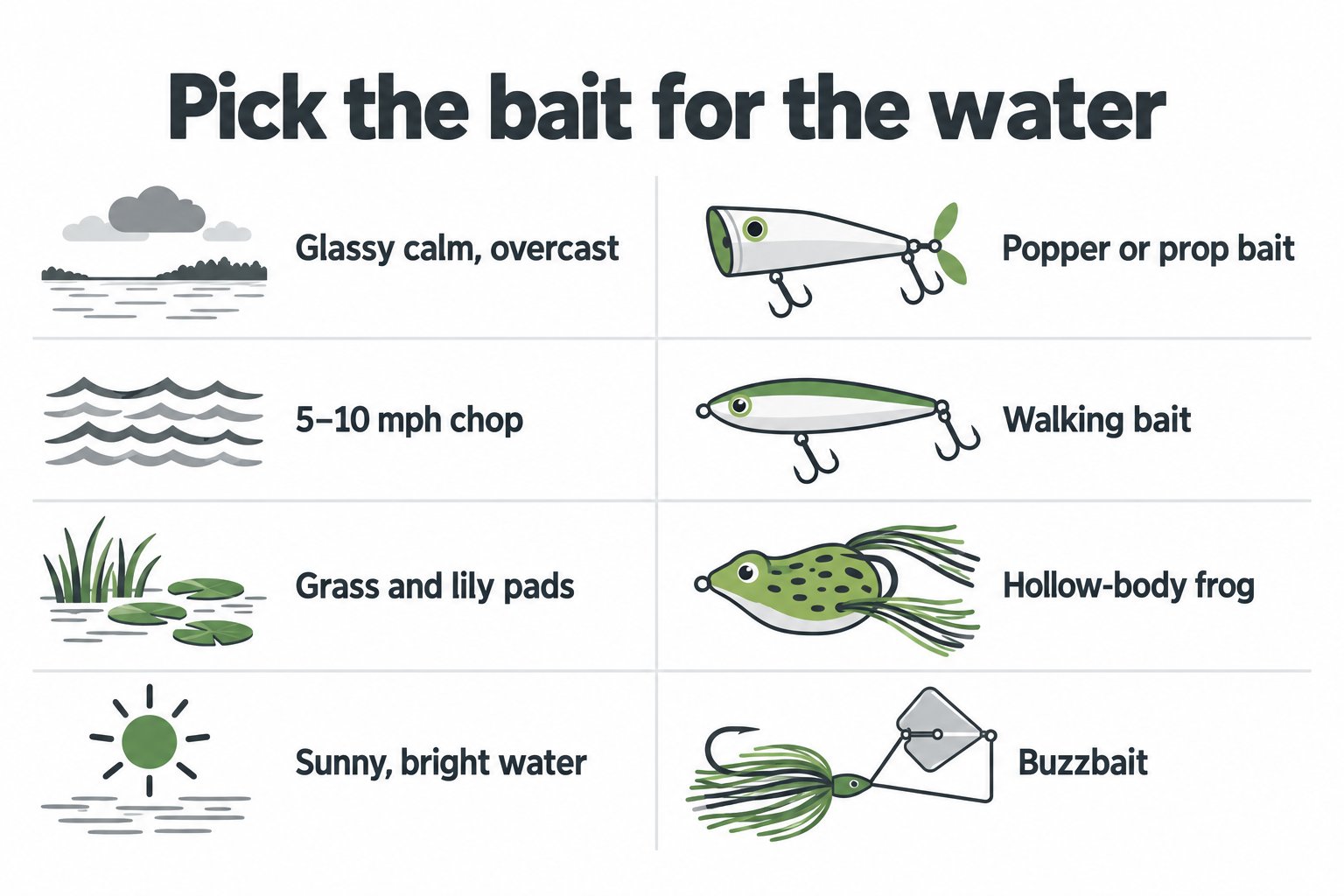
You can have perfect pause discipline and still go zero if the bait doesn’t match the water. A few reliable pairings:
- Glassy, calm, overcast water: poppers and prop baits. Poppers excel around grass, wood, and rock when the sky is flat. Prop baits are the patience play on calm mornings over deeper structure — most prop-bait strikes come while the lure is sitting still or just starting to move after a long pause.
- A 5–10 mph chop: walking baits shine, and honestly, a light chop often beats glass-calm water. The texture hides the line and the lure’s wake reads louder to the fish.
- Grass, pads, and matted cover: hollow-body frogs, full stop. Nothing else with exposed hooks survives there.
- Bright sun, clear water: faster reaction baits like buzzbaits give the fish less time to inspect. Loud surface commotion can call bass up from deep structure even when they aren’t actively feeding.
One hard limit: cold water ends the surface game. Below roughly 60°F, bass go lethargic and stop chasing surface baits. Put the topwater rod down and go subsurface. Timing matters at the other end of the day too — the mechanics here pair naturally with the best times of day to fish, since low-light windows pull bass shallow and surface-ward.
The same matching logic applies below the surface, by the way — if you want the subsurface version of this thinking, our crankbait fishing guide covers keeping a bait in the strike zone at depth.
The Follow-Up Cast: Converting the Fish You Missed
You paused. You set on weight. You still missed. The fish is down there ten feet away, looking at your bait — this is the moment that separates good topwater days from great ones.
Keep the lure in the strike zone. Unless the fish clearly had the bait and spat it, leave the lure sitting where the blow-up happened. A pause, one small twitch, another pause — the second and third attempts often come with more commitment than the first.
Give it two or three serious attempts, then move on — but mark the spot. A missed fish marks productive water. Come back to that exact spot a few minutes later with a different bait, and this is where a soft plastic shines: a slow-falling creature bait on the follow-up cast converts a lot of bass that just refused or missed a surface lure. The fish that swam away confused is still there, and a slow presentation gives it a decision it can make without the surface drama.
Putting It Together: A Simple Drill
Find one piece of cover — a grass edge, a dock, a cluster of pads — and fish only that spot for ten casts with one topwater bait. Run the same sequence every cast:
- Walk or pop the bait to the cover.
- Stop. Let it sit five full seconds.
- One twitch, then stop again.
- If a fish blows up: hands off. Count to two. Feel for weight.
- Set with the right mechanic for your bait — sweep for trebles, pull for frogs.
Track your hookup rate: fish seen, strikes, hookups, landed. Most anglers who run this drill for a week see the change immediately — not because the fish changed, but because the swing-at-the-splash reflex finally died. The splash was never the moment. The weight is.