
Lakes are the most common freshwater fishing environment in North America, and for good reason — they typically hold more species than ponds, offer deeper water than creeks, and give you room to explore. But that same size and depth can feel intimidating if you have only fished smaller waters before. The water looks endless, the bottom is invisible, and it is hard to tell where the fish might actually be.
This guide breaks lake fishing down into manageable pieces. By the time you finish reading, you will know what species to expect, how to find the underwater features where fish hold, what gear to bring, and a simple step-by-step game plan for your first trip.
What Makes Lake Fishing Different
If you have fished a pond or a creek, you already know the basics. Lakes require a different mindset because of three factors: depth, surface area, and temperature layers.
Depth and Distance
Ponds are typically less than 15 feet deep and small enough that you can cast to most of the bottom. Lakes can be 50, 100, or even 200 feet deep in their deepest areas. That extra depth means fish have more places to position themselves — and more reasons to move around.
On a pond, you might cast anywhere and eventually find something. On a lake, random casting rarely works. The key is to target specific underwater features — which we cover in the next section.
Still Water Versus Current
Unlike rivers, most lakes are still-water environments. There is no current pushing fish downstream or holding them against a flow. Without current to structure fish, other factors take over: underwater topography, food sources, shade, and water temperature. This makes lake fishing more about reading the bottom than reading the current.
Temperature Layers
During warm months, lakes develop distinct temperature zones. Warm water sits on top, cold water settles at the bottom, and a sharp transition layer — called the thermocline — forms in between. This layering has a major impact on where fish hold, and it is one of the main things that separates lake fishing from pond fishing, since ponds are usually shallow enough to avoid true stratification.
If you are transitioning from pond fishing to lake fishing, the biggest adjustment is learning to think in three dimensions instead of two. In a pond, you mainly worry about where to cast. In a lake, you also need to think about what depth your bait is at and whether the fish are holding above or below certain temperature zones.
Common Fish You Will Find in a Lake
Most freshwater lakes support a variety of species. The exact mix depends on your region and whether the lake is natural or man-made, but you can typically expect to encounter at least several of the following:
Largemouth Bass
The most sought-after game fish in most lakes. Largemouth bass prefer structure and cover — weed beds, docks, fallen trees, and rocky shorelines. They are aggressive biters and will attack a wide range of lures and live baits.
Smallmouth Bass
Similar to largemouth but with different habitat preferences. Smallmouth bass favor clear water and rocky structure. They tend to hold near drop-offs, ledges, and submerged reefs. Many anglers consider them tougher fighters than largemouth.
Crappie
School fish that congregate near structure at moderate depths. Crappie are highly prized table fare and are often caught by suspending a small jig or minnow near docks, brush piles, or submerged timber. They are especially active during spring spawning runs.
Bluegill and Sunfish
Abundant in nearly every lake and among the easiest species for beginners to catch. Bluegill hang out near vegetation, lily pads, and along the shallow shoreline. A small hook, a piece of worm, and a bobber will usually produce fish quickly.
Catfish
Bottom-dwelling fish found near deeper channels, submerged structure, and along the lake floor. Catfish are opportunistic feeders and will take live bait, cut bait, or stink baits. They are particularly active at night but can be caught during the day near structure.
Trout
Depending on your region, lakes may hold lake trout (a cold-water species) or be stocked with rainbow or brown trout. Trout fishing in lakes usually requires targeting deeper, cooler water or using live bait rigs.
Walleye
Common in northern lakes, walleye are low-light predators that hunt near drop-offs, points, and current breaks. They are notoriously finicky but rewarding when they bite.
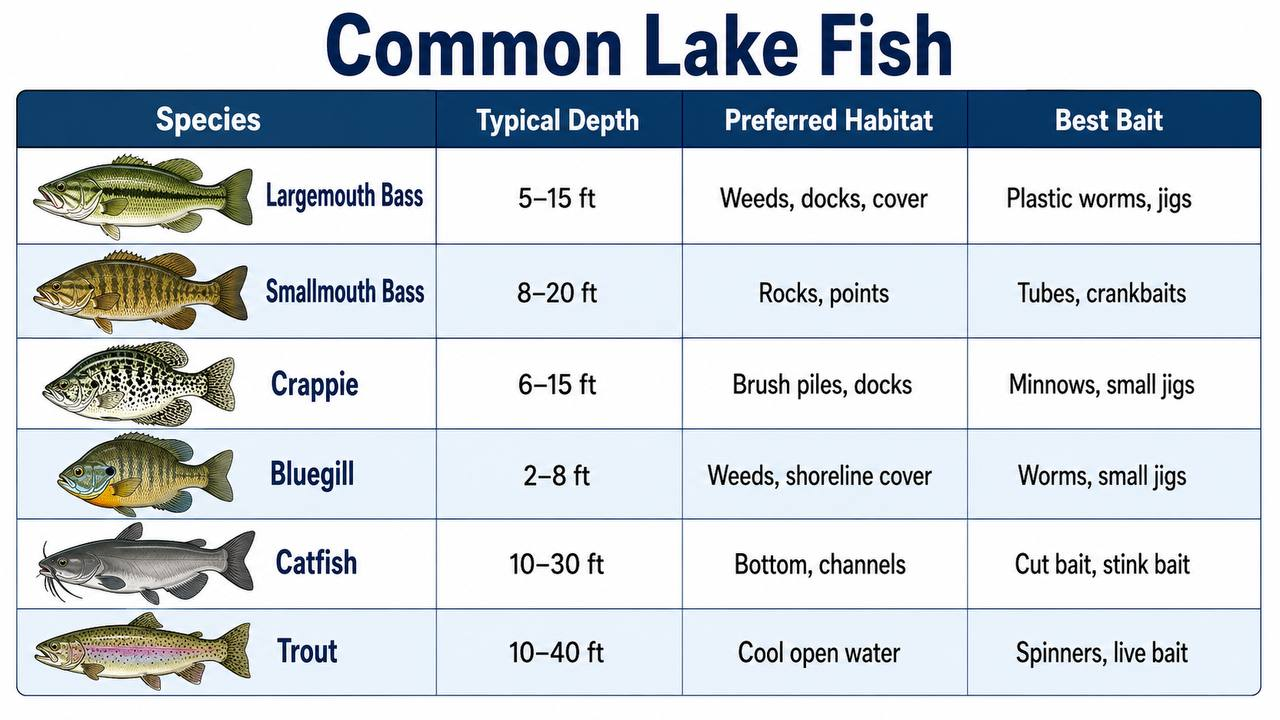
Knowing which species live in your target lake will help you choose the right tackle and bait. If you are unsure, check your local fishing regulations or the state wildlife agency website — most lakes have published fish community surveys.
Finding Fish: Underwater Structure 101
The single most important concept in lake fishing is structure. Structure is anything underwater that is different from the surrounding bottom — a sudden change in depth, a rock pile, a weed bed, or a submerged tree. Fish need structure for three reasons: shelter from predators, ambush points for hunting, and access to food.
Drop-Offs
A drop-off is where the bottom suddenly transitions from shallow to deep. Think of it as an underwater cliff. Drop-offs are sometimes called fish highways because they allow fish to move quickly between shallow feeding areas and deep-water shelter. When you cast near a drop-off, you are giving yourself access to fish at multiple depths with just a few casts.
Ledges
Ledges are underwater terraces or shelves that jut out from the main bottom. They are similar to drop-offs but more gradual — imagine underwater steps instead of a cliff. Ledges are often overlooked by beginners who focus only on the shoreline, but they can hold fish consistently throughout the day.
Weed Beds and Vegetation
Weed beds attract insects, small baitfish, and crustaceans — all of which attract larger fish. Predators like bass and pike use the edges of weed beds as ambush points, while panfish cruise through the weeds themselves. If you see surface vegetation or discoloration in the water, there is likely a weed bed below, and fish are likely feeding there.
Docks and Piers
Man-made structures are reliable fish-holding spots. Docks and piers provide shade, and shade attracts fish. The vertical posts create cover similar to underwater trees. Fish hold around docks in most seasons, making them one of the easiest targets for shore anglers.
Submerged Logs and Rocks
Natural debris — sunken trees, rock piles, boulders — creates cover in open water. Fish use these features exactly as they use weed beds: for shelter and ambush. In clear-water lakes, rocks are especially important because there is less vegetation to provide cover.
Points
A point is where the shoreline extends out into the lake, creating a finger of land. Fish often travel along points because they provide a route from deeper water into shallower areas without leaving cover. Casting to the tip of a point, or just beyond it, can produce fish that you would not find by fishing the shoreline behind it.
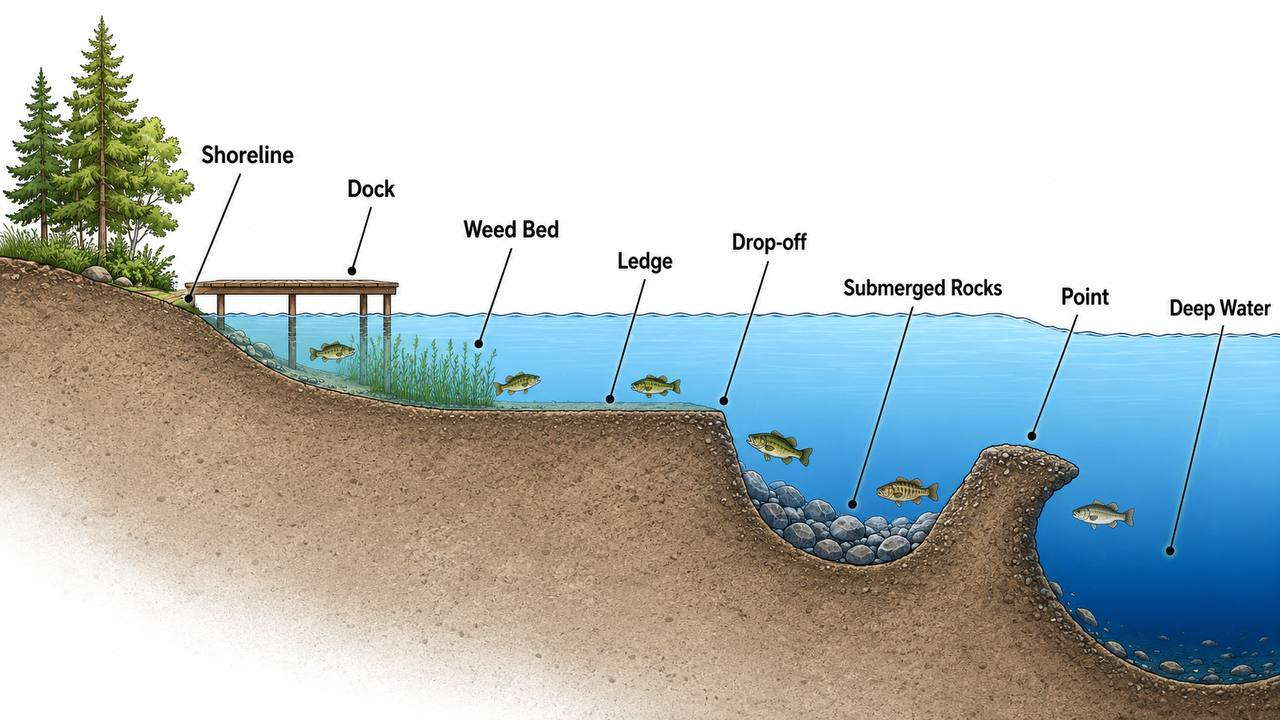
The challenge for beginners is that most underwater structure is invisible from the surface. A fish finder helps, but you can also look for clues: changes in water color, surface vegetation, birds diving, or even maps of the lake bottom. If you are fishing without a boat, focus on shoreline features — docks, points, visible weed lines, and areas where the water color changes.
How Temperature and Seasons Change Where Fish Are
Fish are cold-blooded, which means their metabolism and behavior are directly tied to water temperature. In lakes, this relationship is complicated by the fact that different depths can be at different temperatures — especially during the warm months.
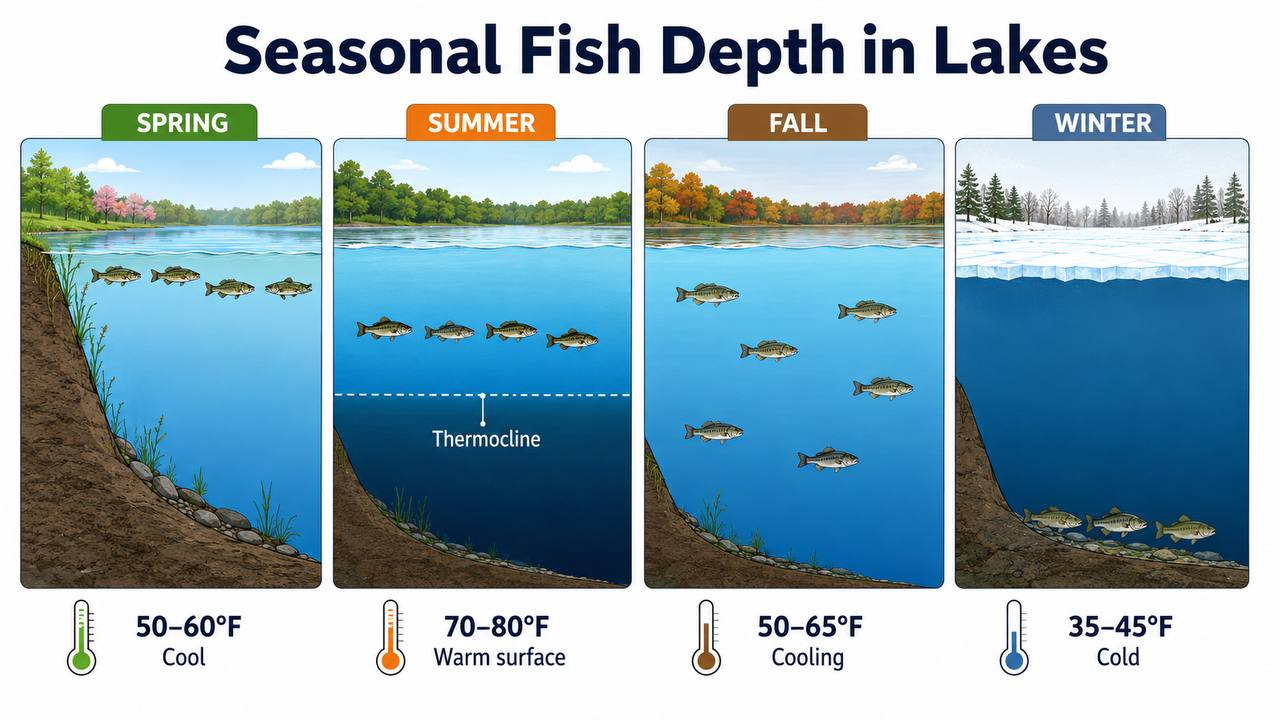
Spring: The Best Beginner Season
As lakes warm up in spring, fish move from their deeper winter holding areas into shallower water. The rising temperature triggers spawning activity, and many species become highly active and aggressive. For beginners, spring is typically the easiest season to catch fish because the fish are shallow, hungry, and relatively easy to locate.
Summer: Stratification and the Thermocline
During summer, lakes develop what is called thermal stratification. Warm water stays on top (the epilimnion), cold water sits at the bottom (the hypolimnion), and a sharp transition layer forms in between — this is the thermocline. The thermocline acts as a barrier for many fish species. Bass, for example, typically stay above the thermocline rather than diving into the cold water below it.
What this means for you: during summer, fish tend to hold at specific depth zones rather than spreading throughout the lake. If you can figure out roughly where the thermocline is — a fish finder makes this easy, or you can ask at a local bait shop — you can position your bait in the right part of the water column.
Fall: Turnover and Spreading Fish
As air temperatures drop in fall, the thermocline breaks down and the entire lake mixes. This process, called turnover, can make the water look cloudy for a few days. After turnover, fish spread back throughout the water column, and feeding activity often increases as fish prepare for winter. Fall is frequently one of the most productive fishing seasons.
Winter: Deep Water Holding
Once water temperatures drop consistently, fish settle into deeper water and become less active. Winter lake fishing requires patience, slower presentations, and targeting the deepest parts of the lake. In colder climates, this is when ice fishing takes over.
A practical tip: before heading out, check the water temperature. Free water temperature apps and online databases can give you a good idea of surface temps, which tells you roughly what depth zone to start fishing.
Gear and Tackle for Lake Fishing
You do not need a boat full of expensive gear to catch fish on a lake. A simple, versatile setup will handle the majority of situations a beginner will face.
Rod and Reel
A medium or medium-light spinning combo is the most versatile option for lake fishing. It is light enough to target panfish and crappie, but has enough backbone to handle bass and smaller catfish. If you are buying your first rod and reel, a quality department-store or sporting-goods combo in the $40–$60 range will serve you well.
Fishing Line
Monofilament line in the 6–10 lb test range is a good starting point. It has some stretch, which forgives beginner mistakes when setting the hook, and it is visible enough that you can track line movement in the water. If you are fishing a clear-water lake, switch to fluorocarbon — it is nearly invisible underwater and runs slightly thinner for the same strength.
Live Bait
Worms, minnows, and crickets are the three most effective live baits for lake fishing. Worms work on almost every species. Minnows are especially good for crappie, bass, and walleye. Crickets are a favorite for panfish and small bass. If you want the simplest possible setup, bring worms and a couple of small hooks.
Artificial Lures
If you prefer casting lures, start with four types that cover most situations:
- Crankbaits — dive to specific depths and mimic baitfish. Effective around structure and drop-offs.
- Spinners — create flash and vibration that attract fish in a wide range of conditions.
- Soft plastic worms — versatile, can be fished at any depth, work on bass and panfish alike.
- Spoons — flash and sink well, good for reaching deeper fish.
For lure colors, green pumpkin, watermelon, and black/blue are versatile choices that work in most water conditions. In murky water, brighter colors may get more attention.
Tackle Box
Keep it simple. A small tackle box with 4–5 lure types, a few hook sizes, some split shot weights, and a handful of bobbers will handle 90% of lake fishing scenarios.
Depth Control
One skill that matters more on lakes than ponds is controlling what depth your bait is at. Heavier lures and weights sink faster. A slower retrieve keeps a lure shallower. A faster retrieve drives it deeper. Practice letting your lure sink for a counted time before starting your retrieve — 3 seconds, 5 seconds, 10 seconds — and you will quickly learn how depth changes.
Fishing from Shore: You Do Not Need a Boat
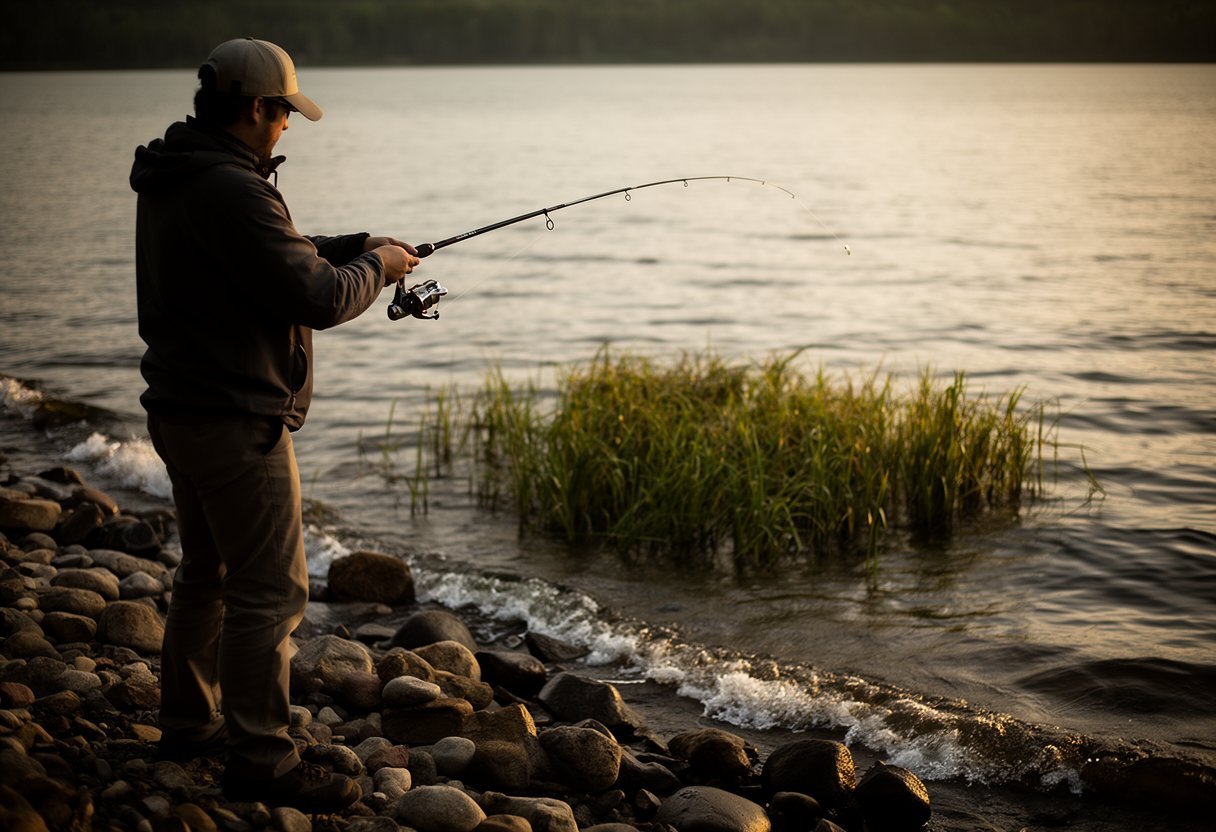
Many beginners assume you need a boat to fish a lake effectively. That is not true. Shore fishing works, especially if you target the right spots.
Where to Fish from Shore
The best shore locations are where shallow and deep water come together. Fish use these transition zones regularly, which means you can reach them without a boat:
- Coves and bays — sheltered areas where fish move in to feed. The entrance to a cove, where it meets the main lake, is often a hotspot.
- Points — sections of shore that extend into the lake. Fish travel along points, so casting to the tip or just beyond it can intercept moving fish.
- Marinas and boat ramps — the concrete or gravel surfaces create structure, and the constant boat activity stirs up food.
- Bridges — the pilings provide cover, shade, and structure. Fish hold in the shadow of a bridge throughout the day.
Shore Casting Tips
Casting distance is less important than casting accuracy. A 30-foot cast right next to a weed bed will outperform a 100-foot cast into open water. Identify visible structure from the shore — rocks, docks, weed lines, log jams — and aim your casts at those features.
If you are not getting bites after 10–15 purposeful casts at one spot, move to the next piece of structure. The most common beginner mistake is staying in one spot too long after confirming it is not holding fish.
Your First Lake Trip: A Simple Game Plan
Here is a straightforward plan to follow on your first lake fishing trip:
- Arrive early. Dawn is typically the most productive time. Fish are more active in low light, and early morning is usually quiet.
- Start near visible structure. Look for docks, points, weed edges, or any feature that breaks up the shoreline.
- Give each spot 5–10 casts. Cast to the same feature repeatedly, varying your retrieve speed and depth slightly each time.
- Move if nothing bites. After 10–15 casts with no response, walk to the next piece of structure.
- Change your approach if two spots fail. Switch to a different lure, a different retrieve speed, or a different depth.
- Take notes. Write down what worked — what lure, what depth, what time, and where. You will thank yourself on the next trip.
- Stay safe. Check local regulations, bring sunscreen and water, and tell someone where you are fishing.
Lakes are the backbone of freshwater fishing. Once you learn to read underwater structure and understand seasonal fish movement, you will be able to walk up to almost any lake and start catching fish. The key is to focus on structure, match your depth to the season, and give each spot a fair amount of attention before moving on.