
You don’t own a boat. Your local shore spots are crowded, or you’re just not sure where you’re allowed to fish. But there’s almost certainly a public pier or jetty within driving distance. And it gives you access to water you’d never reach from the bank. The problem is you don’t know what gear to bring, where to set up, how to rig your line, or how to stay safe — especially on those slippery jetties.
This guide covers everything a beginner needs to fish from piers and jetties with confidence.
Why Piers and Jetties Are Perfect for Beginners
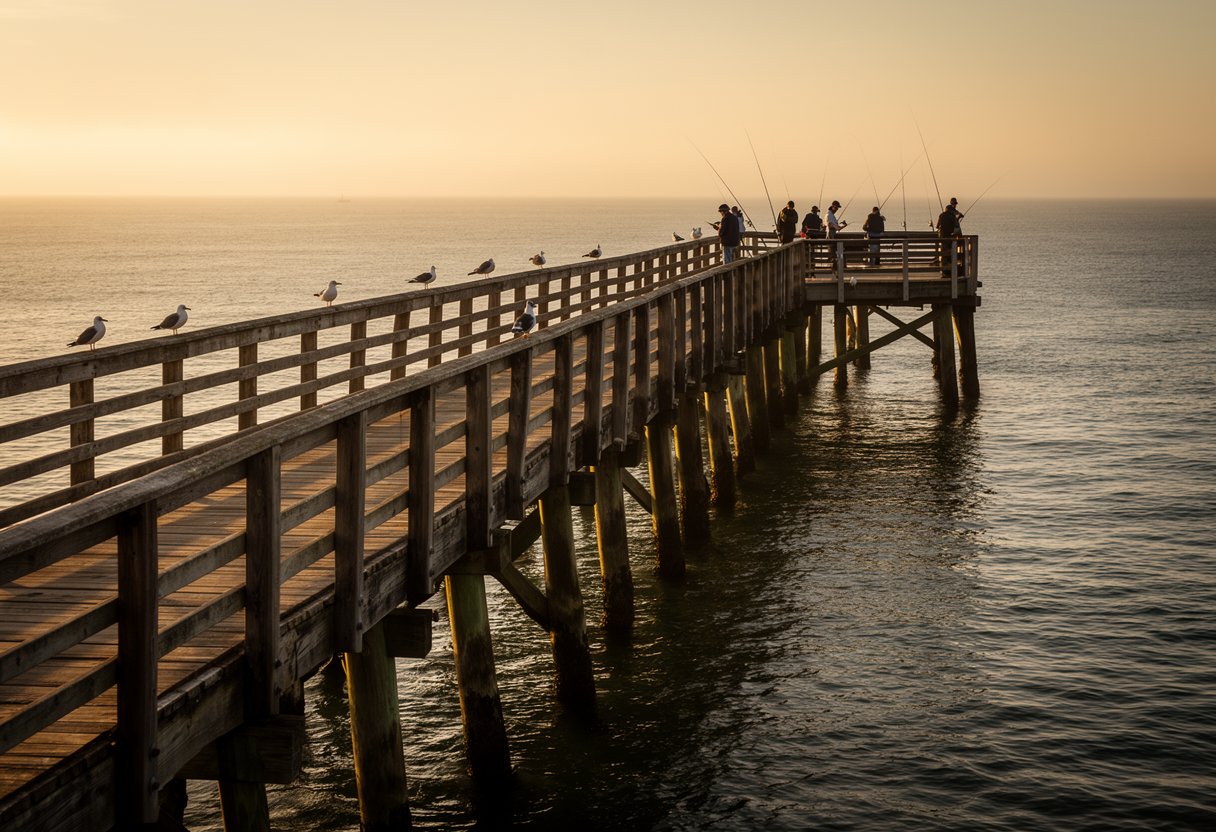
Public fishing piers and jetties are the most accessible fishing infrastructure in North America. You don’t need a boat, a trailer, or years of experience. You need a rod, some bait, and a place to stand.
Piers extend into deeper water than you can reach from shore. That puts you over fish that typically stay beyond casting distance from the bank. Many public piers in coastal states don’t even require a fishing license — though you should always confirm local rules before you go.
Jetties are rock structures built to protect inlets and harbor entrances. They act as artificial reefs. The rocks create habitat for baitfish, crustaceans, and algae, which draws larger game fish to feed. Where a pier gives you vertical access to deep water, a jetty gives you a pathway into current. And current concentrates fish.
Both are scattered along both coasts and around large inland lakes. If there’s water near you, there’s likely a public fishing pier or jetty you can use.
Pier Fishing Gear: What You Actually Need
You don’t need expensive or specialized gear for pier fishing. A basic freshwater or light saltwater setup works for most situations.
Start with a medium-action spinning rod, 7 to 9 feet long. The extra length helps you clear the rail and cast past the pier’s structure. Pair it with a spinning reel spooled with 20- to 30-pound braided main line and a fluorocarbon leader of the same strength. Fluorocarbon is less visible underwater and resists abrasion from barnacles and pilings.
For sinkers, the bottom type determines your choice. On sandy bottoms, a pyramid sinker digs in and holds against current. On rocky bottoms near pilings or jetties, use a bank sinker — it’s shaped like a bowling pin and snags less often on rocks.
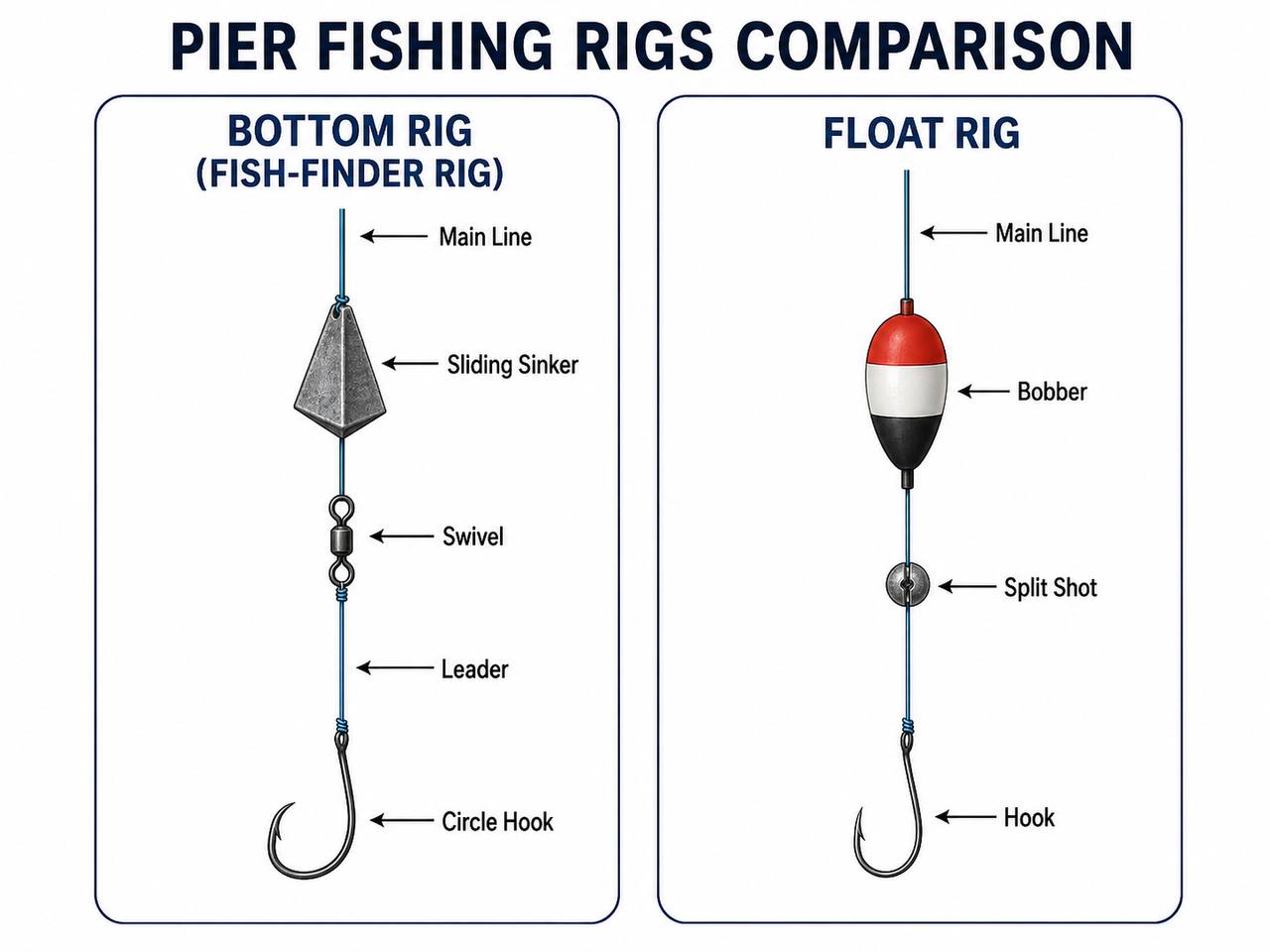
You mainly need two rigs:
- Bottom rig (fish-finder rig): A sliding sinker moves freely on your main line above a swivel. Below the swivel, a 12- to 24-inch leader ends in a circle hook. This puts your bait on the bottom, where many species feed. The sliding sinker lets a fish pick up the bait without feeling the weight.
- Float rig: A bobber or float stops at your chosen depth. Below it, a split shot adds weight, then a leader goes to the hook. This suspends your bait at a specific depth and gives you a visual strike indicator when a fish bites.
Most piers limit you to two rods per person. That’s plenty — set one up with a bottom rig and the other with a float rig, and you’ll cover two depth zones at once.
If you need help choosing your first rod and reel combo, check out our guide on fishing rod and reel combos for beginners for a full breakdown of what to look for.
Where to Set Up on a Pier: Position Matters
Your position on a pier determines what you catch. Different sections of the same pier hold different species.
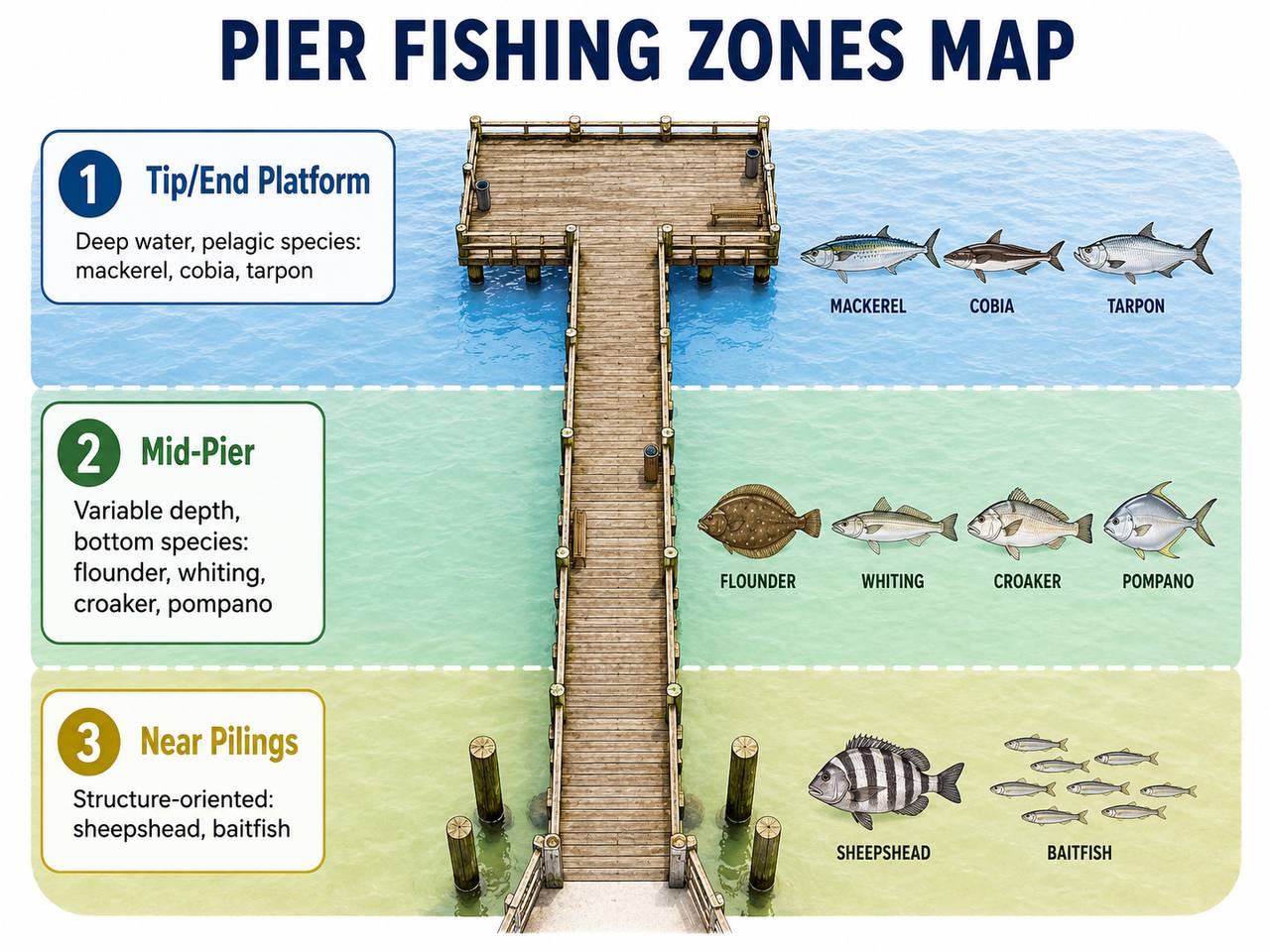
The tip (T-top or end platform) sits over the deepest water. This is where you target larger pelagic species — king mackerel, cobia, tarpon, and bluefish. The tip is also where experienced pier anglers tend to gather.
Mid-pier gives you variable depth and access to bottom-dwelling species. This is the best spot for flounder, whiting, croaker, and pompano. Mid-pier is also the least crowded section on most piers.
Near the pilings — the vertical supports under the pier — you’ll find structure-oriented fish like sheepshead. Barnacles and algae grow on the pilings, which attracts baitfish, and that in turn attracts larger fish. Cast close to the pilings rather than far out.
A good strategy: scout the pier at low tide. Low water reveals submerged troughs, sandbars, and rock piles you can’t see at high tide. Once you know where the underwater structure is, you can set up there when the tide comes in.
One tip that surprises most beginners: cast short, not far. The pier itself is a giant fish attractor. Many fish hold close to its shaded structure. You typically only need to cast 20 to 40 feet from the pier to reach active fish.
Learning to read the water is a skill that transfers to all types of fishing. Our guide on how to read water for fishing covers the basics of identifying fish-holding structure.
Jetty Fishing: What’s Different (and What’s More Dangerous)
Jetty fishing shares some similarities with pier fishing, but it’s a different experience — in technique, strategy, and safety.
Jetties are built from large rocks, not wood or concrete. They extend from the beach into the ocean at inlets, creating a path through the surf zone. The rocks themselves become habitat, sheltering crabs, shrimp, and small fish. Predator species — redfish, speckled trout, snook, black drum, striped bass — patrol the edges of the rocks looking for food.
Tides matter more on a jetty than on a pier. Incoming and outgoing tides often have different current strengths. On some jetties, the incoming tide creates a visible rip line off the tip where bait accumulates — but the opposite side of the same jetty may fish differently on outgoing tides. The key is to watch the water and adjust.
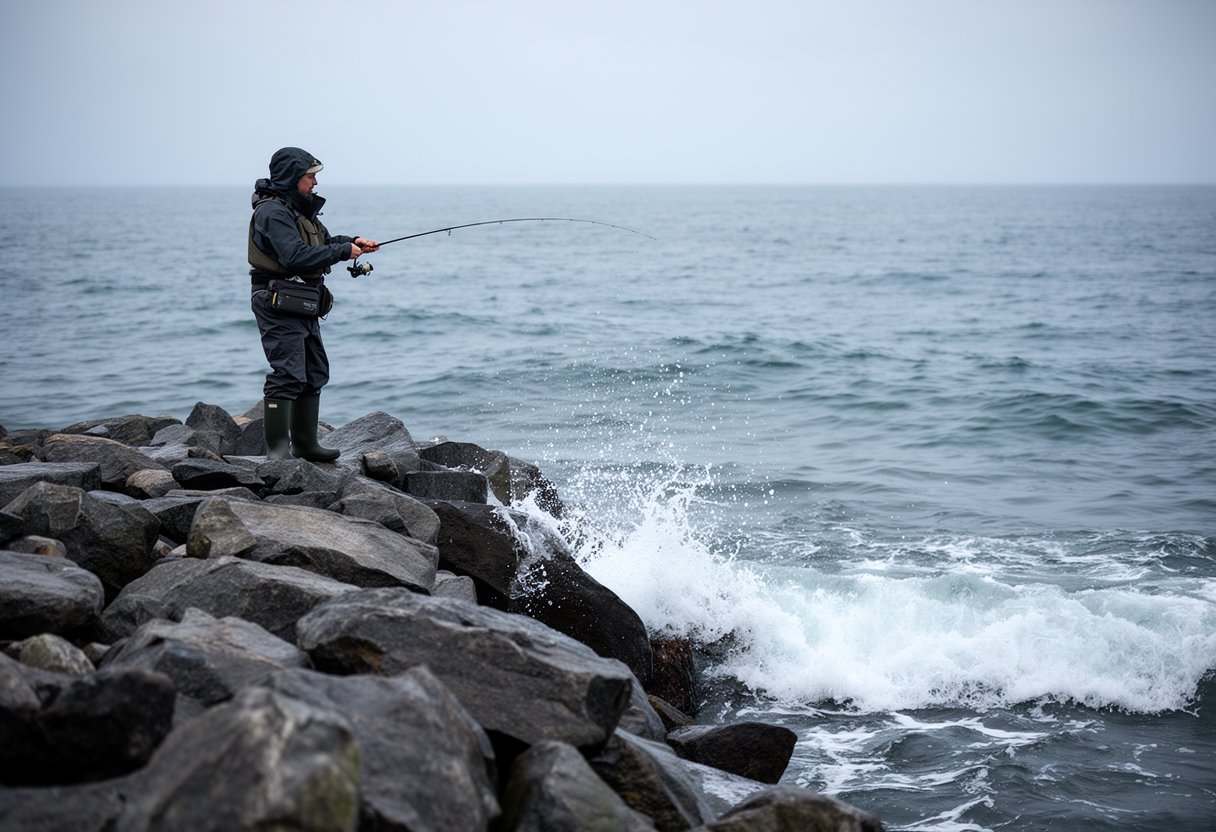
High tide or incoming tide is typically the best time. Dawn and dusk are peak activity windows. During slack tide (the period between incoming and outgoing), the action tends to slow down noticeably.
Safety is the biggest difference. Jetty rocks are slippery, especially when wet from spray or recent rain. Algae growth makes them even more treacherous. Always wear non-slip boots or cleats. Never fish from a jetty in rough weather — waves washing over the rocks can sweep you off your feet. And never jetty fish alone.
Use a heavier leader than you would on a pier — 30- to 40-pound fluorocarbon minimum. When you hook a fish on a jetty, it typically heads straight for the rocks to break you off. You need the abrasion resistance to muscle it clear. Effective lures include Kastmasters (1 ounce or heavier) and jigs tipped with soft plastics like Berkley Gulp.
If you’re fishing saltwater for the first time, our saltwater fishing from piers and jetties guide covers regional species and tide-specific tips.
What You Can Catch: Species by Structure
The fish you catch depends on where you’re fishing — pier or jetty — and where on that structure you set up.
From a pier, saltwater anglers can target:
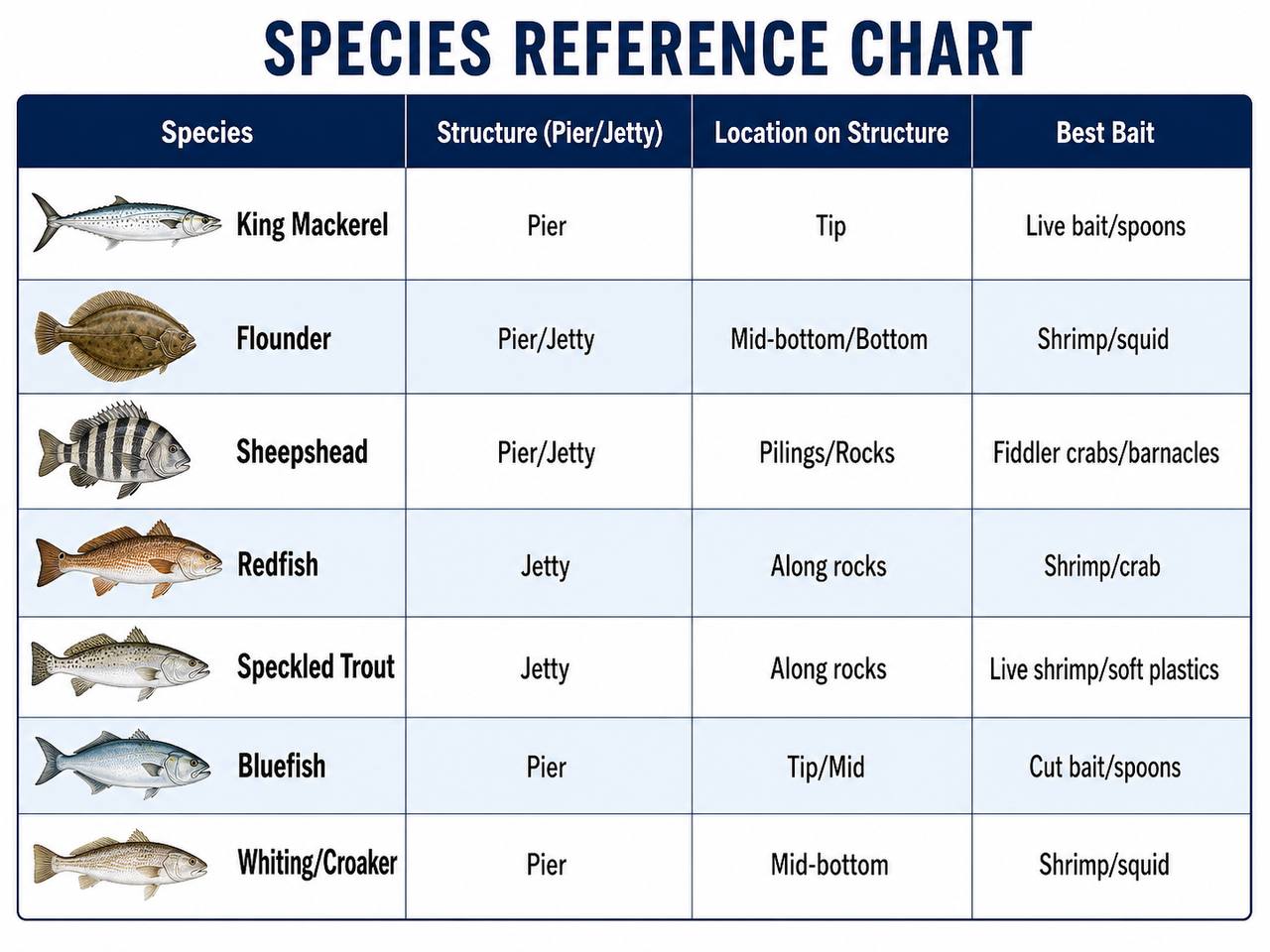
- At the tip: king mackerel, cobia, tarpon, bluefish, Spanish mackerel
- Mid-pier and bottom: flounder, whiting, croaker, pompano
- Near pilings: sheepshead, black drum
- Late summer evenings: bonito, false albacore
From a jetty, common catches include:
- Redfish (red drum)
- Speckled trout (spotted seatrout)
- Snook (in warmer regions)
- Black drum
- Sheepshead
- Flounder
- Striped bass (in northern and transitional inlets)
Freshwater piers on large inland lakes are a different game. You’ll find catfish, carp, sunfish, crappie, perch, and sometimes walleye or northern pike depending on the region.
Top baits across all environments: fresh shrimp (the universal bait), squid strips, cut bait (mullet, menhaden), and live bait like mud minnows or finger mullet. For artificials, 1-ounce metal spoons and jigs are reliable choices.
Pier and Jetty Regulations and Etiquette
Before you pack your gear, know the rules.
License requirements: Many public piers are exempt from fishing licenses, but this varies by state. Some states require a license even on public piers. Always check your local fish and wildlife agency’s website before your first trip.
Size and bag limits apply to everything you catch, whether you’re fishing from a pier, jetty, or boat. Carry a small ruler or fish identification card to measure your catch. Fines for taking undersized or over-limit fish can be steep.
Hook and gear restrictions: Some piers limit the number of hooks you can use. Others ban treble hooks when fishing with bait (single hooks only). These rules exist to protect fish populations and reduce snagging.
Angler etiquette matters on crowded piers. Don’t set up directly next to someone who’s actively fishing. Give people space. If someone is hooked up and fighting a fish, reel in your line to stay out of their way. Ask before moving through someone’s casting area.
For jetty fishing specifically: Check tide schedules before you go. Know when high tide is and when the sun sets. Don’t walk to the end of a jetty if waves are breaking over it. And always tell someone where you’re going and when you expect to be back.
Your First Trip: A Simple Action Plan
Ready to try it? Here’s your plan:
Pier and jetty fishing is the best way to build fundamental fishing skills without the expense and complexity of a boat. The more you fish from structure, the better you’ll understand fish behavior, current, and depth — skills that carry over to every other type of fishing.