
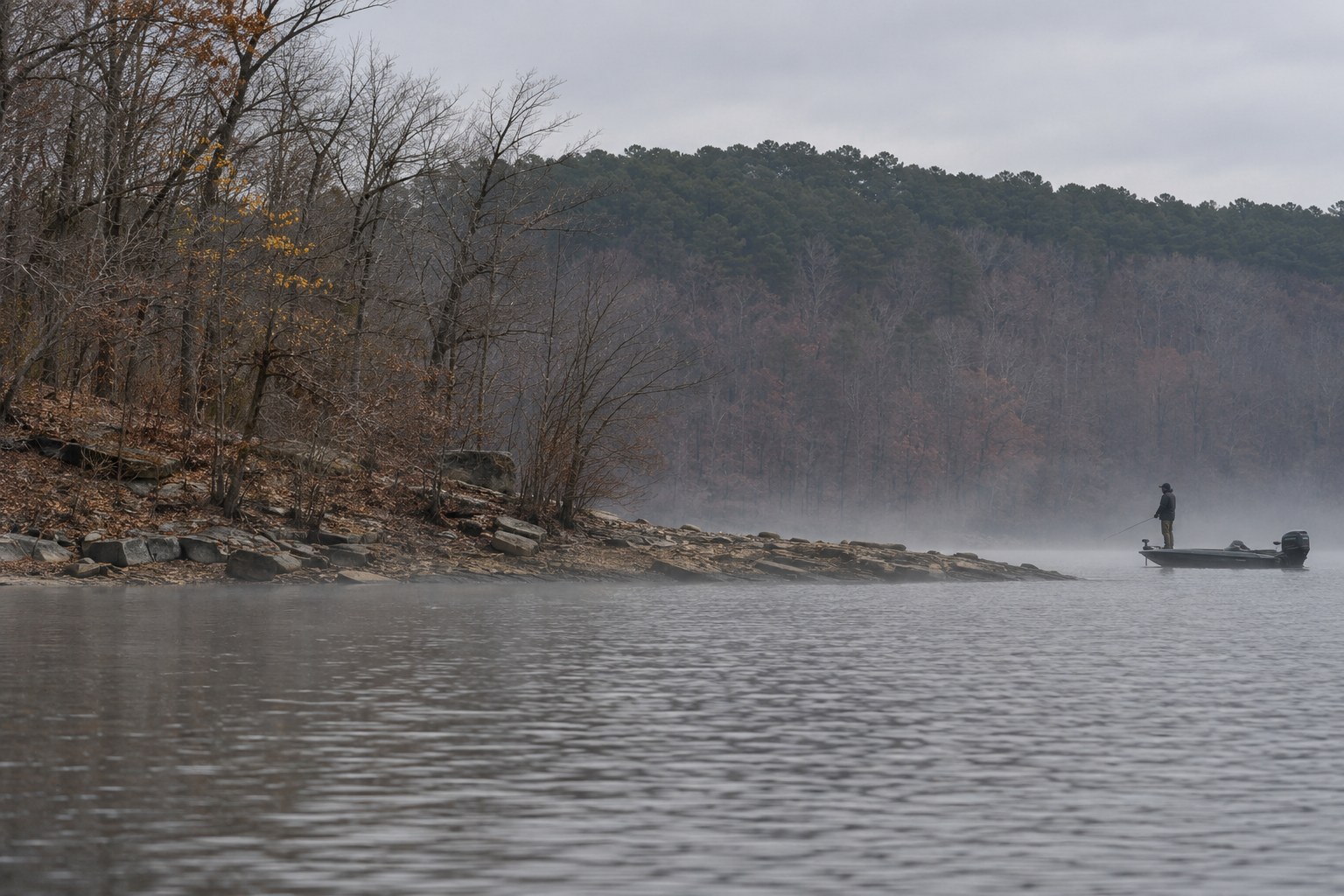
You had a good October. The bass were stacked in the back of a creek arm, the shad were flicking on the surface every morning, and a squarebill or a swim jig got bit on almost every point. Then November arrived, the water cooled a few degrees, and the whole thing shut off. Same creek, same baits, same casts — almost nothing.
The fish did not vanish. The bait did.
The Bite That Quits in November
Most bass anglers learn one half of the fall shad migration and never learn the other half. The half everyone knows is the good half: as nights lengthen and water cools, huge schools of shad push from the open lake into the creeks and coves, and the bass follow them in. That is the October pattern, and it is as close to automatic as bass fishing gets.
The half most people miss is that the migration reverses. Once the water slides out of the low 60s and into the upper 50s, the big shad schools start filtering back out of the creeks toward the main lake, and a lot of the bass go with them.
Bassmaster pro Russ Lane described exactly this. Through most of the fall, he said, the backs of creeks are loaded with baitfish and smaller bass busting through the forage. But as daylight shortens and the water temperature drops into the lower 60s and upper 50s, the large schools of shad leave — and the smaller bass follow the forage out toward the main lake.
That single sentence explains a lot of disappointing November trips.
The question stops being “where were they last month” and becomes “where is the bait right now.” Everything in this article hangs off that.
Why the Shad Leave — and Where They Go
The shad are not following a calendar. They are following food.
Threadfin and gizzard shad are filter feeders, eating mostly phytoplankton and zooplankton. They roam in enormous schools searching for plankton-rich water. Through summer, the main lake holds plenty of that food, so most shad live offshore in open water.
As fall arrives, two things change. Nutrients in the main lake get used up, and cooling water slows the plankton growth out there. Shallow coves and creek arms, though, still warm fast on sunny days, and warm shallow water keeps producing plankton later into the season. So the shad move in. That migration is what makes October so good.
Then the creeks cool down too. The shallow water that held the bloom loses its edge, the plankton thins out, and the food advantage shifts back toward the main lake — or at least toward deeper water where the bait can winter safely. Slowly, school by school, the shad drift out.
The important word there is slowly. This is not a single night when every shad in the lake relocates. It is a weeks-long bleed. The backs of the creeks empty first. Bait collects in the middle sections, then around the mouths, then along the first drops and channel swings outside. Every week the center of gravity of the bait moves farther out and deeper.
Bass do not travel with the bait in a neat convoy. Bass have home ranges. Most fish will not follow a school for miles. What actually happens is that the fish living in each zone get more or less active as the bait passes through, and a few fish shift short distances to sit on the ambush points that the migrating schools have to cross.
This is why the fishing feels so inconsistent in the transition. You are no longer fishing a concentrated population. You are fishing a moving one.
The Three-Stage Map
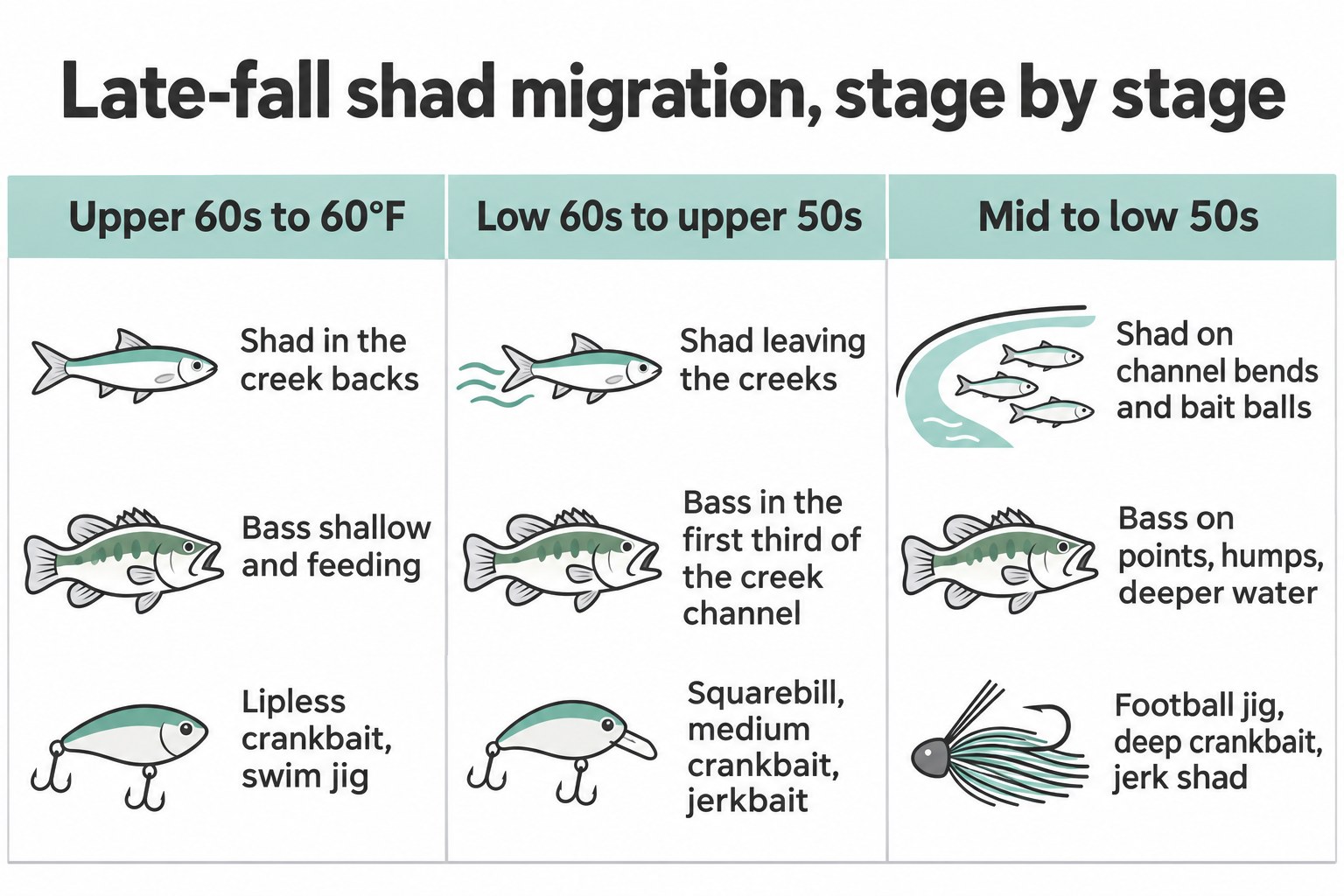
Water temperature is the least bad clock available. It does not tell you everything — latitude, lake type, and which shad species you have all shift the timing by weeks — but it gives you a starting point.
Stage 1: Upper 60s down to about 60°F — the creek bite
The shad are in the backs of the creeks and coves. Bass are shallow, feeding hard, and often willing to chase. Morning is usually the best window. This is the phase most anglers are thinking about when they say “fall fishing.”
Scott Loxley of Bassmaster puts the start of the creek migration at the point where water drops below 60 degrees, which for a lot of the mid-South and mid-Atlantic means late October or early November. Baitfish seem to prefer open-mouth creeks with big shallow flats toward the backs.
Stage 2: Low 60s into the upper 50s — the transition nobody likes
This is the stretch that ruins trips, and it is exactly where many readers are right now.
The shad have started leaving, but they have not finished. Bassmaster pro Beau Browning described it as a short period when fishing gets genuinely tough — a lot of shad trying to transition and a lot of bass trying to transition with them, but the major move has not happened yet.
Where do you find fish in that gap? Browning looks in the first third of the creek channel and shallower on main-lake points, fishing roughly 2 to 8 feet instead of the summer range of 8 to 18.
In other words: not the backs, not the deep main lake. The middle.
Stage 3: Mid to low 50s — channel bends and main-lake structure
Now the move is on. Quality bass follow the creek channel out toward deeper bends, and eventually toward winter sanctuaries on or near the main lake. Russ Lane’s version of this: the big-fish pattern in the creek backs holds until the water hits the mid to lower 50s, and then the better fish slide out along the channel.
Mark Davis, describing falling-water reservoirs, says bass start suspending over points, humps, creek channels, and creek channel swings once the water begins to drop in early fall. Later in the drawdown, he says, bass suspend on points and vertical structure on the main lake.
Below 50°F — winter
The bait is deep and often suspended. Bassmaster pro Beau Browning says that as fall turns to winter, shad migrate out of the creeks and into the deepest guts within the creeks. On a deep highland reservoir that can mean 60 feet. On a shallower reservoir, 20 feet may be as deep as the lake gets, so that is where the fish sit.
One honest caveat before you build a trip around this: not every bass migrates. Large gizzard shad, the ones big bass prefer, are often bottom feeders that graze on the film coating the lake bottom, timber, and rock. They do not need to move to find plankton, and some bass stay offshore in deep water all year eating them. If your summer spots are holding bait, they may still be holding bass.
How to Find Them Without Spending the Whole Day on Sonar
If you have side imaging, a forward-facing sonar unit, or even a basic 2D graph, this pattern gets dramatically easier — you idle a creek arm, look for bait, and fish what you find. Most people do not have all of that, and you do not need it to catch fish. You need to read surface signs and work a creek in the right order.
Watch the birds
This is the highest-value free tool in late fall.
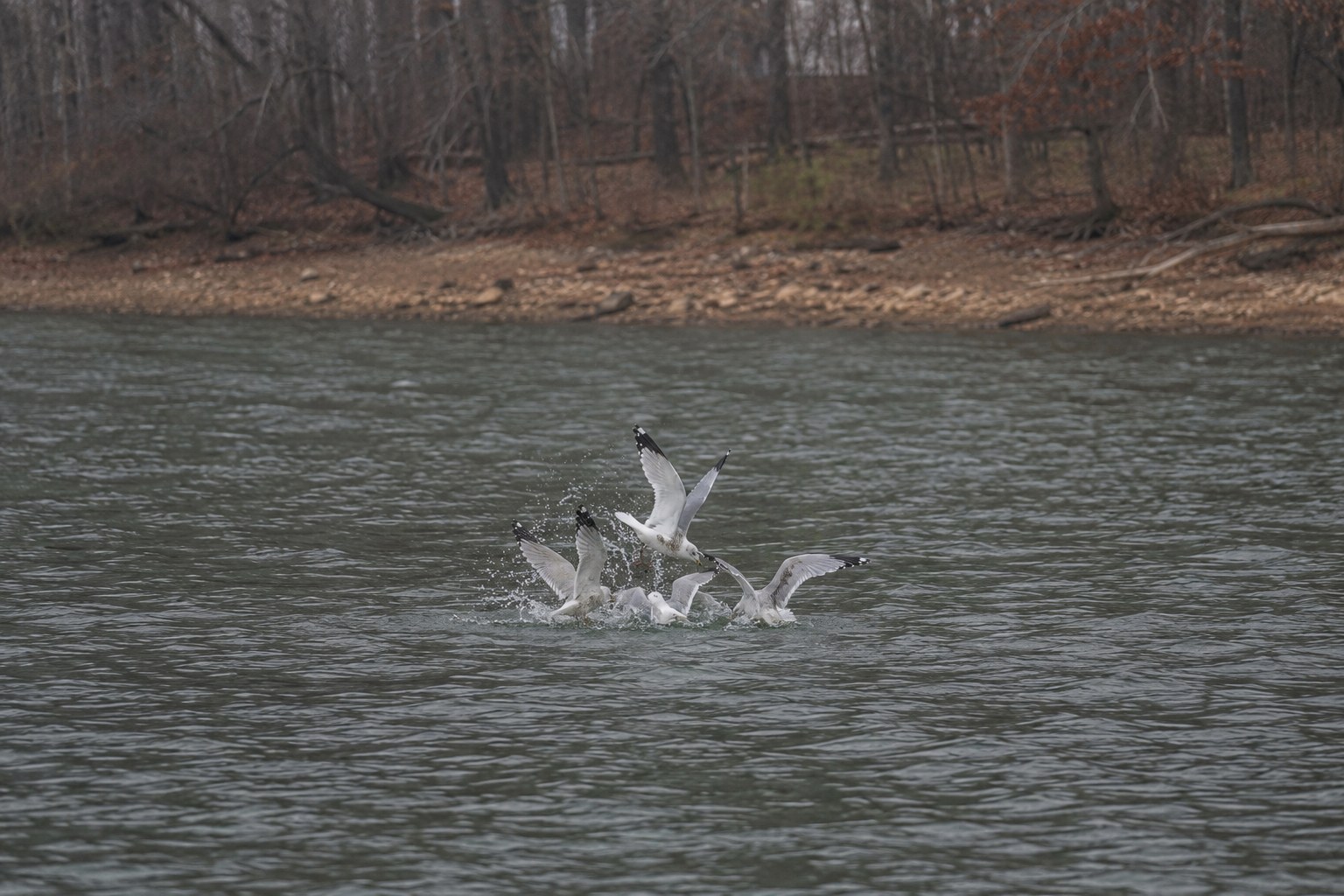
Gulls spread out and circling tell you almost nothing. Gulls doing what Loxley calls “popcorning” — diving straight down and feeding hard in one confined area — tell you bait is pinned there. If the birds do not leave when you pull up, the bait is still there and so are the bass.
Carry polarized sunglasses and, if you have them, binoculars. You can check the back of a creek from a distance without running in, which saves time and fuel on a day when you may need to look at several arms.
Look for flicker and nervous water
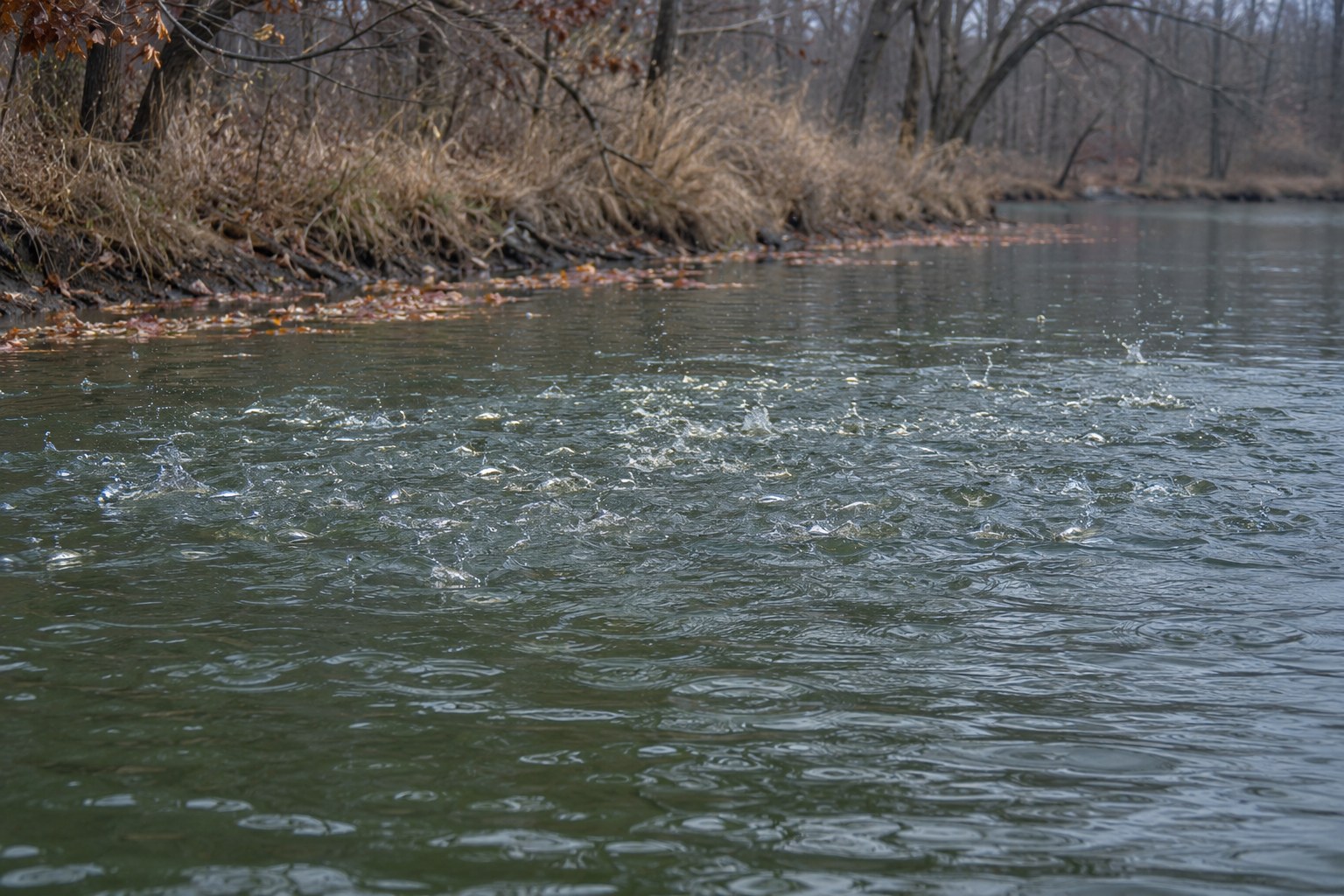
Keith Poche of Major League Fishing looks for shad “flickering” on the surface in the backs of creeks — small dimples, quick silver flashes, water that looks restless in a patch instead of evenly rippled. On calm mornings that flicker is the easiest thing on the lake to spot from a distance.
Poche also says the trigger is obvious in the weather: a couple of nights in the 50s or 60s, leaves changing color, and fog on the water in the morning. If you see fog, the shad are usually moving.
Pick narrow arms and pinch points
Bass are ambushers. Poche’s observation is that they push shad into tight spaces — pinch points, narrow creek arms — places where the bait cannot easily escape. That is one reason a small, narrow feeder creek can outfish a broad, featureless cove in November.
Walk the bends from deep to shallow
If you are working a creek channel, start on the deeper bends and work progressively shallower until you find the depth holding fish. If you are in a big cove, start on the deeper points and move progressively shallower as you go toward the back.
That approach is fast, it covers water, and it stops you from fishing an entire arm at one depth just because that is what worked last week.
Mark the school and come back to it
When you find bait and a bite, drop a marker or save a waypoint and fish it properly. Bait schools move, but they often mill around the same structural feature for days. A marked school is worth more than a new spot.
What to Throw When the Bait Is Leaving
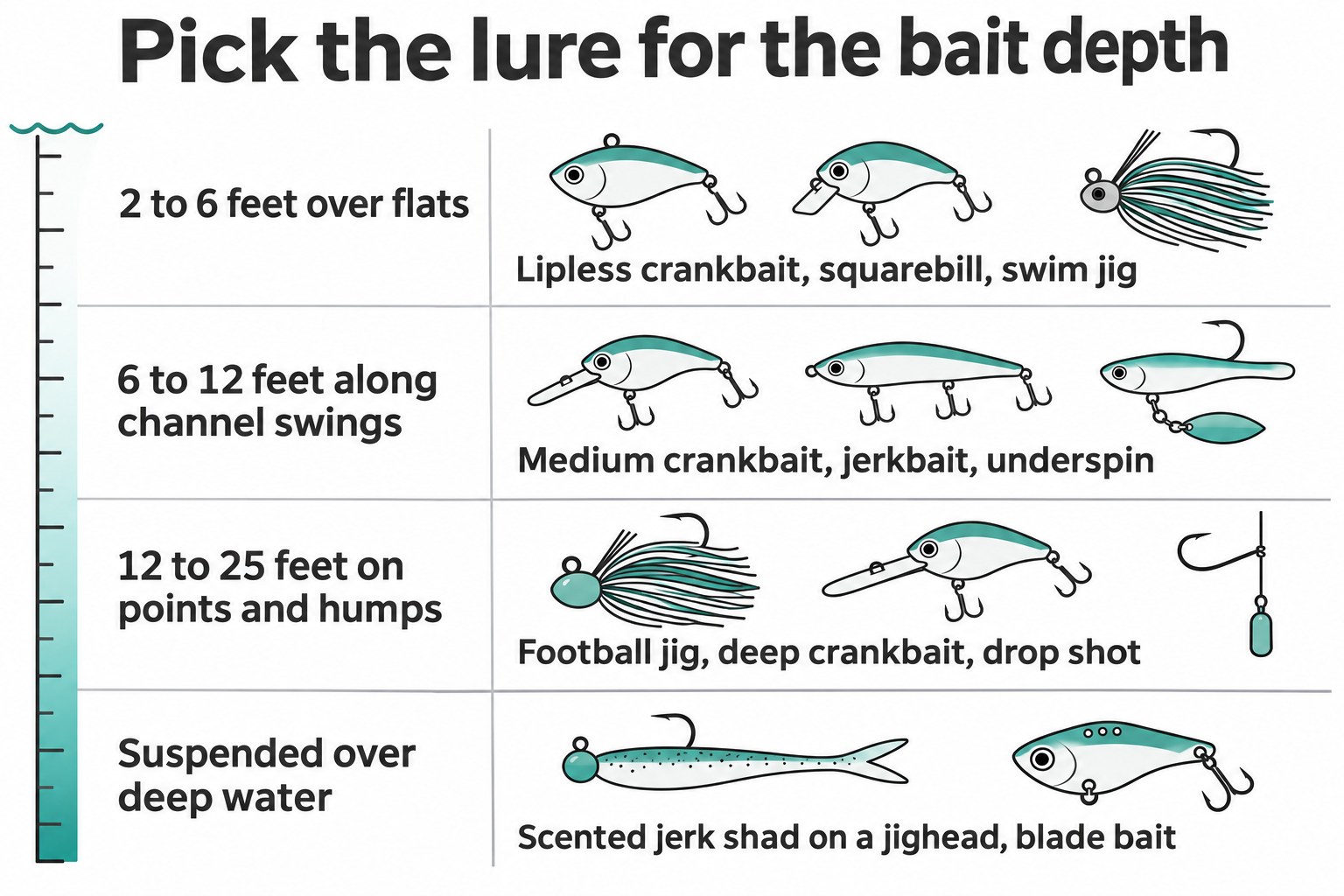
The mistake here is choosing a lure by the calendar instead of by the depth of the bait. Ask where the forage is holding, then pick the presentation that reaches it.
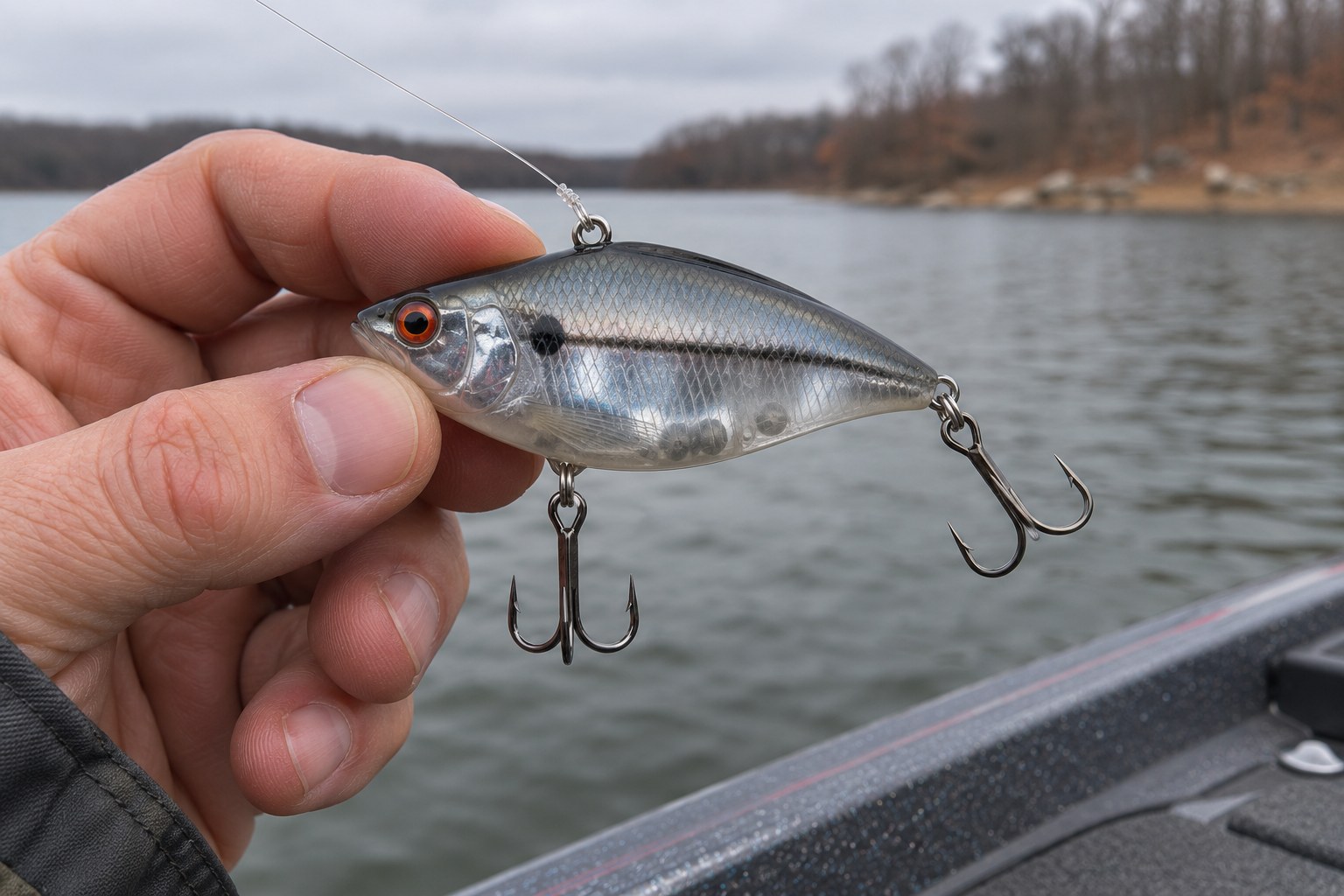
Two to six feet over hard-bottom flats: lipless crankbait, squarebill, swim jig
Russ Lane targets the backs of creeks with hard-bottom flats in 2 to 4 feet of water, adjacent to creek channels 4 to 6 feet deep. His picks are a half-ounce lipless crankbait in shad colors and a 3/8- to 1/2-ounce swim jig with a small creature trailer.
His retrieve detail is worth stealing: he casts to a specific piece of cover, and the strike is what the cover triggers. After the bait hits, he either kills it so it falls straight down or hops it away hard. He is not just casting and winding.
Mark Davis makes a related point about falling water. When a reservoir draws down in fall, the shad often get up on the mud flats in the creeks, and there is not much better than a lipless crankbait for bass feeding on them — a quarter-ounce near the bank, a half-ounce farther out.
Six to twelve feet along channel swings and creek mouths: medium crankbait, jerkbait, underspin
This is the transition zone, and it is where the Stage 2 fish live. A medium-diving crankbait worked along the edge of the old channel is the cleanest way to find the depth where the bait is stacked. If you are not sure how deep your crankbait is running, our crankbait depth control guide covers the counting method and how bottom contact tells you where you are.
A jerkbait shines when fish are suspended and neutral. Cold water slows the cadence down, and the suspending jerkbait cadence for cold water is the right reference for the pause length.
Twelve to twenty-five feet on points, humps, and channel bends: football jig, deep crankbait, drop shot
Once the fish are on main-lake structure, bottom contact matters more than flash. A football jig dragged across rock and gravel is the classic tool for this, and fishing a football jig on rock structure covers the drag-and-crawl retrieve that keeps it in contact.
Suspended over deep water: scented jerk shad on a jighead, blade bait, jigging spoon
When you see bait on the graph at 20 feet over 40 feet of water, horizontal presentations stop working. Beau Browning goes straight to a scented jerk shad on a quarter- or three-eighth-ounce jighead for this exact situation — a soft plastic you can count down and work in the strike zone instead of dragging across the bottom.
Match the shad you actually have
Threadfin shad top out around four to six inches, school tight and high in the water column, and tolerate cold poorly. Gizzard shad grow much larger — six to fourteen inches — and hold deeper. Big bass prefer big gizzards.
That distinction drives lure size. In a threadfin lake, a three-inch swimbait or a small jerkbait matches the menu. In a gizzard lake, going bigger is not a gimmick — it is matching what the biggest fish are eating.
Color is simpler than the tackle aisle suggests. Chrome, bone, white, and natural shad patterns work because that is literally what the bass are eating. Nothing exotic required.
Time of Day Changes in Late Fall
Early fall is a dawn bite. Late fall is not.
Russ Lane’s late-fall pattern peaks in the last three to four hours of daylight, once the sun starts down. The reason is straightforward: shallow flats absorb warmth all afternoon and hold it longer than adjacent deeper water, so bait slides up onto them late and bass follow.
If you only have a morning, fish it — but expect the better window to be late, especially on bluebird days after a cold night.
Cold fronts complicate it further. After a hard front, shallow flats lose their warmth fast and fish pull tight to whatever cover is left. Slow down, fish fewer spots more thoroughly, and stop expecting wolf packs chasing bait across open water.
Falling water is the other wrinkle. On reservoirs that draw down in fall, dropping water pushes shad onto shallow mud flats and can actually pull bass back shallow even as the lake level falls. Bassmaster pro Mark Davis calls it a bite that “all revolves around the shad activity.” If your lake is dropping and you are seeing bait up shallow, fish it shallow — the textbook says deep, the fish say otherwise.
When You’re Marking Bait and Catching Nothing
This is the most common November complaint, and there are four usual causes.
Too much bait. When bass are surrounded by thousands of shad, they do not have to chase anything. You are competing with an unlimited buffet. Downsize your profile, slow the presentation, or fish a lure that looks like an easy, injured meal instead of a healthy one.
Bait suspended and bass neutral. If the graph shows a bait ball with fish underneath but nothing is eating, go vertical. A jigging spoon, blade bait, or counted-down soft plastic puts the lure in the strike zone without dragging through it.
The bass switched forage. Not every bass in the lake is eating shad in November. Bream and crawfish become important as shad thin out, especially for bigger fish. If the shad pattern is dead in a creek that clearly holds bass, try a craw-colored jig or a creature bait on hard cover.
The depth moved. The fish you found last week at 10 feet are not obligated to be at 10 feet this week. Re-run the deep-to-shallow progression every trip instead of starting where you left off.
The One-Page Plan for Your Next Trip
Here is the whole pattern compressed into a sequence you can actually run on the water.
- Check water temperature first. Upper 60s to 60°F means fish the creek backs. Low 60s to upper 50s means fish the first third of the creek channel and the shallow main-lake points. Mid to low 50s means channel bends, creek mouths, and main-lake structure.
- Pick a narrow arm or a pinch point over a broad cove. Bass trap bait in tight spaces.
- Look before you fish. Scan for popcorning gulls, surface flicker, and nervous water. Binoculars save running time.
- Start on the deeper bend and work shallower until you find the depth holding fish. Do not start at last week’s depth.
- Match the lure to the bait depth — lipless and squarebill shallow, medium crank and jerkbait mid, football jig and deep crank on structure, counted-down soft plastics for suspended fish.
- Fish the last three hours of light if you can only pick one window.
- Mark what you find and come back to it before the day ends.
The mindset shift is the real point. In October, you could win by remembering where the shad were. In November, you win by tracking where they are going.
Bass are still eating. They are eating the same silver fish they ate last month — those fish are just in a different part of the lake now. Follow the bait, and the bass pattern usually follows along behind it.