
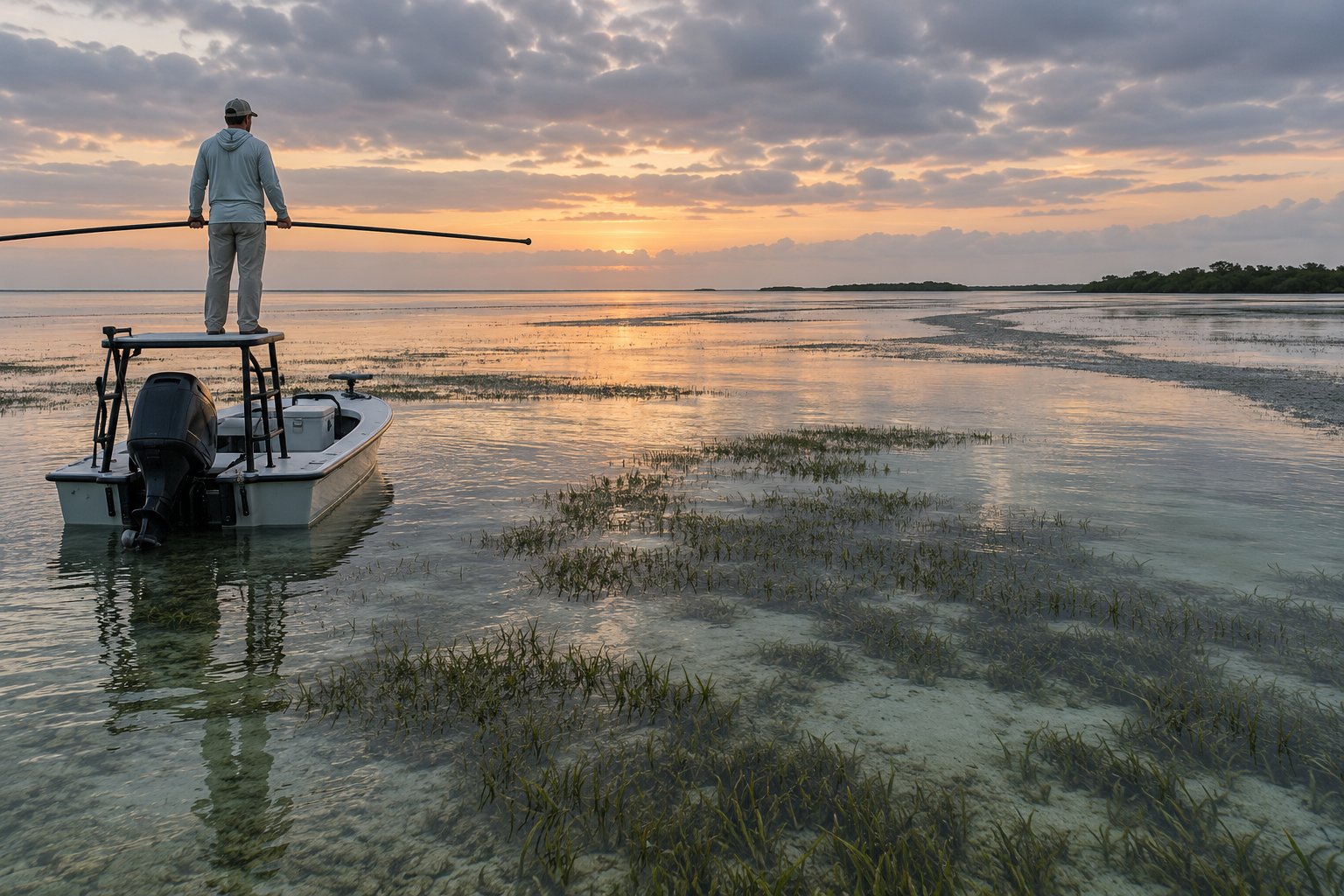
You found the flat. You got there at the right tide, and you can see the grass edge and the sand potholes exactly where the chart said they’d be. Then you pole in, and the flat goes quiet. The tails that were working the shoreline stop. The pushes disappear. For the next hour you’re staring at the same empty edge, casting at water that might as well be a swimming pool.
That’s not a lure problem. It’s an approach problem.
Redfish in shallow water are wired to notice things. They can see a hull, feel a pressure wave, hear a push pole tap shell, and read the shadow of a standing angler. When one fish gets uneasy, the whole school gets uneasy with it. Most flats anglers lose their fish before the first cast ever leaves the rod tip.
This guide is about closing that gap. Not tackle selection, not “what lure for redfish” — the mechanics of getting onto a flat quietly, positioning the boat so a cast actually makes sense, reading what the fish are telling you, and making one presentation that counts instead of five that don’t.
Why Flats Fish Spook Before You Ever Cast
A redfish in two feet of clear water has three ways to detect you: it can see you, it can hear you, and it can feel you.
Sight is the one anglers think about. A boat hull, a standing silhouette, a rod waving, a shadow crossing the bottom — all visible from a long way off in clear water with a bright sky. Sound is the one most anglers underestimate: a push pole crunching on shell, a cooler lid, a trolling motor pedal, a tackle box dropped on the deck. Sound carries differently underwater, and it usually travels farther than most anglers expect. Then there’s pressure — the wave a hull pushes ahead of itself. Even at idle, a skiff moving too fast sends out a bow wave that a redfish reads as something large and wrong.
The practical version of all this is what guides call the cushion: the distance a fish will tolerate between itself and your boat while still being catchable. That distance shrinks in clear water, in calm air, in bright sun, and on flats that get fished hard. It grows in stained water, in a chop, and on fish that haven’t been bothered.
You won’t measure the cushion. You’ll feel it after enough blown casts. What matters now is the concept: your job is to stay at the edge of it, not inside it. The angler who keeps maximum usable distance usually gets multiple shots out of the same school. The angler who crowds them gets one.
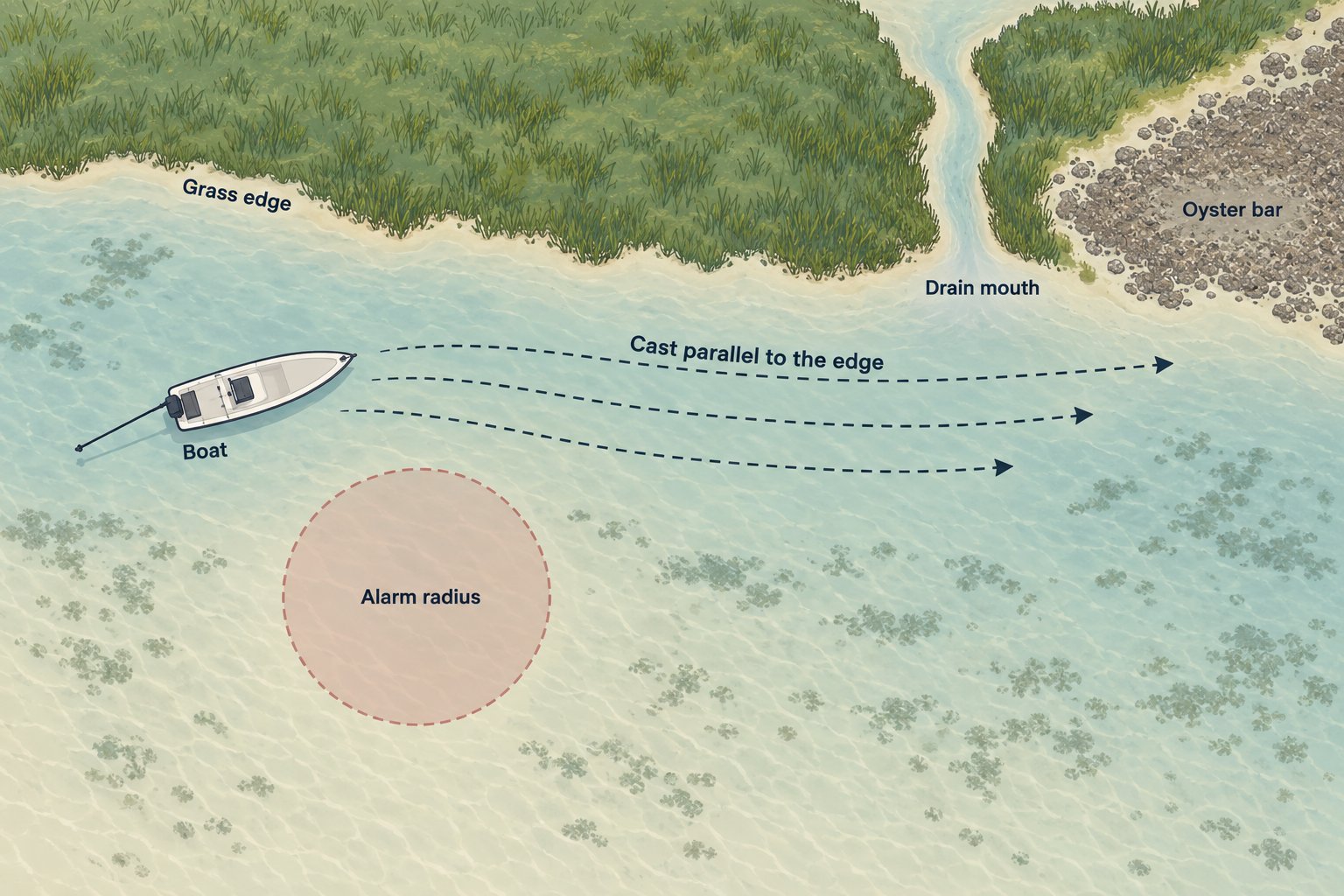
There’s also the alarm radius — the circle around a fish where your lure landing is itself a spook. Drop a bait inside that circle on a skinny-water red and the fish doesn’t just refuse it. It leaves, and it takes the school with it.
Put those two ideas together and the day reorganizes itself. The cast is the smallest part of flats fishing. The read, the approach, and the position are the work.
Read the Flat Before You Commit
The biggest mistake happens before the boat ever gets shallow: running straight onto the flat and looking around once you’re there. By then you’ve already announced yourself.
Stop outside the flat and read it from a distance. Stand up. Put on polarized glasses. Take your time.
Look for transitions rather than uniform water. Grass meeting sand. Shell meeting mud. A drain cutting through a bar. Redfish tend to hold on edges because edges concentrate food — crabs, shrimp, small bait — and give the fish something to ambush against. A flat that looks the same everywhere holds fewer fish than a short stretch where three bottom types come together.
The highest-percentage edges also move water. Drains, points, cuts, and pass mouths concentrate food and deliver it. That combination — structure plus current — is where you want to spend your morning.
Then match the tide stage to where the fish should be. This is where a little chart reading pays for itself, and if the stages still blur together, start with how to read a tide chart. In general terms:
- High water pushes fish into flooded grass and backwater ponds to eat crabs and shrimp. They spread out, and the shots are close and quick.
- Falling water pulls bait off the flats and funnels it through drains and pinch points. This is usually the most patternable part of the day.
- Dead low drops fish back into creeks and channel edges, where they’re warier and the casting angles are tighter.
- Incoming water has fish staging at the first access points — creek mouths, the base of grass lines, small cuts that just became passable again.
Once you know the stage, decide your drift line before the pole goes in the water. Which direction will the wind push you? Where will the sun be? Where do you want the boat to end up relative to the edge?
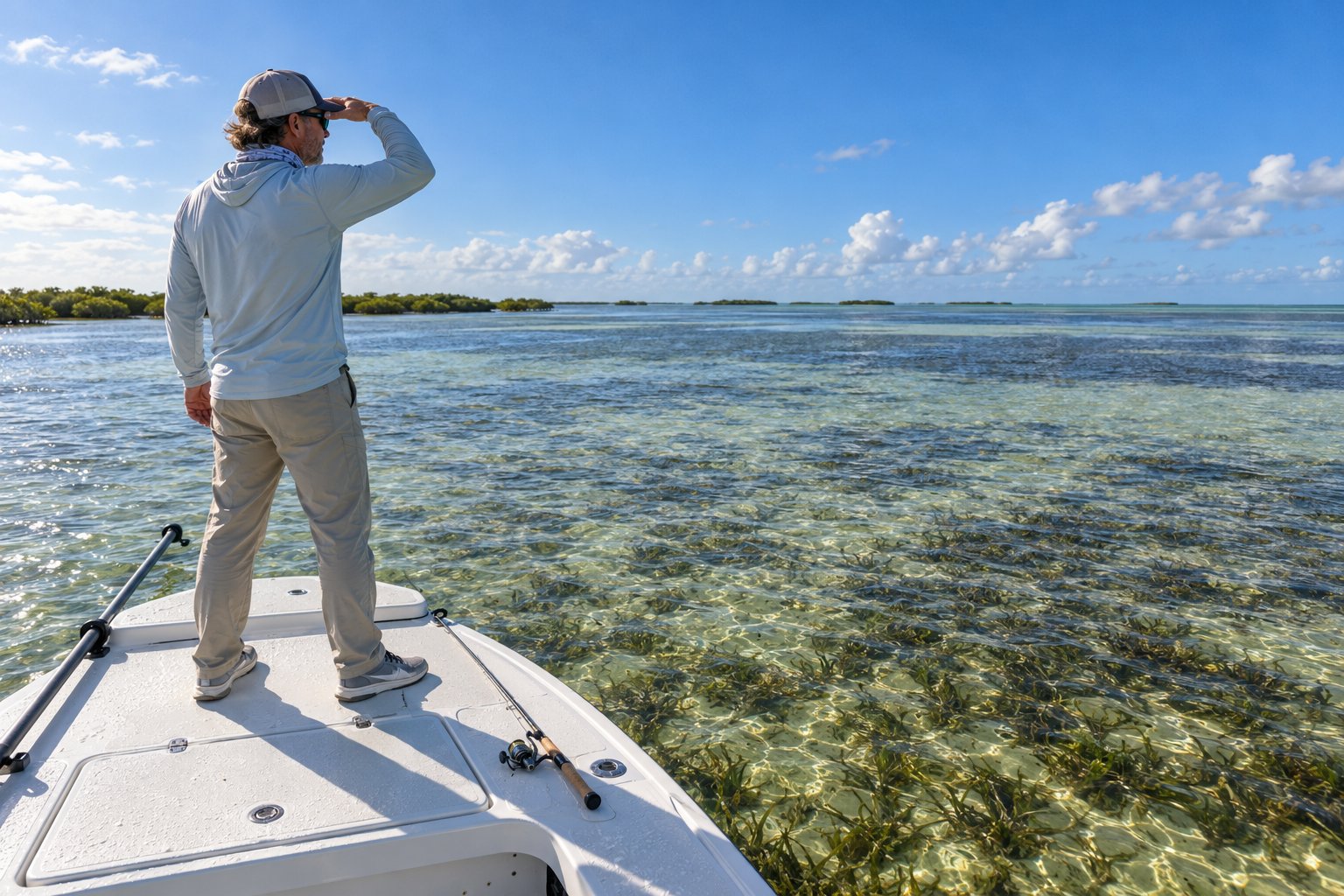
Two rules govern the plan. Keep the sun at your back or over your shoulder so you can see into the water and your shadow falls behind you instead of across the flat ahead. And use the wind as a slow engine — set up so it carries you along the edge, not across the middle of the flat.
Enter Quiet: Poling, Trolling Motor, Wading, and Kayak
Speed is the number one spooking mistake in flats fishing, and it doesn’t require a trolling motor to make it.
A poling skiff gives a lot of anglers a false sense of stealth. You can blow out plenty of fish with a push pole. Poling too fast is functionally the same as running a trolling motor on its highest setting — both send a warning wave ahead of the boat. The fix is simple and boring: pole slowly enough that the water ahead of you stays flat.
Pole discipline matters too. Place the pole rather than shove it. Lift it clear instead of dragging it along the gunwale. And watch the bottom — a pole tip hitting shell makes a crunch that travels. On hard bottom, use shorter, more frequent strokes so you’re never driving the pole into something loud.
If you’re on the electric motor, keep it at a constant low speed. Surge-and-stop is worse than steady. Every time you accelerate, you push a pressure pulse across the flat, and every time you stop, the boat coasts and rocks. Constant, slow, and deliberate is the whole discipline.
Stake-out or anchor deployment is its own skill. You want the hook in the water with as little splash and chain noise as possible, and you want the boat positioned so you’re casting down-current along the edge rather than dragging a lure into the flow. Set up on the up-current side of a drain mouth and let fish come to you.
Wading is the quietest approach there is, with one condition: it depends on the bottom. On hard sand and firm grass, a slow crouching stalk gets you close. On soft mud, no one wades quietly enough — you’ll be pushing silt waves with every step. That’s kayak or poling skiff water.
Kayaks split the difference. They’re quiet on soft bottom, they sit low, and they let you slip into water a skiff can’t reach. The tradeoff is range and how much you can carry.
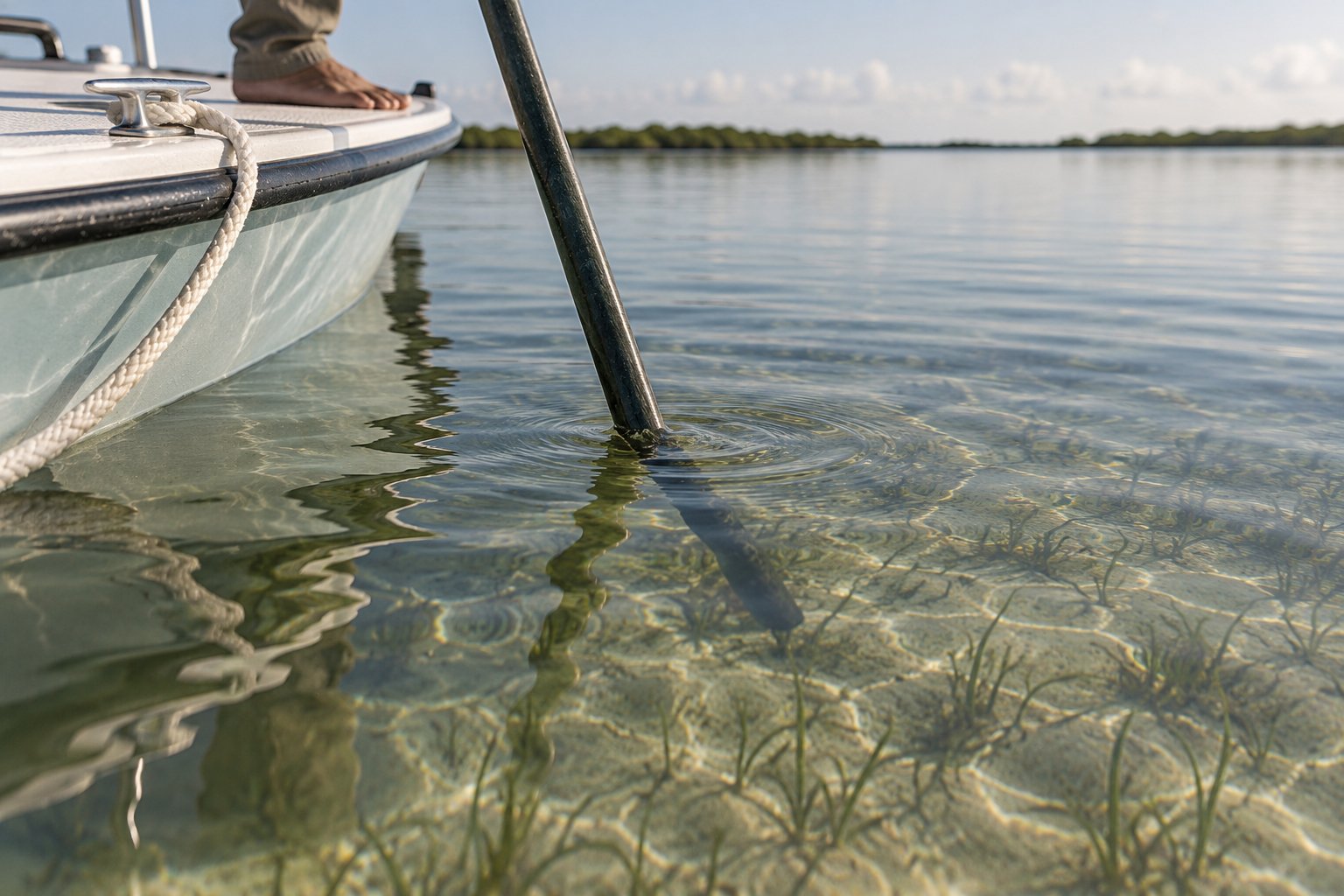
One more thing about noise: the sounds you stop hearing are the ones that matter. A cooler lid, the click of a reel’s anti-reverse, a foot shifting on a deck, a rod butt tapping the gunwale. Fish on a pressured flat tend to hear all of it. Cut the noise you control and you buy yourself distance.
Position for the Cast, Don’t Chase the Fish
There’s a reason guides stake out and wait instead of poling continuously. Position beats pursuit.
When you find a high-percentage edge — a grass line with a drain cutting through it, an oyster bar with current running along it — the move is to set up within casting range of the *path* the fish will travel, then stop moving. Let the fish come to you. A stationary boat in the right place gets more shots than a moving boat covering ground.
Cast angles matter more than most anglers realize. Instead of casting at a grass edge or oyster bar at ninety degrees, position so you can cast parallel to it and, where current allows, up-current. Working a lure along the contour keeps it in the zone where fish are sitting, for longer, instead of crossing that narrow lane in a straight line and ending up on bare sand.
That single habit — parallel and up-current rather than straight across — changes how many fish see your lure.
Drift discipline follows the same logic. If the wind is moving you, plan the drift so it runs *along* the edge rather than over the flat. Drifting across a flat means your hull passes directly over fish you were trying to catch. Drifting along the edge means your boat stays outside the cushion while your lure covers the productive water.
When a fish is moving and your angle is wrong, reposition with the pole rather than firing a hope cast at long range. Twenty seconds of quiet repositioning beats a fifty-foot cast that lands at the wrong angle and spooks the fish anyway.
And hold the cushion. On a flat that gets fished regularly, redfish have seen a lot of lures and a lot of boats. Pressured fish don’t need much of an excuse.
Read the Fish: Tails, Pushes, Wakes, Muds, Nervous Water
Finding fish on a flat is a reading problem before it’s ever a casting problem. Learn five signs and you’ll start seeing fish you used to pole right past.
Tailing. A redfish feeding nose-down in shallow grass or on shell pushes its tail above the surface. The tail waves, tips, and disappears. A tailing fish is usually stationary, focused on the bottom, and not paying attention to you. It’s the most catchable fish on the flat — and it’s the one anglers rush.
Pushes. A cruising redfish pushes a small V-shaped wake. On calm water you’ll spot it at a surprising distance, and it tells you two things at once: where the fish is and which way it’s going. That’s the whole basis of a lead cast.
Nervous water. A patch of surface that seems to shiver or breathe when the wind isn’t doing it usually means a school moving just underneath. Cast to the leading edge of the disturbance, not the middle.
Muds. A rooting fish stirs sediment, and a cloud of off-color water drifting through clean water is a fish that just left. The direction the mud drifts tells you where it went.
Copper flashes. In low sun, a redfish rolling or turning shows a flash of bronze along a grass edge. It’s brief and easy to miss, which is why you scan rather than stare.
There’s a second layer, and it’s the birds. Herons and egrets working a shoreline slowly and deliberately are responding to bait moving under them. Pelicans and gulls diving tight to a bar or a bend usually mean bait is being pushed up from below. Bait spraying at the surface deserves immediate attention — redfish pinning bait against a bank produce some of the most violent shallow-water feeding you’ll ever see.
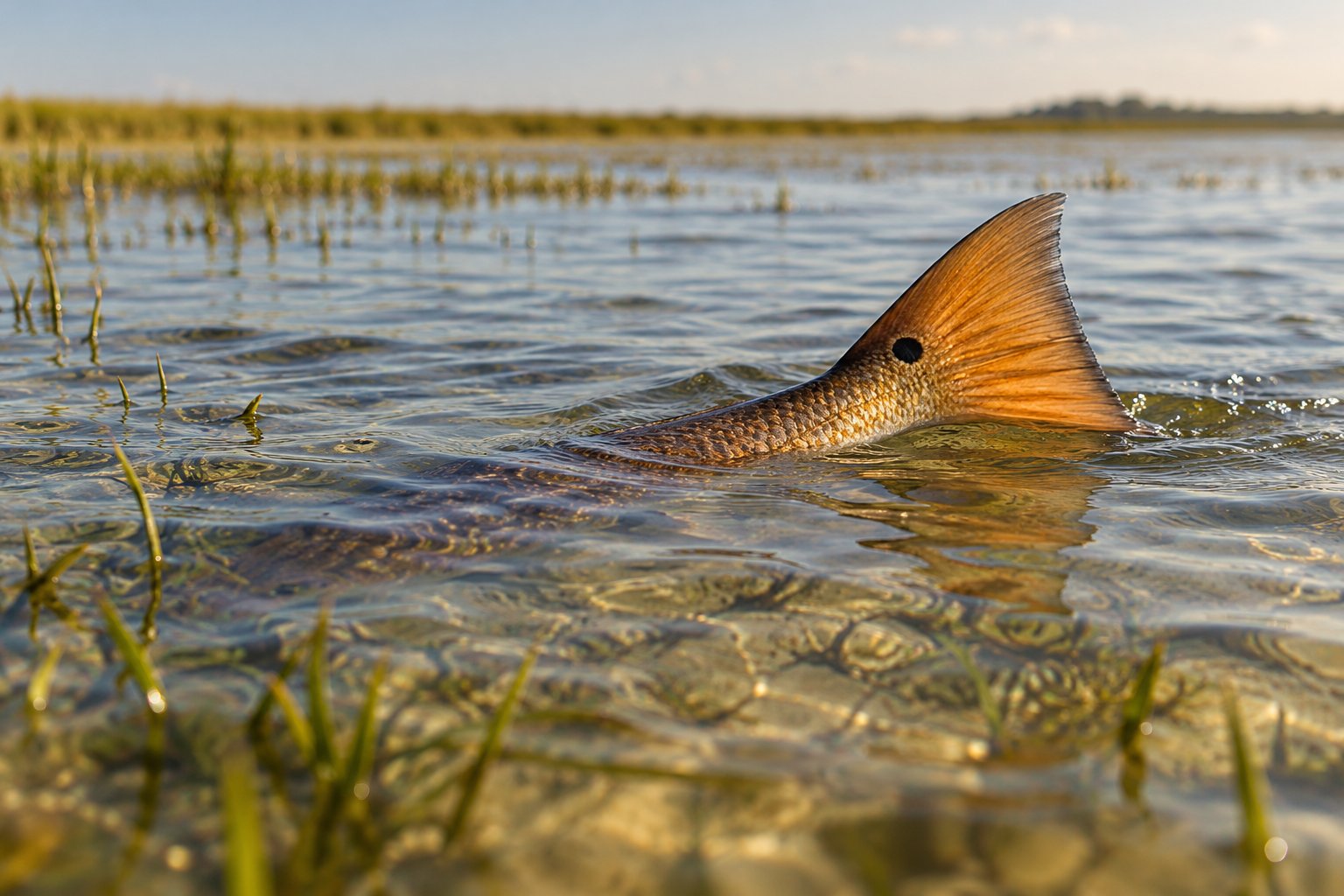
Once you’ve found a fish, read it before you cast. Which way is it facing? Is it moving or holding? Is it feeding or just traveling? A feeding fish is worth a careful approach. A traveling fish is worth a lead cast or nothing.
If the fish keeps changing direction and you can’t get a clean angle, wait. A rushed cast at a bad angle is usually worse than no cast at all.
The Cast That Matters
Everything up to this point exists to buy you one honest cast. Here’s how to make it count.
Lead the fish by the right amount. For a slow fish in skinny water, two to four feet ahead is often enough. A fish cruising with purpose needs four to eight feet, because your lure has to land, settle, and be in position by the time the fish arrives. If you need sink time or you’re casting a heavier presentation, add more.
Land outside the alarm radius and work the lure in. You’re not trying to hit the fish. You’re trying to put the lure where the fish will be, far enough away that the splash doesn’t register as danger. Dropping a lure on top of a skinny-water red blows that fish and usually the school with it.
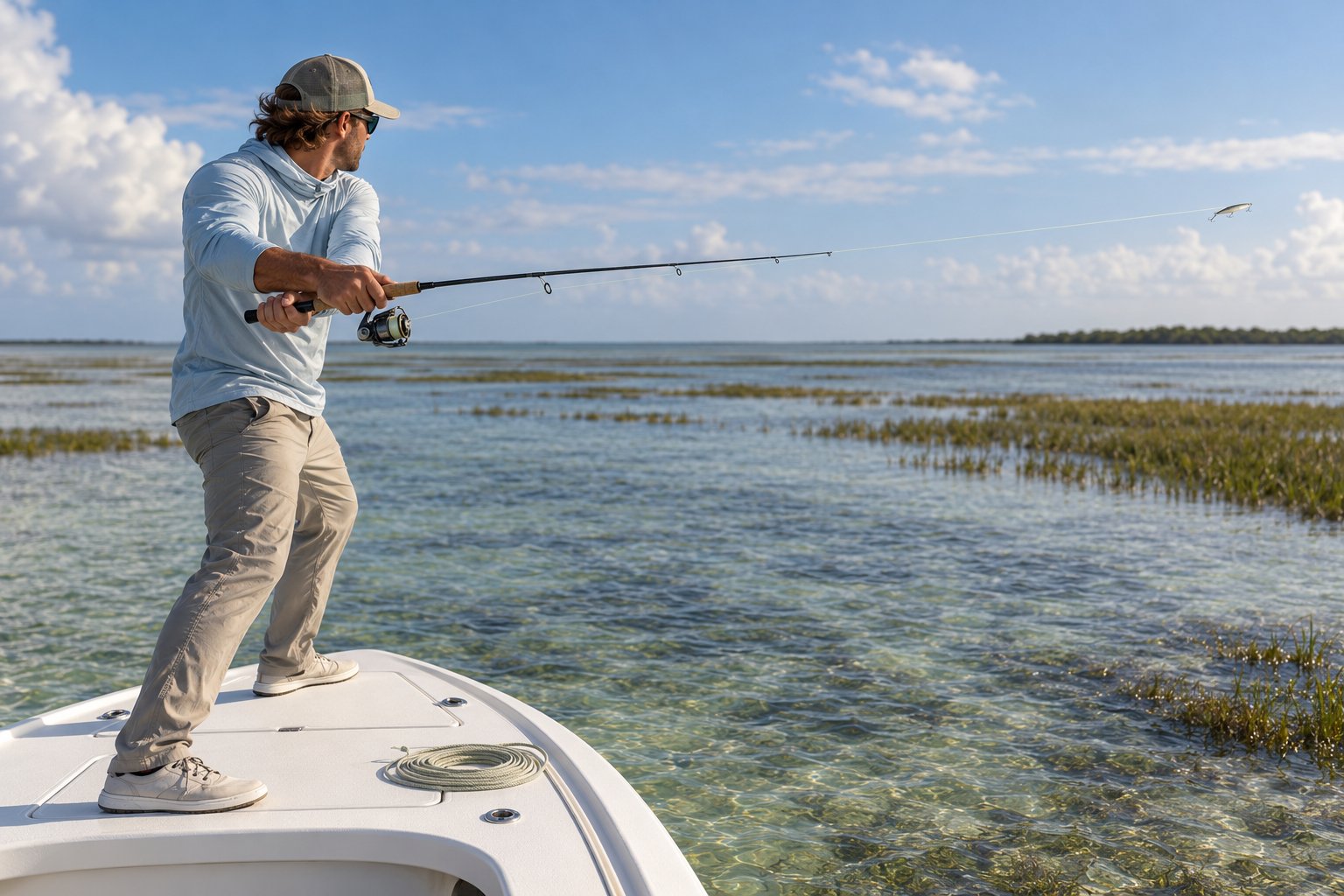
Land it soft. A low, flat, sidearm cast puts a lure down with a small plip instead of a slap. A high lob with a heavy lure is the loudest thing on the flat. Matching lure weight to the rod matters here — an overloaded rod forces a lob, and a lob is a spook.
Then let it stop. Redfish eat on the pause far more often than on the move. A couple of short hops or darts to draw attention, then a dead stop, is the retrieve that produces. The hardest discipline in inshore fishing is not ripping the bait away when a fish follows and doesn’t commit. Leave it. Twitch it. Let it sit.
Re-present, don’t panic. If a fish follows and refuses, let it move clear, then put the lure back softly a few inches off its nose and slightly to one side. That’s either an immediate reaction strike or a blown fish — but it’s a real second chance, and it only exists if you kept your distance in the first place.
Your setup supports all of this or fights it. Braid with a fluorocarbon leader is the standard for a reason: braid gives you casting distance and hook-setting power, and the fluoro leader gives you abrasion resistance around shell and lower visibility in clear water. If you’re still deciding what goes on the reel, this breakdown of monofilament, fluorocarbon, and braid covers the tradeoffs. Leader length and weight should follow the water: longer and lighter in calm clear conditions, shorter and heavier around oysters and shell.
The rod has a job too — it needs to load a light lure without a huge casting motion, which is why a medium-light saltwater rod that casts smoothly at short range beats a heavy rod you have to force.
Spooking Mistakes That End a Flat
Most blown flats tend to come down to a short list. Run through it when the fish disappear.
Poling too fast or running the trolling motor on high. The single most common cause. Slow down until the water ahead of the boat is flat.
Running onto the flat instead of shutting down outside it. Idle in, pole the last stretch, or drift in on the wind.
Casting a shadow across the flat. Sun in front of you means your shadow leads the boat. Reposition or work the flat from the other direction.
Dropping a lure on a fish’s head. Lead it, don’t target it.
Standing too close to the drain you’re fishing. The best-looking spot on the flat is usually the one you should be casting to from thirty feet back, not sitting on.
Chasing fish you’ve already spooked. A blown fish doesn’t forget. Move to a fresh edge and reset instead of re-fishing dead water.
Overworking one school. Pressure makes fish wary, and wary fish stay wary. Take a fish or two and leave the rest alone.
Boat noise you’ve stopped noticing. Cooler lids, tackle boxes, feet, reels, pole taps. Fix these before they cost you a fish.
Reset, Don’t Panic
Flats fishing rewards patience and one good read far more than it rewards casting volume. If you blow a fish, the correct response isn’t to cast harder at the same water — it’s to pole quietly to the next edge and start over with the wind and sun in your favor.
The anglers who catch redfish consistently aren’t the ones who cast the most. They’re the ones who spook the fewest. Get your approach right, keep your distance, read the signs before you commit, and the cast becomes the easy part.