
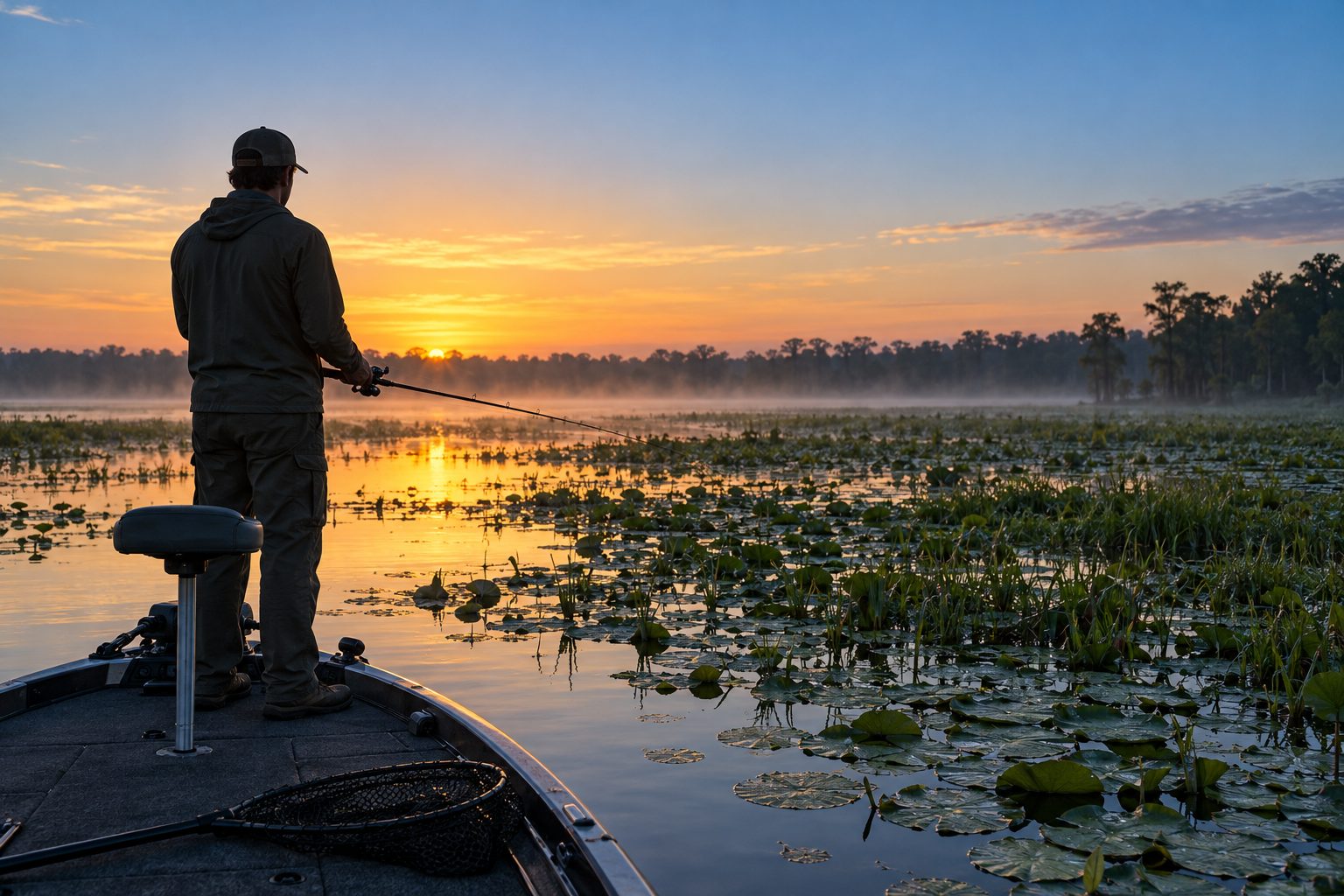
You spooled 30 lb braid because it casts a mile and it’s rated for fish three times bigger than anything you’re likely to hook. Then you threw a hollow-body frog across a grass mat, got the blowup, swung — and came back with nothing. Or the frog stuck, the fish turned, and your next cast stopped dead halfway out because the line had buried itself in the spool.
Neither of those is a hook-set problem or a frog problem. They’re line problems, and the label on the spool doesn’t explain them.
Here’s what actually changes between 30 and 65 lb braid, which size fits which job, and the spooling details that make heavy braid cast the way it’s supposed to.
Why 30 lb Braid Fails on a Frog
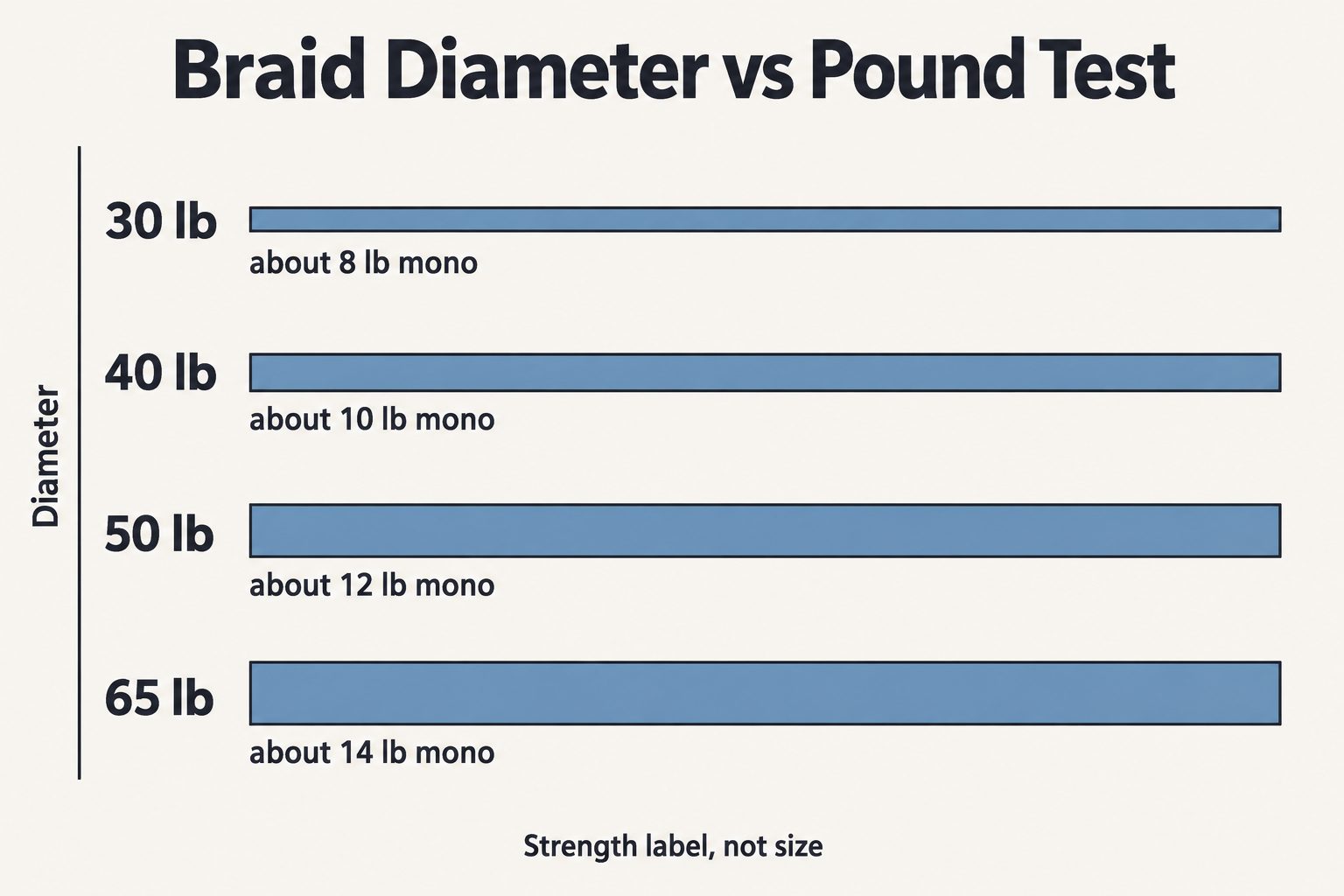
Start with the number itself. Thirty-pound braid is thin — roughly the diameter of 8 lb monofilament. That’s why anglers like it: thin line casts far and holds a lot of it. Good reason in open water. Bad reason in a mat.
Three things go wrong when you push thin braid into heavy cover.
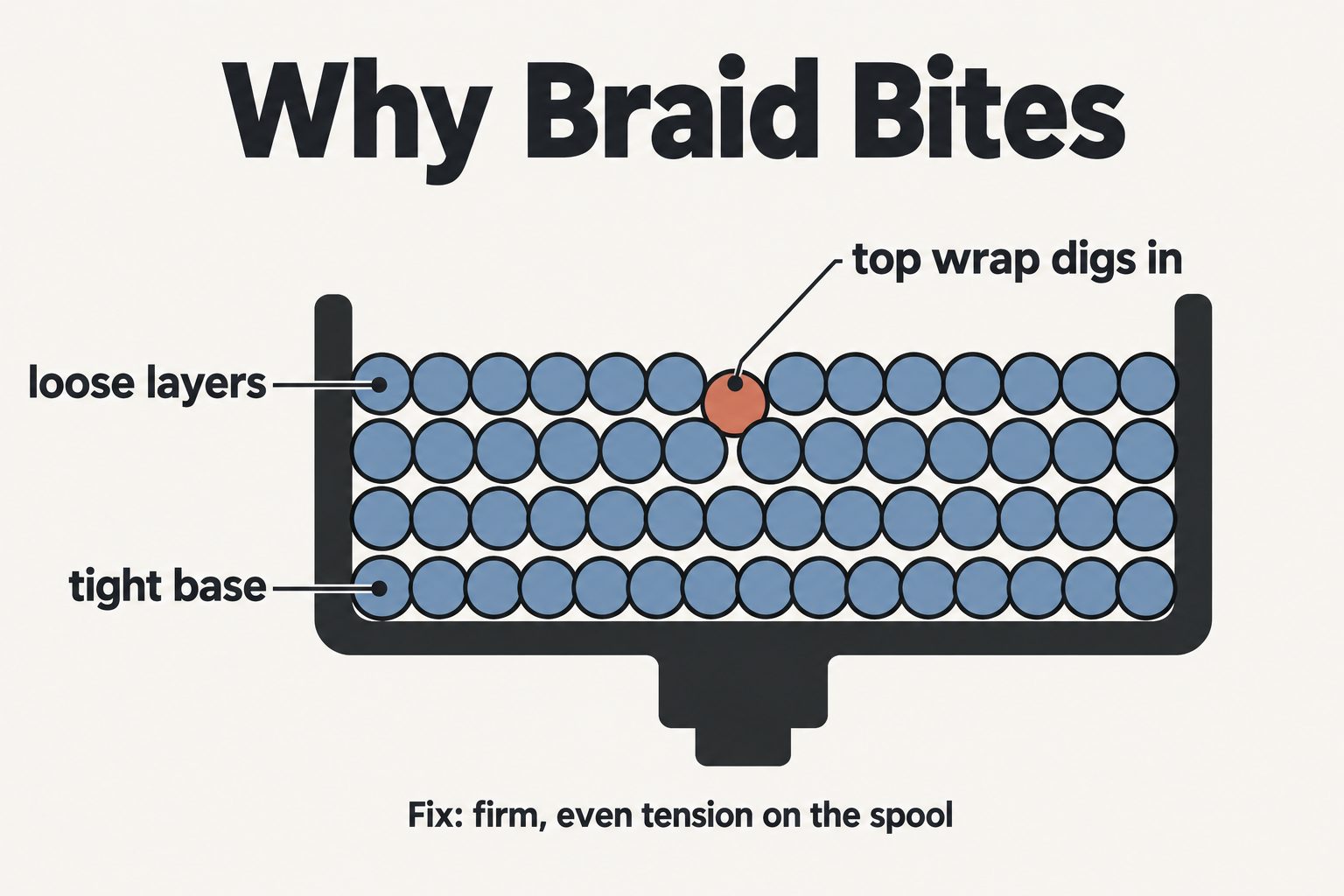
The first is dig-in. Braid has almost no stretch, so when you lean into a hard hook-set, all that force runs straight into the line — and into the wraps underneath it. Thin braid under heavy load presses into the layers below and locks them together. The next cast stalls, or you get a bird’s nest that looks machine-made. Anglers call it braid bite or braid bind, and thin line is more prone to it than heavy line.
The second is abrasion. Pad stems, cattail stalks, and milfoil edges are rough. Every cast drags your line across them, and thin line surrenders a bigger share of its margin with each nick. A hard day in the cover on 30 lb braid can leave you with a fraction of the strength you started with — and nothing visible to warn you.
Third, thin line doesn’t cut. When a bass eats your frog over a mat and dives, you have to drag the line back through a wall of vegetation. Heavy braid’s thicker diameter parts stems and slides through. Thin line wraps and holds, and now you’re pulling against the cover as hard as you’re pulling against the fish.
The fish didn’t get ten times stronger between 30 and 65 lb. The environment changed.
What Braid Size Actually Controls
Most of us read pound test as “how much fish this line can handle.” In heavy cover, that’s the least useful way to read it.
Pound test is a strength rating. Diameter is what decides how the line behaves — how far it casts, how much fits on the spool, how it sits in the wraps, and how it moves through grass stems. Two lines both rated 50 lb can differ in diameter by 15 percent or more depending on brand, fiber, and how the maker measures it.
Braid also doesn’t scale like monofilament. Fifty-pound braid runs about the diameter of 12 to 14 lb mono, and 65 lb is only a little thicker. That’s why heavy braid is far more castable than the number suggests — and why the number alone won’t tell you what you’re buying.
If the package lists a PE rating, that’s the honest number. PE is a diameter standard, not a strength standard: PE 3 is roughly 0.285 mm, PE 4 about 0.330 mm, PE 5 about 0.370 mm. Two lines with the same PE number are the same physical size even when their pound ratings differ. As a rough rule, multiply the PE number by ten for an approximate breaking strain — but expect the same diameter to test differently from brand to brand.
Practical takeaway: when both numbers are printed, trust the millimeter figure over the pound figure. It’s the one that predicts how the line will act on your reel.
The Heavy-Cover Default: 50 to 65 lb
For hollow-body frogs over pads and mats, for punching, and for heavy flipping, 50 to 65 lb braid is where nearly every experienced angler lands. Not because bass weigh 50 lb — almost none do — but because the line has to survive brush all day and then cut a path back out with a fish on the end.
Fifty is the all-around frog size. It handles most pad fields and mat edges, keeps a wider walking action on the frog, and still casts well on a normal baitcaster.
Sixty-five is the step up for punching thick mats, and for the days when you plan to lean on the hook-set as hard as the rod allows. It’s also what most punching anglers run, paired with a 1 to 2 oz tungsten weight pegged tight against the bait so the whole package drops through the mat in one piece.
Eighty is the far end — the heaviest punching and big-bait territory. It works, but for most freshwater anglers it’s more line than the job needs, and the extra diameter costs casting distance.
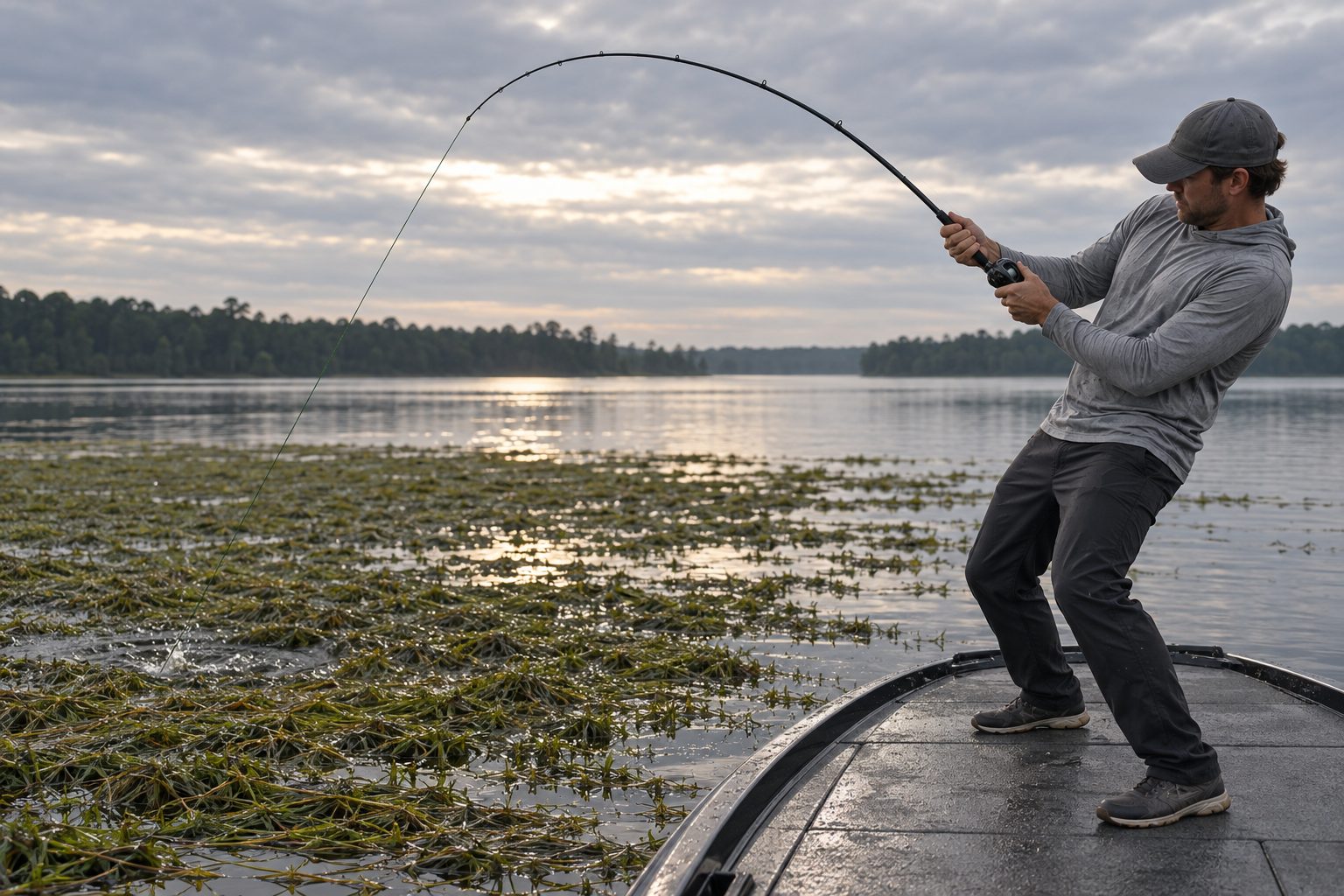
What you’re buying at 50 to 65 lb is margin. The line takes a full day of stems and stalks and is still the strongest link in the system when a good fish eats.
40 lb: The Compromise That Still Works
Not every grass bite is a mat. If your lake has scattered pads, pad edges, sparse cattails, laydowns along the bank — or you’re walking a buzzbait over submerged grass — 40 lb does the job and casts better than 65.
The trade is straightforward. You give up some abrasion margin and some cutting power. Around sparse cover that trade is worth it, because you get distance and lure action back. In a true mat, forty is where the “I set the hook and nothing happened” stories come from.
A reasonable way to decide: think about what happens after the bite. If a hooked fish can swim in three directions without dragging line through stems, 40 lb is fine. If every direction is stems, move to 50 or 65.
There’s no universal cutoff here. Cover density varies too much from lake to lake for anyone to hand you one number with confidence.
Making Heavy Braid Behave on a Baitcaster
The most common complaint about 65 lb braid is that it won’t cast. Almost every time, the line is fine and the spooling isn’t.
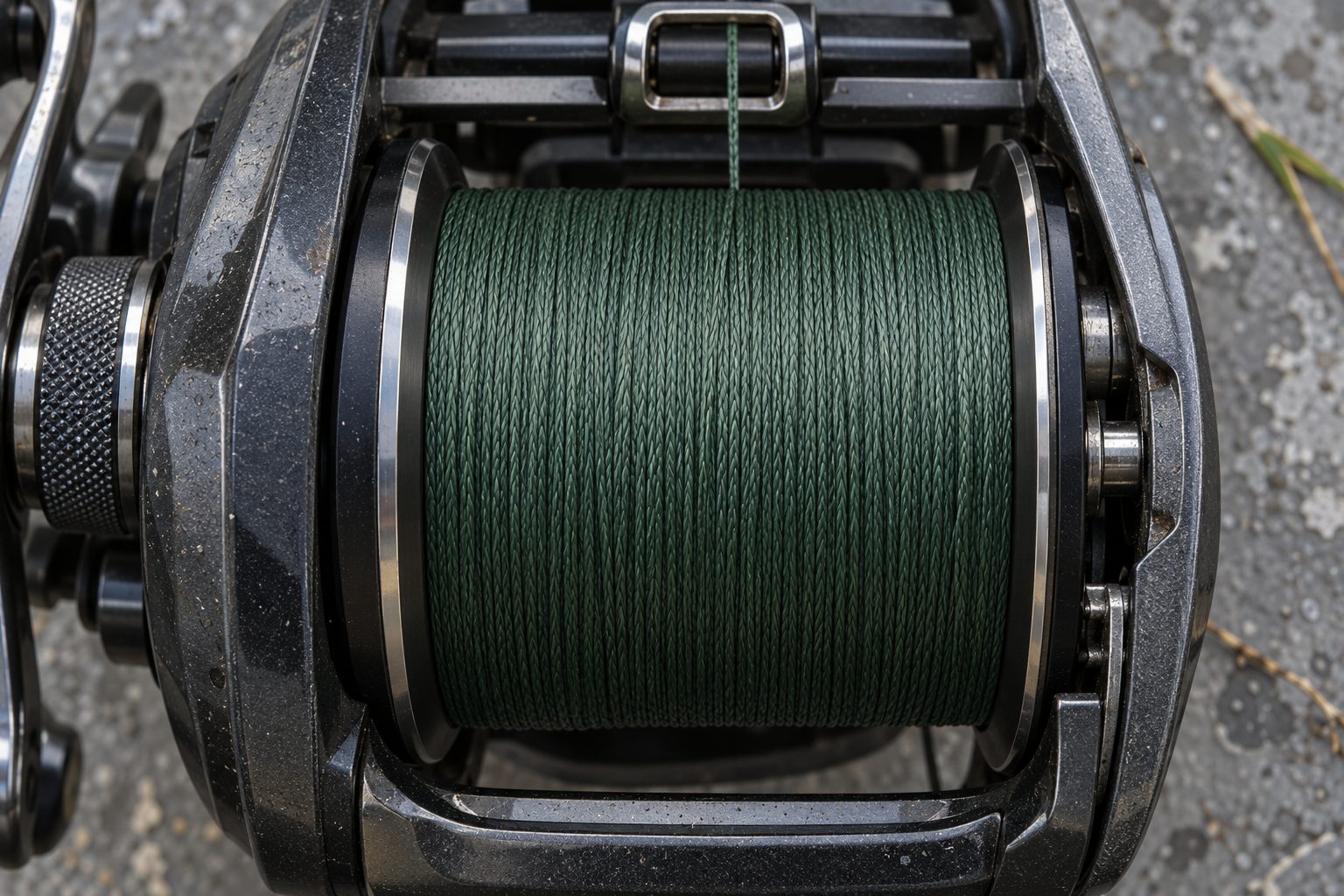
Braid is slick. On a bare metal spool it slips, no matter how good your knot is — the spool turns and the line doesn’t. That makes your drag feel broken and can chew the line at the arbor. The fix is a base layer: ten to twenty yards of 8 to 10 lb monofilament, or two or three wraps of electrical tape over the arbor, then join the braid to the mono with a double uni, Albright, or FG knot.
Tension matters as much as backing. Braid wound on loose is braid that will bury itself the first time you set the hook or pull a snag free. Wind it on hard — the pressure that makes you want a towel or a glove — and keep it even across the spool. That firm, flat base is what prevents braid bite in the first place.
Fill the spool to about an eighth of an inch below the lip. Overfilled braid backlashes on every cast. Underfilled braid costs distance and makes the reel feel slow.
On the water, protect the work you did at the bench. After a hard hook-set, or a snag you had to break off, strip a few feet off the spool and wind it back on under thumb pressure. Clearing a buried wrap on the deck takes ten seconds. Discovering it mid-cast costs you the cast, and probably the fish.
One more thing: don’t lock the drag down just because the line can take it. A drag that gives a little keeps line from digging into the spool and keeps hooks from tearing out. Heavy braid is strong enough to let the drag do its job.
Leaders, Knots, and the Hardware End
Frogging and punching are two of the few bass techniques where the right answer is no leader at all. Tie braid straight to the bait.
A fluorocarbon leader adds a second knot and a weaker connection at exactly the moment you need one clean, uninterrupted pull through vegetation. And braid’s visibility isn’t the limiting factor when a bass is looking up at a black frog silhouetted against the sky. Skip it.
The knot to use is the Palomar, tied with a doubled line. It keeps roughly 95 percent of line strength, it’s compact enough to slip through grass, and it’s simple enough to tie in the dark on a moving boat.
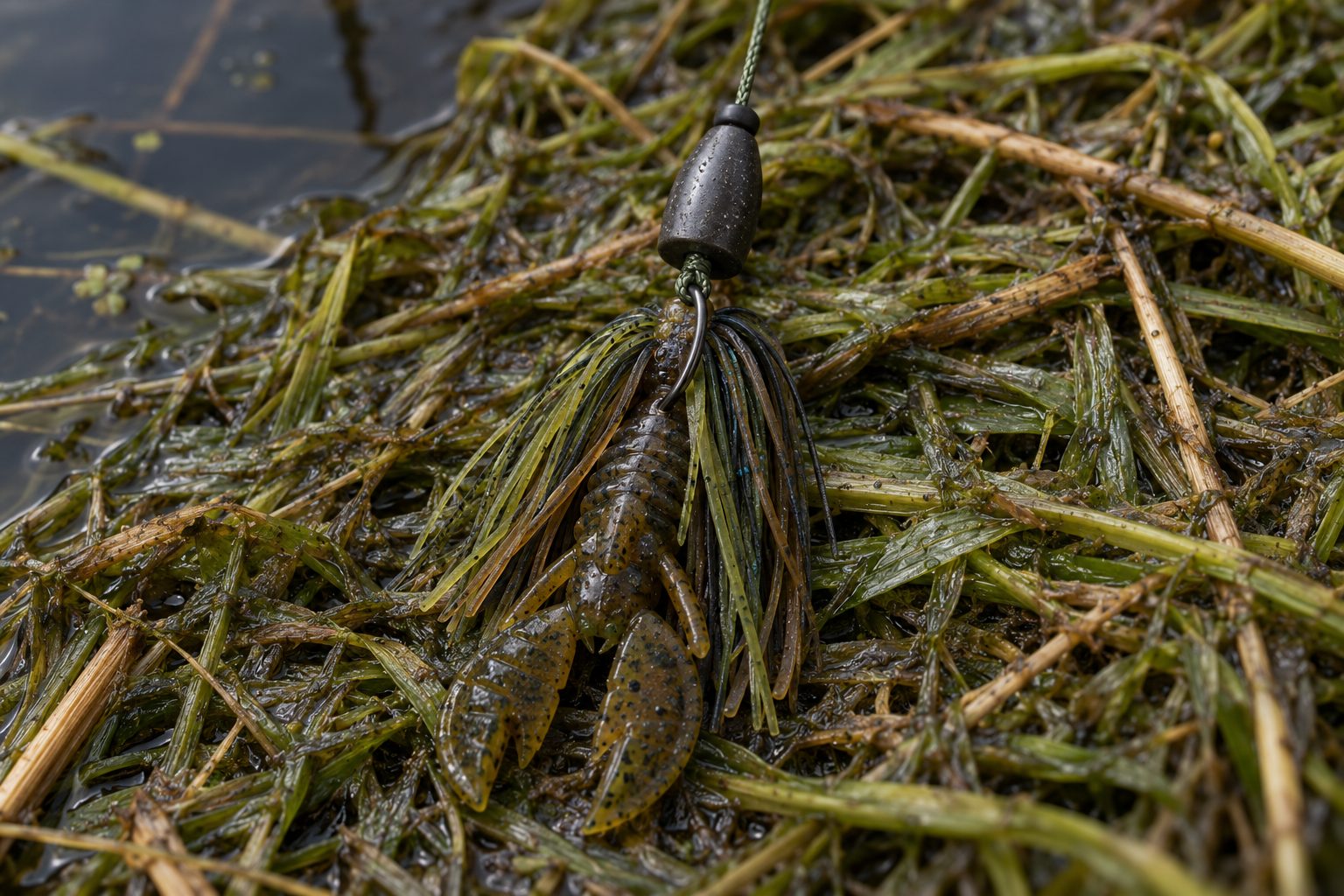
Then there’s the other half of the system. A frog carries two heavy-gauge hooks that both have to come through a rubber body and into a bass’s mouth. That takes force, and the force has to come from somewhere. A medium-power rod loads and gives that force back too slowly. You want heavy power with a fast action, long enough to move line on the hook-set — something in the 7-foot-3 range or longer — plus a reel fast enough to gather slack over the mat.
Line is one third of that equation. Heavy braid on a soft rod and a slow reel still misses fish.
When to Cut Back and When to Re-Spool
Cover fishing eats line, and the damage is invisible from the deck.
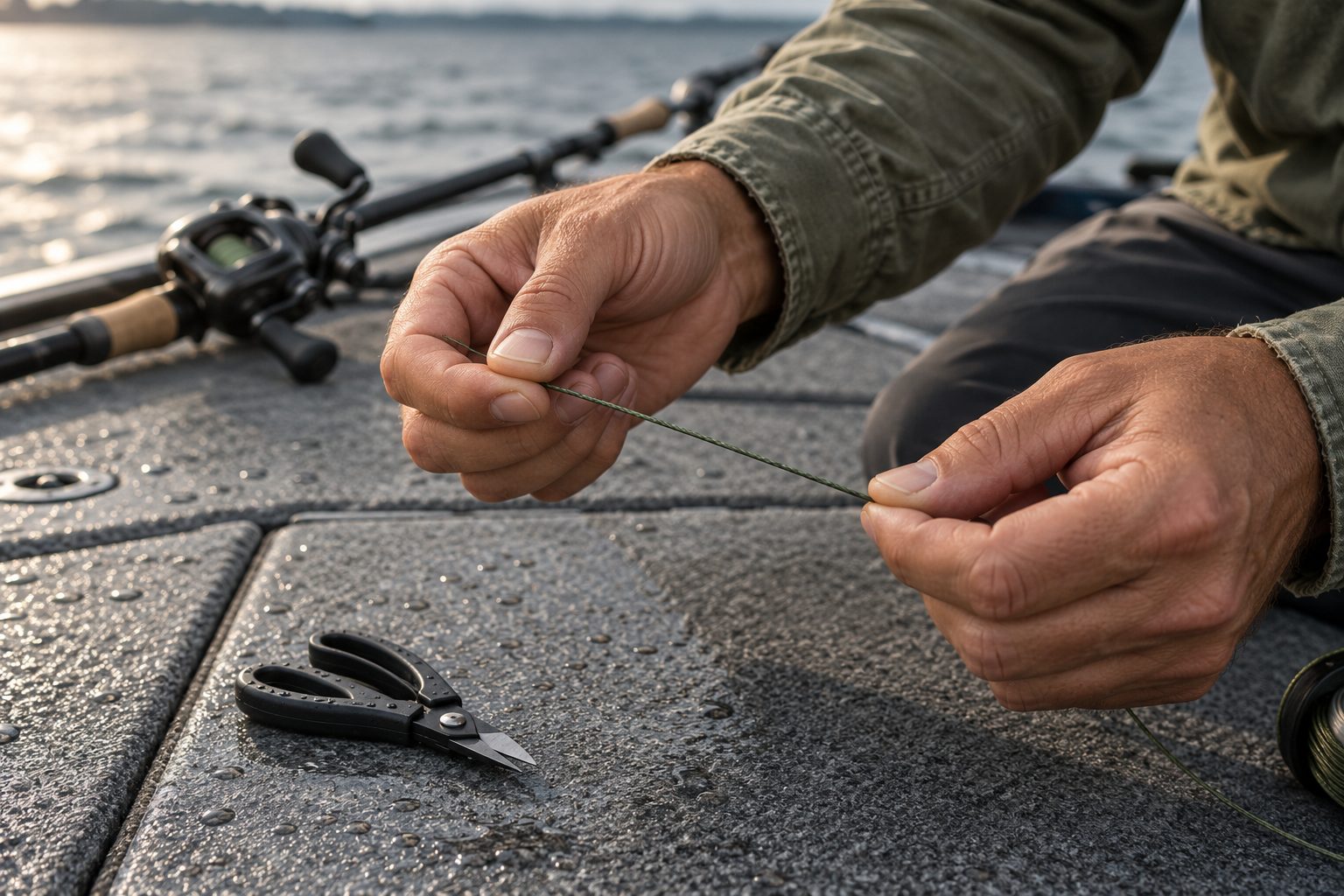
After every fish, and every snag you pull out of the grass, run the last three to six feet between your thumb and forefinger and look at it. Fuzz, flat spots, roughness, or a section that feels thinner than the rest means that line is done. Cut back past the damage and re-tie. Losing ten feet of braid costs almost nothing. Losing a good fish costs the day.
Re-spool when you’ve cut back far enough that the spool sits noticeably low, or at the start of each grass season. Mid-season you can unspool onto a spare spool and wind it back on reversed, which puts the unused section at the working end. Old trick, still works.
Store the reel out of direct sun and out of a hot truck cab. UV and heat break line down quietly, which is the worst possible way to lose it.
Quick Reference: Match the Braid to the Job
- Hollow-body frog over pads and mats: 50 to 65 lb, tied direct, no leader.
- Punching thick mats: 65 lb, with 80 lb for the worst of it. Pegged 1 to 2 oz tungsten, no leader.
- Flipping and pitching heavy cover: 50 to 65 lb.
- Buzzbait or walking topwater over grass: 40 to 50 lb.
- Swim jig in grass: 30 to 40 lb.
- Texas rig in wood or scattered grass: 40 to 50 lb with a 15 to 17 lb fluorocarbon leader.
- Clear open water: braid is probably the wrong tool. That’s a fluorocarbon job.
If you want the wider picture on how the three line types differ, read our breakdown of mono, fluorocarbon, and braid before you buy another spool.
And when a day ends with a bird’s nest anyway — it happens to everyone — our guide to clearing baitcaster backlashes and managing line walks through the fix without cutting your line out.
The short version: in heavy cover you aren’t buying strength. You’re buying thickness you can depend on, a spool that stays put under a hard hook-set, and enough margin to survive a full day of stems. Pick the size for the cover you’re fishing, not the fish you’re hoping for. If reading that cover is still the hard part, start with how grass and vegetation position bass — line choice gets a lot more obvious once you can see where the fish actually sits.