
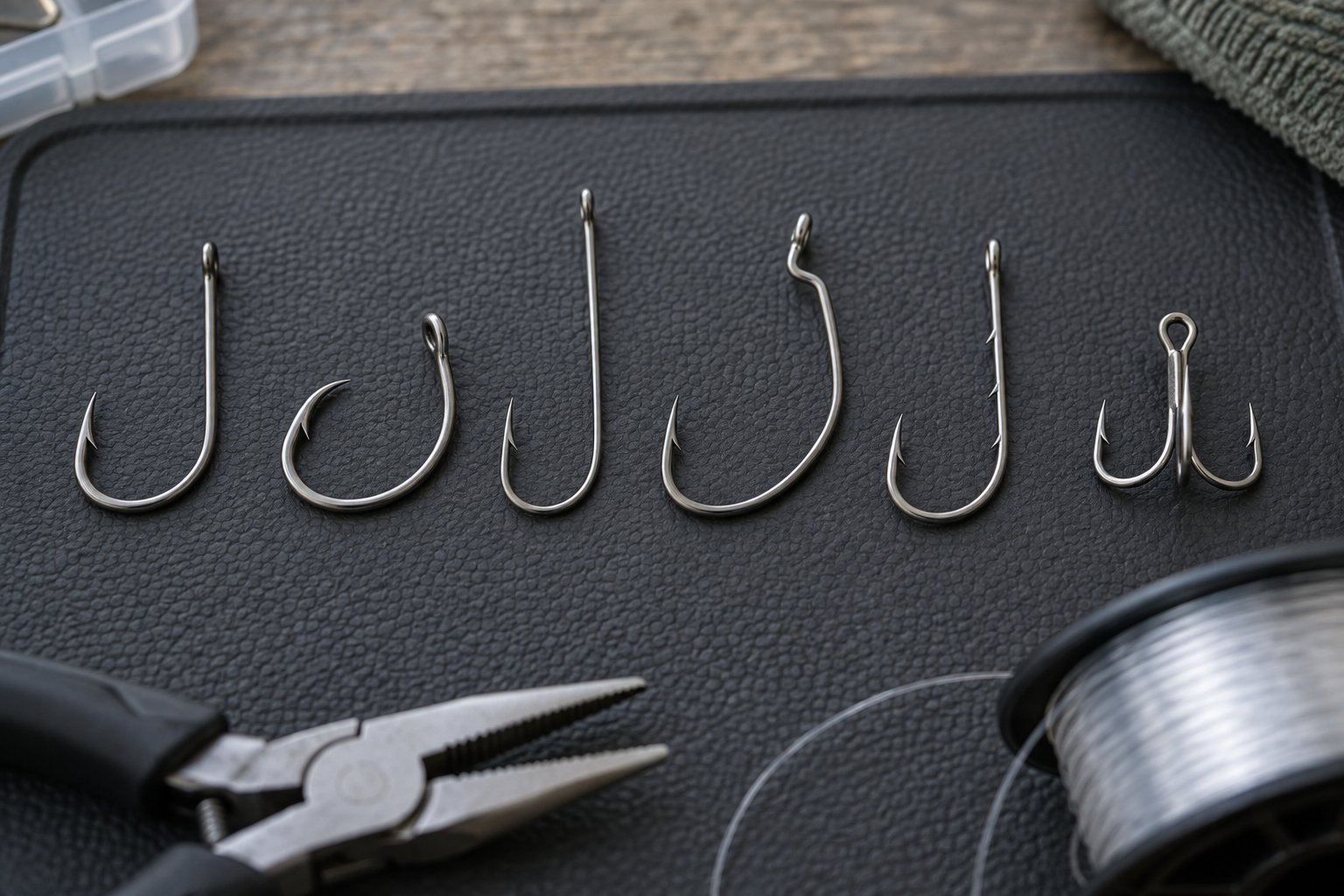
You walk into the tackle shop, find the hook wall, and stop. Hundreds of hooks hang in small packets. Aberdeen, octopus, siwash, 8/0, 4/0, baitholder. Nothing on the wall tells you what any of it does, and the person in line behind you is already tapping their foot.
Good news: you don’t need all of them. A handful of hook shapes covers almost everything a beginner will fish in a pond, lake, or river. This is a short tour of the hooks you’ll actually use, how the confusing size numbers work, and a simple list you can take to the shop.
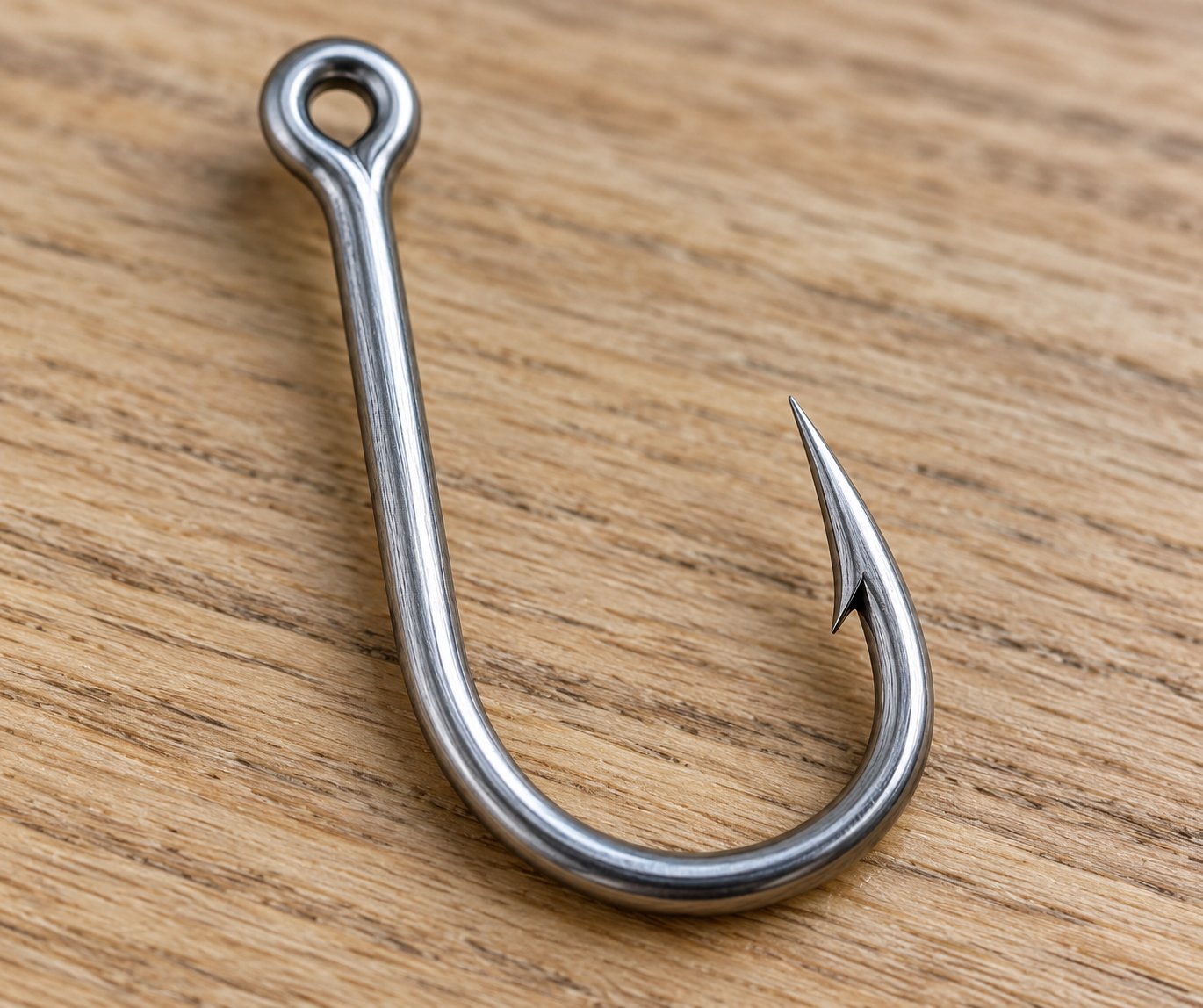
Hook Anatomy in 30 Seconds
Before types and sizes make sense, you need the four words every hook has in common.
- Eye — the little loop at the top where your line ties on.
- Shank — the straight section below the eye. Longer shanks show more of the hook; shorter shanks hide it inside bait.
- Bend — the curved section at the bottom. The shape of the bend is what separates one hook type from another.
- Gap — the open space between the shank and the point. Wide gaps hold chunky bait; narrow gaps suit small baits.
- Point — the sharp tip. Most points have a small barb, a backward flange that keeps a fish from slipping off the line.
That’s the whole vocabulary. Every hook in the store is a variation on these five parts.
The J-Hook: Your Default
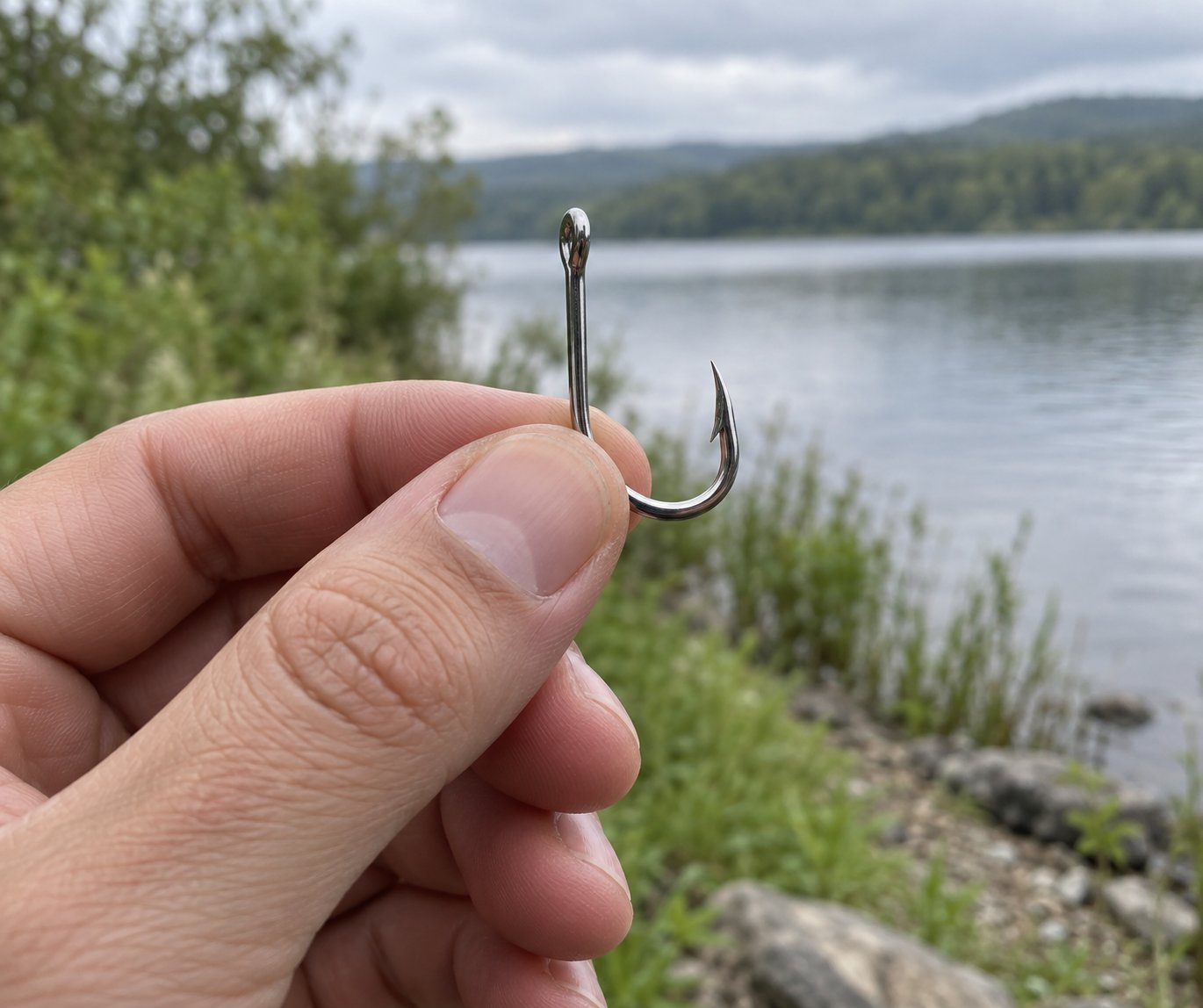
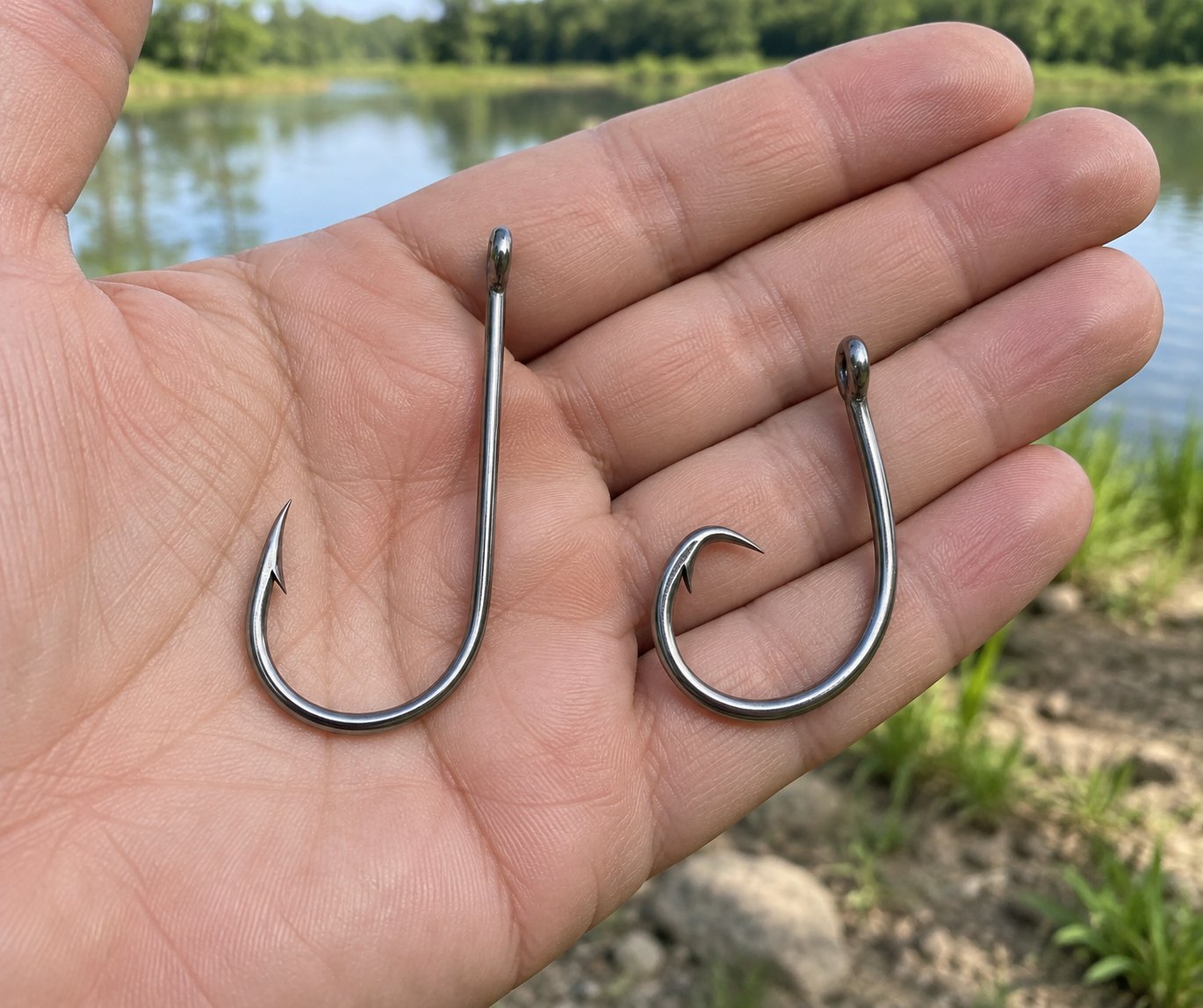
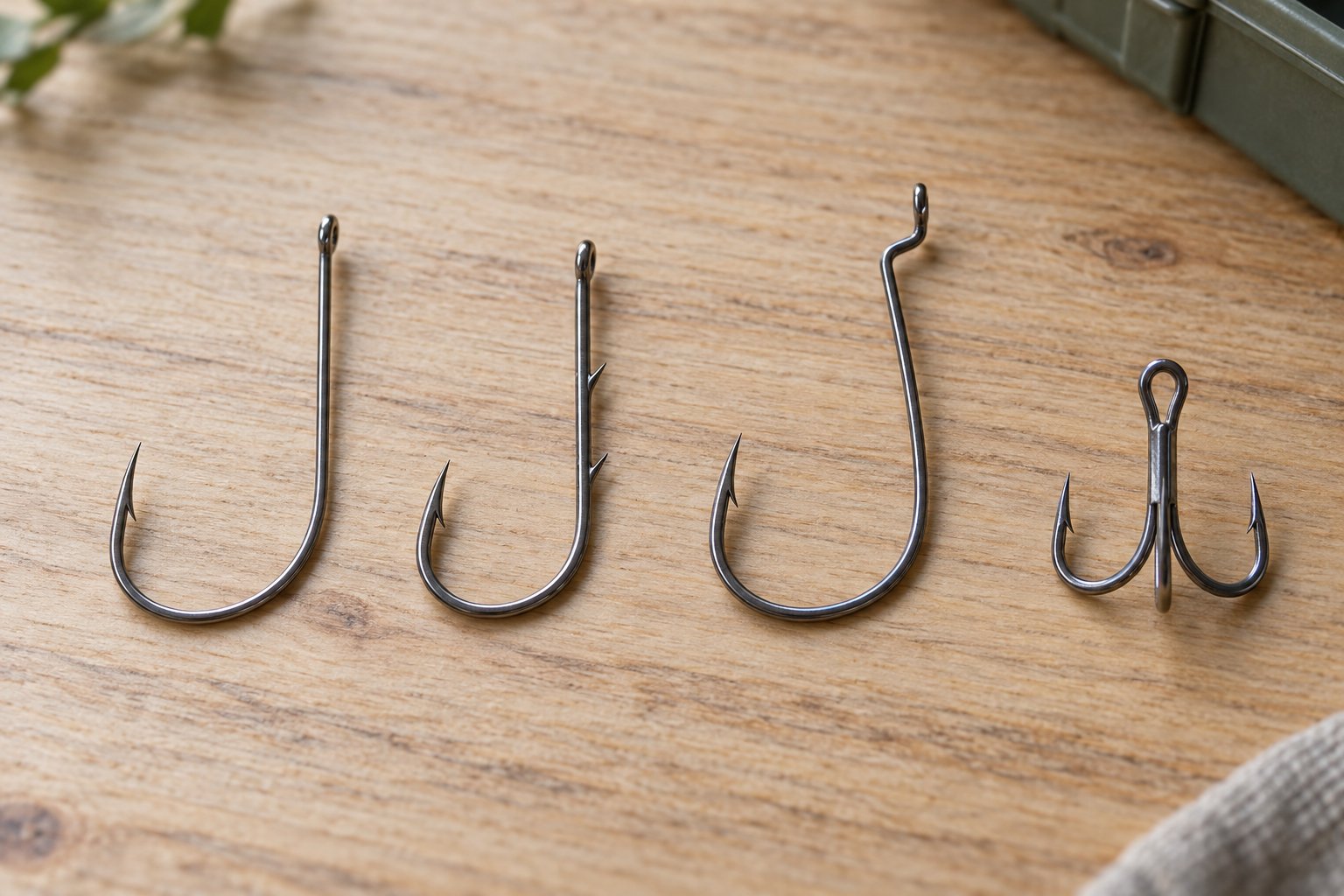
The J-hook is named for its shape: a straight shank, then a curve that ends in a point, like the letter J. It’s the most versatile hook made and the one most beginners learn on first.
Worms, minnows, cut bait, soft plastics — it works with all of them. Bass, panfish, catfish, trout — it works on all of them.
The catch is that a J-hook needs you to set it. When a fish takes the bait, you have to lift the rod to drive the point in. Miss that moment and the fish swims off. That makes the J-hook a great learning tool, because it teaches you what a bite feels like and when to react.
There’s one downside. If a fish swallows a J-hook, it tends to land deep in the mouth or the belly. That hurts the fish, especially when you’re practicing catch and release. This is the main reason circle hooks exist — more on them in the next section.
Circle Hooks: The Easy (and Counterintuitive) One
A circle hook looks almost the same as a J-hook at a glance. Then you look at the point. On a circle hook, the point curves sharply back toward the shank, almost touching it. That one difference changes how you fish it.
You don’t set a circle hook. When a fish takes the bait and swims off, you apply steady pressure and start reeling. The hook rotates on its own and settles into the corner of the fish’s jaw. Jerk the rod hard and you’ll usually pull a circle hook straight back out.
That jaw-corner placement is why circle hooks are the standard for catch and release. The fish is rarely gut-hooked, which means less damage and better survival after release. It’s also why regulations increasingly require them — many saltwater fisheries now mandate circle hooks for certain species, and freshwater rules are following.
The biggest beginner mistake with circle hooks is the reflex to swing. You feel a bite, muscle memory says *set it*, and you lift the rod. The hook pulls out and the fish is gone. When you switch to a circle, the trick is patience: feel the weight, load the rod, reel steadily. The hook does the work.
The Rest You’ll Meet
A few other hook shapes show up in the store. Here’s the short tour so they don’t scare you.
Aberdeen Hooks
An Aberdeen is a thin-wire J-hook with a wide, open gap. The light wire does two jobs: it’s gentle on the fish, and it’s easy to unhook. That makes it the go-to for panfish like bluegill and perch, and a popular catch-and-release choice. They’re usually small, anywhere from size 6 to 12, and cheap enough to grab a full pack.
Baitholder Hooks
A baitholder is a J-hook with one or two tiny barbs working backward on the shank. Those barbs grip a worm or a piece of cut bait so it doesn’t slide down the shank on the cast. If you’re worm-fishing, the baitholder is the hook to grab. One tradeoff: those little barbs make the hook a bit harder to remove from a fish, so it’s less ideal for release fishing.
Offset and Worm Hooks
These are wide-gap hooks built for soft plastics. The wide gap lets the hook clear a fat worm without the point stabbing through the bait. A good rule of thumb: a 3- or 4-inch worm takes a 2/0 or 3/0 hook, while a chunky 10-inch worm wants a 4/0 or 5/0. Match the hook to the plastic, not the fish.
Treble Hooks
A treble is three hooks fused at a single eye. You almost never buy one for bait fishing — trebles live on lures like crankbaits and topwaters, and they usually come pre-attached. If your lure’s factory trebles have dulled, swapping in sharp ones of the same size is one of the cheapest ways to get more bites.
Hook Sizes Without the Headache
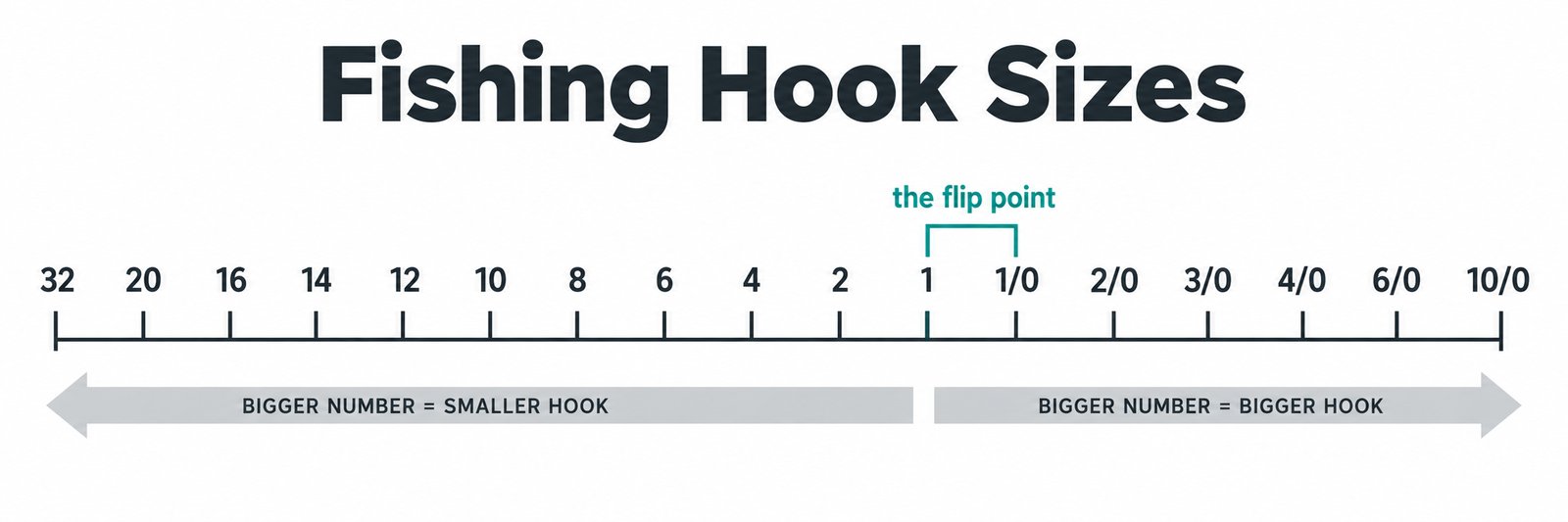
This is the part that confuses everyone, so let’s get it out of the way. Hook sizes use two number scales that run in opposite directions.
The first scale counts down from 32: 32, 20, 16, 14, 12, 10, 8, 6, 4, 2, 1. In this scale, a bigger number means a smaller hook. A size 20 is smaller than a size 10, which is smaller than a size 1.
The second scale starts after size 1 and counts up using “aughts”: 1/0, 2/0, 3/0, 4/0, 6/0, 10/0. Here, a bigger number means a bigger hook.
The two scales meet at size 1 — the smallest hook in the aught world and the biggest in the numbered world. Think of it as a flip point.
Here’s the practical truth: as a beginner in freshwater, you’ll live somewhere between size 6 and size 3/0. That’s the entire shopping decision. Anything smaller is for fly fishing and tiny bait; anything bigger is for big saltwater fish.
Which Hook Do I Buy?
Skip trying to memorize everything and start with your bait or lure instead:
- Worms and natural baits → baitholder or Aberdeen. If you want to read more about picking natural baits, our guide to the best natural baits for freshwater fishing covers which baits pair well with which hook.
- Live bait (minnows, shiners) → circle or octopus hook. The hook should be sized to the baitfish, with the point just visible.
- Soft plastics → a wide-gap worm hook matched to the plastic’s bulk.
- Lures → whatever single or treble hook came on the lure. You can learn to set up a simple fishing rig once you’re comfortable with these basics.
One more rule of thumb: the hook point should be visible but not buried inside the bait. Can’t see the point at all? The hook is probably too small. Point sticking way out? Too big, and fish can see it.
A quick species reference for common freshwater targets:
| Species | Hook type | Size |
|---|---|---|
| Bluegill, sunfish | Aberdeen | 8-12 |
| Perch | Aberdeen | 6-10 |
| Trout | single hook | 10-14 |
| Walleye | octopus, jig | 4 to 2/0 |
| Largemouth bass (plastics) | worm / wide-gap | 2/0-3/0 |
| Smallmouth bass | worm hook | 2/0-3/0 |
| Channel catfish | circle, baitholder | 2/0-5/0 |
These are starting points, not laws. Bait size and local conditions will push you a size up or down.
The First-Tackle-Box Hook List
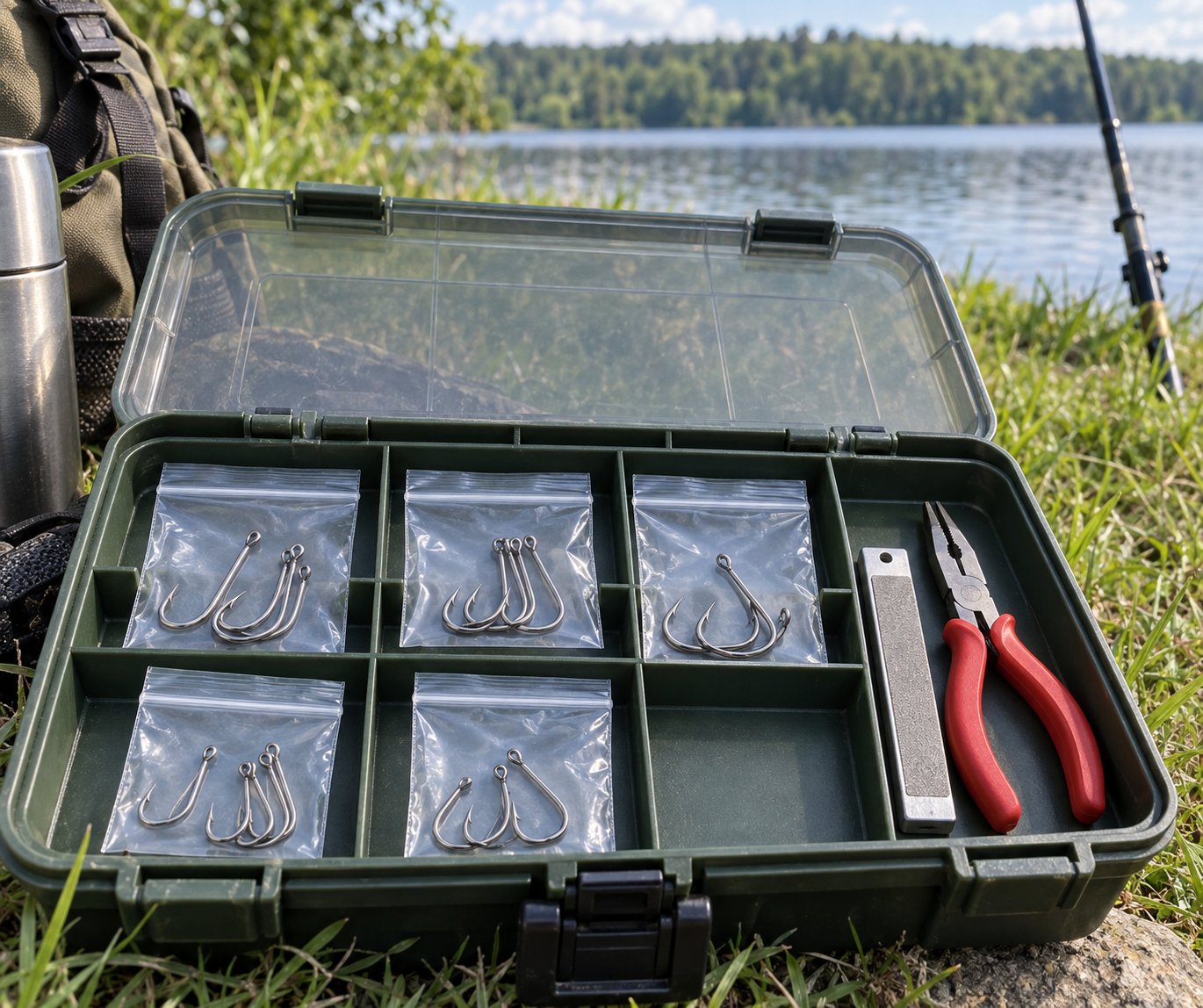
If you only remember one thing from this article, make it this list. Five small packets, a few dollars total, and the hook wall stops being scary:
- Aberdeen hooks, size 8-10 — panfish and light natural bait
- Baitholder hooks, size 6-1/0 — worms and cut bait
- Worm / wide-gap hooks, 2/0-3/0 — soft plastics
- Circle hooks, 2/0-3/0 — live bait and catfish
- A few spare trebles, 1/0 — for replacing dull hooks on lures
Buy them in small plastic packets at any tackle shop or online. Keep them in a tackle box tray where you can see them, and add a small hook sharpener — dull hooks quietly cost you fish. If you’re building a first tackle box, our starter kit checklist shows where everything fits.
Quick Rules to Remember
- Match the hook to the bait first, the fish second.
- J-hooks need an active hookset; circle hooks need steady pressure. Don’t mix up the two reflexes.
- Check local rules before you fish — some waters require barbless hooks, ban trebles in catch-and-release areas, or mandate circle hooks for certain species. Our catch and release guide covers the why behind the rules.
- Keep hooks sharp. A five-second pass with a sharpener beats a new pack of hooks.
The hook wall isn’t as big as it looks. Once you know five shapes and one size system, you can walk into any tackle shop, point at the right packet, and start fishing.