

You can cast, you can change baits, and on a good day you can even catch a couple of fish on a spinnerbait. Then one morning you hit your favorite spot and the same water that produced five bass last week goes completely quiet. You throw bigger lures, faster retrieves, louder colors. Nothing happens. The easy diagnosis is that the fish are “sick” or just not biting, and most anglers go home with that explanation. Usually the fish are fine. The presentation is too loud, too big, or too fake for the conditions. That’s what finesse fishing is for.
Finesse fishing sounds like a tournament buzzword, but it’s really a set of principles you can apply on your next trip. This guide covers what finesse actually means, the conditions where it beats power fishing, the gear that makes it work, the five rigs worth learning, and the small technical skills that separate the anglers who catch fish on light line from the ones who just wish they could.
What Finesse Fishing Actually Means
Finesse fishing is not a lure. It’s not a brand. It’s a way of presenting bait to fish that aren’t chasing. The core idea: when fish get wary, cold, or pressured, they stop reacting to loud, big, fast presentations. They start inspecting. They want something that looks natural, moves slowly, and doesn’t scare them.
So you adjust in five directions at once: lighter line, lighter rod, smaller lure, more natural colors, and subtler action. A tournament bass angler put it well: finesse is “what you do when fish aren’t biting normally” — and the things that cause that include weather fronts, fishing pressure, and water conditions you can’t always name.
Here’s the part that surprises people: you can finesse almost any lure. You can finesse a crankbait, a spinnerbait, or a jerkbait by using lighter line, smaller sizes, and slower action. The same word covers a 1/32-ounce jig head with a three-inch stick bait on a spinning rod and a slightly slower retrieve on a 1/4-ounce crankbait. The common thread isn’t the tackle, it’s the presentation.
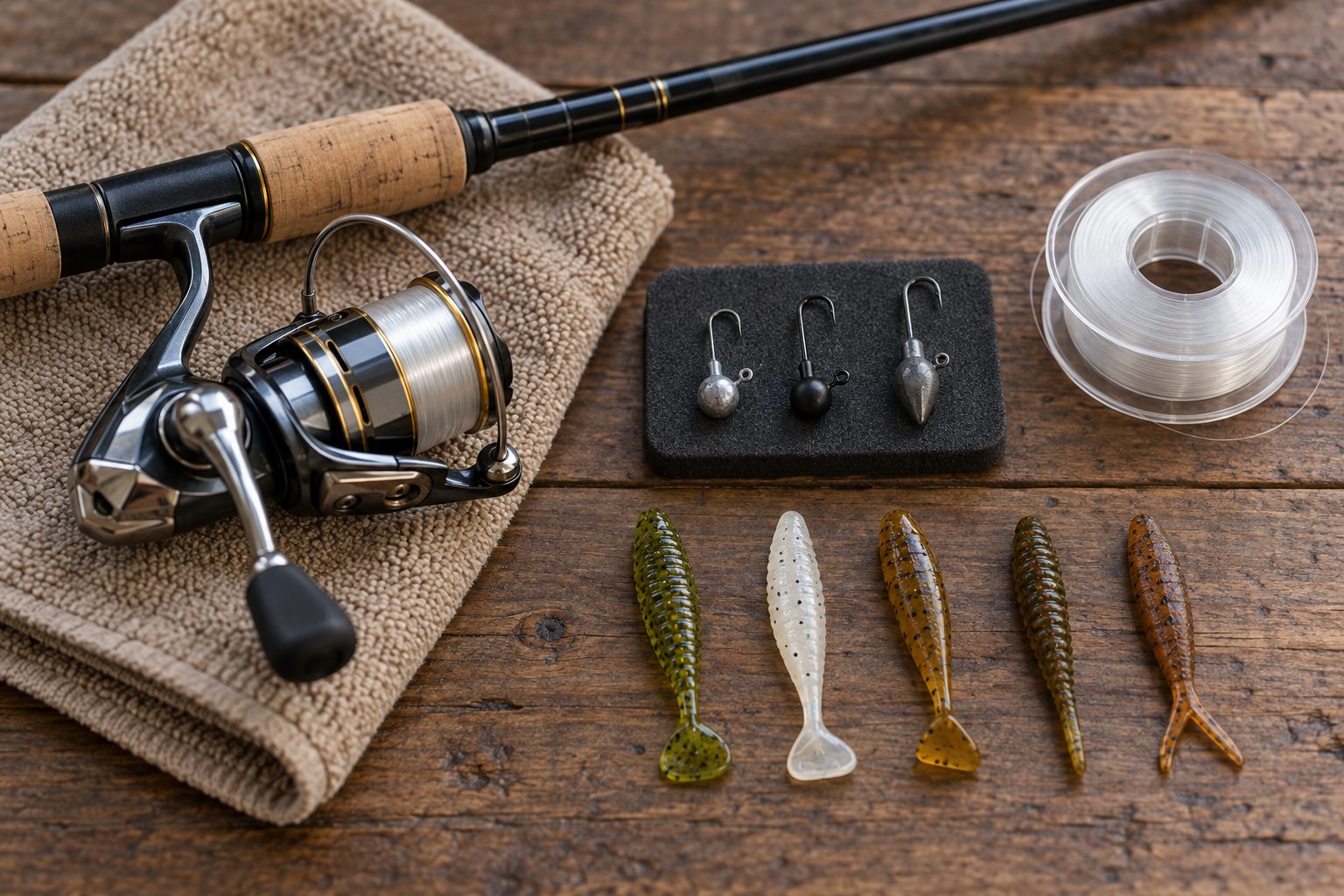
When we talk about finesse in this guide, we mean the light-tackle end of the spectrum: spinning gear, light line, and small soft plastics. That’s where most anglers go blank first, and where the biggest gains come from.
The Conditions That Call for Finesse
Knowing *when* to reach for finesse tackle is more important than knowing how to tie a Ned rig. There are four situations where finesse presentations typically outperform power baits.
Clear, sight-feeding water. In a clear lake on a bright day, bass can inspect a lure from a distance. Anything that looks artificial gets snubbed. In clear water, fish rely heavily on their sight, so natural translucent colors — watermelon, pumpkin, ghost, white — read as real forage instead of plastic. Fluorocarbon line helps too: it refracts light like water, making it nearly invisible.
Heavy fishing pressure. This is the most common trigger for weekend anglers. Every lake gets fished, and the fish start seeing the same big lures on repeat. A bass that’s been nipped by a chatterbait and a spinnerbait a dozen times is far less likely to chase a bigger, louder version of the same thing. Smaller, slower, and quieter beats them all. This is exactly why experienced anglers keep a dedicated box of small tackle: pressure changes can turn a power-fishing day into a finesse day in a single weather front.
After a cold front. A cold front does two things at once: it drops the barometric pressure and the water temperature. Bass are cold-blooded, so colder water slows their metabolism — they’re less willing to chase. And the pressure changes make them less comfortable feeding aggressively. The day or two after a front, when the water is cold and clear and the sky is blue, is classic finesse water.
Post-spawn. In spring and early summer, right after the spawn, bass often stop feeding for a while. They’re not aggressive, they’re not chasing, and they’re holding close to cover in shallow water. Big reaction baits get ignored. Small, slow presentations fished right over the same structure catch the fish that everyone else wrote off for the week.
One honest caveat: in very muddy water, finesse isn’t always the answer. When visibility is near zero, fish lean on their lateral line — the vibration sense that runs along a fish’s body — and sometimes they need more sound and water displacement. A light “power-finesse” setup (small profile, heavier line, faster work) or a loud backup bait has its place on the murkiest days. If you’re new to the loud end of the spectrum, our guide to crankbait fishing for beginners covers when those power baits actually win.
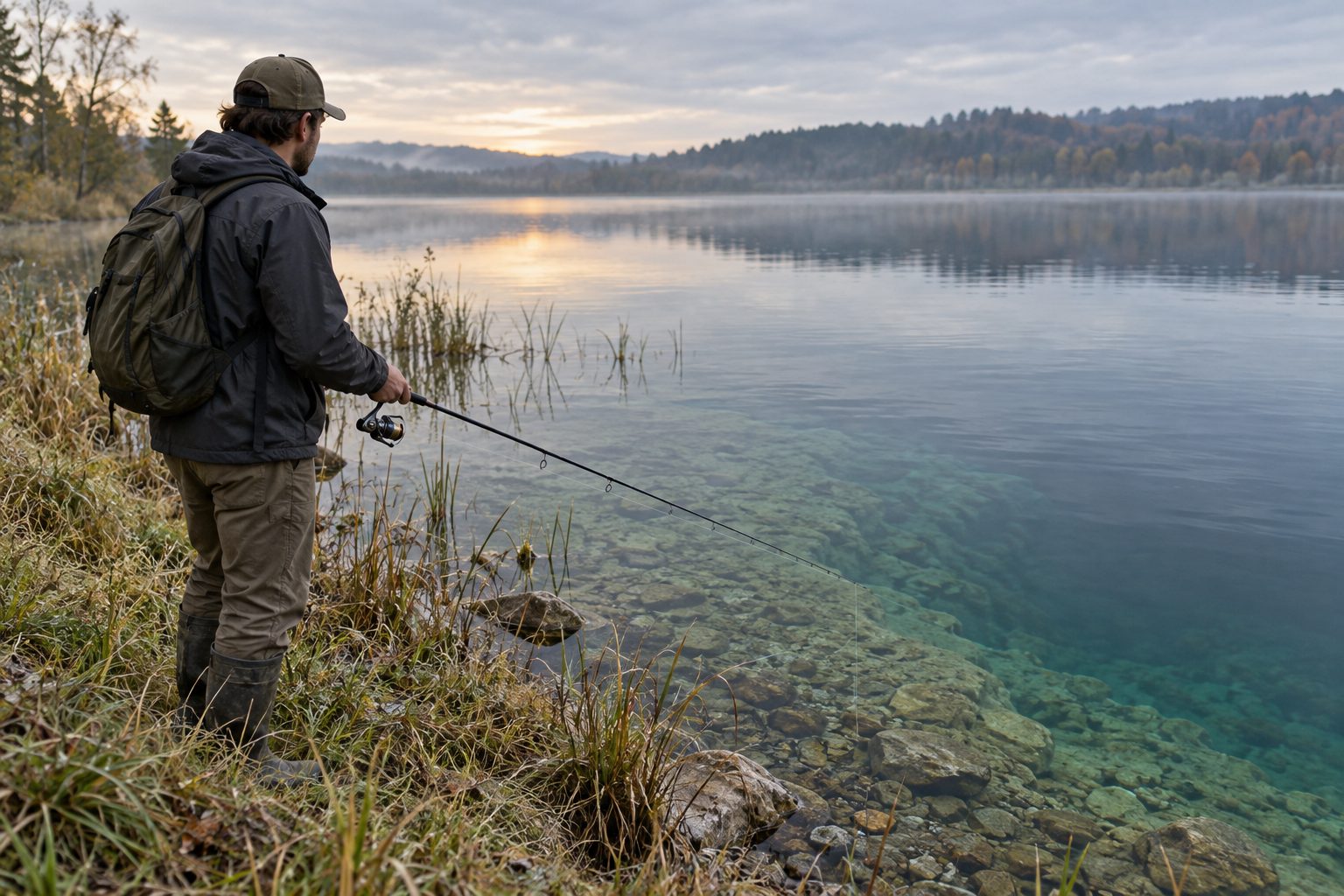
The Finesse Gear Setup
You don’t need a second boat full of rods. One light spinning setup is enough to start, and most anglers can build it from parts they already own.
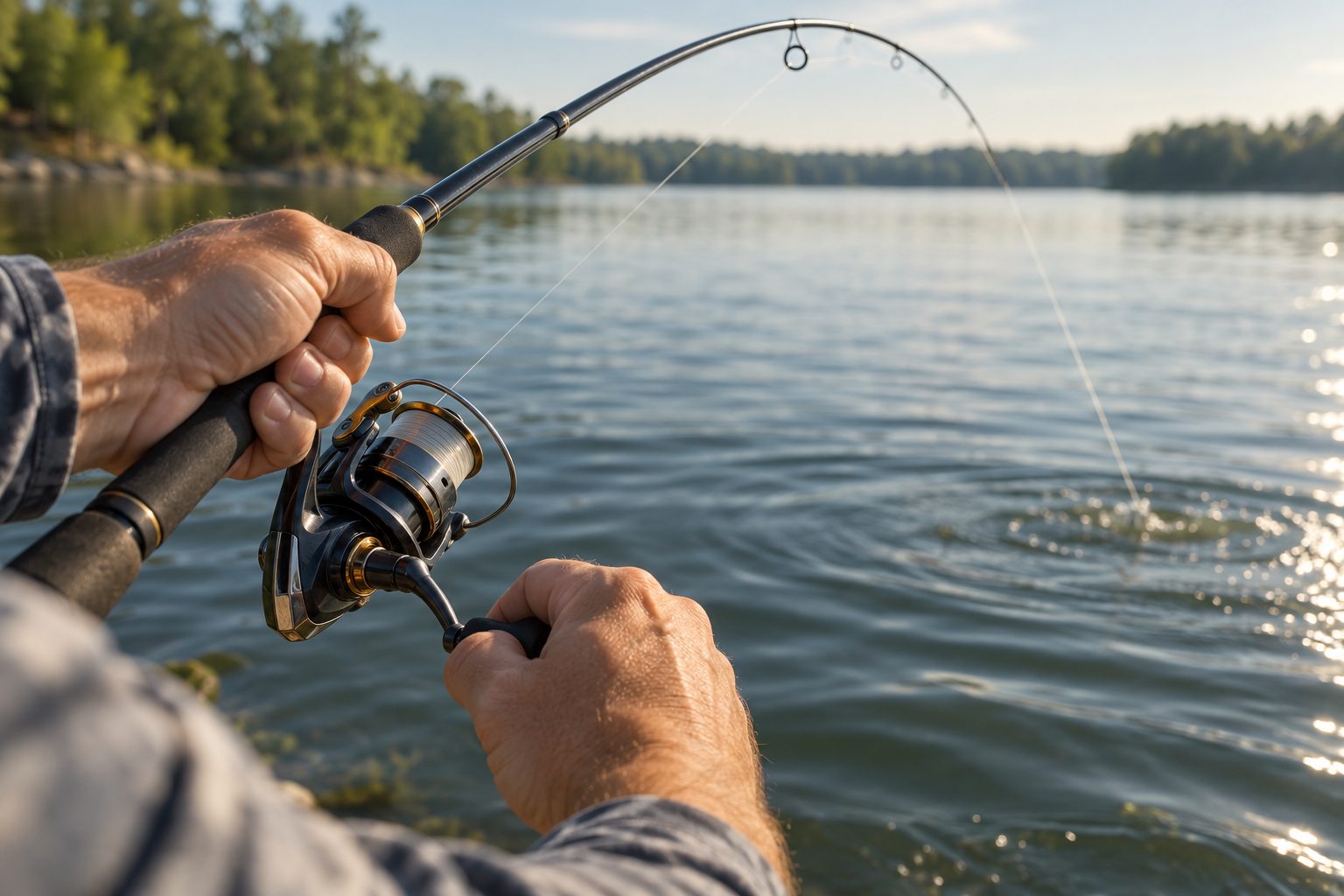
Rod and reel: A 6-to-7-foot light-action spinning rod paired with an open-face spinning reel. That’s it. The longer side of that range helps a lot: with light line, a longer rod gives you better line control and a more effective hookset at distance, the same reason fly fishers use long rods.
Line: 6-to-10-pound test fluorocarbon is the standard finesse mainline. Drop to 6-pound in very clear or deep water, and go up to 10-pound when you’re fishing around cover. Many anglers run 8-to-10-pound braid as their mainline with a 6-to-8-pound fluorocarbon leader, tied with a strong knot. The trade: braid is stronger and lets you feel every tick of the bottom, but fluorocarbon is nearly invisible and stretches slightly, which helps land bigger fish without light line.
The weight problem is the whole game. Here’s the mistake that kills most finesse attempts: using gear that’s too heavy for the bait. A flipping rod and 20-pound braid will drag a 1/8-ounce jig straight to the bottom the moment you stop reeling, and once the tiny bait is plastered to the bottom, you’ve lost the subtle fall and drift that make it work. The gear has to be light enough that the bait floats, rests, and moves the way it’s supposed to.
Colors: In clear water, go natural and translucent — white, watermelon, pumpkin, ghost, or the local forage color. In stained water, darker colors like black-and-blue or even a flashier pattern start to work because the fish are feeling for shape and vibration more than inspecting detail.
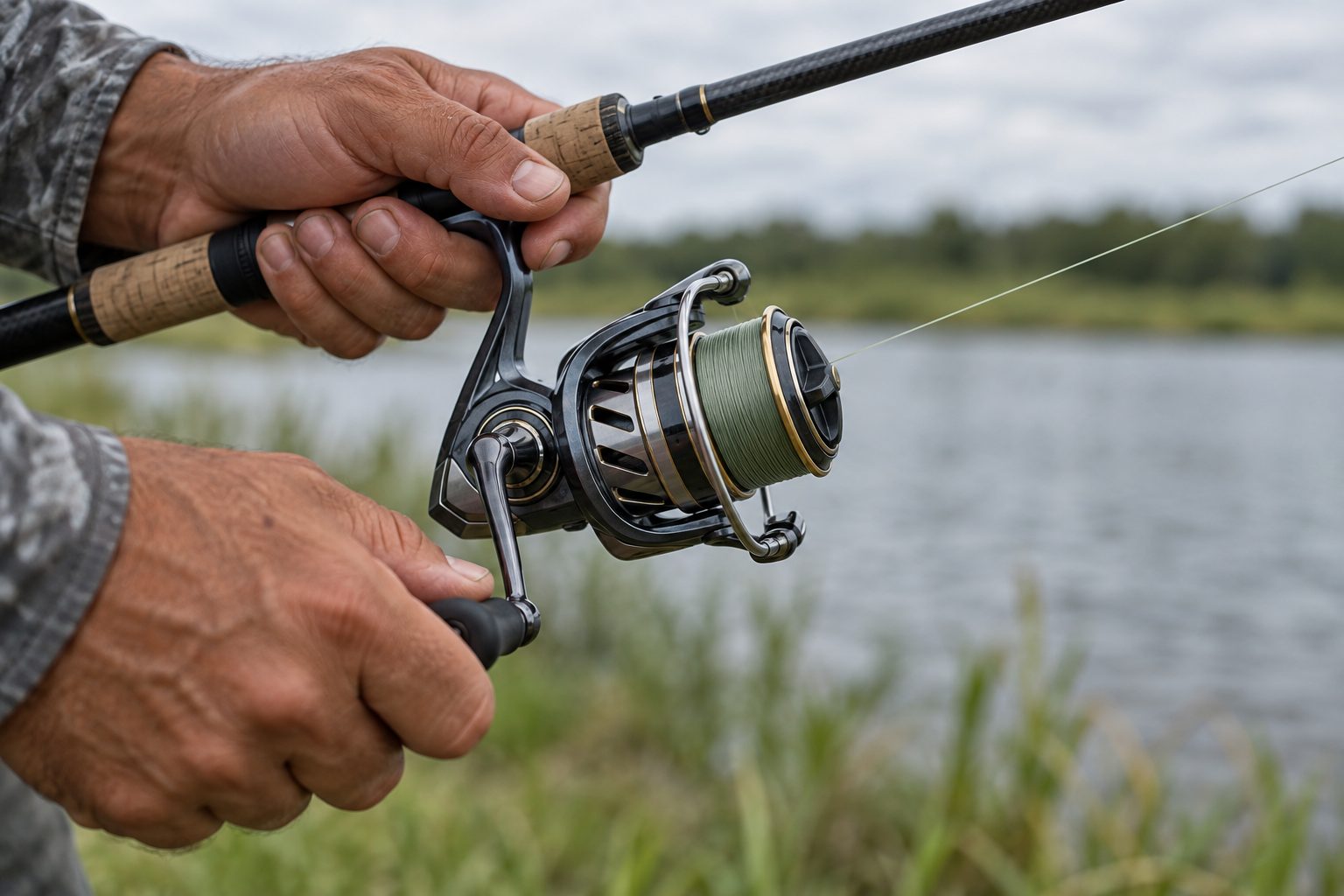
Hooks: Small bait needs small hooks. The hooks that fit your big craws and trick worms are usually too big for three-inch stick baits and short grubs. A handful of #1, 1/0, and 3/0 drop shot and jig hooks covers most finesse work.
The Five Finesse Rigs (and When Each Wins)
You don’t need to learn ten rigs. These five cover the overwhelming majority of finesse situations, and if you’re already comfortable with the basics, you know most of the mechanics already — the Texas rig and drop shot are two of them, just built smaller. And the plastics you’ll use — short grubs, stick baits, straight tails — are the same family we break down in our soft plastic baits guide.
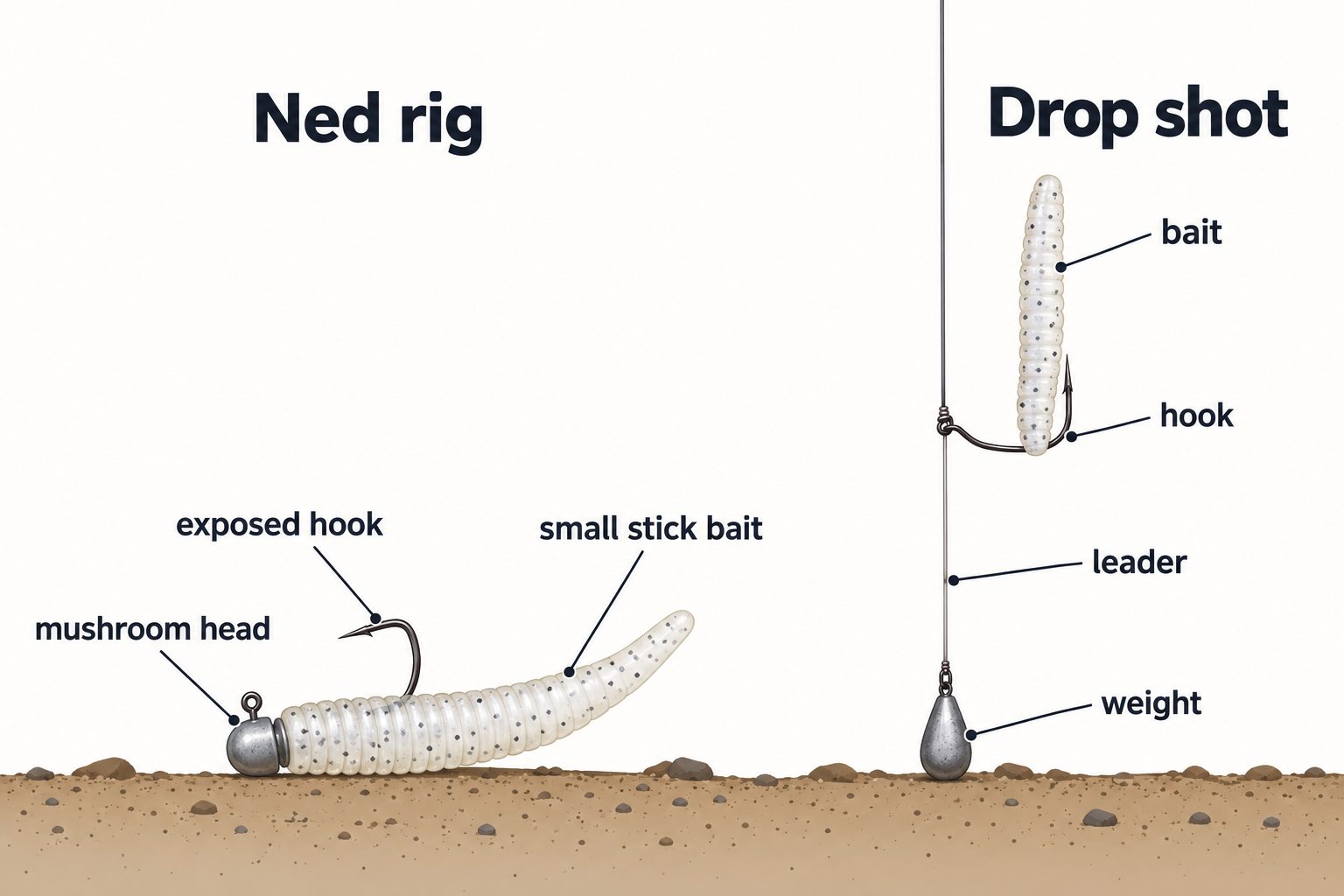
Drop shot. The hook is tied above the weight, so the bait floats 6-to-18 inches off the bottom while the weight sits on it. This is the go-to for suspended fish, deep structure, and gunky or mucky bottoms — the weight stays in the gunk, the bait floats above it. It also works beautifully vertically, right under a dock or boat. You control exactly what depth the bait sits at by changing the distance between the hook and the weight.
Ned rig. A tiny mushroom-shaped jig head (1/32 to 1/8 ounce) with a short, buoyant stick bait, usually about three inches. The hook is exposed. You cast it, drag it a few inches, and let it rest. The buoyant tail stands up on the bottom, and that vertical, tail-up posture is what triggers strikes. It’s the classic pressured-lake and smallmouth bait, and it works best in relatively shallow water (2-to-25 feet) on clean, hard bottoms like rock, gravel, and sand. In deep water, the tiny head just won’t get down fast enough.
Shaky head. Heavier than the Ned — 1/8 to 1/2 ounce — a round or football jig head with a straight-tail worm threaded onto it, often rigged weedless with a small bait screw. You keep the bottom contact and twitch the rod tip to make the worm quiver in place. Because it’s heavier, it reaches depth faster and holds its spot better in current, which makes it the deep-water and current finesse option. It also penetrates cover more cleanly than the exposed-hook Ned.
Texas rig (finesse version). Same weedless setup you already know — bullet weight, buried hook, soft plastic — just smaller. This is the one you reach for when the other finesse rigs keep hanging on grass, wood, or brush. When the fish are in cover the Ned can’t survive, the small Texas rig punches through.
Wacky rig. No weight at all. The hook is threaded through the middle of a soft plastic, and the bait falls in a natural, wiggling tumble. It’s the go-to for docks, shade, and open-water situations where you want the bait to drift and fall exactly the way a real piece of bait would.
A quick decision map:
- Suspended fish or deep water → drop shot
- Pressured clear water, shallow hard bottom, smallmouth → Ned rig
- Deep water or current, hard bottom, some cover → shaky head
- Grass, wood, brush → small Texas rig
- Docks, shade, open water, no snags → wacky rig
Reading the Strike on Light Line
This is where finesse fishing separates from everything else, and where most people quietly give up. On 20-pound braid with a big crankbait, a strike is a strike: the rod tip gets yanked down. On 8-pound fluorocarbon with a three-inch stick bait, a strike can be a tap, a twitch, a line that goes slack, or the rod tip just… dipping.
The first thing to change is your hookset. You’re not pulling the rod back over your shoulder. The finesse hookset is short and quick — a firm, smooth motion that drives the hook up and through. Anglers call it a “sweep set.” Because the bait is small and the hook is often exposed, a heavy, violent set will just tear the bait off.
The second thing is patience between strikes. Most finesse bites come during the pause. The standard pattern: shake the bait in place for 10-to-20 seconds, drag it about 6 inches, and let it sit again. Keep your rod tip slightly up so you can feel the line and see subtle movement. If you’re fishing a shaky head or drop shot, keeping contact with the bottom is the whole job — if you let the bait lift too far off the bottom, you’ve moved it out of the strike zone.
The third thing is the follow-through. When a fish takes a light-line bait, it often holds on for a second or two before you realize it’s a fish and not a pebble. Give it a beat, feel for the load, then set the hook. Set it early and you’ll pull most of them off; set it late and you’ll drop them. There’s no perfect timing, and even experienced anglers drop a share of light-line fish — that’s normal.
Common Finesse Mistakes (and How to Fix Them)
Rod and line too heavy. The single most common mistake. If your bait is dragging straight to the bottom the moment you stop reeling, your gear is too heavy for the technique. Swap to a lighter rod and lighter line and the same bait starts to work.
Hooking the bait too deep. On a Ned rig and most jig presentations, you want the hook near the nose of the bait, not buried in the middle. A deep hook point buries the hook, kills the natural tail-up posture, and drops your hookup ratio.
Never letting the bait sit. Finesse fishing is patient fishing. If you’re reeling the bait constantly, you’re fishing it like a power lure. Shake, drag, rest. The rest is the bite.
Bright fake colors in clear water. On a clear lake on a bright day, a chartreuse-and-black blob is exactly that: a chartreuse-and-black blob. When in doubt, go natural and translucent. The fish have to believe it’s food before they’ll move to it.
Not keeping a dedicated box. The last one is organizational: the best anglers keep a small box or tray of finesse tackle — light line, small jig heads, short plastics, small hooks — because conditions can flip from power fishing to finesse in a single afternoon. When the front moves through and the lake goes quiet, you don’t want to be rebuilding your setup. You want to reach for the box and cast.
Finesse fishing isn’t about buying expensive gear or memorizing a hundred techniques. It’s about recognizing when the big baits have stopped working, and having the small, quiet answer ready. Learn the five rigs, spool a light spinning reel, and keep a box of small tackle in the boat. The next time the lake goes quiet, you’ll be the one still catching fish.